TL;DR:
- Real urgency is an honest signal based on actual constraints that builds trust, unlike manipulative tactics.
- Using verified, genuine limits like capacity or timing creates long-term client loyalty and faster sales outcomes.
Most consultants and freelancers hear the word “urgency” and immediately picture a pushy salesperson with a countdown timer and a script full of fake deadlines. That mental image is doing a lot of damage to your close rates. Real urgency isn’t manipulation. It’s a clear, honest signal that helps your potential client make a timely decision based on actual constraints, real value, and genuine business need. In this guide, you’ll see what urgency actually looks like in a service business context, why it matters, and how to use it in ways that build trust rather than erode it.
Table of Contents
- What is urgency in sales — and why does it matter?
- How urgency accelerates sales outcomes
- Ethical strategies to create urgency (without pressure)
- Pitfalls to avoid: When urgency backfires
- What most business owners miss about urgency in sales
- Bring operational urgency to your sales process
- Frequently asked questions
Key Takeaways
| Point | Details |
|---|---|
| Real urgency beats fake | Urgency drives results only when based on true constraints and real client value. |
| Speed wins deals | Rapid responses and follow-up can dramatically increase the odds of closing qualified leads. |
| Ethics build trust | Noncoercive urgency tactics foster long-term relationships and positive referrals. |
| Avoid urgency pitfalls | Using artificial or repeated urgency can erode trust and reduce future business. |
What is urgency in sales — and why does it matter?
Urgency in sales is the experience that prompts a prospect to act sooner rather than later. It’s not about tricking anyone. It’s about making the cost of inaction visible and real.
There are two types of urgency worth knowing: real urgency and artificial urgency. Real urgency is grounded in actual constraints, like a limited number of client spots this month, a project start date that has to align with your schedule, or a pricing structure that changes at the end of a quarter. Artificial urgency is manufactured pressure with no basis in reality, think fake countdown timers, invented “last chance” emails, or deadlines that reset every week.
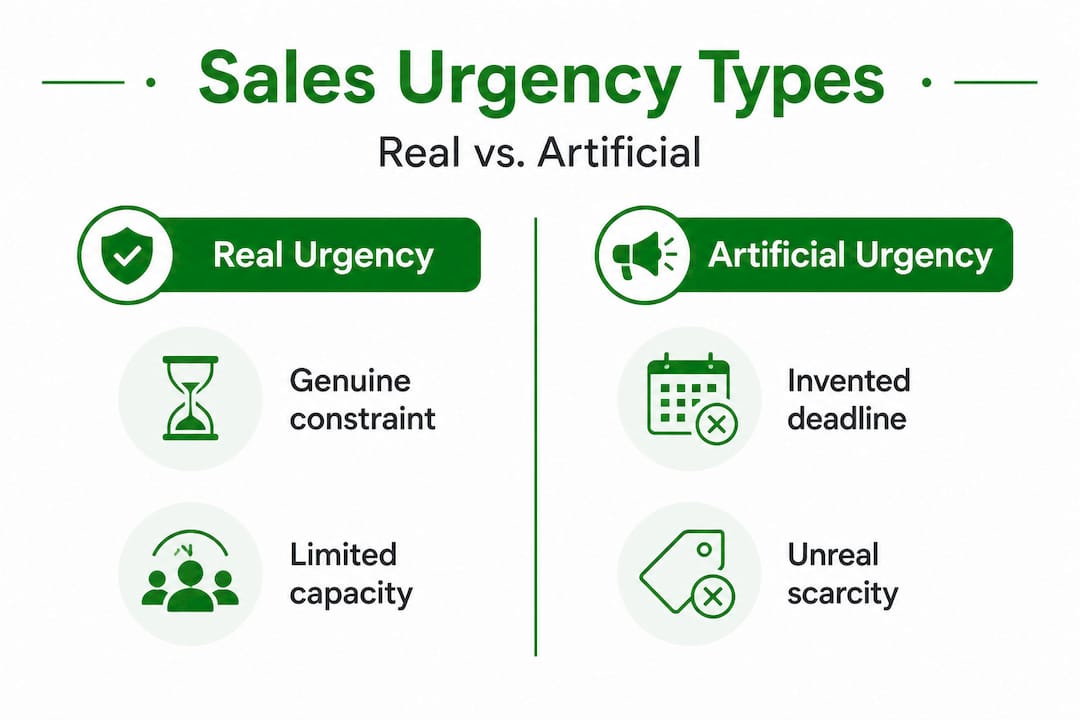
The psychological mechanisms behind urgency are well understood. Scarcity (limited time or capacity) and loss aversion work together to make action feel more pressing. When someone believes they might miss out, the brain treats inaction as a loss rather than just a non-gain, and people are wired to avoid losses more than they chase equivalent gains. Urgency and scarcity drivers are powerful levers, but only when they reflect something true, because fake or repeating urgency undermines trust the moment a client figures it out.
Here’s a quick comparison to make this concrete:
| Feature | Real urgency | Artificial urgency |
|---|---|---|
| Source | Actual capacity, timing, or demand | Invented deadlines or scarcity |
| Client reaction | Trust and motivation | Skepticism or resentment |
| Long-term effect | Referrals and repeat business | Churn and reputation damage |
| Reset frequency | Naturally changes over time | Often recycled repeatedly |
| Ethical standing | Fully defensible | Hard to justify |
You can also use urgency-focused sales tactics to speed up decisions without resorting to pressure. The key is matching your urgency signal to something your prospect can verify. If they check and it’s real, trust goes up. If they check and it isn’t, you’ve lost them.
Urgency pitfalls to watch:
- Reusing the same “limited time” framing too often
- Urgency that doesn’t connect to a real business reason
- Urgency applied at the wrong stage of the conversation
- Pressure tactics that skip the client’s decision-making process
Urgency drivers that actually work:
- Genuine capacity limits (booked calendar, limited project slots)
- Seasonal timing tied to the client’s business goals
- Competitor demand for your services (when true and verifiable)
- Delivery timelines that affect the client’s own project or launch date
“Urgency that isn’t grounded in real constraints doesn’t just fail to convert. It actively damages the trust you’ve worked hard to build.”
As part of your overall service business growth hacks, urgency should be a recurring element of your process, not a one-time trick you pull out when deals stall.
Now that you’re clear on what urgency is, the next step is understanding how it actually impacts your sales outcomes.
How urgency accelerates sales outcomes
Speed matters more in sales than most independent business owners realize. Not just your client’s speed in deciding, but your own speed in responding, following up, and moving deals forward.
Here’s a finding that should change how you operate: speed-to-lead research shows that leads contacted within an hour are far more likely to qualify than those contacted later, and the drop-off is steep and non-linear. In plain terms, waiting 24 hours to respond to an inbound inquiry doesn’t just cut your odds slightly. It can cut them dramatically. For a solo operator or small consultancy, this is a huge competitive advantage if you act on it.
Urgency accelerates outcomes in a few distinct ways:
- Rapid proposal follow-up. Send your proposal with a clear validity window attached. Not a fake deadline, but a genuine one based on your current availability. “I can hold this start date for 10 days” is both honest and motivating.
- Limited booking slots. If your onboarding capacity is genuinely finite (and for most solos and fractional executives, it really is), say so. “I’m taking two new clients in Q2” is true, believable, and creates natural urgency.
- Response time as a KPI. Track how quickly you follow up after initial contact, after proposal delivery, and after the first sales call. Faster follow-up signals professionalism and keeps deals warm.
- Clear next steps after every touchpoint. Every meeting, email, or call should end with a defined next action and a specific date. Ambiguity is the enemy of momentum.
- Calendar holds. Offer to put a placeholder on the calendar while the client decides. This keeps your availability visible and subtly reinforces that your time is in demand.
You can also sharpen your lead-to-client proposals by building urgency signals directly into the proposal document itself.
Real talk: the biggest urgency leak in most service businesses isn’t the sales call. It’s the follow-up. Deals die in the gap between “sounds interesting” and “let’s move forward” because nobody maintained momentum. Speed and clarity are the antidote.

Pro Tip: After every discovery call, send a short email recap within two hours. Include a summary of what was discussed, your proposed next step, and a specific date to reconnect. This one habit alone can meaningfully increase your conversion rate from calls to clients.
Client acquisition strategies that factor in response time and proposal follow-up speed will consistently outperform those that treat urgency as optional.
Knowing urgency can visibly impact outcomes, let’s look at ways to apply it without falling into the trap of pressure or manipulation.
Ethical strategies to create urgency (without pressure)
Ethical urgency isn’t softer or less effective. It’s actually more powerful over the long term. Research on noncoercive urgency shows that encourage-to-deliberate approaches can outperform pressure-to-purchase tactics by increasing word-of-mouth and preserving client agency. In other words, when you help clients make an informed decision rather than forcing their hand, they’re more likely to refer others to you and stick around.
Here are practical, ethical tactics you can use right now:
Limited capacity messaging. Be upfront about how many clients you’re taking on. “I have one spot open in my consulting schedule for the next quarter” is honest, specific, and creates natural urgency without manipulation.
Deadline clarity. Connect your proposal or pricing to a real date. “This proposal reflects my current rates, which I’m reviewing at the end of the month” is both transparent and timely. Clients appreciate knowing where the goalposts are.
Showing demand with proof. If you’re genuinely in demand, say so. A comment like “I’ve had three similar conversations this week” gives real context without inventing fake competition. Pair this with a client testimonial or case study to reinforce credibility. Your client testimonial strategies can support this beautifully.
Signs you’re using urgency ethically:
- Your urgency claim would hold up if the client asked you to verify it
- The constraint you’re citing is real and consistent, not invented for this conversation
- You’re encouraging a decision, not cornering the client into one
- You’d feel comfortable explaining your reasoning openly
- The urgency is about their timeline or your capacity, not manufactured pressure
Here’s a side-by-side look at the difference:
| Approach | Trust impact | Word-of-mouth | Client agency |
|---|---|---|---|
| Pressure-to-purchase | Damaged over time | Negative or neutral | Removed |
| Noncoercive (encourage-to-deliberate) | Built over time | Positive and amplified | Preserved |
| Fake scarcity | Severely damaged | Negative | Undermined |
| Real capacity limits | Strengthened | Positive | Respected |
The goal of ethical urgency is to encourage your prospect to make a decision, not to force one. Big difference. When someone feels pushed, they often push back or disengage entirely. When someone is encouraged to decide based on real information, they feel respected and tend to commit more fully.
You can learn more about the practical mechanics in effective sales call methods and weave urgency naturally into your business development tactics without feeling salesy.
Ethical urgency works because it matches actual constraints. However, using urgency the wrong way carries real risks.
Pitfalls to avoid: When urgency backfires
Let’s be honest about what goes wrong. A lot of independent business owners get urgency wrong because they borrow tactics designed for high-volume e-commerce businesses and try to apply them to high-trust service sales. The contexts are completely different.
Warning signs that urgency tactics are backfiring:
- Prospects stop responding after your follow-up sequence kicks in
- Deals that seemed warm go cold with no clear reason
- Clients come back later (after missing your “deadline”) and the offer is still available, so they stop believing you
- You’re hearing more objections about being “pressured” or “rushed”
- Referrals from clients who converted under pressure are lower quality or shorter term
Fake or repeated urgency undermines trust and risks disengagement or client churn, particularly when scarcity does not reflect real constraints. That’s a clinical way of saying: if your deadlines aren’t real, clients will figure it out, and when they do, you lose them.
Here’s a scenario many consultants recognize. You tell a prospect that your Q1 schedule is almost full. They don’t respond. You follow up two months later with the same message about Q2 being almost full. Now they know the pattern. Your urgency has become white noise, and worse, it’s made you look less credible.
The fix isn’t complex. Tie every urgency signal to a verifiable, specific business reason.
“If a client can disprove your urgency claim with a single Google search or a follow-up question, it’s not urgency. It’s a gamble with your reputation.”
Examples of verifiable urgency:
- A calendar screenshot showing limited availability
- A rate card with dated pricing tiers
- A waitlist that you reference openly and honestly
- A delivery timeline tied to the client’s own project milestone
Building a repeatable sales process means you won’t need to manufacture urgency on the fly. When urgency is embedded in how you operate, it’s always real and always credible.
Pro Tip: Every time you consider using urgency, ask yourself: “Could I explain this constraint to the client openly, and would they believe me?” If the answer is yes, use it. If the answer is no, rethink the tactic before it costs you a deal or a referral.
You can also study strong sales follow-up strategies that keep deals moving without crossing into pressure territory.
What most business owners miss about urgency in sales
Here’s my honest take after years of building a sales consulting business and a seven-figure agency before that: urgency doesn’t fail because the tactic is wrong. It fails because it’s treated as a last-minute patch instead of a built-in feature of how you work.
Most owners reach for urgency when a deal stalls. They scramble for something to say that might nudge the prospect over the line. That’s urgency as a rescue move, and it rarely works cleanly because it feels reactive, even desperate.
The businesses that actually close deals faster aren’t doing anything flashy. They’ve made urgency a natural part of their daily rhythm. Their calendar genuinely fills up. Their onboarding process has real capacity limits. Their proposals include honest windows. Their follow-ups happen within hours, not days. Urgency is woven into how they operate, not sprinkled in when a deal goes quiet.
Clients are sharp. They can sense the difference between a consultant who is genuinely busy and in demand versus one who is performing busyness to close a sale. The former builds trust automatically. The latter creates friction.
This is why I always encourage people to revisit their sales funnel design before trying to inject urgency at the proposal stage. If urgency isn’t baked into your pipeline from the first touchpoint, it’s going to feel forced later. Start with your calendar. Start with your capacity. Build your availability and your onboarding limits into your outreach and discovery conversations from day one.
When urgency is cultural rather than tactical, it stops being a “move” and starts being just how you do business. And that’s when it becomes genuinely compelling.
Bring operational urgency to your sales process
If this guide has shifted how you think about urgency, the next step is putting these ideas into practice inside an actual sales system.
At GeneratingPipeline.com, the whole philosophy is built around helping service-based business owners create a consistent, repeatable pipeline without relying on referrals or last-minute tactics. The Generating Pipeline OS covers sales execution, outreach, and proposal strategies in a way that makes urgency feel natural rather than forced. You can also grab the free guide on quick-win sales strategies to see 11 revenue-boosting tactics you can apply right away, including how to avoid revenue gaps with smarter pipeline management. For practical call-level tactics, the resource on client-winning sales call tips is a solid next read.
Frequently asked questions
What is the difference between urgency and pressure in sales?
Urgency prompts action based on true constraints or timing, while pressure forces decisions at the expense of trust and client agency. Noncoercive urgency consistently outperforms pressure tactics in driving positive long-term client behavior.
How soon should I follow up with a sales lead to maximize urgency?
Leads contacted within an hour are far more likely to qualify than those contacted later, and the drop-off in engagement is steep and non-linear.
Can urgency work in B2B service sales without harming relationships?
Yes, when urgency is based on real limits and noncoercive approaches, it builds trust and increases referrals rather than damaging them. Noncoercive approaches preserve client agency and generate positive word-of-mouth over time.
What are signs that urgency tactics are backfiring?
Look for increased client hesitation, growing skepticism, or deals going cold after applying urgency. Fake or repeated urgency undermines trust and can push potential clients toward disengagement or churn rather than conversion.
Recommended
- Quick win sales tactics: Fast client acquisition strategies
- Sales call tips that win clients: proven methods and real data
- Sales Process and Optimisation For an Efficient, Repeatable Sales System – Generating Pipeline
- Master the role of sales templates to boost close rates
- Sales opportunity qualification: smarter, faster B2B wins
