Setting the right price for your freelance or consulting services can feel like walking a tightrope. Charge too little and you attract clients who don’t value your expertise. Price too high without justification and you risk losing opportunities. Most independent professionals struggle with this balance, often undervaluing their work and leaving significant income on the table. The good news is that proven pricing strategies exist to help you capture your true worth while attracting quality clients. This guide explores practical pricing strategy examples designed specifically for freelancers and consultants who want to increase profitability and build sustainable businesses in 2026.
Table of Contents
- How To Choose The Right Pricing Strategy: Key Criteria For Freelancers And Consultants
- Pricing Strategy Examples For Freelancers And Consultants
- Comparing Pricing Strategies: Benefits, Challenges, And Profitability
- Making The Decision: Selecting And Implementing Your Best Pricing Strategy
- How Generating Pipeline Supports Your Pricing And Client Growth
Key takeaways
| Point | Details |
|---|---|
| Value-based pricing boosts profits | Focusing on client outcomes instead of hours can increase your earnings by 10-50% compared to hourly billing. |
| Market benchmarking aligns fees | Researching industry standards helps you set competitive rates that reflect your experience level. |
| Cost-plus ensures expense coverage | Adding a margin to your actual costs protects profitability but requires diligent tracking. |
| Premium pricing attracts better clients | Higher fees signal expertise and filter for clients who respect your time and value results. |
| ROI framing justifies rates | Presenting your services as investments with measurable returns makes premium pricing easier to accept. |
How to choose the right pricing strategy: key criteria for freelancers and consultants
Choosing a pricing strategy isn’t just about picking a number. It requires understanding what drives profitability while remaining competitive and communicating value clearly to clients. Many freelancers make the mistake of setting prices based solely on what feels comfortable or what competitors charge, without considering their actual costs or the transformation they deliver.
The foundation of smart pricing starts with accurate cost assessment. New consultants often underestimate the time spent on non-billable activities, leading to inaccurate pricing based on unrealistic billable hours. When you factor in administrative work, marketing, professional development, and downtime between projects, your actual billable time shrinks significantly. This reality means your rates must cover far more than just the hours you spend directly serving clients.
Beyond cost coverage, effective pricing strategies balance several critical criteria. Your approach should focus on the value clients receive rather than just your input. It must align with market expectations for your experience level and specialty. The strategy should be simple enough to explain confidently without lengthy justifications. Most importantly, it needs to scale as your expertise grows without requiring constant renegotiation.
Consider these essential criteria when evaluating pricing approaches:
- Client value focus: Does the strategy tie your fees to outcomes clients care about?
- Complete cost coverage: Will it account for overhead, taxes, insurance, and profit margin?
- Market alignment: Does it position you appropriately within industry benchmarks?
- Communication ease: Can you explain it clearly without defensive justifications?
- Scalability potential: Will it support income growth as your skills and reputation develop?
Pro Tip: Track your time for one month across all activities, not just client work. You’ll likely discover your actual billable percentage is 50-60% of total working hours, which should inform your rate calculations.
The shift from hourly thinking to strategic pricing represents a fundamental mindset change. Instead of selling time, you’re selling transformation and results. This reframing opens the door to premium pricing that reflects your true worth. A consulting pricing guide can help you navigate this transition with frameworks that position you as a strategic partner rather than a commoditized vendor.
Pricing strategy examples for freelancers and consultants
Let’s examine the most common pricing strategies used by successful freelancers and consultants, along with their practical applications, benefits, and limitations. Understanding these options helps you select the approach that best fits your business model and client relationships.
Hourly pricing remains the simplest method. You set an hourly rate and bill for actual time worked. This transparency appeals to clients who want predictable costs and detailed accountability. However, hourly billing creates a ceiling on your income because you only have so many hours to sell. It also trains clients to focus on time spent rather than value delivered, which can undermine your positioning as a strategic expert.

Cost-plus pricing involves calculating your actual costs, including overhead, and adding a profit margin. For example, if your monthly expenses total $5,000 and you want a 30% margin, you need to generate $6,500 in revenue. This method ensures you cover expenses and maintain profitability, but it requires meticulous tracking of both direct and indirect costs. The challenge lies in accurately estimating time per project and accounting for all hidden costs like software subscriptions, insurance, and professional development.
Market rate benchmarking uses competitive research to set prices aligned with industry standards. You investigate what other consultants with similar experience and specialties charge, then position yourself accordingly. Market rate benchmarking is crucial, with rates typically 30-50% of firm charges when you’re working independently versus through an agency. This approach provides a reality check and helps justify your fees to clients, though it can lead to commoditization if you don’t differentiate your unique value.
Value-based pricing represents the most profitable strategy for experienced consultants. Instead of charging for your time, you price based on the business outcomes and value your client receives. Freelancers who switch from hourly to value-based pricing earn 30-50% more on average. If your marketing strategy generates $100,000 in new revenue for a client, charging $15,000 feels reasonable compared to the return. This method requires deep understanding of client economics and strong positioning, but it aligns your incentives with client success.
Subscription or retainer pricing provides steady income through recurring monthly fees for ongoing services. Clients pay a fixed amount for a defined scope of work or access to your expertise. This model smooths cash flow volatility and builds predictable revenue, making it ideal for consultants who provide continuous strategic support rather than one-off projects.
| Strategy | Best For | Profit Potential | Complexity |
|---|---|---|---|
| Hourly | New freelancers, defined tasks | Low to Medium | Low |
| Cost-Plus | Service providers with predictable costs | Medium | Medium |
| Market Rate | Competitive positioning | Medium | Low |
| Value-Based | Experienced consultants with proven ROI | High | High |
| Retainer | Ongoing client relationships | Medium to High | Medium |
Pro Tip: Start with market rate benchmarking to establish a baseline, then transition to value-based pricing as you build case studies demonstrating measurable client outcomes.
Exploring pricing strategies for consultants in depth reveals how top performers structure their offerings to maximize both profitability and client satisfaction. The key is matching your strategy to your experience level, the complexity of problems you solve, and your ability to articulate value beyond time invested.
Comparing pricing strategies: benefits, challenges, and profitability
Understanding how different pricing strategies stack up against each other helps you make informed decisions about which approach fits your current situation and growth goals. Each method carries distinct advantages and trade-offs that affect not just your income but also how clients perceive your value.
Hourly pricing offers maximum simplicity and transparency. Clients understand exactly what they’re paying for, and you can easily track and bill your time. However, this approach fundamentally limits your earning potential because you can only sell a finite number of hours. Hourly billing trains clients to measure your value by time spent, not results delivered, which creates an adversarial dynamic where efficiency works against you. The faster you complete work, the less you earn, discouraging productivity improvements.
Cost-plus pricing provides safety by ensuring you cover expenses and maintain margins. It’s particularly useful when starting out and unsure of market rates. The main challenge is accurately tracking all costs, including hidden overhead like software, insurance, and unpaid time between projects. This method also focuses internally on your costs rather than externally on client value, which can lead to underpricing if your efficiency improves or if you deliver outsized results.
Market rate benchmarking grounds your pricing in competitive reality. It prevents both underpricing and overpricing relative to peers with similar experience. The risk is commoditization, where you compete primarily on price rather than unique value. Without clear differentiation, clients may simply choose the lowest bidder among comparable options.
Value-based pricing drives the highest profitability and client respect when executed well. Consultants can increase profitability by 10-20% using value-based pricing, focusing on client outcomes rather than hourly rates. This approach requires confidence, strong positioning, and the ability to quantify your impact in business terms. The challenge lies in accurately assessing client value and communicating it persuasively. Junior consultants often struggle with value-based pricing because they lack the track record and confidence to justify premium fees.
Retainer pricing balances predictability with profitability. It smooths cash flow and reduces sales cycles by converting one-time projects into ongoing relationships. The main considerations are defining scope clearly to prevent scope creep and ensuring the monthly fee reflects the actual value delivered over time.
| Factor | Hourly | Cost-Plus | Market Rate | Value-Based | Retainer |
|---|---|---|---|---|---|
| Simplicity | High | Medium | High | Low | Medium |
| Profit Potential | Low | Medium | Medium | Very High | High |
| Client Perception | Commodity | Fair | Competitive | Premium Expert | Trusted Partner |
| Income Scalability | Low | Medium | Medium | High | High |
| Risk Level | Low | Low | Medium | Medium | Low |
The comparison reveals a clear pattern: simpler pricing methods offer lower risk but cap your income potential, while strategic approaches like value-based pricing require more skill but deliver significantly higher profitability. Your choice should reflect your current confidence level, client relationships, and ability to demonstrate measurable outcomes.
A consultant pricing comparison framework can help you evaluate which strategy aligns with your business stage and growth ambitions. Most successful consultants start with simpler methods and graduate to value-based pricing as they build credibility and refine their positioning.
Making the decision: selecting and implementing your best pricing strategy
Choosing and implementing the right pricing strategy requires honest assessment of your current situation, clear communication with clients, and willingness to refine your approach based on results. Follow these steps to make confident pricing decisions that support both profitability and client relationships.
-
Assess your business fundamentals. Calculate your actual costs including overhead, taxes, insurance, and desired profit margin. Determine your realistic billable hours after accounting for marketing, administration, and professional development. This foundation ensures any strategy you choose covers your financial needs.
-
Evaluate your positioning and track record. If you’re new to consulting, market rate benchmarking or cost-plus pricing provides a safer starting point. If you have case studies demonstrating measurable client outcomes, value-based pricing becomes viable. Your pricing strategy should match your ability to justify premium fees with evidence.
-
Understand your client’s economics. Research how your services impact client revenue, costs, or strategic goals. Quantify the potential return on investment in specific dollar terms. This insight is essential for value-based pricing and helps you frame any pricing conversation around outcomes rather than inputs.
-
Frame your pricing as investment with clear ROI. The highest-paid freelancers sell transformation, not time, and frame the price as an investment with clear ROI. Instead of saying “I charge $200 per hour,” explain “This project will generate an estimated $50,000 in new revenue, and my fee is $10,000.” The same price feels dramatically different when positioned against tangible business outcomes.
-
Avoid common pricing mistakes. Don’t underprice to win business, as low prices filter out good clients and attract bad ones. Neglecting overhead costs leads to unsustainable pricing. Ignoring client outcomes keeps you trapped in commodity pricing. Position yourself as a strategic partner who solves expensive problems, not a vendor who trades time for money.
-
Test and refine based on feedback. Start with one pricing approach and monitor client reactions, conversion rates, and profitability. If you’re consistently winning every proposal, you may be underpriced. If you’re losing most opportunities, reassess your value communication or target market. Adjust gradually based on real market feedback.
Pro Tip: Create three pricing tiers (good, better, best) for each project. This anchors the conversation around value levels rather than yes/no decisions, and clients often choose the middle option, which should be your target price.
Implementing new pricing strategies feels uncomfortable at first, especially if you’re increasing rates significantly. Practice your pricing conversations until you can state your fees confidently without apologizing or over-explaining. Remember that hesitation signals doubt, while confidence signals value. Exploring client acquisition strategies alongside pricing improvements ensures you have enough opportunities to test your new approach without desperation affecting your negotiations.
How Generating Pipeline supports your pricing and client growth
Mastering pricing strategies is only part of building a sustainable consulting or freelancing business. You also need a consistent flow of qualified clients who value your expertise and can afford your rates. Generating Pipeline provides proven frameworks for independent professionals who want to stop relying on referrals and build predictable client pipelines.
The Generating Pipeline OS offers 20 lessons covering positioning, outbound outreach, LinkedIn strategies, sales execution, and productivity systems designed specifically for solo consultants and fractional executives. Each lesson includes templates and frameworks you can implement immediately to attract better clients and close deals at premium prices. Whether you need to refresh your client pipeline or develop a proven client acquisition strategy, the course provides practical tools without expensive coaching programs or hidden pricing.
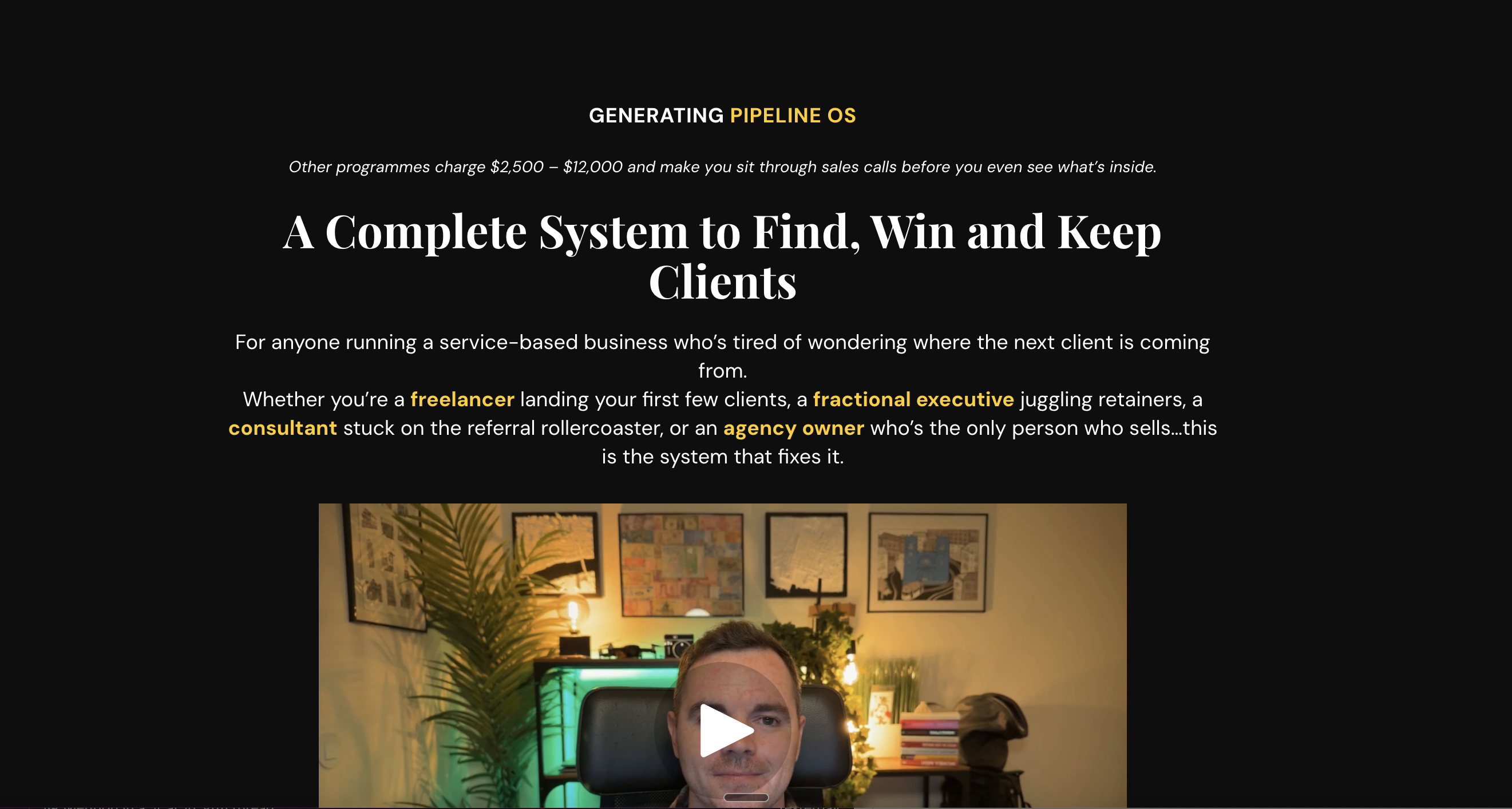
You’ll also find resources on running your consulting business efficiently so you can maximize billable time while maintaining the marketing and sales activities that keep your pipeline full. The transparent, one-time pricing model means lifetime access to frameworks that support both your pricing strategy and overall business growth.
FAQ
What is value-based pricing and why does it work?
Value-based pricing charges clients based on the business outcomes and transformation they receive rather than the hours you invest. It works because clients willingly pay more for results they care about, such as increased revenue, reduced costs, or strategic advantages. This approach aligns your incentives with client success and positions you as a strategic partner rather than a commodity vendor. The key is quantifying the specific value your work creates and communicating it clearly during pricing conversations.
How can I accurately estimate costs for cost-plus pricing?
Start by tracking all direct costs like software, subscriptions, and project-specific expenses. Add indirect overhead including office space, insurance, professional development, and marketing. Factor in taxes and your desired profit margin, typically 20-30% for sustainable businesses. Track your actual billable hours for at least one month to understand realistic capacity after accounting for administrative work, sales activities, and downtime. Divide your total required revenue by billable hours to determine your minimum rate.
Is hourly pricing still a good option for freelancers?
Hourly pricing works for new freelancers who need simplicity and clients who require detailed time tracking. However, it caps your income potential and trains clients to judge your value by time spent rather than results delivered. As you gain experience and build a track record of measurable outcomes, transitioning to value-based or project-based pricing typically increases both profitability and client respect. Use hourly rates as a starting point, but plan to evolve your pricing strategy as your positioning strengthens.
How do I transition from hourly to value-based pricing?
Begin by documenting the specific business outcomes your past projects achieved, quantified in dollars when possible. Use these case studies to demonstrate ROI to prospective clients. Start offering project-based pricing instead of hourly rates, calculating fees based on the value delivered rather than time invested. Practice framing your services as investments that generate returns, not costs that consume budgets. Test your new pricing with ideal clients who understand strategic value, and refine your approach based on their responses and conversion rates.
