Many freelancers and consultants rely on referrals and informal outreach, assuming structured sales processes are only for large teams. This mindset creates unpredictable revenue and missed opportunities. Understanding sales pipeline stages transforms how you attract and convert clients, bringing consistency to your business. This guide breaks down each stage, explains why they matter for independent service providers, and shows you how to implement a repeatable system that eliminates feast-and-famine cycles. You’ll learn practical strategies to track prospects, optimize conversions, and build a sustainable client acquisition engine tailored to your consulting or freelance work.
Table of Contents
- What Are Sales Pipeline Stages And Why They Matter
- Detailed Breakdown Of Common Sales Pipeline Stages
- How To Manage And Optimize Your Sales Pipeline Stages Effectively
- Common Pitfalls In Sales Pipelines And How To Avoid Them
- Streamline Your Client Acquisition With Expert Sales Pipeline Guidance
- Frequently Asked Questions
Key takeaways
| Point | Details |
|---|---|
| Pipeline stages clarify client acquisition | Each stage defines specific actions needed to move prospects toward closing |
| Monitoring prevents revenue gaps | Regular tracking identifies stalled deals and bottlenecks before they impact income |
| Optimized pipelines boost consistency | Structured processes increase efficiency and create predictable sales outcomes |
| Freelancers gain from proven structures | Adopting sales pipeline stages eliminates guesswork and improves forecasting |
What are sales pipeline stages and why they matter
Sales pipeline stages represent the sequential phases a prospect moves through from initial contact to becoming a paying client. Each stage marks a specific point in the buyer journey, helping you understand where prospects stand and what actions will advance them. For freelancers and consultants, this structure replaces reactive selling with a proactive system.
Stages bring clarity to your sales efforts. Instead of wondering why deals stall or revenue fluctuates, you can pinpoint exactly where prospects drop off. This visibility allows you to focus energy on high-value activities and measure progress objectively. A structured sales pipeline helps freelancers avoid feast-and-famine revenue cycles by creating predictability in client acquisition.
Without structured stages, common challenges emerge. You might chase unqualified leads, forget to follow up with promising prospects, or struggle to forecast income. Inconsistent outreach leads to dry spells followed by overwhelming workloads. Pipeline stages solve these problems by creating repeatable workflows.
Key advantages of sales pipeline stages for independent service providers:
- Predictability: Forecast revenue based on pipeline health and conversion rates
- Efficiency: Focus time on prospects most likely to convert
- Relationship building: Nurture connections systematically rather than sporadically
- Scalability: Grow your business without proportionally increasing sales effort
- Measurement: Track what works and refine your approach with data
Pro Tip: Schedule monthly pipeline reviews to identify deals stuck for more than two weeks and take immediate action to move them forward or remove them.
Detailed breakdown of common sales pipeline stages
Understanding typical pipeline stages helps you build a framework that matches your service delivery. While you should customize stages to fit your business, these seven phases form the foundation most consultants and freelancers use:
- Lead generation/prospecting: Identifying potential clients who match your ideal customer profile through outbound outreach, content marketing, networking, or referrals
- Lead qualification: Assessing whether prospects have the budget, authority, need, and timeline to become viable clients worth pursuing
- Initial contact/discovery call: Engaging prospects to understand their challenges, goals, and how your services might help while establishing rapport
- Proposal/presentation: Presenting your solution, demonstrating value, and outlining deliverables, timeline, and investment required
- Negotiation: Addressing objections, refining scope or terms, and working through final concerns before commitment
- Closing: Finalizing the agreement through contracts, payment terms, and project kickoff logistics
- Post-sale follow-up: Ensuring client satisfaction, delivering excellent results, and encouraging referrals or repeat business
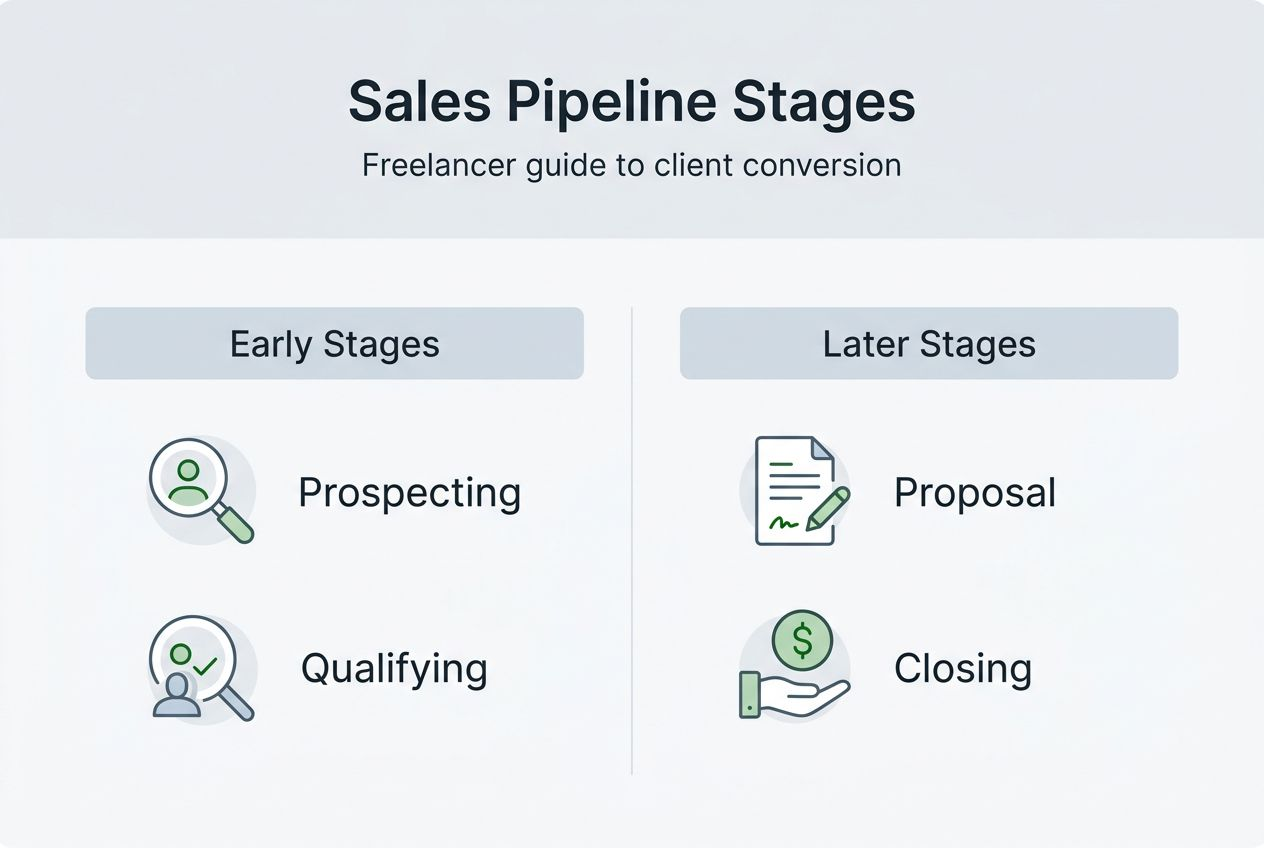
The typical sales pipeline includes stages such as prospecting, qualifying, meeting, proposal, and closing, though you can adapt these to your specific workflow. A client acquisition strategy for fractional executives might include additional relationship-building stages, while a freelance designer might combine proposal and negotiation.

| Stage | Purpose | Key Activities | Goal |
|---|---|---|---|
| Lead Generation | Build prospect pool | Outreach, networking, content | Fill top of funnel |
| Qualification | Filter viable leads | Budget/need assessment | Focus on best fits |
| Discovery | Understand requirements | Diagnostic conversations | Uncover pain points |
| Proposal | Present solution | Scope, pricing, value demo | Earn consideration |
| Negotiation | Address concerns | Objection handling, refinement | Remove obstacles |
| Closing | Finalize agreement | Contracts, payment setup | Convert to client |
| Post-Sale | Ensure satisfaction | Delivery, feedback, referrals | Build loyalty |
Pro Tip: Customize your pipeline stages to reflect how your specific clients buy, not generic sales theory, for maximum relevance and effectiveness.
How to manage and optimize your sales pipeline stages effectively
Managing your pipeline requires consistent tracking and strategic refinement. Start by establishing key performance indicators for each stage. These metrics reveal where prospects get stuck and which activities drive conversions.
Simple CRM tools or even spreadsheets work well for solopreneurs. The system matters less than using it consistently. Track prospect names, current stage, last contact date, next action, and deal value. This visibility prevents leads from falling through cracks.
Best practices for managing pipeline stages:
- Conduct weekly pipeline reviews to update deal status and plan outreach
- Follow up within 24 hours after discovery calls while interest is high
- Prioritize qualified leads showing budget and timeline over tire kickers
- Continuously qualify prospects even in later stages to avoid wasted effort
- Leverage automation for routine tasks like follow-up reminders and email sequences
Optimizing your sales pipeline leads to higher close rates and steadier revenue flows by eliminating inefficiencies. Understanding your ICP and personas foundation sharpens qualification and helps you attract better-fit prospects from the start.
| Pipeline Stage | Example KPI | Target Metric for Freelancers |
|---|---|---|
| Lead Generation | New leads per week | 10-15 qualified contacts |
| Qualification | Qualification rate | 40-50% move forward |
| Discovery | Call-to-proposal ratio | 60-70% receive proposals |
| Proposal | Proposal-to-close rate | 30-40% convert |
| Negotiation | Average negotiation time | Under 7 days |
| Closing | Monthly close rate | 3-5 new clients |
| Post-Sale | Referral generation | 1 referral per 3 clients |
These benchmarks vary by industry and service type, but they provide starting points. Track your actual numbers over three months to establish personalized baselines, then work to improve conversion rates at each stage.
Pro Tip: Block 30 minutes every Friday to review your pipeline, update deal stages, and schedule next-week outreach to maintain momentum.
Common pitfalls in sales pipelines and how to avoid them
Even with good intentions, freelancers and consultants make predictable mistakes that undermine pipeline effectiveness. Recognizing these errors helps you avoid costly setbacks.
Frequent pitfalls that weaken sales pipelines:
- Informal processes: Relying on memory instead of documented systems leads to forgotten follow-ups
- Skipping qualification: Pursuing every lead wastes time on poor-fit prospects unlikely to close
- Insufficient follow-up: Giving up after one or two contacts misses deals that need more nurturing
- Pipeline clutter: Keeping dead deals active creates false optimism about revenue forecasts
- Lack of measurable goals: Operating without KPIs prevents identifying what needs improvement
These mistakes compound over time. Informal processes create inconsistent results. Skipping qualification fills your pipeline with tire kickers who drain energy without converting. Poor follow-up leaves money on the table, as many prospects need multiple touchpoints before committing.
Ignoring pipeline stages or poor follow-up often causes deals to stall and revenue to dry up, creating the exact feast-and-famine cycles that structured pipelines prevent.
Strategies to avoid these pitfalls start with creating a repeatable sales process. Document your stages, define what moves prospects forward, and commit to following your system. Use simple tracking tools, even basic spreadsheets, to maintain visibility. Limit active deals to a manageable number based on your capacity, typically 15 to 25 for solopreneurs.
Pipeline discipline smooths revenue fluctuations. When you know exactly how many prospects sit in each stage and your historical conversion rates, forecasting becomes straightforward. This predictability reduces stress and enables smarter business decisions about when to invest in growth or adjust pricing.
Regularly clean your pipeline by removing stalled deals. If a prospect hasn’t responded in 30 days despite multiple attempts, move them to a nurture list rather than cluttering active stages. This honest assessment keeps your forecast realistic and your focus sharp on viable opportunities. Implementing sales process optimization for solopreneurs transforms these strategies from theory into daily habits.
Streamline your client acquisition with expert sales pipeline guidance
Building an effective sales pipeline requires more than understanding stages. You need proven frameworks, practical templates, and expert guidance tailored to independent service providers. Generating Pipeline specializes in helping freelancers and consultants create consistent client acquisition systems.
Explore resources to avoid revenue gaps consulting and maintain steady income. Learn sales process for solopreneurs that fits your schedule and service model. Understanding ICP and personas foundation sharpens your targeting and improves every pipeline stage from prospecting through closing. These practical tools help you implement what you’ve learned here and build a repeatable system that eliminates reliance on referrals.
Frequently asked questions
What are the most important sales pipeline stages for freelancers?
The critical stages include prospecting, qualifying, discovery, proposal, negotiation, and closing. However, customization matters more than following generic templates. Tailor stages to match how your specific clients buy and how you deliver services. Some consultants combine proposal and negotiation, while others add relationship-building phases. The goal is creating a structure that brings clarity to your sales efforts and helps you track progress systematically.
How can I track progress through my sales pipeline effectively?
Use simple CRM software, spreadsheets, or pipeline management apps that fit your workflow and budget. Define specific KPIs for each stage, such as number of active leads, conversion rates, and average time in stage. Conduct weekly reviews to identify bottlenecks where deals stall. Update deal status immediately after prospect interactions to maintain accuracy. Consistent tracking reveals patterns that help you refine your approach and forecast revenue reliably.
What common mistakes should I avoid in managing my sales pipeline?
Ignoring pipeline structure, skipping follow-ups, and maintaining too many active leads cause deals to stall and revenue to become unpredictable. Avoid treating every inquiry as equally valuable without proper qualification. Don’t let deals sit in your pipeline for months without action or honest assessment. Maintain discipline by regularly updating stages, removing dead deals, and focusing energy on prospects most likely to convert. These habits transform your pipeline from wishful thinking into a reliable revenue engine.
How long should prospects stay in each pipeline stage?
Timelines vary by service type and deal complexity, but general benchmarks help. Prospecting and qualification typically take one to two weeks combined. Discovery calls should happen within days of qualification. Proposals usually require one week to prepare and present. Negotiation ideally completes within one to two weeks. If prospects linger beyond these timeframes, investigate why and either address obstacles or move them to nurture status. Tracking stage duration reveals inefficiencies and helps you maintain momentum.
Can I use sales pipeline stages if I only get referral clients?
Absolutely. Pipeline stages work regardless of lead source. Referrals still need qualification to ensure fit, discovery to understand needs, proposals to formalize scope, and closing to finalize agreements. The structure prevents you from assuming referrals automatically convert, which leads to poor qualification and mismatched projects. Applying pipeline discipline to referrals improves conversion rates and client satisfaction while preparing you to scale beyond referral-only growth when ready.
Recommended
- 7 sales tactics for freelancers to grow clients in 2026
- Client Pipeline Refresh: How to Avoid Gaps and Keep Your Revenue Steady – Generating Pipeline
- Sales Process and Optimisation For an Efficient, Repeatable Sales System – Generating Pipeline
- How I Use ChatGPT to Run My Solo Consulting Business Efficiently (2025) – Generating Pipeline
