Many freelancers and consultants believe pipeline management is only for large sales teams with complex deals and multiple reps. The reality is simpler: pipeline management is how you track every prospect from first contact to signed contract, giving you the power to forecast revenue and avoid the dreaded feast or famine cycle. Whether you’re a fractional executive juggling three clients or a consultant waiting for your next project, understanding how to manage your pipeline transforms guesswork into predictable growth. This guide breaks down what pipeline management actually means, why it matters for independent service providers, and how to implement it without drowning in spreadsheets or expensive software.
Table of Contents
- Key takeaways
- Understanding pipeline management and why it matters
- Simple tools and routines to manage your pipeline effectively
- Strategies to grow revenue predictably using your sales pipeline
- Real world impact: case study and common pitfalls to avoid
- Explore tailored solutions for your client pipeline
- Frequently asked questions
Key Takeaways
| Point | Details |
|---|---|
| Revenue forecasting | Tracking prospects through stages from lead to closed helps forecast revenue three to six months out and plan accordingly. |
| Simple freelancer CRMs | Simple CRMs designed for freelancers provide pipeline visibility, deal tracking, and basic automation at affordable prices. |
| Weekly pipeline time | Block dedicated time each week for pipeline work to prevent neglect and keep your forecast up to date. |
| Lead hygiene and follow ups | Regularly prune stale leads and focus follow ups to avoid revenue gaps and improve conversion chances. |
Understanding pipeline management and why it matters
Pipeline management is the process of tracking prospects through sales stages from lead to closed deal to predict revenue and optimize client acquisition for service-based independents like freelancers and consultants. Think of it as your visual roadmap showing exactly where every potential client sits in your sales process. Unlike traditional sales teams with dedicated pipeline managers, you’re wearing every hat, which makes systematic tracking even more critical.
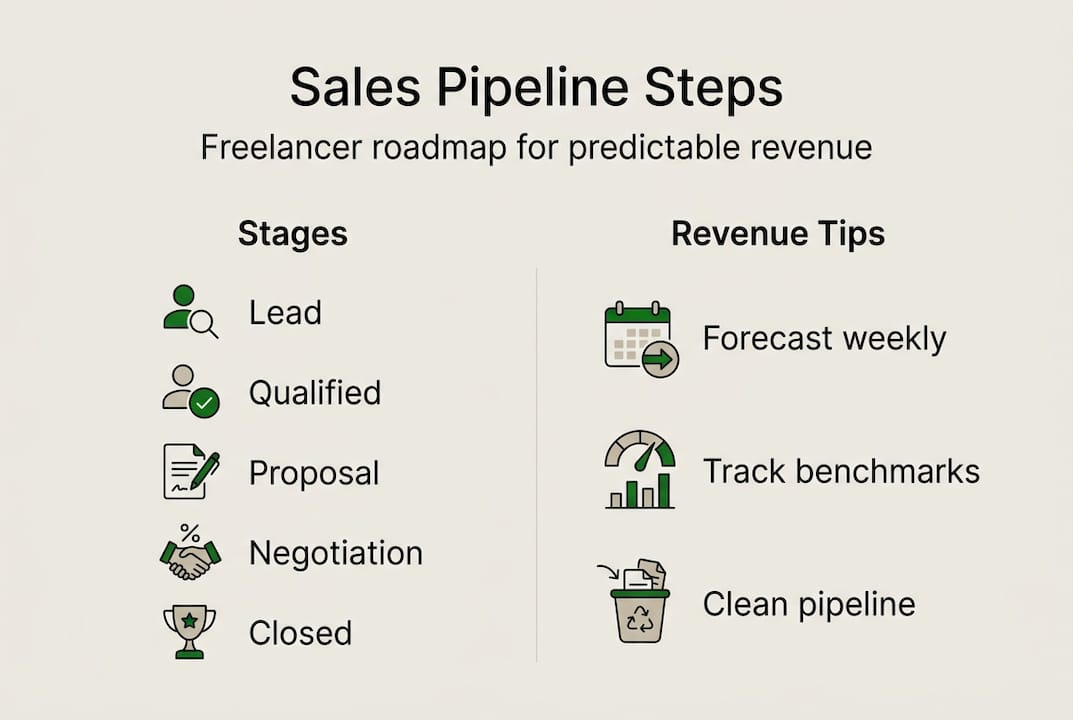
For freelancers and consultants, your pipeline typically flows through five core stages. First comes the lead stage, where someone expresses initial interest or you identify them as a potential fit. Next is qualified, where you’ve confirmed they have budget, need, and timeline. The proposal stage involves submitting your scope and pricing. Negotiation covers any back and forth on terms or deliverables. Finally, closed marks either a won deal or a lost opportunity you can learn from.
The benefits of managing your pipeline systematically go beyond just organization. You gain the ability to forecast revenue three to six months out, which means you can plan expenses, decide when to market harder, and avoid scrambling when projects end. You can prioritize which prospects deserve your limited time based on deal size and likelihood to close. Most importantly, you build a client acquisition strategy that doesn’t depend solely on referrals or luck.
Freelancers face unique pipeline challenges that corporate sales teams never encounter:
- Limited time to update systems when you’re billing hourly or delivering projects
- Lack of dedicated tools or training on pipeline best practices
- Inconsistent follow up because you’re juggling client work and business development
- No team to hold you accountable for pipeline hygiene
Pro Tip: Block two hours every Friday afternoon exclusively for pipeline work. Treat it like a client meeting you cannot reschedule. This dedicated time prevents pipeline neglect and keeps your forecast current.
As one pipeline management expert notes, “The pipeline is your business lifeline. Without visibility into what’s coming, you’re always reacting instead of planning.” This reactive mode leads to accepting bad fit clients out of desperation or turning down good opportunities because you’re overbooked. Business development for solopreneurs requires the same discipline as client delivery, and your pipeline is where that discipline starts.
Simple tools and routines to manage your pipeline effectively
You don’t need enterprise CRM software costing hundreds per month to manage your pipeline well. Simple CRMs like Bigin and Jetpack are specifically designed for freelancers and consultants who need pipeline visibility without complexity. Bigin offers pipeline views, deal tracking, and basic automation starting at $7 per month. Jetpack CRM is a WordPress plugin that’s completely free and integrates directly with your website if you run one.

The key is choosing a tool you’ll actually use consistently. Look for these features: visual pipeline board showing deals by stage, contact management linking people to opportunities, task reminders for follow ups, and basic reporting on pipeline value and conversion rates. Avoid platforms built for enterprise sales teams with features you’ll never touch like territory management or multi-level approval workflows.
Time allocation matters more than tool sophistication. Allocate 20% of your work time weekly to pipeline management activities. For a typical 40 hour week, that’s eight hours split between prospecting, updating deal stages, following up with proposals, and cleaning out dead leads. This might feel like a lot when you’re used to spending 100% of time on billable work, but the investment pays off in steadier revenue.
Weekly pipeline cleaning prevents your forecast from becoming fiction. Every Friday, review each deal and ask: Is this person still responsive? Has the timeline shifted? Do they actually have budget approved? Move stale opportunities to a “nurture” stage or mark them lost. Keeping fake leads in your active pipeline inflates your forecast and leads to poor planning decisions. A smaller, accurate pipeline beats a bloated, hopeful one every time.
Consider productizing your services to make pipeline management easier and more scalable. Instead of custom scoping every project, offer packages with defined deliverables, timelines, and pricing. This approach speeds up your sales process for solopreneurs because prospects can quickly understand what they’re buying. Your pipeline moves faster when you’re not reinventing your offer for each conversation.
Pro Tip: Create pipeline stage templates with specific actions required to advance deals. For example, your “qualified” stage checklist might include: budget confirmed, decision maker identified, timeline discussed, pain points documented. This ensures you’re consistently gathering the right information at each stage.
The goal is building habits that avoid feast and famine cycles. When you’re in a feast period with multiple active clients, it’s tempting to ignore pipeline work entirely. That’s exactly when you should be prospecting and nurturing relationships so your pipeline stays full when current projects wrap up. Your CRM and weekly routine make this possible even when you’re busy.
Strategies to grow revenue predictably using your sales pipeline
Predictable revenue starts with clear benchmarks. Target 65 to 80% billable utilization as a freelancer or consultant. This means if you work 40 hours per week, aim for 26 to 32 hours on client work, leaving the rest for business development, pipeline management, and administrative tasks. Many independents try to hit 100% utilization, which leaves zero time for filling the pipeline and guarantees revenue gaps between projects.
Implement three touch outreach sequences to engage prospects systematically. Your first touch introduces value and relevance. The second touch, sent three to five days later, shares a specific insight or resource related to their business challenge. The third touch, another week out, includes a clear call to action like scheduling a brief call. This sequence keeps you top of mind without being pushy, and it works whether you’re doing cold outreach or following up on warm referrals.
LinkedIn becomes a pipeline growth engine when you use it strategically. Post valuable content twice per week that demonstrates your expertise and attracts your ideal clients. Comment thoughtfully on posts from prospects and industry peers to stay visible. Send personalized connection requests to people who fit your target profile, then follow up with a genuine conversation starter, not a sales pitch. These activities compound over time, filling your pipeline with inbound interest.
Establish weekly marketing habits that create steady client inflow:
- Identify and reach out to five new prospects every Monday
- Publish one piece of valuable content (article, video, or post) by Wednesday
- Follow up with three stale opportunities to re-engage them
- Ask one current or past client for a referral or testimonial
- Review pipeline metrics and adjust your approach based on what’s working
These sales tactics for freelancers transform business development from sporadic panic to systematic growth. The key is consistency over intensity. Five new conversations per week beats 25 conversations one week then nothing for a month.
Forecasting four to six weeks ahead prevents both overbooking and dry spells. Look at your pipeline value by expected close date. If you see $30,000 in proposals likely to close next month and your monthly revenue target is $20,000, you’re in good shape. If you see only $10,000, you know you need to accelerate prospecting now, not when the gap hits. This forward visibility lets you make smart decisions about taking on new work or focusing on delivery.
| Pipeline metric | What to track | Target benchmark |
|---|---|---|
| Pipeline value | Total dollar value of all open opportunities | 3x your quarterly revenue goal |
| Conversion rate | Percentage of proposals that close | 30 to 40% for warm leads |
| Average deal size | Mean revenue per closed project | Varies by service, track your baseline |
| Sales cycle length | Days from first contact to signed contract | 30 to 60 days for most consulting services |
Pro Tip: Create a simple spreadsheet or use your CRM to track these four metrics monthly. Spot trends early, like declining conversion rates signaling you need to improve qualification or proposal quality. Small adjustments based on data compound into significant revenue improvements.
Your pipeline is the leading indicator of future revenue. Client work is the lagging indicator showing what happened weeks or months ago. Business development for solopreneurs means respecting both, but pipeline work drives everything that follows. When you build these strategies into your routine, revenue becomes predictable instead of surprising.
Real world impact: case study and common pitfalls to avoid
The measurable impact of proper pipeline management shows up clearly in real results. One marketing agency saw 62% growth and saved 875 hours after implementing CRM automations and systematic pipeline tracking. Those 875 hours translated to more than 20 full work weeks freed up from manual tracking, duplicate data entry, and searching for client information. For a freelancer or consultant, that time savings means more hours for billable work or business development.
The growth came from better visibility into which prospects were actually moving forward versus stalling. With clear pipeline stages and consistent updates, the team could focus energy on deals likely to close instead of chasing ghosts. They forecasted revenue accurately enough to hire confidently and invest in marketing during slower periods. This level of control is exactly what independent service providers need but rarely achieve without systems.
Forecasting four to six weeks ahead prevents the overbooking trap that damages client relationships and your reputation. When you can see three proposals likely to close in the next month, each requiring 40 hours of work, you know not to take on a fourth project starting simultaneously. You can either delay the start date, refer the work to a trusted peer, or adjust scope to fit your capacity. Without this visibility, you end up overcommitted, delivering rushed work, and burning out.
| Common pipeline pitfall | Why it hurts | How to avoid it |
|---|---|---|
| Neglecting pipeline during busy periods | Creates revenue gaps when projects end | Block non-negotiable weekly time for pipeline work regardless of client load |
| Keeping fake or stale leads active | Inflates forecast and leads to poor planning | Clean pipeline weekly, move unresponsive prospects to nurture or lost |
| Inconsistent follow up | Prospects forget about you and choose competitors | Use CRM task reminders and set specific follow up dates for every conversation |
| No clear stage definitions | Deals sit in wrong stages, forecast becomes meaningless | Define exact criteria for moving between stages and apply them consistently |
Pro Tip: Set a pipeline value threshold below which you don’t stress about individual deals. If your monthly revenue target is $15,000 and you’re tracking a $500 opportunity, don’t spend hours customizing a proposal. Have a standard offering or politely decline so you can focus on higher value prospects.
Many freelancers and consultants make the mistake of only prospecting when their pipeline is empty. This creates the classic feast or famine cycle where you’re either too busy for business development or desperately scrambling for any work. The solution is treating pipeline refresh as ongoing maintenance, not emergency repair. Even with a full client load, spend a few hours weekly on relationship building and light outreach.
Another common pitfall is confusing activity with progress. Sending 50 generic LinkedIn messages feels productive but rarely fills your pipeline with quality opportunities. Instead, focus on targeted outreach to specific prospects where you’ve done research and can offer genuine relevance. Ten personalized, thoughtful conversations beat 100 spray and pray messages every time.
As one sales expert notes, “Your pipeline health directly reflects your business discipline. A messy, neglected pipeline signals a reactive business. A clean, actively managed pipeline signals a professional who’s in control.” This perception matters when prospects evaluate whether to hire you. If you can’t manage your own sales process systematically, why would they trust you to manage their project?
Consider joining a pipeline sprint or accountability group where other independents share pipeline metrics and hold each other to consistent business development habits. The social pressure and shared learning accelerate your progress beyond what most people achieve alone. You’ll spot patterns in what’s working, get feedback on your approach, and stay motivated during slower periods.
Explore tailored solutions for your client pipeline
Building a consistent, predictable pipeline takes more than good intentions. It requires proven frameworks, practical templates, and accountability to implement what you learn. If you’re ready to move beyond referral dependence and create systematic client acquisition, Generating Pipeline offers targeted solutions designed specifically for freelancers, consultants, and fractional executives.

Our approach focuses on actionable tactics you can implement immediately, not theory or generic advice. Whether you need help refreshing a stale pipeline to avoid revenue gaps, want to join a focused pipeline sprint with other independents, or need comprehensive business development strategies covering positioning through delivery, we’ve built resources that respect your time and deliver results. Explore how systematic pipeline management transforms your business from reactive to proactive.
Frequently asked questions
What are the key stages in a sales pipeline?
A typical sales pipeline for freelancers and consultants includes five core stages: lead, qualified, proposal, negotiation, and closed. The lead stage captures initial interest or identification of potential clients. Qualified means you’ve confirmed budget, need, timeline, and decision maker. Proposal involves submitting your scope and pricing. Negotiation covers any discussion about terms, deliverables, or pricing adjustments. Closed marks either a won deal where you’ve signed a contract or a lost opportunity you can learn from for future prospects.
How often should I update and clean my sales pipeline?
Update your pipeline at least weekly, ideally on the same day each week to build a consistent habit. During this review, remove or move any leads that haven’t responded in two weeks, update deal stages based on recent conversations, and adjust close dates if timelines have shifted. Regular cleaning maintains forecast accuracy and prevents you from making business decisions based on inflated or outdated pipeline data. Monthly deep cleans can catch anything you missed in weekly reviews.
What CRM tools are best for freelancers and consultants?
Lightweight CRMs like Bigin and Jetpack work well for solo operators because they offer essential pipeline features without enterprise complexity. Bigin provides visual pipeline boards, contact management, and basic automation starting around $7 monthly. Jetpack CRM is a free WordPress plugin that integrates directly with your website. Choose tools emphasizing ease of use, pipeline visualization, and task reminders over advanced features like territory management or complex reporting you won’t use.
How can I avoid overbooking and manage workload using pipeline management?
Forecast four to six weeks ahead by reviewing your pipeline value and expected close dates against your available capacity. Aim for 65 to 80% billable utilization, leaving buffer time for unexpected client requests, pipeline work, and administrative tasks. When you see multiple proposals likely to close simultaneously, proactively adjust start dates, refer excess work to trusted peers, or modify project scope to fit your realistic capacity. This forward visibility prevents overcommitment and the rushed, poor quality work that damages your reputation.
