TL;DR:
- Fractional executives use systematic frameworks like referrals, inbound marketing, and targeted outreach to build pipelines.
- They deliver high ROI and cost savings compared to full-time leadership, enabling faster results.
- For enterprise clients, a structured 5-step process involving research, relationship building, and tailored solutions is essential.
Inconsistent client flow is one of the most frustrating problems in a service business. You land a great project, deliver excellent work, and then spend weeks scrambling to find the next one. Fractional executives are changing that pattern for a growing number of service-based businesses. They bring senior-level strategy, proven acquisition frameworks, and the kind of systematic thinking that turns unpredictable pipelines into repeatable engines. This guide breaks down exactly how they do it, what frameworks they use, and what you should realistically expect, whether you’re evaluating a fractional hire or sharpening your own acquisition approach.
Table of Contents
- Why fractional executives excel at client acquisition
- Core client acquisition frameworks used by fractional executives
- Adapting for enterprise clients: The 5-step acquisition playbook
- Challenges, nuances, and optimization tips for fractional executive acquisition
- Fresh perspective: What most business owners get wrong about fractional executive client acquisition
- Unlock your client acquisition potential with expert support
- Frequently asked questions
Key Takeaways
| Point | Details |
|---|---|
| Systematic acquisition strategies | Fractional executives use proven frameworks like referrals, inbound marketing, and diagnostic-to-pilot funnels to deliver predictable client growth. |
| Scalable return on investment | Service businesses gain agility and 150-500% ROI when hiring fractional executives for client acquisition leadership. |
| Enterprise tactics differ | Acquiring enterprise clients requires a structured, relationship-focused approach distinct from SMB acquisition. |
| Optimize for scale | Tracking, specialization, and blending inbound and outbound tactics help avoid limits of referral-only acquisition models. |
Why fractional executives excel at client acquisition
Fractional executives are not consultants who show up with a slide deck and disappear. They embed into your business, own outcomes, and apply frameworks they’ve refined across multiple engagements. That cross-company exposure is a serious advantage. They’ve seen what works, what doesn’t, and how to adapt quickly.
The core methods they use to drive client acquisition strategy fall into four main categories:
- Systematized referrals: Building structured referral programs instead of hoping past clients mention you.
- Inbound visibility: Using content and SEO to attract qualified leads who are already searching for solutions.
- Diagnostic-to-pilot funnels: Converting prospects through low-risk entry points before committing to full engagements.
- Targeted outbound: Reaching specific ideal client profiles with personalized, relevant messaging.
As the research from Be The Hero Studios confirms, fractional executives streamline client acquisition by systematizing referrals, building inbound visibility through content and SEO, implementing diagnostic-to-pilot funnels, and leveraging targeted outreach.
“The fractional model isn’t about doing more. It’s about doing the right things in the right order, with the right tracking in place.”
The numbers back this up. Empirical benchmarks show that fractional executives regularly deliver 150-500% ROI in 12-18 months. One fractional CMO drove revenue from £500k to £1.5m in 12 months, a return exceeding 1000%. A fractional COO delivered 72% ROI in just 90 days. Client acquisition cost (CAC) reductions of 69% (from $156 to $48) have been documented in real engagements.
Compared to a full-time executive hire, fractional leaders offer speed and flexibility. You get senior-level expertise without the six-figure salary, benefits package, and 90-day onboarding ramp. For service businesses that need results now, that trade-off is often the smarter move. The business of expertise rewards those who can move fast and prove value quickly.
Core client acquisition frameworks used by fractional executives
Now that we’ve established why fractional executives succeed, let’s look inside the frameworks they use to build robust client pipelines.
The three frameworks you’ll see most often are the referral-inbound hybrid, the diagnostic-to-pilot-to-retainer funnel, and targeted outbound. Each one serves a different stage of growth.
The referral-inbound hybrid is the most reliable early-stage approach. Referrals bring warm, pre-qualified leads. Pairing them with inbound content creates discoverability for people who don’t already know you. Together, they compound over time.
The diagnostic-to-pilot-to-retainer funnel is where things get interesting. According to pricing benchmarks, fractional executives typically structure engagements like this:
- Diagnostic: $2,500 to $5,000 for a focused audit or assessment.
- Pilot engagement: $7,500 to $15,000 for a defined short-term project.
- Retainer: $15,000 and above for ongoing strategic work.
This funnel works because it lowers the barrier to entry. Clients don’t have to commit to a large retainer upfront. They experience your value at a lower risk, and then the natural next step is a longer engagement.
Targeted outbound is used to scale past the ceiling that referrals create. This means identifying a specific ideal client profile (ICP), crafting personalized messaging, and reaching out through channels like LinkedIn or direct email.

| Framework | Best for | Time to results |
|---|---|---|
| Referral-inbound hybrid | Early stage, warm market | 1-3 months |
| Diagnostic-to-pilot funnel | Converting skeptical prospects | 2-6 weeks |
| Targeted outbound | Scaling beyond referrals | 2-4 months |
Pro Tip: Don’t rely on just one framework. The most resilient pipelines combine all three. Referrals fill the top of your funnel, the diagnostic funnel converts them efficiently, and outbound keeps new leads flowing when referrals slow down. You can explore more business development strategies that work specifically for consultants and fractional executives.
The expert secrets that separate top performers from average ones often come down to combining these frameworks with clear positioning and consistent follow-through.
Adapting for enterprise clients: The 5-step acquisition playbook
Beyond core frameworks, enterprise client acquisition poses unique challenges requiring specialized tactics.
Enterprise deals are slower, more complex, and involve more people. There’s rarely a single decision-maker. Procurement, legal, finance, and multiple business stakeholders all have a say. If you treat enterprise acquisition like an SMB sale, you’ll lose deals you should have won.
Fractional executive Robert Gilbreath outlines a 5-step enterprise playbook that addresses these dynamics directly:
- Research and qualify: Understand the company’s challenges, priorities, and buying process before making contact.
- Build multi-level relationships pre-RFP: Connect with champions, influencers, and decision-makers before any formal opportunity opens.
- Tailor your solution: Generic pitches don’t win enterprise deals. Map your offer directly to their specific pain points.
- Structured onboarding: Enterprise clients expect a professional, organized start. A rocky onboarding kills retention.
- Long-term partnership focus: Enterprise relationships compound. Position yourself as a strategic partner, not a vendor.
| Enterprise vs. SMB | Enterprise | SMB |
|---|---|---|
| Decision timeline | 3-12 months | 2-8 weeks |
| Number of stakeholders | 5-15+ | 1-3 |
| Contract value | $50k-$500k+ | $5k-$50k |
| Relationship depth needed | Very high | Moderate |
Pro Tip: The biggest mistake in enterprise acquisition is going straight to the economic buyer. Start with a champion, someone who feels the pain you solve and has influence but not final authority. Build that relationship first, and let them help you navigate the internal politics.
Adopting a trusted advisor approach is essential here. Enterprise clients don’t buy from vendors. They invest in advisors they trust to deliver results over time.
Challenges, nuances, and optimization tips for fractional executive acquisition
With proven approaches covered, it’s crucial to consider the real-world challenges and advanced nuances of executing these strategies.
Here’s what most people don’t talk about openly. The first clients almost always come from your warm network, not cold outreach. That’s normal. But it also creates a dangerous pattern. If you only rely on referrals, your pipeline is at the mercy of other people’s timing.
Research confirms that the majority of fractional engagements start from referrals, and most fractional executives spend just 10-20% of their time on acquisition activities. That’s efficient, but it also means the pipeline can dry up fast if referrals slow down.
Key challenges to watch for:
- Over-reliance on referrals: Pair your warm network with SEO and content so you’re discoverable when referrals aren’t flowing.
- Generic positioning: Vague messaging kills conversion. The more specific your niche, the higher your fees. Niche ICP specialists charge 2-3x more than generalists.
- Poor attribution tracking: If you don’t know where your clients are coming from, you can’t optimize. Track every lead source rigorously.
- Misaligned expectations: Fractional executives aren’t a shortcut. They work best when the business already has a clear offer and a defined delivery process.
“Referrals are dominant but unpredictable. The smart move is to amplify them with SEO and content so you’re always findable, even when your network goes quiet.”
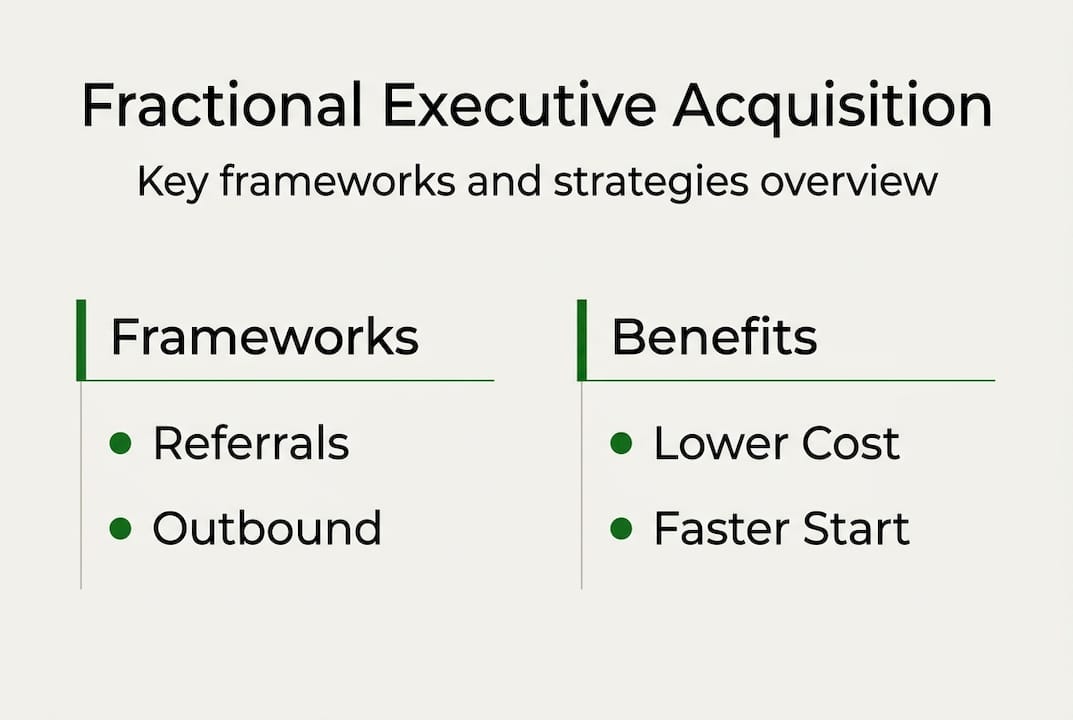
On the cost side, fractional models offer 40-60% savings compared to full-time hires, and you can get started in weeks rather than months. But if your business needs consistent, stable leadership over the long term, a full-time hire might actually be more cost-effective. Fractional works best for agility, speed, and specialized expertise in defined windows.
A smart pricing strategy for fractional roles also matters here. Underpricing signals low confidence. Overpricing without clear proof of value loses deals. The diagnostic funnel helps you bridge that gap. And if you’re thinking about building a one-person powerhouse, these same principles apply directly to your own client acquisition engine.
Fresh perspective: What most business owners get wrong about fractional executive client acquisition
Having tackled the common challenges, let’s reframe what it really takes to leverage fractional executives beyond the hype.
Here’s the uncomfortable truth. Most business owners hire a fractional executive hoping they’ll fix a broken pipeline with minimal input from the owner. That rarely works. Fractional executives are force-multipliers, not miracle workers. They amplify what’s already working. If your positioning is unclear or your delivery is inconsistent, a fractional hire will just surface those problems faster.
The businesses that get the best results are the ones that come in prepared. They have a defined offer, a target client profile, and at least some sense of what’s working. The fractional executive then systematizes and scales that foundation.
I also think too many founders skip the diagnostics phase and jump straight to outbound. That’s backwards. You need to understand why clients choose you before you can replicate it at scale. The entrepreneurial approach to consulting that actually works treats acquisition as a system, not a series of one-off efforts. The market rewards consistency and specialization, not hustle alone.
Unlock your client acquisition potential with expert support
Ready to move from insight to action? Here’s how to start building your client acquisition engine, supported by proven frameworks and expert guidance.
The frameworks in this article work. But knowing them and executing them consistently are two different things. At GeneratingPipeline.com, we’ve built resources specifically for service-based business owners who want a repeatable pipeline without the chaos. From avoiding revenue gaps to mastering pipeline forecasting, the tools are here when you’re ready. Start with our practical client acquisition strategies and build from there. No sales calls, no fluff, just actionable frameworks you can use today.
Frequently asked questions
What makes a fractional executive different from a full-time executive for client acquisition?
Fractional executives bring specialized, senior-level strategy with 40-60% cost savings and faster deployment compared to full-time hiring, making them ideal for businesses that need agility over long-term stability.
How do fractional executives typically find new clients?
Referrals are the primary source, but the most successful fractional executives pair their warm network with inbound content and structured outreach to build a more predictable pipeline.
What return on investment can service businesses expect from hiring a fractional executive?
Typical ROI ranges from 150-500% in 12-18 months, with some engagements exceeding 1000% revenue growth and client acquisition cost reductions of up to 69%.
How does client acquisition change for enterprise clients with fractional executives?
Enterprise acquisition relies on a structured 5-step process that includes deep stakeholder mapping, multi-level relationship building, and tailored solutions rather than the faster, simpler approach used for SMB clients.
Recommended
- A Proven Client Acquisition Strategy for Fractional Executives and Consultants – Generating Pipeline
- Entrepreneur Revolution for Consultants and Fractional Executives – Generating Pipeline
- The Business of Expertise Consultants and Fractional Executives – Generating Pipeline
- Expert Secrets for Consultants and Fractional Executives – Generating Pipeline
