What is pipeline forecasting: A client acquisition guide
Freelancers and consultants often struggle with unpredictable income and inconsistent client flow. Many believe client acquisition is pure luck or rely solely on referrals. Pipeline forecasting changes this by providing a systematic way to predict revenue and plan growth confidently. This guide explains what pipeline forecasting is, how to implement it for your service business, and why it matters for stable cash flow. You’ll learn practical steps to build a trackable pipeline, improve forecasting accuracy, and scale your client acquisition without the feast and famine cycle.
Table of Contents
- Key takeaways
- Understanding pipeline forecasting and why it matters
- How to build and track a simple pipeline for your service business
- Improving forecasting accuracy: pipeline hygiene and hybrid approaches
- Applying pipeline forecasting to scale your client acquisition confidently
- Boost your client acquisition with targeted pipeline insights
- Frequently asked questions
Key Takeaways
| Point | Details |
|---|---|
| Forecast revenue from pipeline | Predict future revenue by analyzing the current sales pipeline and assigning probabilities to each stage. |
| Track stage progress | Record every lead as it moves through stages to improve forecast accuracy. |
| Use win rates and hygiene | Leverage your historical win rates and maintain pipeline hygiene to enhance forecast accuracy. |
| Hybrid forecasting approach | Combine pipeline analysis with historical data to maximize accuracy and support revenue planning. |
Understanding pipeline forecasting and why it matters
Pipeline forecasting is the process of predicting future revenue by analyzing your current sales pipeline, assigning probabilities to deals based on their stage, and using historical data to project outcomes. For freelancers and consultants, this means tracking every potential client from initial contact through contract signing, then calculating expected revenue based on where each prospect sits in your process.
Your pipeline typically includes these stages: lead generation (initial contact or inquiry), marketing qualified lead (expressed interest), sales qualified lead (ready for proposal), opportunity (active discussion), and closed deal. Each stage represents progress toward revenue, and understanding how prospects move through these phases helps you forecast when money will arrive.
Forecasting reveals critical business intelligence. You can see how many leads you need at the top of your funnel to hit revenue targets. You understand average deal velocity, the time from first contact to signed contract. You identify bottlenecks where prospects get stuck or drop off. This visibility transforms client acquisition from guesswork into a manageable process, directly supporting your client acquisition strategy as a fractional executive or consultant.
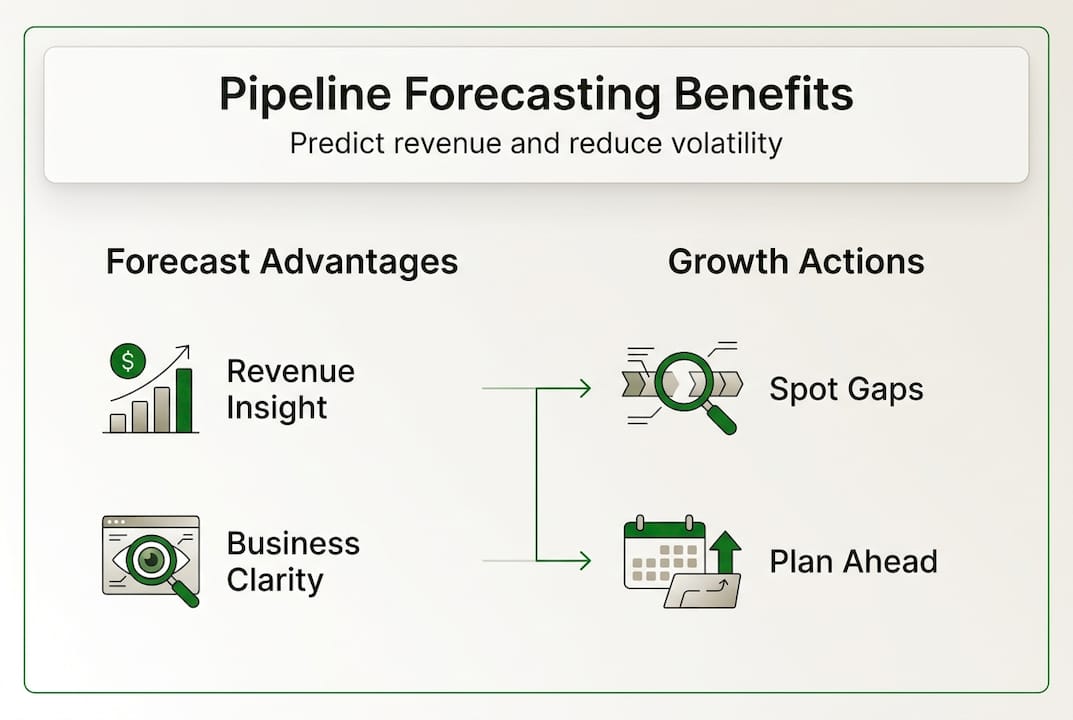
The benefits extend beyond revenue prediction. Forecasting reduces income volatility by showing gaps before they become crises. It informs your marketing efforts, telling you when to increase outreach or pause to focus on closing existing opportunities. You can plan expenses, investments, and capacity with confidence instead of anxiety.
Pro Tip: Regularly review and update stage probabilities based on your own historical data rather than industry averages. Your conversion rates from lead to opportunity or opportunity to close are unique to your positioning, pricing, and sales approach. Tracking your actual numbers for three to six months provides the foundation for accurate forecasting that reflects your real business performance.
How to build and track a simple pipeline for your service business
Building a functional pipeline starts with defining stages that match your sales process. For most independent service professionals, five stages work well: lead generation (content marketing, outreach, referrals), marketing qualified lead (downloaded resource, replied to email, engaged on LinkedIn), sales qualified lead (scheduled discovery call, expressed specific need), opportunity (sent proposal, actively negotiating), and closed deal (signed contract, payment received).
You don’t need expensive software to start. Google Sheets or a basic CRM like HubSpot’s free tier handles pipeline tracking effectively. The tool matters less than consistent use and accurate data entry.
Follow these steps to implement your pipeline:
- Set up your tracking system with columns for prospect name, company, stage, deal value, probability percentage, expected close date, and last contact date.
- Record every new lead immediately when they enter your world, assigning them to the appropriate stage based on their level of engagement and qualification.
- Assign probability percentages to each stage based on historical performance or reasonable estimates (lead 10%, MQL 20%, SQL 40%, opportunity 60%, closed 100%).
- Update deal statuses weekly during a dedicated pipeline review session, moving prospects forward, backward, or out of the pipeline entirely.
- Calculate your total weighted pipeline value by multiplying each deal’s value by its probability percentage, then summing all weighted values.
Building a pipeline of freelance clients requires maintaining adequate coverage. Your pipeline coverage ratio compares total pipeline value to your revenue quota or target. A healthy ratio sits between 3x and 4x, meaning if you need $30,000 in monthly revenue, your weighted pipeline should contain $90,000 to $120,000 in potential deals. This cushion accounts for deals that stall, prospects who disappear, and the natural attrition in any sales process.

Weekly pipeline reviews keep your forecast current. During these sessions, update deal stages based on recent conversations, remove prospects who’ve gone silent for 30 days or explicitly passed, and add new leads from your generation activities. This discipline ensures your forecast reflects reality rather than wishful thinking. Understanding your sales process as a solopreneur helps you define stage transitions clearly and move prospects through systematically.
Pro Tip: Focus on lead quality mechanics rather than pure volume. Ten highly qualified prospects who match your ideal client profile convert better than fifty random inquiries. Quality leads shorten your sales cycle, increase win rates, and improve forecast accuracy because they progress predictably through your pipeline. Invest time in targeting and qualification upfront to build a cleaner, more reliable pipeline. This approach also supports better pricing strategy decisions because you’re working with clients who value your expertise.
Improving forecasting accuracy: pipeline hygiene and hybrid approaches
Pipeline hygiene means keeping your pipeline clean, current, and reflective of real opportunities. Stale deals clutter your view and inflate forecasts artificially. Review your pipeline monthly and remove any opportunity that hasn’t progressed or had meaningful contact in 30 days. If a prospect hasn’t responded to three follow-up attempts, they’re not an active opportunity regardless of how promising the initial conversation felt.
Prioritizing pipeline hygiene involves several best practices. Use your actual historical win rates per stage rather than generic industry benchmarks. If your data shows 35% of sales qualified leads become opportunities, use 35% instead of assuming 40% or 50%. Track deal velocity, the average time prospects spend in each stage, to identify deals moving slower than normal. Measure conversion rates between stages to spot where your process loses prospects.
Best practices for clean forecasting include:
- Remove deals with no activity in the past 30 days during monthly reviews
- Update probability percentages based on recent conversations and prospect engagement levels
- Document reasons for lost deals to improve qualification and avoid similar situations
- Verify deal values reflect current scope discussions rather than initial estimates
- Set realistic close dates based on typical sales cycle length, not optimistic hopes
Hybrid forecasting methods combine multiple approaches for superior accuracy. Sales forecasting methods include stage-weighted (probability based on pipeline position), rep commit (your personal confidence assessment), and AI-driven pattern recognition. Using all three together yields the most reliable predictions because each compensates for the others’ weaknesses.
| Method | Accuracy | Pros | Cons | Best Use |
|---|---|---|---|---|
| Stage-weighted | 70-75% | Objective, data-driven, easy to calculate | Ignores deal-specific factors and timing nuances | Baseline forecast for overall pipeline health |
| Rep commit | 65-80% | Incorporates relationship insights and gut feel | Subjective, prone to optimism bias | Adjusting stage-weighted for known variables |
| AI-driven | 85-95% | Identifies patterns humans miss, learns over time | Requires significant historical data, complex setup | Mature pipelines with 12+ months of clean data |
| Hybrid | 90%+ | Balances objectivity with context and pattern recognition | More time-intensive, needs multiple data sources | Quarterly planning and critical revenue decisions |
Measure your forecasting accuracy quarterly by comparing predicted revenue to actual closed deals. Calculate your accuracy percentage by dividing actual revenue by forecasted revenue. If you predicted $45,000 and closed $40,000, your accuracy was 89%. Track this metric over time to see improvement as you refine your process and probabilities. This discipline helps you avoid revenue gaps in consulting by catching forecast errors before they become cash flow problems.
Pro Tip: Backward plan your client acquisition starting from revenue goals using funnel math. If you need $50,000 monthly revenue with an average deal size of $5,000, you need 10 closed deals. If your opportunity to close rate is 50%, you need 20 opportunities. If your SQL to opportunity rate is 40%, you need 50 SQLs. Work backward through each stage to determine exactly how many leads you must generate. This approach, part of effective business development for solopreneurs, transforms vague growth goals into specific, actionable lead generation targets.
Applying pipeline forecasting to scale your client acquisition confidently
Pipeline forecasting informs every aspect of lead generation and business growth. When your forecast shows a gap three months out, you know to increase outreach now rather than panicking when the gap arrives. When your pipeline overflows with qualified opportunities, you can pause new lead generation and focus energy on closing existing deals or raising prices to match demand.
Your forecast dictates lead generation targets and outreach frequency. If you need 50 new leads monthly to maintain pipeline coverage, you know exactly how much content to publish, how many cold emails to send, or how many networking conversations to initiate. This clarity eliminates the common feast and famine cycle where freelancers alternate between being overwhelmed with work and desperately searching for the next client.
Key lead generation tactics tailored to pipeline goals include:
- Structured outreach sequences with three touchpoints (initial contact, value-add follow-up, final check-in) to move leads into your pipeline systematically
- Content marketing focused on attracting your ideal client profile rather than generic traffic, improving lead quality and conversion rates
- Referral systems that encourage existing clients to introduce you to similar prospects, leveraging relationships for warmer pipeline entries
- LinkedIn engagement strategies that build visibility and credibility with your target market before making direct contact
Use forecasting data to predict cash flow and schedule sales activities with these steps:
- Review your weighted pipeline value and expected close dates to project monthly revenue for the next 90 days.
- Identify months where projected revenue falls below your target, flagging them as focus periods for accelerated closing activity.
- Calculate required lead generation volume by working backward from revenue gaps through your conversion rates at each pipeline stage.
- Schedule specific blocks of time for outreach, follow-up, and proposal creation based on pipeline needs rather than random availability.
- Adjust pricing or service offerings if persistent pipeline analysis shows consistent gaps that lead generation alone can’t fill.
Nurturing existing clients for repeat business strengthens your pipeline beyond new client acquisition. Freelance income becomes more predictable when you focus on lead mechanics over pure quantity and build systems for repeat engagements. Past clients who had positive experiences convert at much higher rates than cold prospects, often moving directly from lead to opportunity stages.
Mastering pipeline forecasting enables confident scaling. You can hire support, invest in tools, or increase marketing spend knowing your pipeline supports the investment. You avoid overcommitting to expenses during temporary pipeline spikes or cutting essential investments during normal fluctuations. The visibility transforms reactive scrambling into proactive business building.
Pipeline forecasting connects directly to broader sales tactics for freelancers and comprehensive client acquisition strategies. As you implement forecasting, you’ll naturally identify which sales tactics generate the highest quality leads, which marketing channels fill your pipeline most efficiently, and which service offerings close fastest. This feedback loop continuously improves your entire client acquisition system.
Boost your client acquisition with targeted pipeline insights
Implementing effective pipeline forecasting takes practice and refinement. Generating Pipeline helps service-based independent business owners build consistent, repeatable client pipelines that eliminate reliance on referrals and word of mouth. Whether you need a client pipeline refresh to avoid gaps, sales process optimization for solopreneurs, or comprehensive business development strategies, the right systems transform unpredictable income into steady revenue.
The Generating Pipeline OS provides templates, frameworks, and practical tools designed specifically for busy professionals who sell expertise and time. You’ll learn positioning clarity, outbound strategies, conversation techniques, and sales execution methods that fill your pipeline with qualified prospects. Explore these resources to move from forecasting concepts to implemented systems that consistently deliver clients and revenue.
Frequently asked questions
What is pipeline forecasting in simple terms?
Pipeline forecasting predicts future revenue by analyzing current sales opportunities, where they sit in your sales process, and their likelihood of closing. You assign probability percentages to each deal based on its stage, multiply deal value by probability, then sum all weighted values to project expected revenue. This gives you visibility into timing and amount of incoming cash flow.
How often should I update my sales pipeline to maintain accuracy?
Update your pipeline weekly to track deal movement, remove stale opportunities, and add new leads. Weekly reviews keep your forecast current and responsive to real business conditions. Monthly deep reviews should focus on cleaning out inactive deals and recalibrating stage probabilities based on recent conversion data.
Is a CRM necessary for pipeline forecasting?
No, spreadsheets like Google Sheets work effectively for small pipelines and solo practitioners. Simple tracking with columns for prospect details, stage, value, probability, and close date provides everything needed for accurate forecasting. CRMs add automation and efficiency as your pipeline grows but aren’t mandatory for getting started.
What benefits does pipeline forecasting bring to freelancers and consultants?
Forecasting delivers predictable cash flow by showing expected revenue timing and amounts. You gain better client acquisition focus by knowing exactly how many leads you need to generate. The visibility reduces income volatility and eliminates feast and famine cycles, letting you plan expenses and growth investments confidently instead of reactively.
How should I deal with stale or stuck deals in my pipeline?
Review your pipeline monthly and remove any deal with no activity or contact in 30 days. Stale deals inflate your forecast artificially and cloud decision making. Some stuck deals can be revived by re-engaging with fresh value or a different approach, but most should be removed to keep your forecast realistic and actionable.
Recommended
- Client Pipeline Refresh: How to Avoid Gaps and Keep Your Revenue Steady – Generating Pipeline
- Business Development: 7 Practical Client Acquisition Strategies
- A Proven Client Acquisition Strategy for Fractional Executives and Consultants – Generating Pipeline
- 2025 Guide To Cold Email Campaigns – Generating Pipeline
