TL;DR:
- Building a targeted prospect list increases conversion rates and improves outreach efficiency.
- Regularly qualify, organize, and update your list to ensure high-quality, relevant contacts.
- Consistent relationship-building and follow-up turn a list into a sustainable pipeline.
You know that feeling when your pipeline goes quiet and you’re not sure where the next client is coming from? It’s stressful. And for most service-based business owners, the root cause is the same: no consistent system for finding and tracking the right prospects. Building a targeted prospect list is the single most reliable way to fix that. It gives you control over your business growth instead of waiting on referrals to show up. This guide walks you through every step, from defining who belongs on your list to qualifying and organizing contacts so your outreach actually lands.
Table of Contents
- Why a targeted prospect list matters
- Get ready: Defining your ideal client and preparation steps
- Proven methods to find and build your prospect list
- How to qualify and organize your prospect list for real results
- Common prospecting mistakes and how to fix them
- A smarter approach to prospecting that most overlook
- Next steps: Put your prospect list to work
- Frequently asked questions
Key Takeaways
| Point | Details |
|---|---|
| Target the right prospects | Your list works best when you clarify and focus on your ideal client. |
| Use a step-by-step method | Follow a logical process to source, qualify, and organize new leads. |
| Avoid common pitfalls | Validate your data and personalize outreach to see higher response rates. |
| Keep your list up to date | Regularly review and refresh your prospect list to maintain momentum. |
Why a targeted prospect list matters
There’s a big difference between a random list of names and a targeted prospect list. One wastes your time. The other fills your calendar with the right conversations.
Most freelancers and consultants start their outreach by casting a wide net. They message everyone who might possibly need their services and wonder why response rates are low. The truth is, volume without focus is just noise. Targeted prospecting increases conversion rates and saves outreach time by making sure every contact you reach is a realistic fit.
Here’s what happens when you skip the targeting step:
- You spend hours chasing people who can’t afford your services or don’t need them right now
- Your outreach messages feel generic because they have to appeal to everyone
- You burn bridges with warm contacts by pitching too early or to the wrong person
- Your pipeline looks full but never actually converts
And here’s what changes when you get specific:
- Higher close rates because you’re talking to people who already match your best clients
- Less time chasing because prospects recognize the relevance of your message
- More referrals because satisfied clients in a defined niche talk to each other
“The quality of your pipeline is a direct reflection of the quality of your list. Garbage in, garbage out.” That’s not just a cliche. It’s the reality every consultant eventually learns the hard way.
Strategic prospecting protects your reputation too. Sending poorly targeted outreach damages how people perceive you. One bad first impression in a tight-knit industry can ripple fast. Taking time to build the right list is an investment in your credibility, not just your calendar.
Get ready: Defining your ideal client and preparation steps
Once you understand the value of targeting, the next step is getting specific about who belongs on your list.
This starts with your Ideal Client Profile (ICP). An ICP is a detailed description of the type of client who gets the most value from your work and is easiest for you to serve. Defining your ICP leads to faster and more relevant prospecting because you stop second-guessing who to reach out to.
Here are the core elements to nail down:
- Industry and niche: What sector do your best clients operate in?
- Company size: Do they have 1 to 10 employees, or 50 to 200?
- Job title: Who are you actually selling to? The founder? The VP of Operations?
- Key pain points: What problem are they trying to solve right now?
- Budget signals: Can they realistically afford your rate?
- Buying triggers: What event (new funding, rapid growth, leadership change) makes them need you?
Before you start building, get your tools and setup in order:
| Preparation step | What to use |
|---|---|
| Define your ICP criteria | Spreadsheet or Notion doc |
| Choose your outreach channels | LinkedIn, email, phone |
| Pick your CRM or tracker | HubSpot free, Airtable, or Google Sheets |
| Set your outreach goal | Number of contacts per week |
| Validate your messaging | Test subject lines and openers |
Pro Tip: Pull up your last three to five clients who were a joy to work with. Write down what they had in common: industry, company stage, how they found you, and what they hired you to fix. That pattern is your ICP. Don’t guess when you have real data sitting right there.

Proven methods to find and build your prospect list
With a clear profile and tools ready, let’s dig into practical ways to actually fill your prospect list.
There are three main approaches, and the best results usually come from combining all three. Multiple outreach channels enhance prospect list effectiveness far more than relying on just one source.
1. Manual methods
These take more time but deliver high accuracy.
- Search LinkedIn using filters for job title, company size, and location
- Browse industry directories and trade association member lists
- Check speakers and attendees at relevant conferences and events
- Monitor publications and podcast guest lists in your niche
- Review company pages of your best clients and look at similar businesses
2. Semi-automated methods
These speed things up without fully removing human judgment.
- Use tools like Prospeo, Apollo, or Hunter to pull contact data at scale
- Set up LinkedIn Sales Navigator searches for ongoing lead discovery
- Use Chrome extensions to enrich contact records as you browse
3. Paid data sources
These can accelerate list building but carry real risk if used carelessly.
| Method | Cost | Speed | Accuracy | Time investment |
|---|---|---|---|---|
| Manual (LinkedIn) | Free | Slow | High | High |
| Semi-automated tools | Low to mid | Medium | Medium to high | Medium |
| Paid list vendors | Mid to high | Fast | Variable | Low |
Pro Tip: Never buy a list and blast it cold. Always validate email addresses with a tool like NeverBounce or ZeroBounce before sending. A high bounce rate will tank your sender reputation and get your domain flagged as spam. Check out sales tactics for freelancers and consultant sales funnels for how to put a validated list to work.
How to qualify and organize your prospect list for real results
With your list built, the final critical piece is turning those raw contacts into a machine for predictable new business.
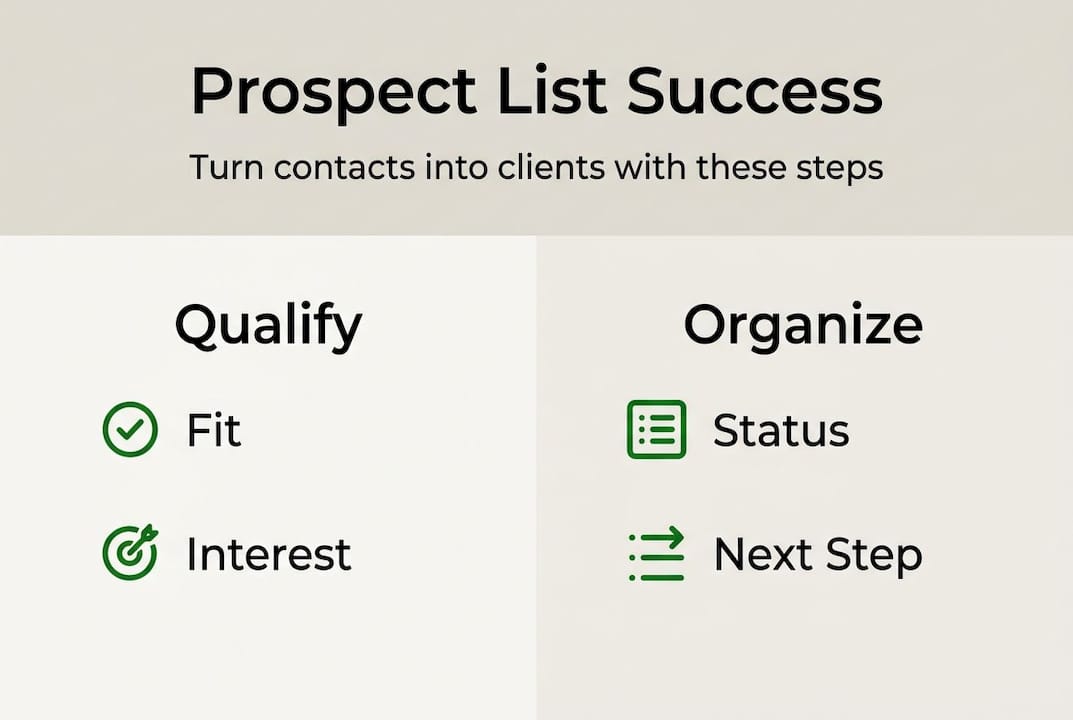
Not every contact on your list deserves equal attention. Effective client qualification increases outreach success by focusing your energy on the leads most likely to convert.
Use these criteria to qualify each prospect:
- Decision-maker status: Are they the one who signs off on projects or budgets?
- Fit score: Do they match your ICP on at least 4 out of 6 criteria?
- Budget indicator: Do company size and role suggest they can afford your services?
- Buying trigger: Is there a recent signal (funding, hiring, expansion) that suggests urgency?
- Past engagement: Have they interacted with your content, attended your events, or been referred?
Pro Tip: Create a simple A, B, C rating system. A prospects match all your criteria and have a clear trigger. B prospects are a strong fit but no trigger yet. C prospects are possible but need more research. Focus your weekly outreach on A prospects first, always.
To organize your list effectively:
- Use a CRM (even a free one like HubSpot) to track outreach stages and notes
- Build your step-by-step sales process around pipeline stages: New, Contacted, In Conversation, Proposal Sent, Closed
- Set a calendar reminder to review and re-score your list every four weeks
- Archive contacts who go cold after three to four touches rather than letting stale leads clutter your view
A well-organized list is the difference between a pipeline that hums and one that just sits there looking pretty.
Common prospecting mistakes and how to fix them
Even great systems break down without awareness of potential pitfalls. Here’s how to avoid common traps.
Most prospecting problems come down to a handful of recurring mistakes. The good news is they’re all fixable once you know what to look for.
Common mistakes to watch for:
- Buying lists without validating them: Purchased data is often outdated. Contacts change jobs, companies shut down, and emails bounce. Always run new data through a verification tool before outreach.
- Skipping segmentation: Sending the same message to a startup founder and a VP at a 200-person company is a waste of both their time and yours. Segment by industry, role, or stage and tailor your messaging accordingly.
- Treating list building as a one-time task: Your list decays fast. Studies suggest B2B data can become outdated by 25% or more per year. Build list review into your monthly routine.
- Scattershot outreach: Reaching out to 200 people with a generic message will always underperform reaching out to 30 people with a specific, relevant one.
- Not tracking what happens after you reach out: If you’re not logging responses, you can’t improve.
“The best outreach isn’t the loudest. It’s the most relevant. Fewer, better contacts will always beat a massive, unfocused list.”
The mindset shift here is simple but powerful. Stop measuring success by how many contacts you add and start measuring it by how many good conversations you start. Quality beats quantity every single time. If your sales call tips and outreach messaging are dialed in but your list is weak, results will always disappoint.
A smarter approach to prospecting that most overlook
Here’s something most articles on this topic won’t tell you: building a list is the easy part. What actually creates a sustainable pipeline is the ongoing relationship you build with that list over time.
I’ve seen consultants spend weeks building a perfect list, send one round of outreach, get no response, and give up. They assume the list didn’t work. But the list wasn’t the problem. Consistency was.
The myth of the “set-it-and-forget-it” prospect list is one of the most common traps in solo business development. A list is a living document. People change jobs, companies pivot, and buying timelines shift constantly. If you’re not revisiting your list monthly, you’re working with bad data and wondering why nothing converts.
What the top earners I’ve seen do differently is treat their list like a relationship asset, not a spreadsheet. They follow up. They add value before pitching. They track signals and reach out when the timing is right, not just when they need revenue. That rhythm, built into a solid consulting sales process, is what turns a list into actual, predictable income. The step that matters most isn’t building the list. It’s showing up consistently after you build it.
Next steps: Put your prospect list to work
You’ve got the framework. Now it’s time to take action and put your list to work inside a system that actually converts.
At GeneratingPipeline.com, we’ve built resources specifically for freelancers, consultants, and fractional executives who are ready to stop waiting on referrals. Start with our client pipeline guide to see how a well-built list fits into your broader growth strategy. If you want to protect your revenue between projects, our guide on how to avoid revenue gaps is a solid next read. And when you’re ready to go deeper, our pipeline management strategies will show you how to keep momentum going month after month. No sales calls. No hidden pricing. Just practical tools that work.
Frequently asked questions
What is the easiest way to start building a prospect list?
Begin with your existing network and research potential clients on LinkedIn, using simple filters to match your ideal client profile. Manual methods like LinkedIn and industry directories are effective starting points for beginners with no budget.
How many prospects should I have on my list?
Aim for at least 30 to 50 highly qualified prospects to maintain a healthy and active pipeline. Focus on quality over quantity so each contact represents a genuine opportunity worth pursuing.
What key information should I collect for each prospect?
Gather name, company, title, contact details, pain points, and any notes on fit or buying triggers. Collecting role, triggers, and decision power details increases the overall effectiveness of your list and outreach.
Should I buy prospect lists from data vendors?
It’s best to avoid purchasing generic lists and instead build your own using verified sources. Failing to validate purchased data consistently lowers conversion rates and can damage your sender reputation.
How often should I update my prospect list?
Review and update your prospect list at least once a month to maintain accuracy and relevance. B2B contact data changes quickly, so regular review keeps your outreach from landing on outdated or irrelevant contacts.
Recommended
- How to Build a Targeted Prospect List with Prospeo | Generating Pipeline
- How to create a client pipeline that grows your business
- Business Development: 7 Practical Client Acquisition Strategies
- Create a step-by-step sales process to win more clients
- 7 Practical Sales Growth Tips for Small Business Owners
