Referrals are great. Honestly, there’s nothing better than a warm introduction from a happy client. But here’s the thing: referrals alone won’t give you a steady, predictable income as a consultant. They cover only a portion of your potential opportunities, and when they dry up (and they will), you’re left scrambling. That’s the feast-or-famine trap so many consultants fall into. A structured sales funnel changes that. It gives you a repeatable system to attract the right people, qualify them, and convert them into paying clients, without waiting for someone else to make an introduction for you.
Table of Contents
- What is a consultant sales funnel?
- Breaking down the five key stages
- Navigating edge cases and common pitfalls
- Tools and tactics for funnel management
- Alternate funnel models and the importance of trust
- Next steps: practical resources for mastering your client funnel
- Frequently asked questions
Key Takeaways
| Point | Details |
|---|---|
| Structure drives results | A formal sales funnel helps you attract, qualify, and convert clients reliably—not just rely on referrals. |
| Stage-by-stage benchmarks | Knowing conversion rates for each stage lets you spot weak points and improve your process. |
| Trust builds momentum | Content, case studies, and relationship tactics matter more than automation for winning client business. |
| Review and optimize | Weekly pipeline reviews and lead scoring are essential for maintaining a healthy client flow. |
What is a consultant sales funnel?
Let’s clear something up first. A sales funnel isn’t just a marketing buzzword. For consultants, it’s a practical framework that guides potential clients from the moment they first hear about you all the way through to signing a contract.
As defined by consulting experts, a consultant sales funnel is a structured process guiding potential clients from awareness to paying customer, typically with five stages. Those stages are: Awareness, Interest, Consideration, Decision, and Action. Simple in theory. Powerful in practice.
Now, here’s where it gets interesting. A consultant funnel is very different from an ecommerce funnel. When someone buys a product online, the decision is fast and low-risk. When someone hires a consultant, they’re making a high-trust, high-investment decision. The funnel has to reflect that. It needs to build credibility, demonstrate expertise, and create genuine relationships, not just push people toward a checkout button.
Here’s a quick comparison to make this concrete:
| Feature | Product funnel | Consultant funnel |
|---|---|---|
| Decision speed | Fast (minutes) | Slow (weeks to months) |
| Trust required | Low to medium | High |
| Key conversion tool | Landing page | Discovery call |
| Follow-up needed | Minimal | Extensive |
| Relationship focus | Transactional | Relational |
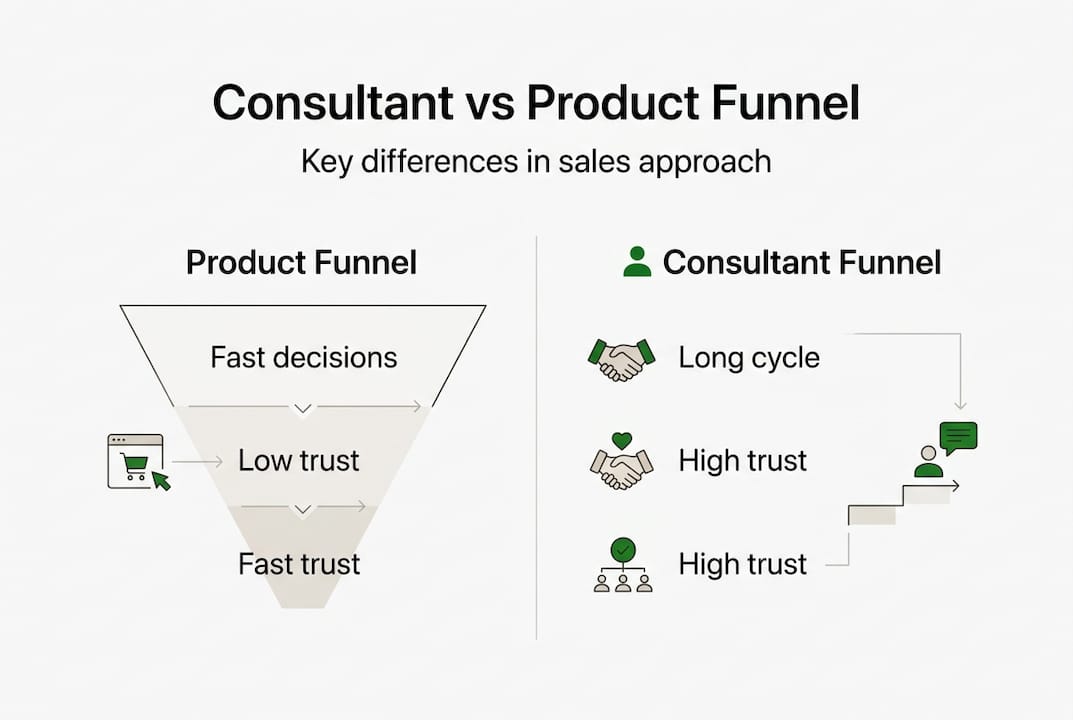
For consultants, your client acquisition strategy has to account for this longer, more relationship-driven journey. A well-built funnel does exactly that. It also connects directly to your broader sales pipeline guide, giving you visibility into where every prospect stands at any given moment.

Why does this matter so much for service-based businesses? Because without a funnel, you’re essentially hoping the right clients find you at the right time. With one, you’re actively guiding them. There’s a big difference between those two realities. You can explore more on this topic through sales funnels for consultants and the broader consulting blog resources available to help you go deeper.
Breaking down the five key stages
Having defined the funnel and its stages, let’s go deeper. What does each stage really mean in practice for consultants?
- Awareness: This is where people first discover you. Think LinkedIn content, SEO articles, podcast appearances, or a referral (yes, referrals still play a role here). Your job is to show up where your ideal clients are spending their time.
- Interest: They’ve noticed you. Now they want to know more. This is where lead magnets like free guides, webinars, or email sequences come in. You’re nurturing curiosity into genuine interest.
- Consideration: The prospect is actively evaluating you. Case studies, testimonials, and detailed service pages do the heavy lifting here. They’re comparing you to alternatives.
- Decision: This is the discovery call stage. You’re having real conversations, understanding their problem, and presenting a tailored proposal.
- Action: They sign. The deal closes. But this stage also includes your onboarding experience, which sets the tone for referrals and repeat business down the line.
Now let’s talk numbers. B2B conversion benchmarks show that visitor-to-lead rates sit around 1-3%, lead-to-MQL (marketing qualified lead) at 10-35%, MQL-to-SQL (sales qualified lead) at 20-30%, SQL-to-opportunity at 30-40%, and opportunity-to-close at 15-30%. For professional services specifically, lead-to-opportunity rates can reach 18-32%, which is notably higher than many other industries.
| Funnel stage | Typical B2B rate | Professional services |
|---|---|---|
| Visitor to lead | 1-3% | 2-4% |
| Lead to MQL | 10-35% | 15-35% |
| MQL to SQL | 20-30% | 22-32% |
| SQL to opportunity | 30-40% | 30-42% |
| Opportunity to close | 15-30% | 18-32% |
These numbers matter because they help you diagnose where your funnel is leaking. If you’re getting plenty of leads but few discovery calls, the problem is in your consideration stage, not your awareness efforts.
Pro Tip: Use a simple CRM (even a spreadsheet works to start) to tag every prospect with their current funnel stage. Review it weekly. You’ll spot patterns fast and know exactly where to focus your energy.
For more on keeping prospects engaged between stages, check out these consultant lead nurturing tactics and sales tactics for freelancers that work in the real world. You can also get a visual overview of how stages connect with this sales pipeline stages visual guide.
Navigating edge cases and common pitfalls
Now that we know the ideal funnel flow, let’s look at what trips up real-world consultants and how to fix it.
The biggest issue? Long sales cycles. Complex consulting services can take 9-12 months to close, especially when multiple decision-makers are involved. That’s not a failure of your funnel. It’s just the reality of high-value B2B services. Your funnel needs to be built for patience, not speed.
Here are the most common pitfalls and how to handle them:
- Relying only on referrals: Referrals are one input, not a strategy. When they slow down, your pipeline dries up. Build multiple lead sources in parallel.
- Ignoring non-linear journeys: Buyers don’t always move neatly from stage one to stage five. Someone might jump from awareness straight to a decision call. Your funnel needs to accommodate that flexibility.
- Giving up on cold leads too soon: A “no” today is often a “not yet.” Keep nurturing those contacts with valuable content. Circumstances change.
- Neglecting multiple stakeholders: In larger organizations, you might be talking to a champion who loves your work but needs to convince a CFO or CEO. Build materials that help your champion sell internally.
Real talk: most consultants lose deals not because their service isn’t good enough, but because they stopped following up. Consistent, value-driven follow-up is what separates a full pipeline from an empty one.
Pro Tip: Create a “nurture” tag in your CRM for leads that went cold. Send them a relevant article, a case study, or a quick check-in every 6-8 weeks. You’ll be surprised how many come back when the timing is right.
Building a repeatable sales process is the antidote to all of these pitfalls. When you have a system, you stop relying on memory and gut instinct, and start making decisions based on data.
Tools and tactics for funnel management
With pitfalls in mind, here’s a toolkit to make your funnel truly work in practice.
- Set up a CRM with five custom stages. Tools like HubSpot (free tier), Pipedrive, or even Notion work well. Customize it to match your five funnel stages so every deal has a clear home.
- Score your leads. Not all leads are equal. Assign simple scores based on fit (industry, company size, budget) and behavior (opened emails, attended a webinar, visited your pricing page). Focus your energy on high-score leads first.
- Run weekly pipeline reviews. Block 30 minutes every Friday. Look at what moved, what stalled, and what needs a follow-up. This habit alone will improve your close rate significantly.
- A/B test your outreach. Try two different subject lines for your cold emails. Test two versions of your proposal intro. Small tweaks compound over time.
- Align your content with funnel stages. Awareness content (LinkedIn posts, articles) feeds the top. Case studies and testimonials support the middle. Proposals and ROI calculators close the bottom.
One important note: avoid over-automating your funnel, especially for high-trust services. Automation is great for reminders and follow-up sequences, but your discovery calls and proposals should always feel personal and tailored.
Tracking the right numbers is essential here. Learn how to track pipeline metrics so you always know your conversion rates at each stage. And when it comes to closing, having the right sales templates for closing can make a real difference in your win rate. For additional inspiration, this high-converting sales funnel tips resource from Forbes is worth a read.
Alternate funnel models and the importance of trust
Before we wrap up, it’s worth exploring some alternate perspectives and why trust shouldn’t be an afterthought.
The traditional funnel is linear. But buyer behavior rarely is. Here are three models worth knowing:
- The flywheel model: Instead of a funnel that ends at the sale, the flywheel keeps spinning. Happy clients generate referrals and repeat business, feeding new leads back into the top. It’s a momentum-based approach that rewards great delivery as much as great marketing.
- The messy middle: Google’s research shows that buyers loop between exploration and evaluation multiple times before deciding. For consultants, this means a prospect might visit your website five times, read three case studies, and attend a webinar before ever reaching out. Your funnel needs to support that non-linear journey.
- The trust funnel: This model puts relationship-building at the center of every stage. Social proof (testimonials, case studies, LinkedIn recommendations) isn’t just a nice-to-have. It’s the engine that moves people through the funnel.
For consultants especially, trust is the currency. You’re not selling a product someone can return. You’re asking someone to invest in your expertise and judgment. Every touchpoint in your funnel should reinforce that you’re the right person for the job.
Exploring proven acquisition strategies that combine these models will help you build something that works for your specific market and style.
Next steps: practical resources for mastering your client funnel
You now have a clear picture of what a consultant sales funnel looks like, how each stage works, where things go wrong, and what tools to use. That’s a solid foundation. But knowing and doing are two different things.
The next step is putting this into action. At GeneratingPipeline.com, everything is built to help you do exactly that, without expensive coaching programs or hidden pricing. Start by learning how to avoid revenue gaps consulting so you’re never caught short between projects. Then dig into the pipeline management guide to get your system set up properly. And if you want quick wins you can implement this week, the revenue growth hacks resource covers pricing, sales, and marketing tactics that actually move the needle. Your pipeline won’t build itself, but with the right system, it gets a whole lot easier.
Frequently asked questions
What are the typical conversion rates for a consultant sales funnel?
Professional services see lead-to-opportunity rates around 18-32%, with final opportunity-to-close conversions in the 15-30% range, which is stronger than many other B2B industries.
How should consultants track and review sales funnel progress?
Set up a CRM with five stages that match your funnel and run a weekly pipeline review to identify stalled deals and prioritize follow-ups before opportunities go cold.
What’s the biggest mistake in consultant funnels?
Over-relying on referrals creates feast-or-famine cycles that leave your pipeline unpredictable. Building multiple lead sources alongside referrals gives you consistent, controllable growth.
How can consultants personalize their funnel for more trust?
Lead with case studies, client testimonials, and tailored proposals, and avoid over-automating touchpoints where a personal message would land far better than a generic sequence.
Recommended
- A Proven Client Acquisition Strategy for Fractional Executives and Consultants – Generating Pipeline
- Blog – Generating Pipeline
- Sales Process and Optimisation For an Efficient, Repeatable Sales System – Generating Pipeline
- How I Use ChatGPT to Run My Solo Consulting Business Efficiently (2025) – Generating Pipeline
