If you’re a freelancer or consultant, you’ve probably lived through the feast-or-famine cycle at least once. One month you’re slammed with client work, the next you’re staring at an empty inbox wondering where your next project is coming from. 62% of freelancers experience income volatility because they have no structured system tracking their opportunities. A revenue pipeline fixes that. This guide breaks down exactly what a revenue pipeline is, how it works in practice, and how you can use one to build steadier, more predictable income as an independent service provider.
Table of Contents
- What is a revenue pipeline?
- Key stages of a revenue pipeline
- Revenue pipeline metrics and benchmarks for independents
- How to manage your pipeline: Tools, reviews, and workflows
- Avoiding pitfalls: Common pipeline mistakes for freelancers and consultants
- Take your revenue pipeline to the next level
- Frequently asked questions
Key Takeaways
| Point | Details |
|---|---|
| Pipeline creates predictability | A well-managed revenue pipeline helps freelancers and consultants avoid income swings and plan ahead. |
| Follow structured stages | Breaking your pipeline into clear stages improves win rates and keeps prospects flowing. |
| Track key metrics | Pipeline coverage, win rate, and sales velocity are benchmarks that reveal the health of your system. |
| Review and improve weekly | Consistent reviews and using simple tools make it easier to manage your pipeline and income. |
| Avoid common traps | Don’t skip qualification or follow-up—these mistakes often lead to stalled deals and lost revenue. |
What is a revenue pipeline?
Let’s start with a clean definition. A revenue pipeline is a structured system tracking prospects from the moment you first identify them all the way through to a signed contract and payment. It gives you a bird’s-eye view of every active opportunity so you always know what’s in play, what needs attention, and what’s likely to close.
For freelancers and consultants, this matters more than most people realize. Without a pipeline, you’re essentially flying blind. You finish a project, then scramble to find the next one. That scramble is what creates the income rollercoaster.
A revenue pipeline isn’t just a list of leads. It’s a live operating system for your business revenue. It brings structure, visibility, and control to what is otherwise a chaotic process.
One thing worth clearing up right away: a pipeline is not the same as a forecast. A pipeline versus forecast distinction matters because your pipeline is your operational inventory (the deals you’re actively working), while a forecast is a prediction of which ones will close and when. Mixing them up leads to bad decisions. Good pipeline management definition starts with understanding this difference.
Here’s why building a pipeline is worth your time:
- Predictability: You can see income coming weeks or months ahead.
- Focus: You know exactly which opportunities to prioritize right now.
- Better client flow: You’re always nurturing new leads, even when you’re busy.
- Confidence: No more panic-pitching when a project ends.
And pipeline forecasting becomes much more accurate once your pipeline is healthy and consistently managed.
Pro Tip: Don’t treat your pipeline like a static spreadsheet you update once a month. It should be a living system you interact with every week. The more you engage with it, the more useful it becomes.
Key stages of a revenue pipeline
Now that you know what a revenue pipeline is, let’s break down the practical stages that make it work. These typical stages for freelancers map directly to how independent service providers actually win clients.
- Prospecting and lead generation. This is where you identify potential clients. Think LinkedIn outreach, referrals, content marketing, or cold email. The goal is to fill the top of your pipeline consistently.
- Qualification. Not every lead is worth your time. Qualification means figuring out if a prospect has the budget, the need, and the authority to hire you. Skip this step and you’ll waste hours on dead-end conversations.
- Discovery and needs analysis. This is your first real conversation. You’re learning about their situation, their goals, and their pain points. It’s also where you start positioning your expertise.
- Proposal. You put together a tailored offer. This could be a formal proposal doc or a simple scope-of-work email, depending on your style and the client’s expectations.
- Negotiation and objection handling. Clients push back. That’s normal. This stage is about addressing concerns, adjusting scope if needed, and keeping the deal moving forward.
- Closing. The contract is signed, the deposit is paid, and the work begins. But closing isn’t the end of your pipeline work. It’s the start of a new cycle.
You can explore pipeline stages explained in more detail if you want to go deeper on each one. And if you’re looking for practical ways to move deals through faster, check out these sales tactics for freelancers.
Pro Tip: Qualification is the stage most independents rush or skip entirely. If a deal stalls later, nine times out of ten it’s because the lead wasn’t properly qualified upfront. Be honest with yourself early.
Revenue pipeline metrics and benchmarks for independents
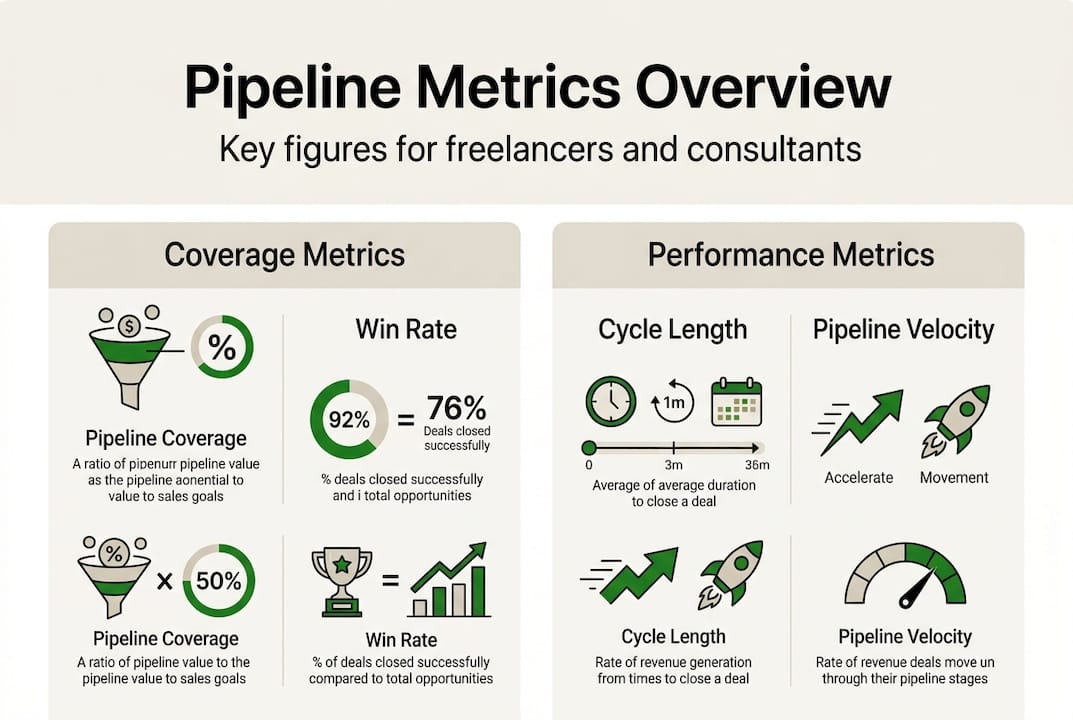
Understanding your pipeline’s stages is just the start. Tracking the right metrics helps you know if it’s really working. Here are the four numbers you need to know.
Pipeline coverage is the total value of your active pipeline divided by your revenue goal. The recommended coverage ratio is 3 to 4 times your quota. So if you need $10,000 this month, you should have $30,000 to $40,000 worth of active opportunities.
Win rate is the percentage of proposals that turn into paying clients. Industry benchmarks for professional services put win rates at 35 to 55% at the proposal stage, with an average sales cycle of 44 to 51 days.
Pipeline velocity measures how fast deals move through your pipeline. The formula is: (number of deals x win rate x average deal size) divided by average cycle length.

Time in stage flags where deals are getting stuck. If proposals are sitting for three weeks without a response, that’s a signal to follow up or disqualify.
| Metric | What it measures | Benchmark |
|---|---|---|
| Pipeline coverage | Total pipeline vs. revenue goal | 3 to 4x quota |
| Win rate | Proposals that close | 35 to 55% (professional services) |
| Sales cycle length | Days from first contact to close | 44 to 51 days |
| Pipeline velocity | Speed of revenue generation | Higher is better |
Businesses that track pipeline metrics consistently see 28% higher revenue growth than those that don’t. That’s not a small difference.
Watch for these early warning signs that your pipeline is in trouble:
- Your pipeline coverage drops below 2x your monthly revenue goal.
- Deals are sitting in the same stage for more than two weeks with no movement.
- You haven’t added a new prospect in over a week.
If any of those sound familiar, check out this consultant sales pipeline guide for a practical reset.
How to manage your pipeline: Tools, reviews, and workflows
Once you know what to track, it’s time to make managing your pipeline a routine. Here’s how to do it efficiently without it taking over your week.
The most important habit is a weekly pipeline review. Block 30 minutes every week to go through every active deal. Ask yourself: What’s the next action? Is this deal still alive? Does it need to move forward or be removed?
When it comes to tools, the best one is the one you’ll actually use. Here’s a simple comparison:
| Tool type | Pros | Cons | Best for |
|---|---|---|---|
| Spreadsheet | Free, flexible, familiar | Manual updates, no reminders | Solo operators just starting out |
| Simple CRM (e.g., HubSpot free, Notion) | Automated reminders, visual pipeline | Small learning curve | Independents with 5+ active deals |
Essential pipeline habits that keep your income stable:
- Add new prospects every single week, even when you’re busy with client work.
- Set a clear “next action” for every deal in your pipeline.
- Remove dead deals ruthlessly. A bloated pipeline gives you false confidence.
- Review your win rate quarterly and adjust your qualification criteria accordingly.
You can find more practical ways to stabilize freelancer revenue and explore pipeline tools that fit a solo operator’s workflow.
Avoiding pitfalls: Common pipeline mistakes for freelancers and consultants
With tools and routines set up, let’s make sure you don’t fall for common traps that stall your pipeline or shrink your revenue.
Here are three mistakes that show up again and again:
- Skipping qualification. You get excited about a new lead and jump straight to a proposal. Two weeks later, they ghost you. Proper qualification would have revealed they didn’t have the budget or weren’t the decision-maker. Time wasted.
- Neglecting follow-up. Most deals don’t close on the first conversation. But many freelancers send one email and then wait. Stalled deals from poor follow-up are one of the top reasons independents lose revenue they should have won.
- Relying only on referrals. Referrals are great when they come in. But they’re unpredictable. Building a pipeline means you’re actively generating leads, not just waiting for someone to recommend you.
Ignoring your pipeline doesn’t just cost you deals. It costs you the ability to plan, price confidently, and grow on your own terms. The freelancers who build consistent income are the ones who treat pipeline management as a non-negotiable business habit.
The fix for all three mistakes is the same: build a system and stick to it. Review your pricing strategy examples to make sure you’re not underpricing out of desperation when your pipeline runs dry. And if you’re already feeling the pinch, these revenue gap solutions can help you course-correct fast.
Take your revenue pipeline to the next level
You now have a solid foundation. You know what a revenue pipeline is, how to structure it, what to measure, and what mistakes to avoid. The next step is putting it all into practice.

At GeneratingPipeline.com, everything is built specifically for freelancers, consultants, fractional executives, and micro agency owners who want to stop relying on referrals and build a repeatable client pipeline. The Generating Pipeline OS covers 20 lessons across positioning, outreach, sales execution, and delivery, with templates and frameworks you can use immediately. There’s also a free guide with 11 revenue-boosting tactics if you want quick wins right now. If you’re serious about learning to avoid revenue gaps and want a proven system to stabilize freelancer revenue, this is the place to start. No sales calls, no hidden pricing, just practical tools built for busy independents.
Frequently asked questions
Why do freelancers need a revenue pipeline?
A revenue pipeline helps freelancers avoid feast-famine cycles by giving them a structured system to track and manage client opportunities. Without one, 62% of freelancers experience income volatility that’s entirely preventable.
What’s the difference between revenue pipeline and revenue forecast?
Your pipeline tracks the active deals you’re working right now, while a forecast predicts which of those deals will close and when. Treating them as the same thing leads to poor pipeline decisions and inaccurate income planning.
What metrics show if my pipeline is healthy?
The four key metrics are pipeline coverage (aim for 3 to 4x quota), win rate, average sales cycle length, and pipeline velocity. If any of these are off, you’ll know exactly where to focus.
How often should I review my revenue pipeline?
A weekly pipeline review is the standard recommendation. Thirty minutes once a week is enough to keep your pipeline accurate, catch stalled deals early, and make sure you always have a next action on every opportunity.
What is a common mistake freelancers make with pipelines?
The most common mistake is poor qualification and follow-up, which causes deals to stall and income to become unpredictable. Fixing these two habits alone can dramatically improve your close rate.
