If you run a service business, you already know the pattern: a great month followed by a slow one, a full calendar that suddenly empties, and a revenue line that looks more like a heartbeat than a growth curve. The feast-famine cycle is one of the most common and frustrating challenges for freelancers, consultants, and fractional executives. The internet is full of growth advice, but most of it is either too generic or too risky for solo operators. This article cuts through the noise and gives you six research-backed, practical hacks that actually move the needle.
Table of Contents
- What makes a revenue hack work?
- Revenue growth hack #1: Specialize and raise your rates
- Revenue growth hack #2: Productize your expertise
- Revenue growth hack #3: Build recurring revenue streams
- Revenue growth hack #4: Upsell and cross-sell to existing clients
- Revenue growth hack #5: Incentivize referrals systematically
- Revenue growth hack #6: Always-on business development
- Summary comparison: Choosing your best revenue hacks
- Ready to grow? Apply these hacks with a predictable pipeline
- Frequently asked questions
Key Takeaways
| Point | Details |
|---|---|
| Specialize for higher rates | Focusing on a niche allows you to command premium pricing and more demand. |
| Productize your offers | Defining clear, repeatable service packages boosts sales conversion and delivery efficiency. |
| Build recurring revenue | Retainer and subscription models stabilize cash flow and reduce sales stress. |
| Leverage existing clients | Upselling, cross-selling, and referrals from happy clients grow revenue with minimal new acquisition cost. |
| Prioritize ongoing business development | Allocating regular time to new lead generation prevents feast-famine cycles. |
What makes a revenue hack work?
Not every tactic deserves the label “growth hack.” For service businesses, a real revenue hack must meet a specific set of criteria before it earns a place on your shortlist.
Here is what separates a genuine hack from a short-lived trick:
- Sustainable: It works month after month, not just once.
- Repeatable: You can run it again without rebuilding from scratch.
- Compatible with service delivery: It fits how you actually work and sell.
- Proven with real-world data: It has measurable results behind it, not just theory.
The biggest mistake service providers make is chasing quick wins. A spike in leads from a viral post feels great, but it does not fix the underlying problem. Feast-famine cycles are broken by always-on systems that allocate 15 to 20 percent of your time to business development, blending inbound and outbound activity consistently.
“The goal is not to find one magic tactic. It is to build a system where revenue growth is a predictable output of consistent effort.”
Think of practical client acquisition strategies as the engine, and these hacks as the fuel. Both matter. Now, let’s get into the list.
Revenue growth hack #1: Specialize and raise your rates
Specialization is the unlock that makes every other hack easier. When you serve everyone, you compete on price. When you serve a specific type of client with a specific problem, you compete on expertise.

Niche specialization enables higher pricing and more sustainable revenue because clients pay a premium for someone who deeply understands their world. A generalist copywriter might charge $75 per hour. A copywriter who specializes in SaaS onboarding sequences can charge $200 or more.
Here is a simple comparison of pricing models once you specialize:
| Model | Generalist rate | Specialist rate | Annual difference |
|---|---|---|---|
| Hourly | $75/hr | $175/hr | +$20,000+ |
| Per project | $1,500 | $4,500 | +$18,000+ |
| Monthly retainer | $2,000 | $5,500 | +$42,000+ |
The numbers above assume the same number of working hours. Specialization does not require more time. It requires more clarity.
The fear most people have is that raising rates will drive clients away. But doubling your rates typically retains around 90 percent of clients while significantly boosting revenue. The math almost always works in your favor.
Pro Tip: Raise rates for new clients first. Once you see that new clients accept the higher price without hesitation, you have the confidence to bring existing clients up at their next renewal.
Specialization also helps you command higher fees by positioning you as the obvious choice rather than one of many options. Pair that with value-based pricing and your revenue ceiling rises significantly.
Revenue growth hack #2: Productize your expertise
Once you have a specialized offer, the next step is to package it so it sells itself. Productized services are structured, fixed-scope packages with a clear deliverable, timeline, and price. They remove the friction of custom proposals and make it easier for clients to say yes.
Here is how to productize in three steps:
- Identify your most repeatable solution. What do you do for almost every client? That is your starting point.
- Package and price it clearly. Give it a name, define the scope, set a fixed price, and write it up as a one-page offer.
- Design a simple onboarding process. A short intake form and a welcome email sequence make delivery consistent and professional.
A paid audit or a focused workshop works especially well as an entry-point product. It is low-risk for the client and gives you a chance to demonstrate your value before they commit to a larger engagement.
Stat: Productized audits convert to recurring retainers at a rate of 30 to 50 percent, making them one of the highest-ROI offers a service provider can build.
Pro Tip: Use a “good-better-best” offer ladder. Your entry product sits at the bottom, your core retainer in the middle, and a premium or VIP tier at the top. This gives clients a natural upgrade path and increases your average deal size over time.
Productizing also supports your client acquisition strategy by making it easier to describe what you do in a single sentence, which is critical for referrals and outbound outreach.
Revenue growth hack #3: Build recurring revenue streams
One-off projects are exhausting to sell. Every month, you start from zero. Recurring revenue changes that equation entirely by giving you a predictable base to build from.
Recurring revenue for service businesses typically looks like:
- Monthly retainers for ongoing strategy, support, or execution
- Subscription-based access to your expertise (office hours, async reviews)
- Ongoing maintenance or monitoring packages
- Quarterly planning or review sessions on a fixed schedule
Industry benchmarks suggest that mature service businesses should target 40 to 60 percent of revenue from recurring sources. Below that threshold, you are still riding the feast-famine wave.
| Revenue mix | Cash flow stability | Sales pressure | Growth potential |
|---|---|---|---|
| 100% project-based | Low | High | Moderate |
| 50% recurring / 50% project | Medium | Medium | High |
| 70%+ recurring | High | Low | Very high |
The key to selling retainers is framing them around the client’s ongoing need, not your desire for steady income. Show them what it costs to stop and restart, versus the value of continuous momentum. That framing makes the retainer feel like the smart choice, not a favor to you.
Building a steady revenue model does not happen overnight, but even converting one project client to a retainer per quarter compounds quickly.
Revenue growth hack #4: Upsell and cross-sell to existing clients
Your current clients are your most underutilized revenue source. They already trust you, they know your work, and they have seen results. Selling to them costs a fraction of what it takes to win a new client.
Effective add-ons to offer existing clients include:
- Priority support: Faster response times or dedicated availability for a monthly fee
- Quarterly reviews: A structured check-in that keeps strategy on track
- Training sessions: Teaching their team to use what you have built
- Expanded scope: Adding a second channel, market, or deliverable to an existing engagement
- Done-for-you upgrades: Taking a task they currently handle themselves off their plate
Upselling with ROI-tied add-ons increases revenue without the cost of acquiring new clients, making it one of the highest-margin growth moves available to you.
“Scale your highest-margin services first with the clients who already see your value. That is where the fastest revenue growth lives.”
Upselling also improves retention. When a client is using more of your services, they are more embedded in your work and less likely to leave. Check out add-on pricing tips and expert cross-sell tactics to structure these conversations well.
Revenue growth hack #5: Incentivize referrals systematically
Most freelancers and consultants get referrals occasionally, but very few have a system for generating them consistently. The difference between hoping for referrals and building a referral engine is simply structure.
Here is how to set up a simple referral program:
- Identify your best referral sources. Past clients, current clients, and complementary service providers are your top three.
- Define the reward. A bonus service, a credit toward their next invoice, or a cash referral fee all work. Keep it meaningful but not excessive.
- Make it easy to refer. Give them a short description of your ideal client and a simple email template they can forward.
- Track every referral. Use a simple spreadsheet or CRM to log who referred whom and when.
- Follow up and thank them. A personal thank-you after a referral converts goes a long way toward generating the next one.
Referral systems with incentives bring in new clients and generate additional revenue from existing relationships, making them one of the most cost-effective pipeline tools available.
Pro Tip: Only deliver the referral reward after the new client pays their first invoice. This keeps your incentive tied to real revenue and avoids awkward situations where a referral does not convert.
Pair this with referral growth tactics and a plan to avoid feast and famine for a pipeline that feeds itself.
Revenue growth hack #6: Always-on business development
All five hacks above work better when you treat business development as a non-negotiable weekly habit rather than something you do when things get slow. Sporadic prospecting creates gaps. Consistent effort creates momentum.
Allocate 15 to 20 percent of your working week to business development. For a 40-hour week, that is six to eight hours. It sounds like a lot until you realize that one new client per month more than justifies the investment.
Your business development mix should include:
- Outbound: Direct outreach on LinkedIn, personalized emails, follow-ups with warm leads
- Inbound: Publishing content, engaging in communities, optimizing your profile or website
- Referral activation: Checking in with past clients, asking for introductions
- Pipeline review: Updating your CRM, following up on open proposals, re-engaging cold leads
Always-on business development is the single most reliable way to break feast-famine cycles, because it keeps your pipeline moving even when you are busy delivering work.
The long-term effect is a calmer business. When you know your pipeline is always being fed, you stop taking on bad-fit clients out of desperation. That alone improves your revenue quality. Build the habit of staying consistent with avoiding feast-famine cycles before the slow months hit.
Summary comparison: Choosing your best revenue hacks
Not every hack fits every stage of business. Use this table to find your best starting point based on where you are right now.
| Hack | Effort | Cost | Speed to revenue | Best for |
|---|---|---|---|---|
| Specialize and raise rates | Medium | Low | Fast | Early-stage or plateaued businesses |
| Productize your expertise | Medium | Low | Medium | Anyone with a repeatable service |
| Build recurring revenue | Medium | Low | Medium | Established client relationships |
| Upsell to existing clients | Low | Very low | Fast | Anyone with active clients |
| Incentivize referrals | Low | Low | Medium | Businesses with happy clients |
| Always-on BD | High (habit) | Low | Slow but compounding | All stages |
Revenue per consultant benchmarks show that the highest-earning service providers combine at least three of these hacks simultaneously. Picking one is a start. Stacking them is where the real growth happens.
Start with the one or two hacks that match your current stage. Track results for 60 to 90 days before adding another. Consistency beats complexity every time. If you are worried about avoiding revenue gaps, the recurring revenue and always-on BD hacks are your highest-priority moves.
Ready to grow? Apply these hacks with a predictable pipeline
Knowing the hacks is one thing. Building the system that runs them consistently is another. That is exactly where most service providers get stuck: they understand the strategy but struggle to execute it week after week without a clear structure.
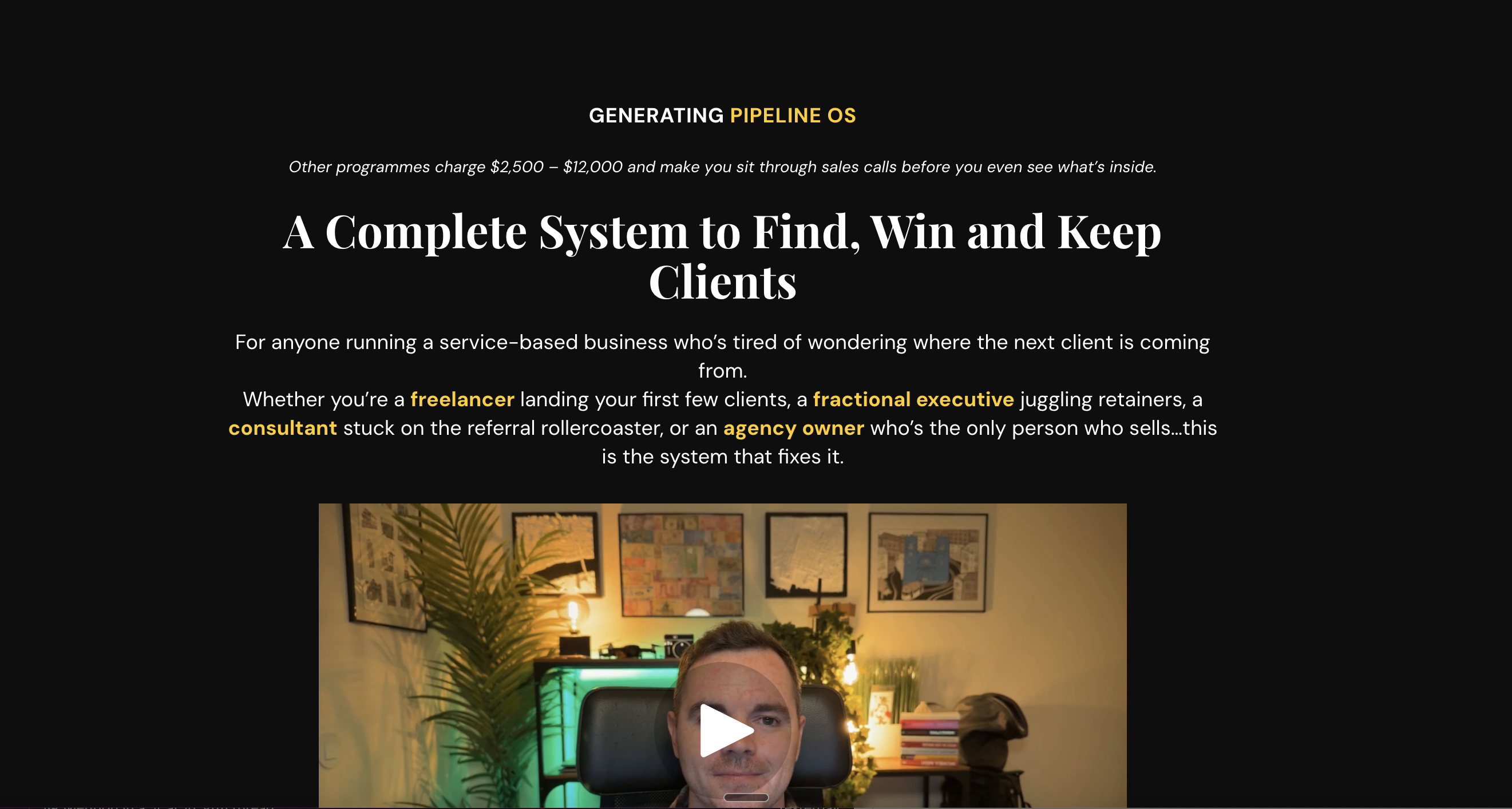
At GeneratingPipeline.com, we have built the tools, templates, and frameworks to help you put all six of these hacks into practice without the guesswork. Whether you want to sharpen your positioning, launch a referral program, or finally build a client pipeline that does not depend on luck, the Generating Pipeline OS walks you through every step. Start with our free guide covering 11 revenue-boosting tactics, or explore 7 sales tactics for freelancers to see what fits your business right now. No sales calls, no hidden pricing, just a clear path forward.
Frequently asked questions
What is the best revenue growth hack for a new freelancer?
Niche specialization paired with a productized entry offer is the most effective starting point, because it attracts ideal clients quickly at rates that are actually profitable.
How much recurring revenue should I aim for in my service business?
Industry data suggests targeting 40 to 60 percent recurring revenue for stable, predictable operations in a mature service business.
How do I incentivize referral partners without discounting my main services?
Offer bonus services, exclusive access, or a referral credit rather than a discount on your core offer. Always deliver the reward after the referred client pays their first invoice.
Why do most service businesses struggle with feast-famine revenue cycles?
Inconsistent business development and a lack of recurring offers are the two main causes. Always-on systems that dedicate 15 to 20 percent of time to BD are the most reliable fix.
Is doubling my rates risky?
Less risky than you think. Research shows that around 90 percent of clients stay when rates double, meaning the revenue gain almost always outweighs any client loss.
Recommended
- Business Development: 7 Practical Client Acquisition Strategies
- 7 sales tactics for freelancers to grow clients in 2026
- Why diversify revenue streams for service businesses in 2026
- Blog – Generating Pipeline
- Optimize restaurant coffee service for 2026 profitability
