Many consultants and service-based business owners struggle with pricing because they anchor to hours worked or costs incurred, leaving money on the table and undervaluing their expertise. Pricing strategy examples that boost profits for freelancers show that aligning price with the value clients receive transforms both profitability and relationships. This guide explains value-based pricing fundamentals, dispels common myths, and provides actionable frameworks to implement this approach in your consulting or service business, helping you charge what you’re truly worth while delivering outcomes clients care about.
Table of Contents
- Key takeaways
- What is value-based pricing and why does it matter?
- Common myths and challenges in value-based pricing
- How to calculate and implement value-based pricing effectively
- Examples of value-based pricing in consulting and service businesses
- Explore tools and strategies to master pricing and client acquisition
- Frequently asked questions
Key Takeaways
| Point | Details |
|---|---|
| Value focused pricing | Value based pricing anchors price to the client outcomes rather than costs or hours. |
| Align price with outcomes | Pricing should reflect the tangible results the client receives, not the time spent or expenses incurred. |
| Upfront client discovery | Invest time to understand client goals, metrics, and willingness to pay before quoting a price. |
| Flexible pricing models | Use fixed fees, retainers, or performance based models to align incentives with outcomes. |
What is value-based pricing and why does it matter?
Pricing strategy examples that boost profits for freelancers demonstrate that value-based pricing focuses on the perceived value to the client rather than cost or time spent. Instead of calculating your hourly rate or marking up your costs, you determine what the outcome is worth to the client and price accordingly.
Traditional pricing models like cost-plus or hourly rates anchor to your inputs. Cost-plus adds a margin to your expenses. Hourly rates multiply time by a fixed rate. Both ignore the impact your work creates for the client. A consultant who saves a client $500,000 annually deserves more than $10,000 simply because the project took 100 hours. Value-based pricing captures that discrepancy.
This approach reshapes profitability. When you price on value, your revenue grows without proportional increases in time or effort. You escape the ceiling imposed by billable hours. Clients also benefit because they pay for results, not activity. This alignment shifts the relationship from vendor to partner.
Value-based pricing elevates your positioning. Clients view you as a strategic advisor focused on their success, not a commodity service provider. This perception opens doors to larger projects, longer engagements, and referrals to higher-value clients.
Key traits distinguish value-based pricing from traditional methods:
- Pricing tied to client outcomes and benefits, not your costs or time
- Requires deep understanding of client goals, metrics, and willingness to pay
- Focuses on the transformation or impact delivered, not the process
- Encourages transparent conversations about value and expectations upfront
- Allows for flexible pricing structures like fixed fees, retainers, or performance-based models
Value-based pricing demands more upfront work to understand client needs and articulate value, but the payoff in profitability and client satisfaction justifies the effort. Recognizing these differences prepares you to address the myths and challenges that often prevent consultants from adopting this strategy.
Common myths and challenges in value-based pricing
Many consultants wrongly believe value-based pricing is complex or risky, but these misconceptions stem from unfamiliarity rather than reality. Addressing these myths helps you move forward with confidence.
Myth 1: Value-based pricing is too complicated to calculate. Some think quantifying value requires advanced analytics or extensive data. In practice, you estimate value through client conversations, industry benchmarks, and simple frameworks. You don’t need precision, just a reasonable range based on the client’s situation and goals.
Myth 2: Clients will reject higher prices based on value. Consultants fear sticker shock when they quote prices above hourly equivalents. Yet clients accept higher prices when you clearly connect the investment to tangible outcomes like revenue growth, cost savings, or risk reduction. The key is framing the conversation around value, not price.
Myth 3: It only works for certain industries or clients. Value-based pricing applies across consulting, coaching, design, marketing, and technical services. Any engagement where you deliver measurable outcomes can use this approach. The tactics vary by context, but the principle holds universally.
Challenges do exist. Accurately assessing client value requires discovery skills and industry knowledge. You must ask the right questions to uncover what success looks like and what the client would pay to achieve it. Communicating value effectively demands clarity and confidence. You need to articulate benefits in the client’s language, using their metrics and priorities.
Another challenge is internal mindset. Shifting from hourly thinking to value thinking takes practice. You may underestimate your worth or feel uncomfortable charging for results rather than effort. Building this confidence comes with experience and proof points.
Key obstacles to adopting value-based pricing include:
- Difficulty quantifying intangible benefits like brand reputation or team morale
- Clients accustomed to hourly rates who resist alternative pricing models
- Lack of case studies or testimonials to demonstrate past value delivered
- Fear of overpricing and losing opportunities to competitors
- Uncertainty about how to structure proposals and contracts around value
Pro Tip: Start small with pilot projects to test value pricing and build confidence. Choose clients where you understand the value clearly and the relationship is strong. Use these early wins to refine your approach and gather testimonials that support future value-based proposals.
Recognizing these myths and challenges equips you to navigate them strategically. With obstacles identified, you can focus on practical frameworks for calculating and implementing value-based pricing effectively.
How to calculate and implement value-based pricing effectively
Effective value-based pricing depends on deep understanding of client outcomes, benefits, and willingness to pay. Follow a structured process to determine prices that reflect the value you deliver.
Step 1: Conduct deep discovery. Ask questions that uncover the client’s goals, pain points, and success metrics. What problem are they solving? What does success look like? What happens if they don’t solve this problem? Quantify the impact wherever possible. If a client wants to increase revenue, ask by how much. If they want to reduce costs, estimate the savings.
Step 2: Identify tangible and intangible benefits. Tangible benefits include revenue growth, cost reduction, time savings, and risk mitigation. Intangible benefits include improved reputation, team morale, and strategic positioning. Both matter, but tangible benefits are easier to price against.

Step 3: Estimate the economic value. Calculate what the outcome is worth to the client. If your work generates $200,000 in additional revenue, the economic value is at least that amount. Your price should capture a portion of this value, typically 10 to 30 percent depending on the situation.
Step 4: Set price anchors reflecting value tiers. Offer options at different price points tied to varying levels of value. A basic package delivers core outcomes. A premium package includes additional support, faster timelines, or enhanced results. This structure lets clients choose based on their budget and priorities.
Step 5: Frame the proposal around value, not price. Lead with the outcomes and benefits. Show the return on investment. Present the price as a logical reflection of the value delivered. Use visuals, case studies, and testimonials to reinforce your claims.
Implementation steps for business owners:
- Review past projects to identify where you delivered measurable value
- Develop a discovery questionnaire to uncover client value in future engagements
- Create pricing tiers that align with different levels of value and client needs
- Practice articulating value in client conversations and proposals
- Gather testimonials and case studies that demonstrate outcomes and impact
- Refine your approach based on client feedback and win rates
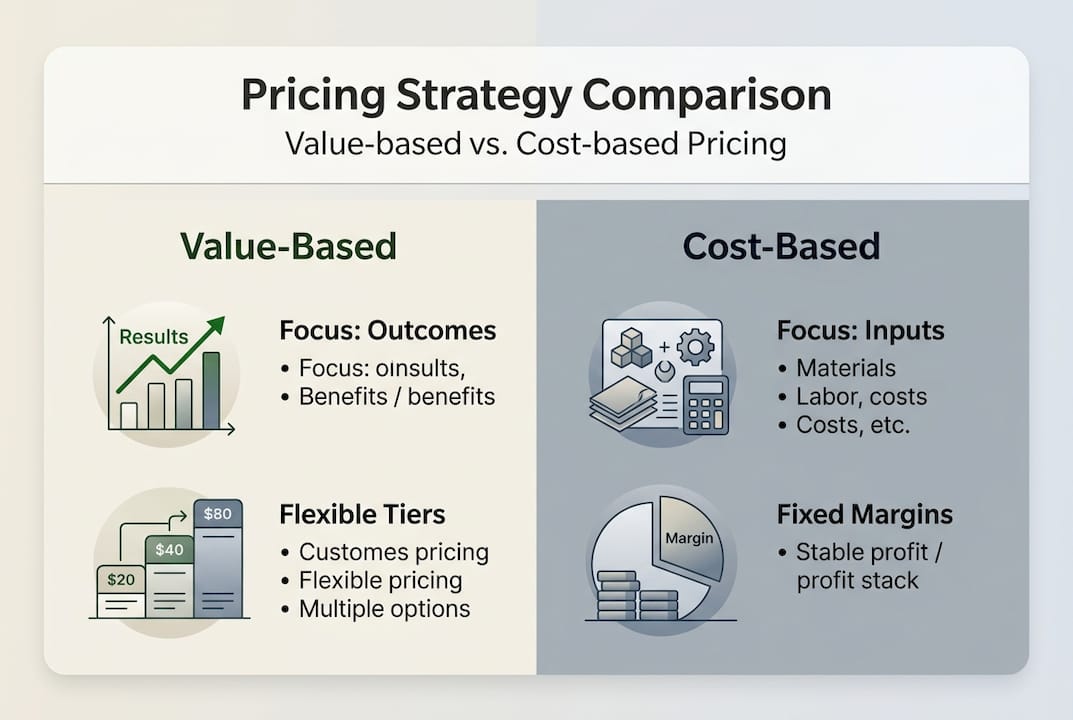
A comparison table clarifies the differences between value-based and traditional pricing:
| Element | Value-Based Pricing | Hourly/Cost-Based Pricing |
|---|---|---|
| Focus | Client outcomes and benefits | Time spent or costs incurred |
| Pricing basis | Value delivered to client | Hours worked or expenses plus margin |
| Profit potential | High, scales with value | Limited by billable hours or cost structure |
| Client perception | Strategic partner | Service provider or vendor |
| Proposal emphasis | Results and ROI | Scope of work and deliverables |
| Risk | Shared, based on outcomes | Low, client pays for effort regardless of results |
Pro Tip: Use client testimonials and case studies to demonstrate value. Concrete examples of past successes make it easier for prospects to see the potential impact and justify higher prices. Quantify outcomes wherever possible, such as percentage increases in revenue or specific cost savings achieved.
These frameworks provide a roadmap for calculating and implementing value-based pricing in your consulting business. With the process clear, examining real-world examples shows how this strategy works in practice.
Examples of value-based pricing in consulting and service businesses
Consulting firms that implement value-based pricing increase profitability and client trust by aligning fees with outcomes rather than effort. Real-world examples illustrate how different service providers apply this approach.
A fractional CFO helps a mid-sized company optimize cash flow and secure a $2 million line of credit. The economic value to the client is significant, enabling growth and reducing financial stress. The CFO charges a $50,000 fixed fee for the engagement, capturing a fraction of the value created. This price far exceeds what hourly billing would yield for the same work.
A marketing consultant increases a client’s lead generation by 40 percent over six months, resulting in $300,000 in additional revenue. The consultant prices the engagement at $30,000, representing 10 percent of the incremental revenue. The client sees a clear return on investment, and the consultant earns more than they would billing by the hour.
A solo business consultant helps a founder streamline operations, reducing overhead by $100,000 annually. The consultant charges $20,000 for the project, reflecting the immediate and ongoing savings. The client gladly pays because the value is obvious and measurable.
These examples share common value signals that justify premium pricing:
- Quantifiable financial impact like revenue growth, cost savings, or improved margins
- Strategic outcomes such as market positioning, competitive advantage, or risk reduction
- Time savings that free up the client to focus on higher-value activities
- Enhanced capabilities or knowledge that empower the client’s team long-term
- Measurable improvements in key performance indicators relevant to the client’s goals
Tailoring value propositions for different service types requires understanding what clients care about most. For financial consulting, emphasize cost savings and revenue growth. For operational consulting, highlight efficiency gains and risk mitigation. For marketing services, focus on lead generation and customer acquisition. For strategic advisory, stress long-term positioning and competitive advantage.
Value-based pricing works across service types because every client seeks outcomes, not just deliverables. Your job is to identify what those outcomes are worth and price accordingly. These examples demonstrate that when you articulate value clearly and align pricing with client priorities, you create win-win engagements that benefit both parties.
With practical examples in mind, exploring tools and strategies to support your pricing and client acquisition efforts provides the next logical step in mastering this approach.
Explore tools and strategies to master pricing and client acquisition
Mastering value-based pricing requires more than understanding the theory. You need systems to identify the right clients, communicate value effectively, and manage your pipeline consistently. Generating Pipeline offers resources designed specifically for consultants and service-based business owners who want to implement these strategies without expensive coaching programs or hidden pricing.
The Generating Pipeline OS provides frameworks for positioning, outbound outreach, and sales execution that complement value-based pricing. When you understand your ideal client profile and personas, you can tailor your value propositions to resonate with the clients most likely to pay for outcomes. The course includes templates and examples to help you articulate value in proposals and conversations.
If you’re looking to avoid revenue gaps in your consulting business, building a repeatable pipeline ensures you always have opportunities to apply value-based pricing. Relying on referrals and word of mouth leaves you vulnerable to feast-or-famine cycles. A structured approach to client acquisition gives you control over your revenue and the confidence to price based on value, not desperation.
For deeper insights into consulting best practices, expert secrets for consultants offers proven tactics from experienced practitioners. These resources help you position yourself as a trusted advisor, communicate value clearly, and close deals at premium prices.
These tools and strategies support your journey toward pricing mastery and sustainable business growth. With the right systems in place, you can consistently attract high-value clients and charge what you’re worth.
Frequently asked questions
What is value-based pricing?
Value-based pricing is a strategy where you set prices based on the perceived and delivered value to the client, rather than your costs or time spent. It focuses on the outcomes and benefits the client receives, aligning your fee with the impact you create. This approach allows you to capture more of the economic value you generate for clients.
How do I determine the value my service provides?
Evaluate client goals, tangible benefits like revenue growth or cost savings, and their willingness to pay to quantify value. Ask discovery questions to understand what success looks like and what the client would invest to achieve it. Use industry benchmarks and past case studies to estimate the economic impact of your work.
Will clients accept higher prices using value-based pricing?
Clients accept higher prices when the value and outcomes are clearly explained and demonstrated through case studies, testimonials, and ROI calculations. The key is framing the conversation around the benefits they receive, not the effort you expend. When clients see a clear return on investment, price becomes less of an objection.
Can value-based pricing be applied to all consulting services?
Most consulting services can use value-based pricing by tailoring the value proposition to client needs and outcomes. Whether you provide financial, operational, marketing, or strategic consulting, you deliver measurable results that clients care about. The tactics and metrics vary by service type, but the principle of pricing based on value holds across the board.
What is a good first step to start using value-based pricing?
Pilot value-based pricing with select projects to learn and adjust before full rollout. Choose clients where you understand the value clearly and have a strong relationship. Use these early engagements to refine your discovery process, pricing frameworks, and value communication. Gather testimonials and case studies to support future proposals.
Recommended
- Pricing strategy examples that boost profits for freelancers
- Million Dollar Consulting: The Professional’s Guide to Growing a Practice for Consultants and Fractional Executives – Generating Pipeline
- A Proven Client Acquisition Strategy for Fractional Executives and Consultants – Generating Pipeline
- Business Development: 7 Practical Client Acquisition Strategies
