Most service business owners treat revenue forecasting like reading tea leaves, but accurate forecasting is actually a systematic process that transforms how you plan capacity, manage cash flow, and grow sustainably. Revenue forecasting predicts your future income based on client projects, billable hours, and pipeline probability, giving you the financial visibility to make confident decisions. This guide walks you through what revenue forecasting is, why it matters for freelancers and consultants, and exactly how to forecast revenue effectively for your service business.
Table of Contents
- Key takeaways
- Understanding revenue forecasting and its importance
- Core techniques for accurate revenue forecasting in service businesses
- Avoiding common pitfalls and improving forecast accuracy
- Applying revenue forecasting to grow your service business
- Boost your revenue forecasting skills with Generating Pipeline
- Frequently asked questions
Key Takeaways
| Point | Details |
|---|---|
| Forecasting purpose | Revenue forecasting provides financial visibility to plan capacity, manage cash flow, and grow sustainably. |
| Capacity utilization target | Aim for about 75 percent billable utilization to estimate realistic revenue potential. |
| Core forecasting steps | Compute available billable hours by multiplying team size times hours per week and weeks in the forecast, apply utilization, then multiply by the hourly rate to project revenue. |
| Spread revenue across project duration | Spread revenue over the project duration rather than recognizing it fully in the start month to avoid spikes. |
| Early warning signals | Link forecasts to pipeline metrics to generate early warnings of revenue shortfalls months ahead. |
Understanding revenue forecasting and its importance
Revenue forecasting is the process of predicting how much income your service business will generate over a specific period, typically monthly or quarterly. Unlike product businesses that forecast based on inventory and sales cycles, service businesses must account for billable hours, project timelines, client retention patterns, and capacity constraints. This distinction matters because your revenue depends directly on how many hours you and your team can realistically bill.
For freelancers and consultants, revenue forecasting provides critical financial visibility that referral-based pipelines cannot deliver. When you know what revenue to expect three or six months out, you can make informed decisions about hiring, marketing spend, and which client opportunities to pursue. Forecasting also helps you identify revenue gaps early, giving you time to fill them before cash flow problems emerge. The alternative is reactive scrambling when projects end unexpectedly or client payments delay.
Capacity and utilization modeling forms the foundation of service business forecasting. Most consultants achieve around 75% billable utilization when accounting for business development, administrative tasks, and downtime between projects. This benchmark helps you calculate realistic revenue potential rather than assuming every hour is billable. For example, if you work 40 hours weekly at $150 per hour with 75% utilization, your weekly billable capacity is 30 hours or $4,500 in potential revenue.
Accurate revenue forecasting delivers several concrete benefits:
- Financial visibility that supports better cash flow management and reduces surprises
- Strategic planning capability to time marketing pushes and capacity investments
- Workload management that prevents burnout from overcommitting or revenue loss from underutilization
- Client pipeline insights that show which prospect types convert reliably and generate sustainable revenue
- Early warning systems that flag potential revenue shortfalls months before they impact operations
These benefits compound when you integrate forecasting with tracking sales pipeline metrics, creating a complete view of both current and future business health. Service business owners who forecast consistently report greater confidence in growth decisions and fewer cash flow crises than those who operate on gut feel alone.
Core techniques for accurate revenue forecasting in service businesses
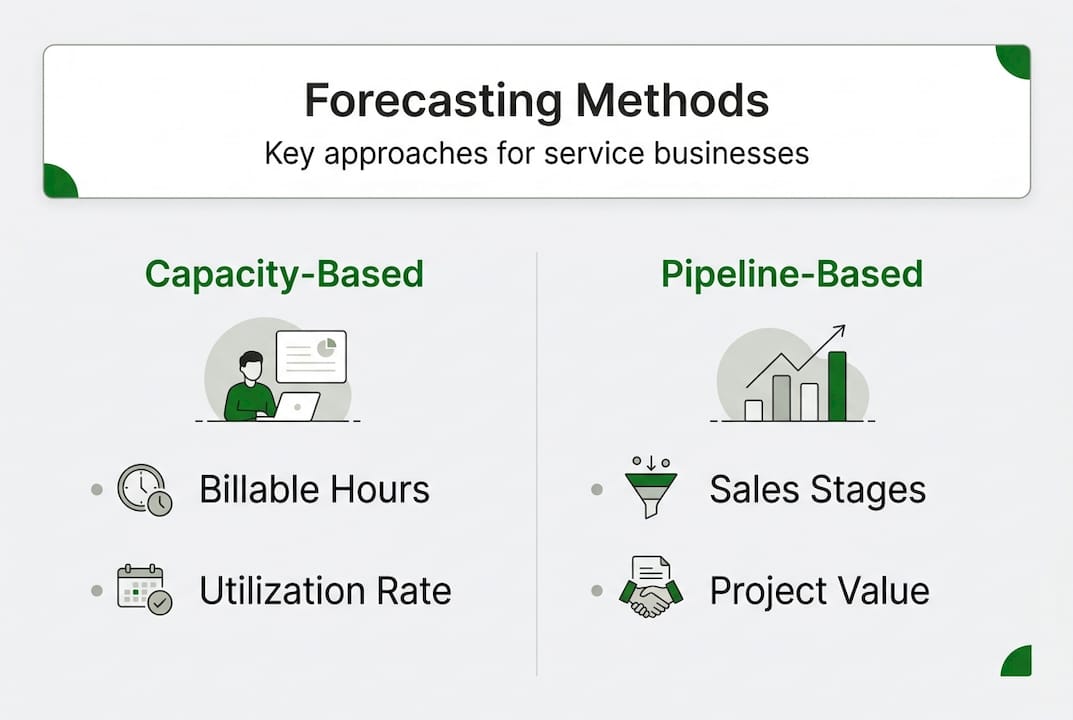
Capacity modeling starts with calculating your total available billable hours, then applying a realistic utilization rate to determine actual revenue potential. Here is the step-by-step process: First, multiply your team size by hours per week and weeks in the forecast period. Second, apply your utilization percentage to get billable hours. Third, multiply billable hours by your average hourly rate to project revenue. For example, 5 consultants working 40 hours weekly at 75% utilization generates 150 billable hours per week or 600 hours monthly, which at $200 per hour equals $120,000 in monthly revenue capacity.

Spreading revenue over project duration prevents the misleading spikes that occur when you book all revenue in the month a project starts. If you land a $90,000 project running from May through July, distribute $30,000 to each month rather than recording the full amount in May. This approach matches revenue recognition to actual service delivery and gives you a more accurate picture of monthly cash flow. It also helps you spot capacity conflicts when multiple projects overlap.
Client cohort analysis groups your clients by type, size, or service line, then tracks revenue patterns within each cohort. Retainer clients provide predictable monthly revenue with high renewal rates. Project clients generate larger one-time payments but require constant pipeline refilling. Productized service clients fall somewhere between, offering repeatable engagements with moderate predictability. By analyzing each cohort separately, you can forecast total revenue more accurately than treating all clients as identical.
| Forecast method | Best for | Pros | Cons |
|---|---|---|---|
| Capacity modeling | Service businesses with hourly billing | Grounds forecasts in realistic utilization | Requires accurate time tracking and utilization data |
| Revenue spreading | Project-based consultants | Matches cash flow to delivery timeline | Assumes projects proceed on schedule without delays |
| Cohort analysis | Mixed client portfolios | Captures different revenue behaviors by segment | Needs sufficient client volume per cohort for patterns |
| Pipeline probability | Growing businesses with active sales | Incorporates new business likelihood | Accuracy depends on honest pipeline stage definitions |
Combining these methods produces more reliable forecasts than relying on any single approach. Use capacity modeling as your baseline, adjust for known projects with revenue spreading, layer in cohort retention patterns, and add weighted pipeline opportunities to complete the picture. This multi-method approach accounts for both existing commitments and future growth.
Pro Tip: Update your utilization assumptions monthly based on actual billable hours to keep forecasts grounded in reality. Many consultants discover their true utilization runs 10 to 15 percentage points below their initial estimates, and adjusting forecasts accordingly prevents chronic over-optimism. Tracking this metric also helps you identify productivity improvements that genuinely increase revenue capacity without adding hours.
Avoiding common pitfalls and improving forecast accuracy
Clean, accurate data forms the foundation of reliable revenue forecasting. If your time tracking is inconsistent, your client records are incomplete, or your project values are estimates rather than confirmed figures, your forecasts will inherit these errors and mislead you. Start by auditing your current data sources and implementing consistent tracking practices before building complex forecasting models. Simple, accurate data beats sophisticated analysis of garbage inputs every time.
Combining multiple forecasting methods reduces the risk that any single method’s blind spots will derail your predictions. Capacity modeling alone ignores pipeline conversion. Historical trending misses capacity constraints. Pipeline probability forecasting overlooks retention and renewal patterns. When you layer these approaches together, the strengths of each method compensate for others’ weaknesses, producing forecasts that reflect business reality more completely.
Key performance indicators that lead revenue provide early signals about forecast accuracy. Win rate measures how often proposals convert to signed projects, directly affecting how much pipeline revenue will actually materialize. Utilization rate tracks the gap between available hours and billable hours, revealing whether capacity assumptions are realistic. Client acquisition cost and lifetime value ratios show whether your pipeline economics support sustainable growth. Monitoring these KPIs monthly helps you spot forecast drift before it compounds.
Scenario planning creates three parallel forecasts representing different future outcomes. Your conservative scenario assumes lower utilization, fewer pipeline wins, and client churn at the high end of historical patterns. Your realistic scenario uses your best estimates based on current trends and confirmed commitments. Your optimistic scenario models higher conversion rates and utilization improvements you are actively working toward. Planning against all three scenarios helps you prepare contingency responses rather than being surprised by variability.
Common forecasting pitfalls include:
- Ignoring capacity constraints and forecasting revenue beyond what you can physically deliver
- Over-relying on historical patterns without checking whether market conditions or service mix have changed
- Treating all pipeline opportunities as equally likely regardless of stage or client fit
- Failing to account for seasonal variations in client demand or your own availability
- Neglecting to update forecasts as actual results come in, letting predictions drift from reality
Pro Tip: Build scenario planning into your monthly forecast review process rather than treating it as a one-time exercise. Market conditions change, client priorities shift, and your capacity evolves, so refreshing your scenarios regularly keeps your planning relevant. This practice also trains you to think probabilistically about the future rather than anchoring to a single prediction.
“Service businesses that track operational KPIs alongside financial forecasts improve prediction accuracy by 30% compared to those using financial data alone, because leading indicators reveal problems before they hit revenue.”
This improvement occurs because operational metrics like proposal volume, discovery call bookings, and project delivery milestones predict revenue changes weeks or months before they appear in financial statements. By the time revenue drops, you have already lost the lead time needed to correct course. Leading indicators give you that time back, making your forecasts both more accurate and more actionable for pipeline forecasting and client acquisition.
Integrating these practices into your forecasting routine transforms predictions from static numbers into dynamic planning tools. Regular data audits maintain input quality. Multi-method forecasting captures complexity. KPI monitoring provides early warnings. Scenario planning prepares contingency responses. Together, these elements create forecasts you can actually trust to guide business development and client acquisition strategies.
Applying revenue forecasting to grow your service business
Revenue forecasting directly informs capacity and workload planning by showing you when you will have bandwidth for new projects and when you risk overcommitment. If your forecast shows 90% utilization for the next two months, you know to be selective about new client work or risk burnout and delivery quality problems. Conversely, if your forecast reveals 50% utilization three months out, you have a clear signal to increase business development activity now rather than waiting until the revenue gap arrives.
| Scenario type | Primary use | Planning actions |
|---|---|---|
| Conservative | Risk management and cash reserves | Build larger operating buffer, delay discretionary spending, focus retention |
| Realistic | Day-to-day operations and commitments | Normal hiring and marketing pace, standard client intake |
| Optimistic | Growth planning and stretch goals | Invest in capacity expansion, test premium pricing, pursue larger clients |
This scenario framework helps you match your business decisions to likely outcomes rather than betting everything on a single prediction. Your conservative forecast guides how much cash reserve you maintain. Your realistic forecast drives operational planning and resource allocation. Your optimistic forecast identifies growth opportunities worth pursuing if conditions align favorably.
Strategic actions enabled by accurate forecasting include:
- Managing client intake timing to smooth workload and avoid feast-or-famine cycles
- Adjusting pricing based on demand forecasts and capacity constraints rather than arbitrary percentages
- Focusing marketing efforts on client segments that fill specific capacity gaps in your forecast
- Making confident hiring decisions because you can see sustained revenue supporting new team members
- Negotiating better payment terms with clients when forecasts show strong cash position
Connecting revenue forecasts to pipeline stages and project milestones improves timing accuracy significantly. Rather than guessing when pipeline opportunities will close, assign each deal a probability based on its current stage and your historical conversion rates by stage. A discovery call might have 20% probability, a proposal submitted might have 50%, and a contract in legal review might have 90%. Weight each opportunity’s value by its probability, then schedule the weighted revenue in the month you expect it to close based on typical sales cycle length.
Spreading project revenue over delivery duration ensures your forecast reflects when cash actually arrives rather than when contracts sign. This timing precision matters for managing expenses, planning draws from business accounts, and avoiding the false sense of security that comes from front-loading project revenue. It also reveals the true shape of your revenue curve, showing whether you have sustainable momentum or are masking gaps with lumpy project timing.
Continuous forecast refinement with actual results creates a feedback loop that steadily improves prediction accuracy. Each month, compare your forecast to actual revenue, then analyze the variances. Did projects take longer than expected? Did utilization run lower than planned? Did pipeline conversion rates differ from assumptions? Use these insights to adjust future forecasts, gradually calibrating your model to match your business reality. This process transforms forecasting from a guessing game into a systematic discipline that genuinely supports better decisions.
The compounding effect of accurate forecasting shows up in reduced financial stress, more confident growth investments, and the ability to plan personal income more reliably. When you know what revenue to expect, you can structure your business finances to support both stability and growth rather than constantly reacting to surprises. This predictability is especially valuable for pipeline management as a freelancer, where income variability creates unique planning challenges that forecasting directly addresses.
Boost your revenue forecasting skills with Generating Pipeline
Mastering revenue forecasting is just one piece of building a sustainable service business. Generating Pipeline offers practical training and frameworks specifically designed for freelancers, consultants, and fractional executives who want to create consistent client pipelines and predictable revenue streams. Our Generating Pipeline OS course covers positioning, outbound outreach, sales execution, and delivery foundations in 20 lessons with templates and tools you can implement immediately.

Whether you are working to avoid revenue gaps in your consulting business, improve your pipeline forecasting for better client acquisition, or strengthen your overall pipeline management practices, Generating Pipeline provides the systems and support to help you move from referral dependence to proactive business development. Explore our resources to turn revenue forecasting from a planning exercise into a competitive advantage.
Frequently asked questions
What is revenue forecasting?
Revenue forecasting predicts your future income based on client projects, billable capacity, utilization rates, and pipeline probability. For service businesses, accurate forecasting requires modeling how many hours you can realistically bill and when project revenue will actually arrive. This financial visibility helps you manage cash flow, plan capacity, and make confident growth decisions rather than reacting to surprises.
How do I include project timelines in my revenue forecast?
Distribute expected revenue monthly across the entire project duration rather than recording it all when the contract signs. For example, a $90,000 project running May through July should show $30,000 in each month to match revenue recognition with actual service delivery. This approach prevents misleading spikes, reveals true monthly cash flow patterns, and helps you spot capacity conflicts when multiple projects overlap. It also aligns your forecast with how clients typically pay, improving accuracy for avoiding revenue gaps in consulting.
What key metrics improve revenue forecast accuracy?
Utilization rate measures billable hours as a percentage of total available hours, showing whether your capacity assumptions are realistic. Most consultants achieve 70 to 80% utilization when accounting for business development and administrative work. Win rate tracks how often proposals convert to signed projects, directly affecting how much pipeline revenue will materialize. Client retention rate reveals how much recurring revenue to expect from existing relationships. Monitoring these leading indicators alongside financial results helps you spot forecast drift early and adjust predictions before errors compound, improving your overall approach to tracking sales pipeline metrics.
How can I prepare my revenue forecast for uncertain client demand?
Create three parallel forecasts representing conservative, realistic, and optimistic scenarios to plan for different future outcomes. Your conservative scenario assumes lower utilization and fewer pipeline wins, helping you set appropriate cash reserves. Your realistic scenario uses best estimates for operational planning. Your optimistic scenario models favorable conditions for growth investments. This scenario planning approach reduces risk from over-optimistic or pessimistic single-point forecasts and prepares contingency responses before uncertainty resolves. Regular scenario updates keep your planning relevant as market conditions and your business evolve, strengthening your overall pipeline forecasting for client acquisition.
