As you consider ways to stabilize your income, understanding why diversifying revenue streams matters is crucial. Many service-based businesses depend heavily on single clients or projects, which creates risk. One client leaving or a market downturn can wipe out months of income overnight. Diversifying income reduces vulnerability to client loss or market downturns while creating multiple pathways to growth. This guide explores why diversification matters and how you can apply it practically without spreading yourself too thin or losing focus on what makes your business valuable.
Table of Contents
- Understanding The Risks Of Single Revenue Streams
- Common Revenue Streams For Service-Based Businesses
- Key Considerations And Potential Pitfalls In Diversification
- Implementing A Diversification Strategy For Your Service Business
- Explore Tools And Strategies To Diversify Your Revenue
- Frequently Asked Questions
Key takeaways
| Point | Details |
|---|---|
| Resilience through diversification | Multiple income streams protect against sudden client loss and market volatility. |
| Strategic income options | Retainers, digital products, coaching, and content monetization create complementary revenue. |
| Quality over quantity | Three to five well-executed streams outperform scattered efforts across too many channels. |
| Execution matters most | Personality traits like openness and conscientiousness significantly impact diversification success. |
Understanding the risks of single revenue streams
Relying on one client or project creates immediate vulnerability to sudden income loss. When that anchor client leaves, your entire business faces an existential threat. The data backs this up: firms with diversified revenue are 30% more resilient during downturns compared to those dependent on single sources. For solopreneurs, this risk intensifies because most lack significant cash reserves to weather extended dry spells.
The numbers paint a stark picture. According to recent research, 55% of single-stream solopreneurs experienced income gaps longer than one month in the past year. These gaps force difficult decisions: dip into personal savings, take on rushed projects at lower rates, or scramble for quick wins that don’t align with long-term strategy. Each gap erodes confidence and makes it harder to maintain consistent quality in your work.
Diversification creates a buffer during market or client downturns. When one stream slows, others can compensate, smoothing out the peaks and valleys that plague single-source businesses. This stability lets you make better strategic decisions because you’re not operating from a place of desperation. You can be selective about clients, invest in skill development, and build assets that compound over time.
Common income interruptions affect over half of single-stream service providers annually. These interruptions include:
- Seasonal fluctuations in client budgets and project availability
- Unexpected client budget cuts or strategic pivots
- Extended payment delays that create cash flow crunches
- Market shifts that reduce demand for specific services
Pro Tip: Track your income sources monthly to identify dangerous dependencies before they become crises. If any single client represents more than 40% of revenue, start building alternatives immediately.
Understanding these risks connects directly to smarter pricing strategy examples for freelancers that account for stability and growth simultaneously. Knowing the risks lets us explore practical ways to build multiple revenue streams that work for your business.
Common revenue streams for service-based businesses
Retainers often provide 50% to 70% of income for established freelancers seeking stability. These recurring agreements create predictable cash flow while freeing mental energy for growth initiatives. Monthly retainers work particularly well for ongoing services like content creation, marketing support, or fractional executive work where clients need consistent access to your expertise.

Digital products like courses and ebooks offer scalable passive income once created. A well-designed course can generate revenue for years with minimal ongoing effort. The initial investment is substantial, requiring 40 to 100 hours to create quality educational content, but the payoff compounds as you build an audience. Ebooks serve as lower-barrier entry points that demonstrate expertise while generating supplementary income.
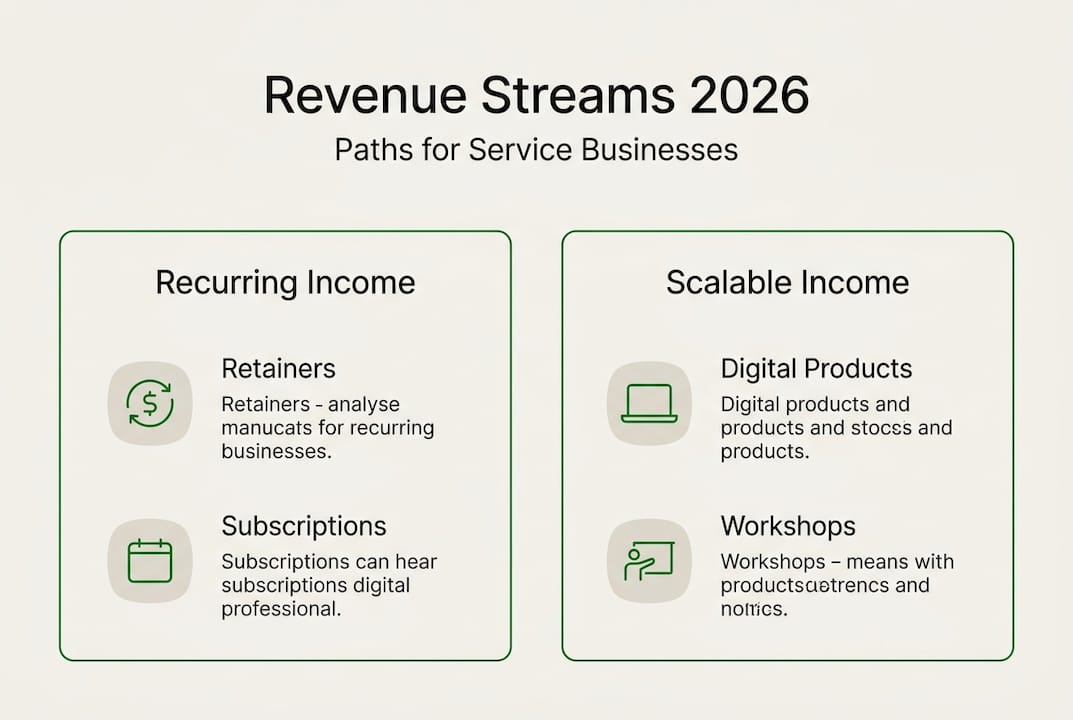
Coaching or group programs command higher hourly rates than traditional project work. One-on-one coaching typically ranges from $200 to $500 per hour for experienced consultants, while group programs can generate $2,000 to $10,000 per cohort. These formats leverage your expertise efficiently because you’re teaching principles rather than doing implementation work. Group settings multiply your impact without proportionally increasing time investment.
Diversifying platforms avoids dependence on single marketplaces that can change terms overnight. Examples include retainers, digital products, coaching, affiliate marketing, and content monetization that spread risk across multiple channels. Platform dependency creates vulnerability when algorithm changes or policy updates suddenly reduce visibility or increase fees.
Content monetization includes newsletters and sponsorships that reward audience building. Paid newsletters on platforms like Substack can generate $500 to $5,000 monthly for writers with engaged audiences of 500 to 5,000 subscribers. Sponsorships from relevant brands add another layer, with rates varying widely based on audience size and engagement quality.
| Revenue Stream | Typical Income Range | Time to Profitability | Scalability |
|---|---|---|---|
| Monthly retainers | $2,000 to $10,000/month | 1 to 3 months | Medium |
| Digital courses | $500 to $5,000/month | 3 to 6 months | High |
| Group coaching | $2,000 to $10,000/cohort | 2 to 4 months | Medium to high |
| Paid newsletter | $500 to $5,000/month | 6 to 12 months | Medium |
| Affiliate marketing | $200 to $2,000/month | 3 to 9 months | High |
Pro Tip: Start with one complementary stream that leverages existing client relationships. If you do consulting, a group coaching program uses the same expertise with different delivery, minimizing learning curves.
Building effective streams connects to proven client acquisition strategy for consultants and broader business development strategies that create sustainable growth. With these revenue options identified, let’s consider important nuances when diversifying.
Key considerations and potential pitfalls in diversification
Too many diverse streams can spread efforts too thin, reducing effectiveness across all channels. Over-diversification can dilute resources and focus, leaving you with multiple mediocre income sources instead of a few strong ones. The goal is strategic diversification, not frantic activity across every possible channel. Each new stream requires setup time, ongoing maintenance, and mental bandwidth to execute well.
International service diversification may encounter regulatory and cultural obstacles that domestic work avoids. Tax implications, payment processing complexities, and time zone coordination all add friction. Some service businesses thrive internationally, but others find the operational overhead outweighs benefits. Evaluate these factors honestly before committing resources to global expansion.
Traits like openness to new experiences correlate with better diversification outcomes. Research shows personality traits like openness and conscientiousness significantly improve profitability odds when implementing multiple income streams. Openness helps you experiment with new formats and adapt to market feedback. Conscientiousness ensures you follow through on commitments and maintain quality across streams. If you struggle with either trait, build systems that compensate.
Successful diversification requires careful assessment and gradual rollout. Launching three new streams simultaneously invites chaos and burnout. Instead, validate one stream thoroughly before adding another. This staged approach lets you learn from mistakes when stakes are lower and build confidence through small wins.
| Diversification Approach | Pros | Cons | Best For |
|---|---|---|---|
| Complementary streams | Leverages existing skills and audience | Limited upside if market shifts | Consultants with established expertise |
| Adjacent markets | Expands reach without starting over | Requires market research and positioning | Service providers ready to scale |
| Passive products | Scales without time trade-offs | High upfront investment | Experts with proven methodologies |
| Platform diversification | Reduces dependency risk | Increases operational complexity | Businesses reliant on marketplaces |
Pro Tip: Audit your energy levels and capacity honestly before adding streams. If your primary service already maxes out your schedule, new streams will either fail or force you to compromise quality everywhere.
These considerations tie directly into entrepreneur revolution for consultants principles that emphasize sustainable growth over hustle culture. Understanding these subtleties helps in mapping a strategic, effective diversification plan.
Implementing a diversification strategy for your service business
Start by mapping current income dependencies to identify risks lurking in your business model. Create a simple spreadsheet listing every client, project type, and revenue stream with their contribution percentages. This visual representation reveals dangerous concentrations immediately. If one client represents more than 40% of revenue or one service type dominates, you’ve identified your vulnerability.
Select complementary and synergistic income streams for best results. Complementary streams use similar skills and serve related audiences, minimizing the learning curve. A consultant offering one-on-one services can add group workshops using identical expertise. A writer producing client content can launch a paid newsletter covering the same topics. Synergy multiplies impact because each stream reinforces the others.
Test each new stream with market validation to minimize wasted effort. Gradual implementation and market validation reduce execution risks by confirming demand before full commitment. Before building a complete course, sell a beta version to 10 clients at a discount. Before launching a membership, survey your audience about what they’d pay for. These small tests provide crucial feedback while generating initial revenue.
Use automation to streamline delivery and scale offerings beyond your personal time. Email sequences nurture leads while you sleep. Scheduling tools eliminate back-and-forth coordination. Payment processors handle transactions automatically. Course platforms deliver content without manual intervention. Each automation frees capacity for high-value activities that only you can do.
Maintain at least 50% income from stable retainers where possible. This base layer provides predictability while you experiment with other streams. Retainers fund your business operations and personal expenses, removing pressure from newer, less proven streams. This stability lets you take calculated risks without jeopardizing your livelihood.
Avoid reliance on fluctuating marketplaces or single platforms where changes can reduce income by 40% overnight. Platform dependency creates the same vulnerability you’re trying to escape. Build on platforms you control: your email list, your website, your direct client relationships. Use marketplaces for discovery, not as your primary revenue engine.
Implementation steps:
- Audit current income sources and identify concentration risks
- Research complementary streams that fit your skills and market
- Validate demand through small tests before full launches
- Build one stream to profitability before adding another
- Automate delivery systems to scale without proportional time increases
- Monitor performance monthly and adjust based on data
Pro Tip: Set a minimum viable threshold for each stream. If a new income source doesn’t reach $500 monthly within six months, either fix the fundamental issues or shut it down to focus elsewhere.
These strategies connect to practical tools for running consulting business efficiently and proven freelancer sales tactics 2026 that support sustainable growth. With a clear roadmap, you can confidently diversify your revenue streams to future-proof your business.
Explore tools and strategies to diversify your revenue
Managing diverse income demands solid client acquisition and pipeline management that prevents gaps before they occur. Our platform offers strategies to avoid revenue gaps and build sustainable streams without overwhelming your schedule or compromising quality. We’ve built resources specifically for service professionals who need practical frameworks, not theoretical advice.

Leverage our business development resources tailored for service-based professionals navigating the complexity of multiple income streams. The client pipeline refresh guide walks through specific tactics for maintaining consistent flow across different revenue types. Our business development for solopreneurs resources provide templates and frameworks you can implement immediately. These tools help you optimize your sales process and client retention for steady income that compounds over time.
Frequently asked questions
What are the benefits of diversifying revenue streams?
Diversification reduces vulnerability to client loss and market downturns by creating multiple income pathways. It provides financial stability, reduces stress, and gives you leverage to be selective about clients and projects. Multiple streams also create opportunities to test new markets and services with limited risk.
How many revenue streams should a service business have?
Focus on synergistic and complementary streams to avoid dilution of effort and attention. Typically three to five well-managed streams provide resilience without overextending your capacity. Quality execution matters more than quantity, so build each stream to meaningful profitability before adding another.
What are some common revenue streams for freelancers and consultants?
Common streams include monthly retainers, digital products like courses, one-on-one or group coaching, affiliate marketing, and content monetization through newsletters or sponsorships. Choosing options that fit your skills and market is key to successful implementation. Start with streams that leverage existing expertise and client relationships.
Can diversifying revenue reduce income stability?
Poorly executed diversification can stretch resources thin, harming stability instead of improving it. This happens when you launch too many streams simultaneously or choose options that don’t complement your core business. Focusing on complementary streams and proper planning mitigates these risks while building genuine resilience.
How do I start building multiple income streams?
Begin by mapping your current dependencies and client base to identify concentration risks. Gradually test complementary income streams with market validation before full commitment. Build one stream to profitability, automate delivery where possible, then add another. This staged approach prevents overwhelm while building sustainable diversification.
