TL;DR:
- Outbound marketing provides control and consistency beyond unpredictable referrals.
- Successful outbound relies on high-quality data, personalization, and persistent multi-channel outreach.
- Combining outbound with referrals creates a resilient, scalable pipeline for sustainable growth.
Referrals feel great when they land. But here’s the uncomfortable truth: you can’t control when they show up. One month you’re turning away work, the next you’re refreshing your inbox hoping something comes in. That feast-or-famine cycle is exhausting, and it’s one of the most common pain points I hear from consultants, freelancers, and fractional executives. The good news? A hybrid approach to pipeline building reduces that referral dependence while creating sustainable growth. This guide walks you through outbound marketing from the ground up, including what it is, why it works, and exactly how to make it a consistent part of your business.
Table of Contents
- Why outbound marketing matters for service providers
- Outbound marketing vs. referrals: A direct comparison
- What makes outbound marketing work today
- Step-by-step outbound strategy for consistent pipeline
- Integrating outbound marketing with referrals for sustainable growth
- Why most outbound advice falls short—and what actually works
- Put outbound marketing to work for your business
- Frequently asked questions
Key Takeaways
| Point | Details |
|---|---|
| Reduce referral risk | Outbound marketing helps build a steady pipeline so you don’t rely solely on unpredictable referrals. |
| Persistence pays off | Most successful outbound campaigns require at least five touches to achieve results. |
| Personalize for impact | AI-driven and personalized outreach is more effective than generic templates in outbound marketing. |
| Measure real opportunity | Track pipeline created, not just response rates, to assess true ROI from outbound efforts. |
| Hybrid is strongest | Combining outbound with referrals creates a more resilient and scalable client growth strategy. |
Why outbound marketing matters for service providers
Let’s be honest. Referrals are wonderful. They come pre-warmed, pre-sold, and often ready to sign. But they’re also completely outside your control. You can’t dial them up when you need revenue. You can’t predict when a past client will mention your name to someone new. That unpredictability is the core problem.
Outbound marketing flips the script. Instead of waiting, you go find your next client. You identify who you want to work with, reach out with a relevant message, and start a conversation. It’s proactive. It’s repeatable. And done well, it creates a steady flow of opportunities regardless of whether your referral network is active or quiet.
Here’s why this matters specifically for service providers:
- You sell expertise and time. That means your capacity is limited, and gaps hurt more than in product businesses where inventory just sits on a shelf.
- Your best clients often don’t come from your existing network. Referrals keep you inside a circle. Outbound marketing breaks you out of it.
- Pipeline health is everything. Without consistent opportunities, you end up discounting, taking on the wrong clients, or stressing about next month’s revenue.
“The most resilient service businesses aren’t the ones with the most referrals. They’re the ones that don’t need to rely on them.”
There are plenty of consulting business growth ideas that combine outbound with other channels, and smart service providers are increasingly treating outbound as a core activity rather than a backup plan. When you look at revenue growth strategies that actually work long-term, proactive outreach almost always plays a central role.
The shift from reactive to proactive isn’t complicated. But it does require intention. You need a clear offer, a defined target audience, and a repeatable process. That’s what the rest of this article is all about.
For a broader view of practical marketing tips that complement outbound, it helps to understand where referrals and pipeline growth intersect. Because spoiler: the best strategy uses both.
Outbound marketing vs. referrals: A direct comparison
So how do outbound marketing and referrals actually stack up against each other? Here’s a clean side-by-side view:
| Factor | Referrals | Outbound marketing |
|---|---|---|
| Control | Low (passive) | High (you initiate) |
| Predictability | Unpredictable | Consistent when systemized |
| Volume | Limited by your network | Scalable |
| Lead quality | Often high (pre-warmed) | Variable (depends on targeting) |
| Time to results | Immediate when they arrive | Takes consistent effort over time |
| Cost | Low (relationship-based) | Moderate (time and tools) |
| Scalability | Hard to scale beyond network | Highly scalable |
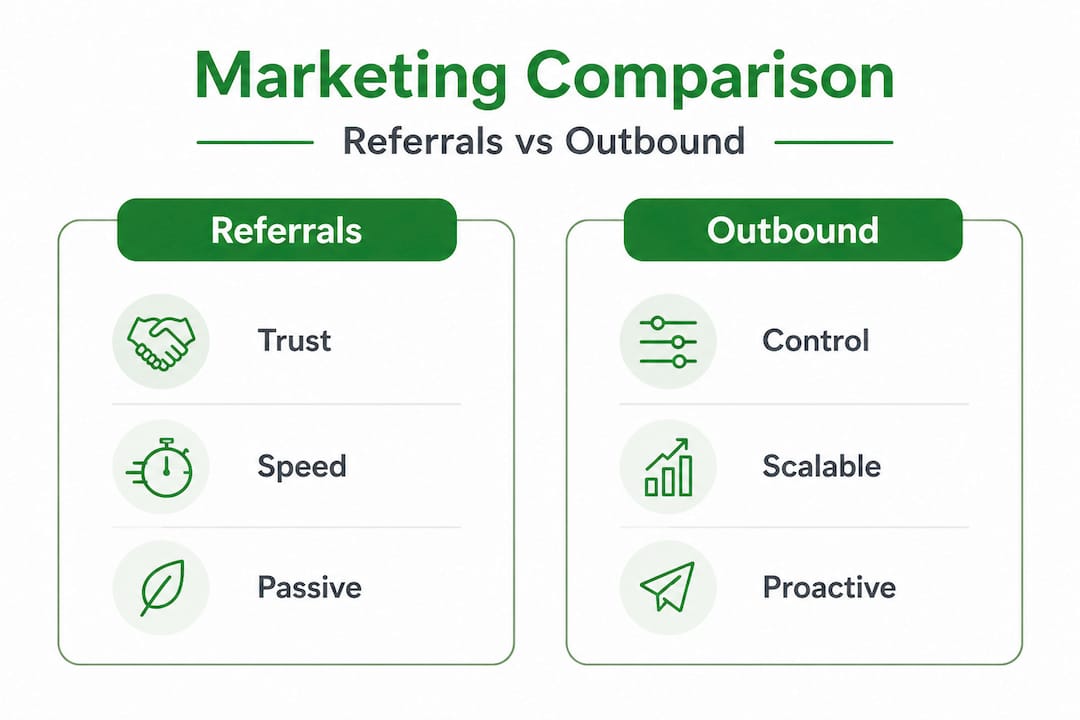
The takeaway here is clear. Referrals win on trust and speed when they show up. But outbound wins on control and scale. And as outbound marketing data confirms, a hybrid approach that reduces referral dependence while building sustainable growth is the most resilient long-term strategy.

Real talk: if you’re only relying on referrals, you’re essentially running your business on hope. And hope isn’t a pipeline strategy.
Pro Tip: Don’t treat outbound and referrals as either/or. The most effective service providers use outbound to fill the gaps between referrals and to expand into new markets their existing network doesn’t reach.
If you’re ready to start building your first outbound effort, a solid outbound campaign checklist is a great place to begin. And if you want a broader view of growth ideas for consulting businesses, there’s a lot of overlap between outbound strategy and general business development thinking.
What makes outbound marketing work today
Here’s where a lot of service providers go wrong. They hear “outbound” and they picture blasting out hundreds of generic cold emails and hoping something sticks. That approach is dead. Or at least, it’s dying fast.
What actually works in 2026 comes down to three things: data quality, persistence, and personalization.
-
Start with accurate targeting. Volume is not the goal. If you’re sending 500 emails a week to the wrong people, you’re wasting time. You want a smaller, tighter list of people who actually match your ideal client profile. This means getting specific about industry, company size, job title, and the problems they’re likely dealing with right now.
-
Use personalization that goes beyond “Hi [First Name].” AI tools now make it possible to reference a prospect’s recent LinkedIn post, a new hire they made, or a funding round they just closed. These kinds of AI personalization triggers dramatically increase reply rates because they show you actually did your homework.
-
Follow up more than you think you need to. Most people give up after one or two emails. But research shows that most deals require 5 or more touches before you get a meaningful response. That’s not being pushy. That’s being persistent in a world full of distracted inboxes.
-
Go multi-channel. Email is a starting point, not the whole game. LinkedIn, voice messages, even a short video recorded for a specific prospect can break through the noise in a way that text alone can’t.
-
Measure pipeline created, not just replies. This is a big mindset shift. A 10% reply rate sounds great, but if none of those replies turn into sales conversations, what’s the point? Track how many warm opportunities your outbound creates, and optimize for that. That’s real ROI from outbound.
Stat to know: Most outbound sequences that generate results include at least 5 to 8 touchpoints across multiple channels. Single-email campaigns are not a strategy.
Your client acquisition strategy needs to account for this persistence layer. And if you’re new to cold outreach, brushing up on cold email strategies is time well spent before you start sending anything. Good business development strategies always connect outbound effort to broader pipeline goals, not just activity metrics. Once you start booking calls, having a framework for sales call tips ready makes the transition from conversation to client much smoother.
Pro Tip: Review your outbound sequence every 30 days. Look at open rates, reply rates, and (most importantly) how many conversations turned into proposals. That feedback loop is how you get better over time.
Step-by-step outbound strategy for consistent pipeline
Now let’s get practical. Here’s a simple, repeatable outbound process you can start using this week.
- Define your ideal client profile. Get specific. Industry, company size, geography, role, revenue, pain point. The more specific, the better your targeting.
- Build a focused prospect list. Use tools like LinkedIn Sales Navigator, Apollo, or Clay to find people who match your profile. Start with 50 to 100 names, not 5,000.
- Research each prospect. Spend two to three minutes per person. What have they posted about? What challenges does their company face? What trigger events (new role, funding, expansion) make them a good fit right now?
- Write personalized first messages. Lead with relevance, not your pitch. Reference something specific to them. Keep it short. One paragraph. One clear question or CTA.
- Set up a follow-up sequence. Plan at least five touchpoints across email and LinkedIn. Space them out: days 1, 3, 7, 14, and 21. Mix formats: email, LinkedIn message, LinkedIn comment on their post.
- Track everything. Use a simple CRM or even a spreadsheet. Know where each prospect is in your sequence and what your next action is.
- Measure pipeline created. Count conversations that moved to a discovery call or proposal stage. That’s your real north star metric.
Here’s how each activity maps to outcomes:
| Activity | Purpose | Key metric |
|---|---|---|
| Prospect list building | Identify best-fit targets | List size and quality |
| Personalized first message | Open a conversation | Reply rate |
| Follow-up sequence | Build familiarity and trust | Sequence completion rate |
| Multi-channel outreach | Increase visibility | Touchpoints per prospect |
| CRM tracking | Maintain consistency | Next action completion rate |
| Pipeline review | Measure real impact | Warm opportunities created |
This process, when done consistently, is what creates a reliable outbound campaign that generates results week after week. And as outbound marketing research consistently shows, the businesses that treat this as a system rather than a one-off tactic are the ones that build sustainable pipeline growth.
Integrating outbound marketing with referrals for sustainable growth
Here’s the real opportunity that most service providers miss. Outbound and referrals don’t compete. They complement each other beautifully when you design them to work together.
Think of it this way. Referrals give you warm, fast-moving leads. Outbound gives you control and scale. Combined, they create a pipeline that’s both predictable and resilient.
Here are some practical ways to integrate both:
- Use outbound to target companies where you already have a referral relationship. If a happy client refers you to their network, use outbound to reach others in that same industry or company type. You can reference your work with the referrer (with permission) to add immediate credibility.
- Ask referral sources to connect you directly via LinkedIn, then follow up with outbound sequencing. A warm introduction from a mutual connection followed by a thoughtful LinkedIn message is far more powerful than either approach alone.
- Time your outbound to fill gaps. When referrals slow down (and they will), your outbound machine keeps running. You don’t have to scramble or discount because you already have conversations happening.
- Use your outbound learnings to sharpen your referral messaging. What resonates in cold outreach tells you a lot about what your audience actually cares about. Feed that back into how you ask for referrals.
“A referral opens a door. Outbound builds the whole hallway.”
The combination isn’t just smart strategy. It’s the difference between a business that grows when conditions are good and one that grows regardless of conditions. Pipeline growth from referrals is a real asset, and outbound is what makes it more durable. As outbound marketing statistics reinforce, the hybrid approach is what leads to long-term, sustainable business growth.
Why most outbound advice falls short—and what actually works
I want to be straight with you here. Most outbound advice online is outdated or oversimplified. “Send more emails.” “Use this proven script.” “Follow up three times.” That’s the template-first, volume-first thinking that fills spam folders and kills sender reputations.
The actual edge in outbound today comes from three things: quality data, genuine persistence, and tech-enabled personalization. And the metric that ties it all together is pipeline created, not response rates.
Here’s what I’ve seen work (and what I coach): stop thinking about outbound as a campaign and start thinking about it as a relationship-starting machine. Each touch should add something. A relevant insight. A connection to their world. A specific reason why you’re reaching out to them, not just anyone with the same job title.
Expert analysis on outbound consistently points to data quality and 5-plus touch persistence combined with AI personalization as the formula that outperforms generic template blasting. It’s not rocket science. But it does take intention.
The second thing most advice gets wrong: it treats outbound as a short-term fix. Send a sequence, get some calls, move on. Real pipeline health comes from making outbound a permanent, consistent part of how you run your business. Not a one-time sprint when revenue drops.
Start with a high-performing email checklist to get the foundations right. Then build your sequence, track your pipeline, and iterate. That’s the actual playbook.
Put outbound marketing to work for your business
If you’ve made it this far, you’re serious about building a pipeline that doesn’t depend on whoever happened to mention your name last week. That’s exactly the kind of thinking that separates service businesses that grow intentionally from those that stay stuck in the referral cycle.
At GeneratingPipeline.com, we’ve built everything around this exact problem. The Generating Pipeline OS walks you through 20 lessons covering positioning, outbound, LinkedIn outreach, sales execution, and more, all designed for solo operators and small service businesses. You can also start by avoiding pipeline gaps with some quick wins, or explore how to create a growth pipeline that works consistently. For a structured approach to managing what you build, the pipeline management guide is a great next step. One payment, lifetime access, no sales calls required.
Frequently asked questions
What is outbound marketing in simple terms?
Outbound marketing is any proactive outreach to potential clients, such as cold emails, LinkedIn messages, or calls, to generate new business rather than waiting for people to come to you.
How does outbound marketing reduce dependency on referrals?
It lets you seek out new clients directly and consistently, so your pipeline doesn’t stall when word of mouth slows down. A hybrid approach builds stability that referrals alone can’t provide.
How many touches does it usually take to get a response in outbound marketing?
Most deals require at least 5 touches before getting a meaningful response, which is why persistence and a planned sequence matter far more than a single well-crafted email.
What’s more important: response rates or pipeline created?
Pipeline created is the metric that actually matters because it reflects real business opportunities moving forward, not just activity or vanity stats.
Does outbound marketing work for all service businesses?
Yes. When you combine quality targeting, genuine personalization, and consistent follow-up, outbound marketing can generate steady client conversations for any service-based business.
Recommended
- Business Development: 7 Practical Client Acquisition Strategies
- 7 service business growth hacks to attract clients fast
- How to get clients as a freelancer: proven steps for steady growth
- Top consulting business growth ideas to boost your pipeline
- AI Lead Generation: Improve Sales with Autonomous AI Agents by AIM Agency
- Blog | spherescout.io – B2B Lead Generation Insights
