TL;DR:
- Sales enablement equips service providers with content, processes, and tools to sell effectively.
- Building simple, consistent systems improves win rates and reduces administrative time.
- Overcomplicating tools and messaging hampers client trust; clarity and follow-up are key.
Most service-based business owners assume sales is purely about personality and persuasion. But here’s a reality check: reps spend 66% of their time on non-selling activities when sales enablement isn’t in place. That’s two thirds of your workday going to admin, searching for the right proposal template, or trying to remember where you saved that case study. If you’re a freelancer or consultant, that time directly costs you money. This guide breaks down what sales enablement actually means for service businesses, the tools and frameworks that matter most, and how to build a simple system that helps you close more clients without burning out.
Table of Contents
- What is sales enablement (and why it matters for service businesses)
- Core components and tools of sales enablement
- Proven methodologies: Aligning enablement with your sales cycle
- Common pitfalls and how to avoid them
- Why most experts overcomplicate sales enablement for service businesses
- Apply sales enablement to your business growth
- Frequently asked questions
Key Takeaways
| Point | Details |
|---|---|
| Sales enablement defined | It’s a strategic process that aligns tools, content, and processes to help close more deals faster. |
| Core components matter | Content management, training, and the right technology tools set the foundation for consistent client growth. |
| Practical over technical | Trust-building and workflow integration make enablement work for service providers. |
| Avoid common pitfalls | Don’t let tools become extra noise—adopt what fits your business and supports real workflow. |
| Start small, scale up | Master one element at a time to build a winning, repeatable sales strategy. |
What is sales enablement (and why it matters for service businesses)
Let’s clear something up right away. Sales enablement isn’t just a buzzword for big tech companies with massive sales teams. It’s not just sales training either, or having a slick pitch deck ready. Sales enablement is the process of equipping yourself with content, training, tools, and processes to sell more effectively, shorten sales cycles, and improve win rates by aligning your sales, marketing, and delivery around what buyers actually need.
For a freelancer or consultant, that definition translates to something very practical. It means having the right proposal ready when a prospect asks. It means knowing exactly what to say when someone raises the price objection. It means your LinkedIn profile, your discovery call, and your onboarding process all tell the same consistent story about who you help and how you help them.
Without that alignment, things get messy fast. You end up reinventing the wheel on every sales conversation. Your proposals look different each time. Your follow-up is inconsistent. Clients get confused about what exactly you do. And you lose deals you should have won.
Here’s a quick comparison to make this concrete:
| Without sales enablement | With sales enablement |
|---|---|
| Searching for old proposals each time | Template library ready to customize |
| Generic pitch that doesn’t connect | Buyer-specific messaging per stage |
| Forgetting to follow up | Automated reminders in your CRM |
| Inconsistent pricing conversations | Clear objection handling playbook |
| Slow onboarding after the close | Documented delivery foundations |
Understanding service business sales funnels gives you a framework for seeing where these gaps tend to show up. Most service providers lose deals not at the pitch stage but in the moments between. Sales enablement plugs those gaps.
“The best service businesses don’t just sell well. They create buying experiences so clear and trustworthy that clients feel confident before the contract is even signed.”
Trust-building materials are especially important in service businesses. You’re not selling a physical product someone can return. You’re asking clients to invest in your expertise, your time, and your judgment. That means case studies, testimonials, clear positioning, and a consistent communication style all become sales enablement assets. Pair that with solid digital marketing tips for consultants and you’re building a client attraction system, not just a sales pitch.
Core components and tools of sales enablement
Now that the definition is clear, let’s talk about what actually makes up a solid enablement setup. Core components include content management (playbooks, case studies, and battle cards), training and onboarding, ongoing coaching, technology tools like CRMs and AI coaching platforms, and performance analytics.
For a solo operator or micro agency, that might sound like a lot. But you don’t need all of it at once. Start with the components that directly address where you’re losing time or deals right now.
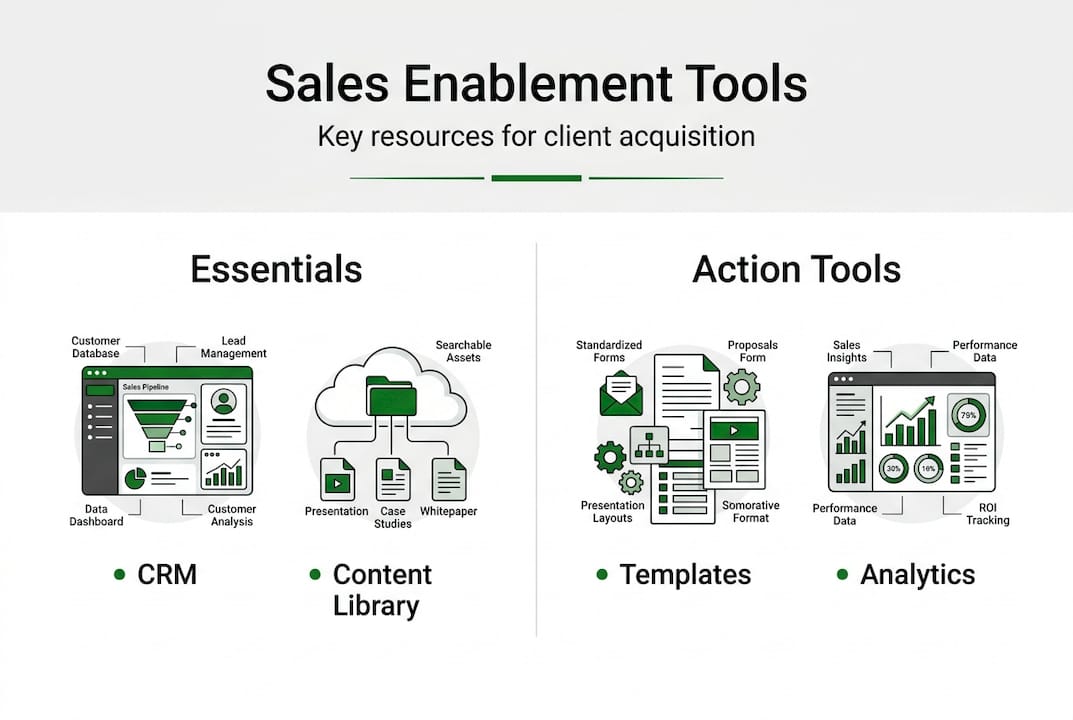
Content management is usually the quickest win. This means having a central place (even a simple Google Drive folder works) where your best proposals, case study summaries, objection responses, and discovery call questions all live. The goal is to spend less time creating from scratch and more time customizing what already works.

Training and micro-learning matter even when you’re working solo. The truth is, most freelancers and consultants never formally study sales. They learn on the job, which is fine, but it’s slow and expensive. Dedicating even 30 minutes a week to reviewing a sales call, reading a framework, or practicing an objection response compounds over time.
Technology tools are where people tend to either over-invest or ignore entirely. Here’s a practical breakdown:
| Tool type | What it does | Good for |
|---|---|---|
| CRM (e.g., HubSpot Free, Notion) | Tracks contacts, stages, follow-ups | Never losing a lead again |
| Proposal software (e.g., PandaDoc) | Creates consistent, trackable proposals | Faster close and professionalism |
| Email sequences | Automates follow-up cadence | Staying top of mind without manual effort |
| Analytics dashboard | Tracks open rates, conversion by stage | Knowing what’s actually working |
Learning about using sales templates is a great way to get the content management piece set up quickly. Templates aren’t rigid scripts. They’re starting points that save you time and keep your messaging sharp.
Performance analytics doesn’t need to be complex. Track a few simple numbers: how many discovery calls you’re booking per month, your close rate, your average deal size, and how long your sales cycle is. If you’re following a step-by-step sales process, those numbers become meaningful quickly because you can see exactly where deals are stalling.
Pro Tip: Don’t treat your enablement tools as a separate project. The moment a CRM or template library feels like “extra admin,” you’ll stop using it. Build the habit of updating your CRM for two minutes after every sales conversation. That’s it. Small, consistent input leads to big, useful data over time.
Proven methodologies: Aligning enablement with your sales cycle
Tools are only useful if they’re backed by a methodology. A methodology is just a repeatable approach, a way of doing things that you can improve over time. For service businesses, the most effective methodologies are the ones built around how your specific buyers make decisions.
Key methodologies include buyer-stage aligned content, continuous micro-learning and coaching, CRM automation for follow-ups, role-specific playbooks, and feedback loops between sales and marketing. Here’s how those translate into practical steps for a freelancer or consultant:
-
Map your buyer’s journey. Think about the stages a typical client goes through before hiring you: awareness (they have a problem), consideration (they’re exploring options), and decision (they’re ready to choose). For each stage, have something ready. A thought leadership post for awareness. A case study for consideration. A clear proposal and FAQ document for decision.
-
Build a simple playbook. A playbook doesn’t need to be a 40-page document. It’s a one-pager that captures your best discovery call questions, the top three objections you hear and how you handle them, and your follow-up sequence after a call. That’s it. If you learn better sales call techniques, add those to your playbook.
-
Automate your follow-up. One of the biggest deal-killers for service businesses is inconsistent follow-up. You have a great discovery call, then life gets busy, and a week later you’ve lost the momentum. Use your CRM to set reminders or trigger simple email sequences. This is one of the fast sales tactics that pays off almost immediately.
-
Review and refine regularly. Once a month, look back at the deals you won and lost. What did the winning deals have in common? What objections came up in the lost ones? Use that feedback to sharpen your messaging and update your playbook. This feedback loop is what separates a repeatable sales process from a random one.
-
Learn continuously. Pick one sales skill to focus on each quarter. Discovery questions. Pricing conversations. Objection handling. Spend time actively studying and practicing that one skill. Micro-learning compounds fast when it’s focused.
Pro Tip: After every lost deal, send a short message asking for honest feedback. Most prospects will give it to you. That real-world input is worth more than any sales book for refining your approach.
Common pitfalls and how to avoid them
Even with the right tools and methodology in place, there are some common ways enablement efforts go sideways. Knowing the traps ahead of time saves you a lot of frustration.
Inconsistent messaging is probably the biggest risk for solo operators. When there’s no formal system, every proposal and every pitch becomes slightly different. Prospects compare notes. They look at your LinkedIn, read your website, and then get a proposal that tells a slightly different story. That inconsistency creates doubt. And doubt kills deals. Poor enablement leads to what some call “rep freelancing,” where each interaction goes off-script and the overall message loses coherence.
Tools without adoption is another real trap. It’s tempting to sign up for every shiny new CRM or AI sales tool. But if the tool doesn’t fit naturally into how you work, it becomes noise. You end up with three different systems that don’t talk to each other and none of them used consistently. The test for any tool is simple: does it make your day easier within the first week? If not, it’s probably not the right fit right now.
Over-relying on AI and automation is a newer pitfall worth calling out. AI tools can genuinely save time on things like drafting outreach emails, summarizing discovery calls, or generating proposal drafts. One technology provider reportedly saw $1M in annual savings through GenAI-powered enablement. But AI works best when you’ve already got a clear process and message. Automating a confused or generic pitch just means you send more of it, faster.
Skipping trust-building content is especially common for service providers who focus too much on features and deliverables. Clients hiring a consultant or freelancer are making a bet on a person. They want to see proof that you understand their world. That’s what good case studies, honest testimonials, and specific positioning do. Building this content is one of the highest-leverage consulting business growth ideas available to you.
Here’s a quick list of pitfalls to watch for:
- Inconsistent messaging across touchpoints (website, proposal, pitch)
- Adding tools before you have a clear process
- Automating before your message is sharp
- Skipping follow-up because you’re “too busy”
- Building generic content that doesn’t reflect your specific expertise
“Sales enablement fails not from lack of tools, but from lack of clarity. Know your message first. Then build the system around it.”
Why most experts overcomplicate sales enablement for service businesses
Real talk. Most of the content you’ll find on sales enablement is written for companies with dedicated sales teams, marketing departments, and six-figure tool budgets. The frameworks are solid, but the execution advice often misses the mark for someone who’s running everything themselves.
I’ve seen this play out a lot. A consultant reads a great article on sales enablement, gets excited, tries to implement a full CRM workflow, a content management system, and a multi-stage email sequence all at once. Two weeks later, they’ve spent 20 hours on setup and haven’t had a single client conversation.
The big company framework ignores something critical for service businesses: your relationships are the product. Clients hire you because of who you are, how you think, and whether they trust you. No amount of automated sequences replaces that personal connection. Over-automating can actually work against you by making your communication feel cold and generic.
The most effective consulting sales process I’ve seen from independent professionals shares three things. First, crystal clear positioning so the right people immediately understand who you help. Second, a small set of consistently used materials, maybe three to five assets that show up across every client interaction. Third, a genuine follow-up rhythm that feels human, not automated.
That’s it. You don’t need a sales tech stack. You need clarity, consistency, and follow-through.
Pro Tip: Start with just one enablement practice this month. Maybe it’s finally writing down your top five discovery call questions. Or updating your case study template. Master that one thing before adding anything else. Simplicity scales. Complexity collapses.
Apply sales enablement to your business growth
If this guide has sparked some ideas, the best next step is turning those ideas into action before they fade. The principles here are solid, but the results come from implementation.
At GeneratingPipeline.com, everything is designed to help service-based business owners like you build a real, repeatable pipeline without the overwhelm. Whether you’re trying to avoid client pipeline gaps, understand how to build your client pipeline from the ground up, or explore practical client acquisition strategies built specifically for solopreneurs and consultants, there’s a clear path forward. The Generating Pipeline OS covers positioning, outreach, sales execution, and delivery in 20 focused lessons, each with templates and frameworks you can use immediately. One payment, lifetime access, no sales calls required.
Frequently asked questions
How does sales enablement improve client acquisition for freelancers?
Sales enablement ensures freelancers present consistent messaging, use relevant content at each stage, and automate follow-up so more leads convert to paying clients without manual effort for every step.
What are the most important sales enablement tools for service-based businesses?
The most critical tools are a content library for proposals and case studies, a CRM for tracking contacts and automating follow-up, and basic analytics to see what’s working. Core components like playbooks and performance tracking round out the essentials.
How do I know if my sales enablement efforts are working?
You should see shorter sales cycles and more consistent messaging fairly quickly. Companies with dedicated enablement see 49% higher win rates and 20% more quota attainment, and even small improvements in those metrics signal your system is working.
Can sales enablement work for solo consultants or only big teams?
It absolutely works for solo consultants. Sales enablement is about organizing how you sell, not managing a team. For a solo operator, even a simple playbook and consistent follow-up routine qualifies as effective enablement.
What is the biggest mistake to avoid in sales enablement?
Adding tools without integrating them into your actual workflow. Tools fail when they don’t fit naturally into your day and quickly become noise rather than support. Build your process first, then choose tools that serve it.
Recommended
- Business Development: 7 Practical Client Acquisition Strategies
- Quick win sales tactics: Fast client acquisition strategies
- Sales Process and Optimisation For an Efficient, Repeatable Sales System – Generating Pipeline
- A Proven Client Acquisition Strategy for Fractional Executives and Consultants – Generating Pipeline
