Most freelancers and consultants believe sales templates are cold, robotic tools that alienate prospects and kill authenticity. They imagine copy-pasted proposals that scream “mass outreach” and damage credibility. The truth? When used strategically, sales templates streamline client acquisition by providing structured frameworks that boost efficiency and close rates. Templates aren’t replacements for personalized conversations. They’re strategic tools that let you focus energy on high-impact customization while standardizing repeatable elements. This guide explores how templates function as confirmation tools, the 80/20 balance between standardization and personalization, common pitfalls that undermine results, and advanced hybrid approaches combining AI and consultative selling to maximize your sales success.
Table of Contents
- Key takeaways
- Understanding the role of sales templates in client acquisition
- Balancing standardization and personalization for trust and effectiveness
- Limitations and edge cases where templates fall short
- Expert nuances and hybrid approaches for maximized sales success
- Explore solutions to enhance your sales process
- Frequently asked questions
Key Takeaways
| Point | Details |
|---|---|
| Templates as confirmations | They function as confirmation tools that formalize discussions you’ve already had, after discovery calls. |
| 80/20 balance | Aim for about 80 percent standardization and 20 percent personalization to build trust while maintaining efficiency. |
| Skeletons with customized sections | Use templates to handle the repeatable skeleton while tailoring the key sections that matter to each client. |
| Identify high impact customizations | Focus personalization on the problem statement, tailored solutions, relevant case studies, and ROI projections that address the client’s unique situation. |
| AI plus consultative selling | Hybrid approaches that combine AI driven tools with a consultative selling approach can boost success. |
Understanding the role of sales templates in client acquisition
Sales templates serve as repeatable frameworks that structure your proposals, discovery call scripts, and follow-up sequences. They’re not meant to replace genuine client conversations. Instead, they function as confirmation tools that formalize discussions you’ve already had. After a discovery call where you’ve identified client pain points and outlined potential solutions, a templated proposal confirms the scope, deliverables, timeline, and investment in a professional format.
Typical template structures include seven-section proposals covering problem statement, proposed solution, deliverables, timeline, pricing options, terms, and next steps. Discovery call scripts often feature 15 core questions organized around situation, problem, implication, and need-payoff. Follow-up email templates provide frameworks for check-ins, objection handling, and closing sequences. These structures enable faster responses during peak outreach periods and reduce the mental load of starting from scratch for every client interaction.
Templates shine when you’re managing multiple prospects simultaneously or scaling your client acquisition strategies beyond referrals. They ensure consistency in your messaging and prevent you from forgetting critical elements like payment terms or project milestones. The efficiency gain is substantial. What might take 90 minutes to craft from scratch drops to 20 minutes when you’re customizing a proven template.
Pro Tip: Build your template library by reverse-engineering your three most successful proposals. Identify the common structural elements and language patterns that resonated with clients, then create master templates you can adapt for similar engagements.
The key distinction is that templates provide the skeleton, not the entire body. You’re not sending identical proposals to different prospects. You’re using a consistent structure that lets you focus customization efforts on the sections that matter most to each specific client. This approach respects both your time and the client’s need to feel understood.
Balancing standardization and personalization for trust and effectiveness
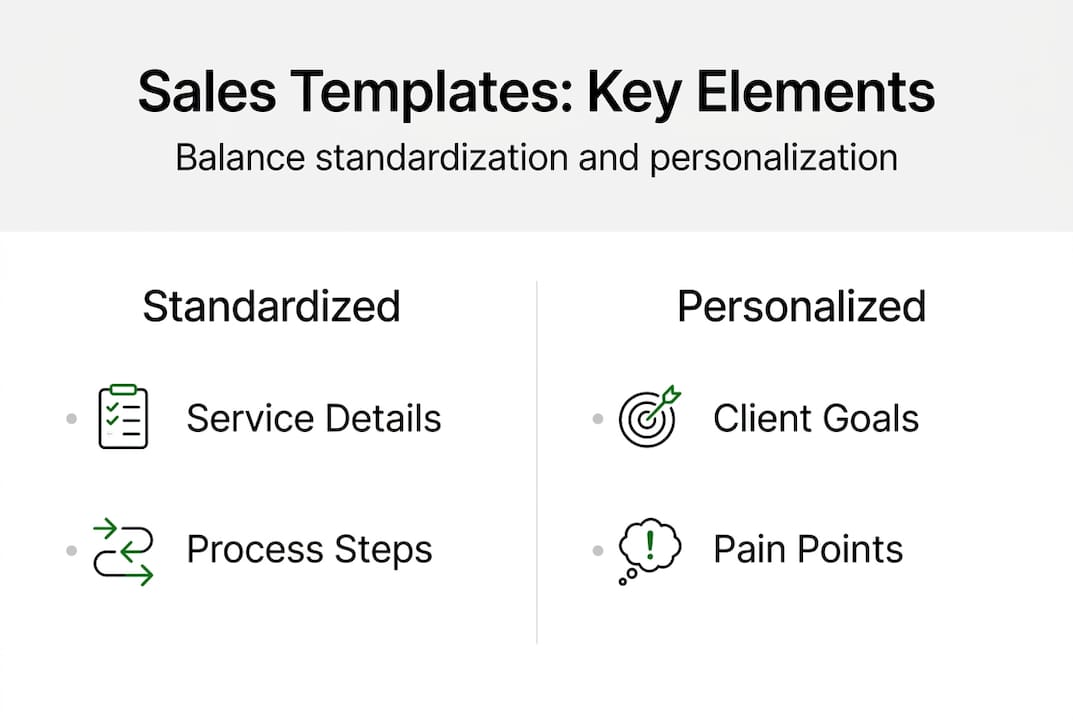
The most effective sales templates follow an 80% standardization with 20% personalization approach. Standardize the elements that remain consistent across clients: your service descriptions, standard deliverables, SLAs, payment terms, and your proven process. These components showcase your expertise and professionalism while saving you hours of repetitive writing.
The 20% personalization focuses on client-specific sections that demonstrate you understand their unique situation. This includes the problem statement referencing their exact pain points, customized solution recommendations addressing their specific goals, relevant case studies from similar industries, and tailored ROI projections based on their business metrics. These personalized elements transform a generic template into a compelling proposal that feels custom-built.
Implementing this balance requires a systematic approach:
- Create master templates for your core service offerings with standardized sections clearly marked
- Identify personalization zones where client-specific information must be inserted
- Develop a research checklist capturing the key details needed for effective personalization
- Use tiered pricing structures with three options to leverage anchoring psychology
- Include a brief executive summary at the top that’s entirely personalized to the client’s situation
Tiered pricing deserves special attention. Presenting three options (basic, standard, premium) gives clients choice while anchoring their perception of value. The middle option typically converts best, but the premium tier makes the standard offering feel more reasonable. Structure your tiers around scope and deliverables, not just price points.

| Pricing Tier | Standardized Elements | Personalized Elements |
|---|---|---|
| Basic | Core deliverables, timeline, standard terms | Client goals alignment, specific pain point addressed |
| Standard | Enhanced deliverables, priority support, extended timeline | Customized solution recommendations, relevant case study |
| Premium | Full-service deliverables, dedicated support, fastest timeline | Comprehensive ROI projection, strategic roadmap |
Pro Tip: Use bracketed placeholders like [CLIENT PAIN POINT] and [SPECIFIC GOAL] in your templates to force yourself to customize critical sections. Never send a proposal with brackets still visible.
The balance between efficiency and personalization directly impacts your close rates. Templates that feel too generic signal you haven’t invested time understanding the client’s needs. Conversely, crafting entirely custom proposals for every opportunity becomes unsustainable as your pipeline grows. The 80/20 approach gives you scalable efficiency without sacrificing the personal touch that builds trust and differentiates your pricing strategy examples.
Limitations and edge cases where templates fall short
Sales templates can backfire spectacularly when misused or applied in the wrong contexts. The most common failure mode is sending obviously templated proposals without meaningful personalization. Prospects immediately recognize copy-pasted content, especially when it includes generic phrases like “your company” or references pain points that don’t match their situation. This signals you’re running a volume game rather than genuinely interested in solving their problems.
High-competition freelance platforms like Upwork amplify these risks. When clients receive dozens of proposals, templates fail without personalization because they blend into the noise. Successful freelancers on these platforms invest extra time crafting opening paragraphs that directly reference the job posting’s specific requirements and demonstrate relevant expertise. The template can structure the rest of the proposal, but that first impression must be unmistakably custom.
Complex, high-ticket sales represent another edge case where rigid template adherence undermines success. When you’re selling strategic consulting engagements or fractional executive services, prospects expect consultative conversations that explore their unique challenges. Following a templated discovery script verbatim makes you sound robotic and destroys the rapport needed for these relationships. Templates should guide your conversation flow and ensure you cover critical topics, but you must adapt dynamically based on client responses.
Key scenarios where templates underperform:
- Cold outreach where you have no prior relationship or context about the prospect’s needs
- Highly customized services requiring deep discovery before you can propose a solution
- Industries with specialized terminology or compliance requirements your template doesn’t address
- Situations where the client explicitly requests a custom approach or has had bad experiences with templated proposals
- Complex stakeholder environments requiring different messaging for different decision makers
The solution isn’t abandoning templates entirely. It’s recognizing them as flexible frameworks rather than rigid scripts. Don’t use full scripts that prevent you from adapting to client signals and conversation flow. Use templates to structure your thinking and ensure comprehensive coverage while maintaining the flexibility to deviate when the situation demands it.
Another limitation emerges when your services evolve but your templates don’t. Outdated templates can reference discontinued offerings, old pricing, or processes you’ve improved. Regular template audits ensure your frameworks reflect your current positioning and sales tactics for freelancers. Schedule quarterly reviews to update case studies, refresh pricing, and incorporate new service elements.
Expert nuances and hybrid approaches for maximized sales success
The most sophisticated approach combines templates with AI personalization, rigorous qualification, and consultative selling methodologies. This hybrid model preserves efficiency while delivering the authentic, customized experience that closes complex deals. AI tools can dynamically personalize templated messages by pulling data from prospect research, previous interactions, and industry-specific insights. This automation handles surface-level customization, freeing you to focus on strategic personalization that demonstrates deep understanding.
Pre-qualifying prospects before sending proposals dramatically improves conversion rates. Use discovery call templates to assess fit, budget, timeline, and decision-making authority. Only invest time in detailed proposals for qualified opportunities where you’ve confirmed genuine interest and ability to move forward. This qualification process prevents wasted effort on prospects who aren’t ready to buy or can’t afford your services.
Advanced practitioners emphasize ROI and client outcomes rather than features and deliverables. Instead of listing “10 hours of consulting” or “weekly strategy calls,” frame your offering around the business results clients will achieve. Quantify expected revenue increases, cost savings, or efficiency gains. This outcome-focused approach aligns with consultative frameworks like SPIN selling, which structures conversations around Situation, Problem, Implication, and Need-Payoff questions.
Implementing a hybrid approach:
- Use AI tools to research prospects and pre-populate basic personalization fields in your templates
- Conduct thorough discovery calls using question frameworks to uncover specific pain points and goals
- Customize proposal templates with outcome-focused language tied directly to discovery insights
- Include relevant case studies and ROI projections that mirror the prospect’s situation
- Follow up with templated email sequences that reference specific proposal elements and address common objections
| Approach | Efficiency | Personalization | Close Rate | Best For |
|---|---|---|---|---|
| Pure Templates | Very High | Very Low | Low | High-volume, low-ticket services |
| Fully Custom | Very Low | Very High | High | Complex, high-ticket engagements |
| Hybrid (Template + AI) | High | Medium-High | Medium-High | Most service-based businesses |
| Consultative + Templates | Medium | Very High | Very High | Strategic consulting and fractional roles |
Pro Tip: Create separate template libraries for different service tiers and client types. Your approach for a $2,000 website project should differ structurally from a $50,000 fractional CMO engagement. Segment your templates to match the complexity and relationship depth each opportunity requires.
The consultative element means treating templates as conversation guides rather than scripts. During discovery calls, use your question template to ensure comprehensive coverage, but follow interesting threads when clients reveal unexpected insights. In proposals, use your structural template but write sections in the client’s language, referencing specific phrases and priorities they mentioned. This combination of efficiency and authenticity positions you as both professional and genuinely invested in their success.
Integrating these approaches with your ICP and personas foundation ensures your templates address the specific concerns and priorities of your ideal clients. Templates built around deep audience understanding naturally feel more personalized because they anticipate common pain points and objections before clients even raise them.
Explore solutions to enhance your sales process
Building effective sales templates is just one component of a comprehensive client acquisition system. If you’re ready to move beyond reactive referrals and create a predictable pipeline, Generating Pipeline offers practical frameworks designed specifically for independent service providers. The sales process for solopreneurs breaks down each stage from initial outreach through closing, giving you repeatable systems that work without a sales team. For those experiencing revenue gaps or inconsistent client flow, the client pipeline refresh consulting helps you identify bottlenecks and implement targeted improvements.
Mastering discovery calls transforms your template effectiveness because better qualification and insight gathering leads to more compelling proposals. The discovery call training teaches you how to uncover true pain points, establish authority, and position your services as the logical solution. These resources work together to help you build a consistent, repeatable system for attracting and closing ideal clients.
Frequently asked questions
What exactly are sales templates and how do they work?
Sales templates are structured frameworks for proposals, discovery calls, and follow-up communications that standardize repeatable elements while leaving room for client-specific customization. They work best as confirmation tools sent after sales conversations to formalize verbal agreements, not as cold outreach replacements.
How much should I personalize a templated proposal?
Follow the 80/20 rule: standardize service descriptions, deliverables, terms, and processes (80%), while customizing problem statements, solution recommendations, case studies, and ROI projections (20%). This balance maintains efficiency without sacrificing the personal touch that builds trust.
When should I avoid using sales templates?
Avoid rigid template adherence in complex, high-ticket sales requiring deep consultative conversations, on high-competition platforms where generic proposals get ignored, and in cold outreach where you lack context about prospect needs. Templates should guide your approach, not replace authentic engagement.
Can I use templates for discovery calls or just proposals?
Discovery call templates are valuable for ensuring comprehensive coverage of situation, pain points, goals, budget, and decision-making process. Use them as flexible guides rather than verbatim scripts, adapting questions based on client responses to maintain authentic conversation flow.
How do I combine templates with consultative selling?
Use templates to structure your sales process while applying consultative frameworks like SPIN selling to guide conversations. Let templates handle administrative efficiency while you focus energy on understanding client needs, demonstrating expertise, and positioning outcome-focused solutions. Build your targeted prospect list before deploying templates to ensure you’re reaching qualified opportunities.
What’s the biggest mistake people make with sales templates?
Sending obviously templated proposals without meaningful personalization is the most common failure. Prospects immediately recognize generic copy-pasted content, which signals you’re running a volume game rather than genuinely interested in solving their specific problems. Always customize sections addressing client pain points and goals.
