TL;DR:
- A sales cadence is a structured, repeatable outreach system that improves client acquisition.
- Consistent follow-up through a sales cadence reduces stress and leads to higher conversion rates.
- Personalizing and refining your cadence over time enhances results and sustains steady business growth.
If you’ve ever heard the term “sales cadence” and assumed it was something only big B2B sales teams with CRMs and SDRs worry about, you’re not alone. Most freelancers, consultants, and independent service providers think structured outreach is overkill for their business. Real talk: that thinking is exactly what keeps so many talented solopreneurs stuck in feast-or-famine mode. A sales cadence is one of the simplest, most powerful tools you can use to bring in clients consistently. In this article, we’ll break down what it actually means, why it beats ad-hoc selling every time, and how you can build one that fits your style and your schedule.
Table of Contents
- Understanding sales cadence: Definition and core principles
- Sales cadence versus ad-hoc selling: What’s the difference?
- The main elements of an effective sales cadence
- How to design and personalize your sales cadence
- Why most service business owners abandon their sales cadence (and how to avoid it)
- Take your next step: Tools and guides for building your sales cadence
- Frequently asked questions
Key Takeaways
| Point | Details |
|---|---|
| Sales cadence explained | A sales cadence is a repeatable sequence of outreach steps to consistently engage prospects and win clients. |
| Structure beats guesswork | Organized cadences outperform ad-hoc selling by keeping the pipeline full and reducing stress. |
| Personalization matters | Customizing your messages and timing can double your reply rates and set you apart from competitors. |
| Consistency drives results | Sticking with your cadence over time is crucial to avoiding feast-or-famine cycles. |
| Anyone can start simple | Solopreneurs can set up effective cadences with basic tools and a clear process—no special software required. |
Understanding sales cadence: Definition and core principles
Let’s start with the basics. A sales cadence is a repeatable sequence of outreach actions designed to move a potential client from “never heard of you” to “let’s work together.” Think of it like a playlist, not a random shuffle. Each song (or touchpoint) has a purpose and a place in the lineup.
According to the step-by-step sales process framework, a cadence gives your outreach structure so you’re not just winging it every week. It removes the guesswork and replaces it with a system.
Here are the core components every sales cadence includes:
- Channels: Where you reach out. Email, LinkedIn, phone, voice notes, video messages.
- Timing: When you make contact. Day 1, Day 3, Day 7, and so on.
- Frequency: How many total touches you make before moving on.
- Messaging: What you say at each stage, tailored to where the prospect is in their journey.
- Response triggers: What happens next if someone replies, clicks, or goes quiet.
Structure beats ad-hoc outreach every single time. When you have a cadence, you’re not sitting there every Monday morning wondering who you should follow up with. The sequence tells you. That mental load reduction alone is worth the effort of building one.
A well-run client acquisition strategy for independent consultants often starts here, with a simple, repeatable outreach rhythm.
Statistic callout: Studies consistently show that consistent follow-up can boost conversion rates by up to 80%, yet most salespeople give up after just one or two attempts.
Pro Tip: Don’t overthink your first cadence. Start with five touchpoints over two weeks. Simple, consistent, and personalized beats elaborate and abandoned every time.
Sales cadence versus ad-hoc selling: What’s the difference?
Now that you understand what a cadence is, let’s talk about what most service businesses actually do instead. Ad-hoc selling means reaching out when you feel like it, when you remember, or when you’re desperate for new work. Sound familiar?
Here’s a quick comparison so you can see exactly why cadence wins:
| Factor | Sales cadence | Ad-hoc selling |
|---|---|---|
| Predictability | High | Low |
| Pipeline health | Consistent | Erratic |
| Stress level | Manageable | High |
| Win rate | Improving over time | Unpredictable |
| Follow-up reliability | Built in | Easily forgotten |
The numbers back this up. Structured cadences outperform ad-hoc selling when it comes to actual client acquisition results, especially for solopreneurs and independent consultants who don’t have a team to catch dropped balls.
Here’s why ad-hoc selling fails most service providers:
- Forgotten follow-ups: You had a great intro call, then life got busy. Three weeks later, they signed with someone else.
- Erratic outreach: You send five emails in one week, then nothing for a month. Prospects notice inconsistency.
- Lost leads: Without a system, warm leads go cold and disappear from your radar entirely.
- Emotional decision-making: You reach out when you feel confident and go quiet when you’re stressed or overwhelmed.
If you’re using quick win sales tactics without a structure to back them up, those wins won’t compound. They stay isolated.
“Structured follow-up is the difference between steady business and feast-or-famine cycles.”
A cadence removes the emotional element from outreach. It tells you what to do and when, regardless of how you’re feeling that day. That’s a game-changer for solo operators who wear every hat in the business.
The main elements of an effective sales cadence
With the difference between cadence and ad-hoc clear, let’s unpack exactly what goes into a high-performing sales cadence. There are five core elements you need to get right.
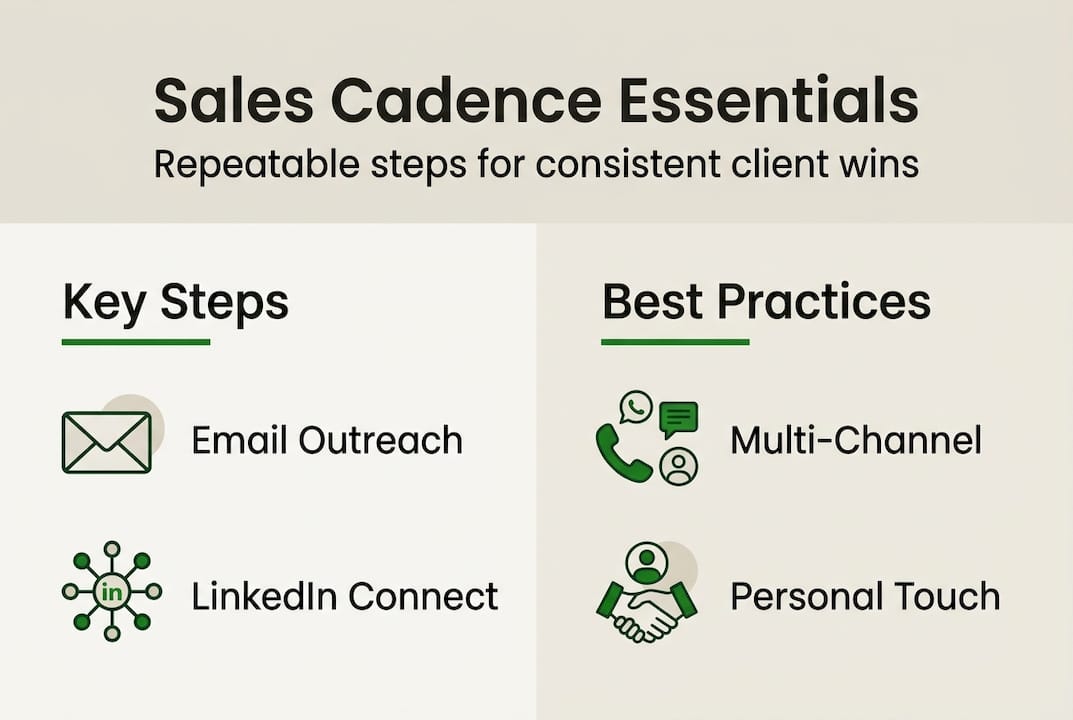
- Channels: Don’t rely on just one. Email is great, but LinkedIn adds a social layer. A phone call or voice note adds warmth. Mix it up.
- Number of touches: Most effective cadences include between 5 and 8 touchpoints. Too few and you’re invisible. Too many and you’re annoying.
- Timing and frequency: Space out your touches so you stay top-of-mind without overwhelming your prospect. Days 1, 3, 5, 8, 12, and 14 is a solid rhythm.
- Messaging: Each message should serve a different purpose. Introduce yourself, share a relevant insight, offer value, ask for a conversation.
- Response triggers: Know what happens at every fork in the road. If they reply, great. If they don’t, what’s your next step?
Here’s a simple example cadence for consultants:
| Day | Channel | Action |
|---|---|---|
| Day 1 | Intro message with clear value prop | |
| Day 3 | Connection request with short note | |
| Day 5 | Follow-up with a relevant insight or resource | |
| Day 8 | Engage with their content or send a DM | |
| Day 12 | Soft ask: “Would it make sense to connect briefly?” | |
| Day 14 | Final message, no hard sell, leave the door open |
The variety of outreach touchpoints across channels drives significantly higher engagement than single-channel approaches. That’s not just theory. It shows up in results.

Pro Tip: Don’t rely only on email. LinkedIn messages, voice notes, and even a short Loom video can dramatically increase response rates because they feel more human and less templated.
For more on what to actually say during live conversations, check out these sales call tips that are built around real data and proven methods. And if you want to see how a repeatable sales system fits together end to end, that’s worth a read too.
How to design and personalize your sales cadence
Knowing the building blocks, you’re ready to assemble and fine-tune your own sales cadence. Here’s how to do it:
- Identify your buyer. Who exactly are you reaching out to? Get specific. Industry, role, company size, common pain points. The narrower your focus, the sharper your message.
- Map their journey. Are they aware they have a problem? Are they actively looking for a solution? Your cadence should meet them where they are, not where you want them to be.
- Select your channels and frequency. Based on where your buyers actually hang out. If they’re active on LinkedIn, lean into that. If they’re email-first, make email your anchor channel.
- Script your message templates. You don’t need to write from scratch every time. Create a base template for each touchpoint and personalize from there. Reference their company, their role, or something they’ve published.
- Test and refine. Send your cadence, track what gets replies, and adjust. A cadence is never truly finished. It evolves as you learn.
Here are some customization tips that make a real difference:
- Adjust timing based on your niche. Decision-makers in fast-moving industries may respond faster than those in regulated sectors.
- Use their language. If your buyer uses a specific term for their pain, echo it back.
- Iterate based on data. If Day 5 emails get zero replies, rewrite them. Don’t just keep sending the same thing.
- Start simple and add sophistication over time. A five-touch cadence that you actually run beats a ten-touch masterpiece you abandon.
Tailored cadences outperform one-size-fits-all approaches, particularly in professional services where trust and relevance are everything.
Pro Tip: Personalization doesn’t mean rewriting every message from scratch. It means adding two or three specific details that show you actually know who you’re talking to. That small effort signals respect and builds real trust.
If you want a deeper framework for this, the consulting sales process guide walks through how independent consultants can build consistent client flow. And if you’re thinking bigger picture, there are some great growth ideas for consultants worth exploring too.
Why most service business owners abandon their sales cadence (and how to avoid it)
Here’s something I’ve seen over and over again. Solopreneurs build a solid cadence, run it for a week or two, get a couple of non-replies, and quietly shelve it. Back to sending emails when inspiration strikes. Back to feast-or-famine.
The reason isn’t laziness. It’s discomfort. Rejection, or even just silence, feels personal when you’re selling your own expertise. So the brain finds ways to avoid it.
But here’s the thing: the consultants and freelancers with the most consistent pipelines aren’t the ones who love rejection. They’re the ones who separate their identity from the process. They track, reflect, and adjust instead of quitting. They treat the cadence like a system, not a referendum on their worth.
Consistency builds reputation over time. A prospect who doesn’t reply today might reach out six months from now because you showed up regularly and professionally. That happens more than you’d think.
For practical ways to close pipeline gaps before they become revenue crises, there are some specific tactics worth having in your back pocket.
“Abandoning your cadence almost guarantees the feast-or-famine cycle returns.”
Stick with it. Refine it. The payoff is a business where clients show up consistently, not just when you get lucky.
Take your next step: Tools and guides for building your sales cadence
If this article got you thinking seriously about building your own cadence, that’s a great first step. The next one is putting it into action.
At GeneratingPipeline.com, everything is built for service-based business owners who want a consistent, repeatable way to bring in clients. Whether you want to refresh your client pipeline, learn how to create a client pipeline from scratch, or get a complete pipeline management guide to keep revenue steady, those resources are ready for you. No sales calls. No webinar funnels. Just practical tools you can use immediately.
Frequently asked questions
How long should a typical sales cadence last?
Most effective sales cadences run between 7 and 14 days, with 5 to 8 touchpoints spread across multiple channels for the best results.
What is the biggest mistake solo consultants make with sales cadence?
The most common mistake is giving up too soon. Consistent follow-up is where most deals actually happen, and dropping out early means handing those opportunities to someone else.
Should I personalize each touch in my sales cadence?
Yes, and it pays off. Personalized outreach significantly increases response rates and builds the kind of trust that generic templates never will.
Can a solo business owner handle sales cadence without software?
Absolutely. A simple spreadsheet and calendar reminders are more than enough to run an effective cadence when you’re starting out. Start lean, then layer in tools as your volume grows.
How do I know if my sales cadence is working?
If you’re consistently booking discovery calls or getting replies, it’s working. Track your outcomes and measure cadence effectiveness by adjusting what isn’t converting until the numbers improve.
