TL;DR:
- Pricing psychology influences client perceptions through emotional cues and cognitive biases.
- Prestige pricing and clear framing signal quality, especially for high-value service offerings.
- Testing small pricing changes over time helps improve client acquisition and sales results.
Most business owners think pricing is just math. Cover your costs, check what competitors charge, add a margin, done. But here’s the thing: that approach ignores one of the most powerful forces in buying decisions — how a price feels to the person reading it. Research in behavioral science shows that the way you present a price can shift perception just as much as the number itself. This article breaks down what pricing psychology actually is, which methods work (and which backfire) for service businesses, and how you can apply these principles to win better clients and improve your sales results.
Table of Contents
- Defining pricing psychology: more than numbers
- Core pricing psychology methods for service businesses
- Common misconceptions and controversies about pricing psychology
- Applying pricing psychology for better client acquisition
- Why pricing psychology works differently for service businesses
- Supercharge your sales strategy with expert pipeline tools
- Frequently asked questions
Key Takeaways
| Point | Details |
|---|---|
| Pricing shapes perception | The way you present your price can influence client decisions as much as the number itself. |
| Charm pricing is risky | Relying on .99 endings can harm your authority as a service provider—consider round numbers for premium offers. |
| Test and adapt | Use pricing psychology as a framework, but adjust approaches for your unique clients and review results often. |
| Trust trumps tricks | For service-based businesses, reinforcing expertise and value goes further than standard pricing tactics. |
Defining pricing psychology: more than numbers
Now that you’ve seen how pricing is more than pure calculation, let’s clarify what pricing psychology actually means and why it’s relevant for you as a service-based business owner.
At its core, pricing psychology is “a pricing strategy that leverages cognitive biases and perceptual shortcuts to influence how consumers perceive prices and make purchasing decisions, rather than relying solely on rational evaluation.” That’s a mouthful, so let me simplify it: your clients are not spreadsheets. They make decisions with emotions and mental shortcuts, then justify those decisions with logic afterward.
This matters a lot when you’re selling expertise and time. Unlike a product sitting on a shelf, your service has no visible manufacturing cost. Clients have to infer value from signals, and price is one of the strongest signals you send.
“The price you charge doesn’t just communicate what something costs — it communicates what something is worth.”
Think about the cognitive biases that shape how your pricing lands:
- Anchoring: The first number a client sees becomes a reference point. Everything else is judged relative to it.
- The left-digit effect: $4,900 feels meaningfully cheaper than $5,000 even though the gap is tiny.
- Decoy pricing: Adding a middle option makes the higher-tier option look more reasonable.
- Social proof framing: Phrasing like “most clients choose our growth package” subtly guides choices.
- Loss aversion: Framing what clients miss out on by not investing can be more persuasive than listing gains.
For consultants, fractional executives, and freelancers, these biases matter because your sales process is built on trust. You’re often selling months of engagement before a check is signed. The way your pricing strategy examples are structured sends a message about your positioning before a single conversation happens.
B2B buyers especially rely on price as a proxy for quality when they can’t easily compare service outputs. A price that looks “too cheap” raises flags. A price presented with clarity and confidence signals that you know your worth. That subtle difference can determine whether a client books a call or quietly moves on.

Core pricing psychology methods for service businesses
With the foundation laid, let’s get practical. These are the most common pricing psychology tactics and how they apply in your industry.
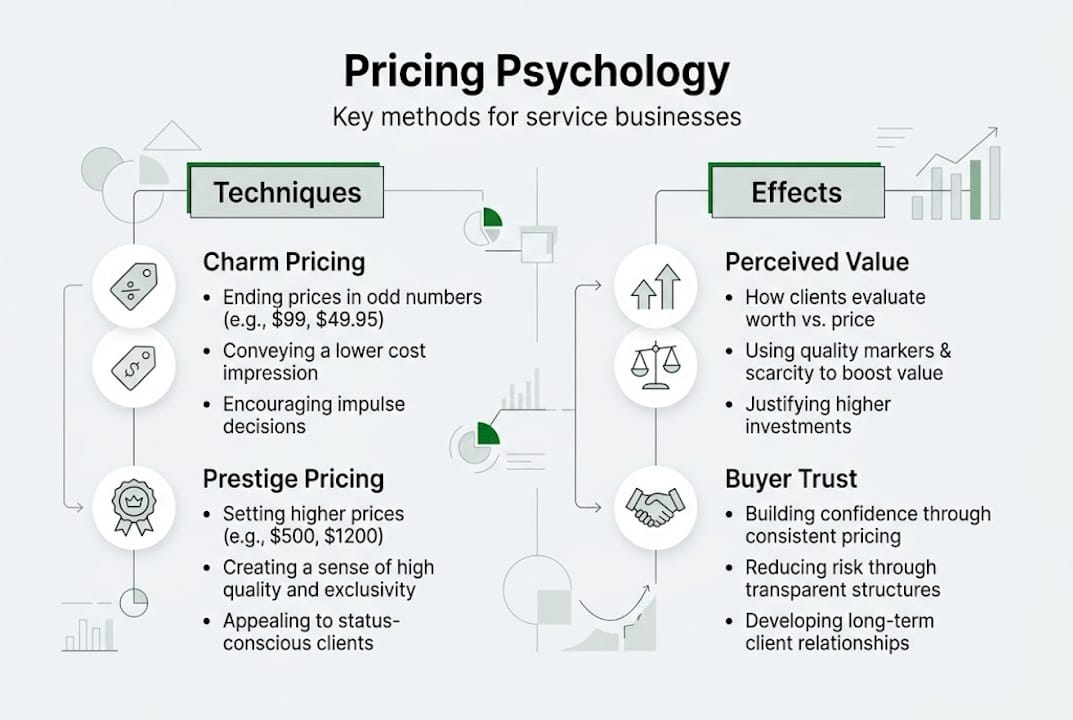
- Charm pricing: Ending prices in 9 or 99 (e.g., $997 instead of $1,000). It’s everywhere in consumer retail because it works there. But 9-endings signal lower quality in premium or B2B contexts, where round numbers actually perform better.
- Prestige pricing: Using clean, round numbers ($5,000, $10,000) to signal quality and authority. This is often the smarter move for high-trust service engagements.
- Anchoring: Presenting a premium option first so that your core offer feels like a smart, reasonable choice by comparison.
- Tiered pricing: Offering two or three packages creates a natural decision frame. Clients compare your options instead of comparing you to competitors.
- Payment framing: Presenting a monthly equivalent (“as low as $500/month”) versus an annual lump sum can reduce perceived pain, even if the total is identical.
| Method | Best use case | Potential pitfall |
|---|---|---|
| Charm pricing ($997) | Low-cost digital products | Undermines premium positioning |
| Prestige pricing ($5,000) | High-value consulting packages | Can feel arbitrary without clear value |
| Anchoring | Proposal or pricing page structure | Anchor must be credible, not inflated |
| Tiered pricing | Retainer or project options | Too many tiers cause decision paralysis |
| Payment framing | High-ticket engagements | May attract price-sensitive clients |
Specific to consultants and agency owners: when you’re positioning for pricing strategy for client acquisition, prestige pricing almost always beats charm pricing. Your buyer is often a senior decision-maker who reads $9,997 as “this person is discounting” and $10,000 as “this person is confident.”
Pro Tip: If you work with corporate clients or enterprise buyers, round your prices. Reserve charm pricing for lower-ticket products like templates, courses, or entry-level offers. The psychological effect of a round number in a B2B proposal is that it signals you’ve priced based on value, not anxiety.
For those exploring value-based pricing, these psychology methods layer neatly on top. You set the price based on client outcome, then present it using anchoring and framing to make it feel intuitive.
Common misconceptions and controversies about pricing psychology
You’ve seen the benefits, but what about the limits? Let’s clear up some misunderstandings and dig into what actually works.
The biggest myth is that pricing psychology is a universal hack. It isn’t. Some studies question efficacy, noting that sophisticated consumers ignore price endings entirely, and the debate continues on whether influence is subconscious or rational. For service businesses, this is especially relevant because your buyers are often experienced professionals who’ve seen every trick in the book.
Here’s what that means in practice:
- A CFO reviewing your proposal won’t be swayed by a $9,997 price tag over $10,000.
- A seasoned procurement manager will notice when anchor prices feel artificially inflated.
- Long-term clients who trust you will respond more to transparent, confident pricing than to any psychological framing.
- Overusing tricks can erode trust, which is the opposite of what you want in a relationship-based business.
“Prestige pricing boosts sales via quality signal in certain categories” — and for service businesses, that category is almost always yours.
The real controversy is subtler: pricing psychology works best when it reinforces genuine value, not when it tries to manufacture perceived value that isn’t there. If your pricing signals premium but your delivery doesn’t follow through, the psychology works against you.
For consultants and consulting secrets worth knowing: the most effective psychological lever isn’t a number trick. It’s the confidence and clarity with which you present your price. Hesitation and overexplaining are the real conversion killers. A clean, well-structured pricing page or proposal signals competence before the client reads a word.
Also worth noting: prestige pricing as a quality signal can actually counter the effects of charm pricing. If a competitor uses $997 and you use $1,000, you’re not losing on price. You’re winning on positioning.
Applying pricing psychology for better client acquisition
Armed with facts and context, here’s how you can use pricing psychology to win and retain better clients.
- Audit your current pricing presentation. Look at your website, proposals, and any pricing documents. Are your numbers clean and confident? Is there an anchor? Are you leading with your highest-value offer?
- Add an anchor. Before your core offer, introduce a premium option (even if rarely purchased). This shifts perception so your main offer feels like a great decision.
- Restructure into tiers. If you only offer one price, clients have to decide yes or no. With two or three tiers, they decide which one. That’s a better conversation to be in.
- Reframe the investment. Instead of “$6,000 for a 3-month engagement,” try “$2,000/month for three months of dedicated strategy support.” Same number, very different feel.
- Test one change at a time. Don’t overhaul everything at once. Adjust one element (anchor, framing, tier structure) and track how prospects respond over 4 to 6 weeks.
| Before | After | Likely impact |
|---|---|---|
| Single flat price ($4,997) | Three-tier structure with anchor | More conversations about which option |
| Lump sum framing ($12,000) | Monthly framing ($4,000/month) | Reduced sticker shock |
| No anchor on pricing page | Premium tier listed first | Core offer feels more accessible |
| Charm pricing ($997) in proposals | Round number ($1,000) | Stronger quality signal |
Pricing psychology can impact how clients respond to your offers and their perception of value, which is why testing matters. Small changes compound over time.
Pro Tip: In proposals, always state your price after you’ve described the client’s outcome. “You’ll add $200K in pipeline in 90 days. The investment is $8,000.” Outcome first, price second. This frames the price as a solution cost, not an expense.
For a deeper look at how this connects to your overall client acquisition strategy, pricing is just one lever. Combine it with revenue growth strategies to build a system that consistently converts.
Why pricing psychology works differently for service businesses
Here’s the thing most articles on this topic completely miss: they’re written with products in mind. A SaaS tool, a course, a widget. Services are different because the buyer is buying you, not just a deliverable.
I’ve seen consultants follow charm pricing advice from generic marketing blogs and immediately tank their positioning with a serious prospect. The moment you use $4,997 in a boardroom proposal, you’ve told that room something about how you see yourself. And it’s not “premium expert.”
The most effective use of pricing psychology for service businesses is to reinforce what’s already true: that you’re a trusted advisor worth the investment. Prestige pricing, transparent offer structures, and confident framing do that. Gimmicks don’t.
My honest take: your price is part of your brand promise. It sets expectations for the experience before the engagement even starts. When you price with clarity and present with confidence, you attract clients who value expertise. When you discount or over-complicate, you attract the wrong room. Use psychology to reinforce your expertise, not to push a number past a mental barrier.
Supercharge your sales strategy with expert pipeline tools
If you’re ready to take your sales and client acquisition even further, these curated resources can help.
Understanding pricing psychology is one piece of the puzzle. Building a repeatable system around it is where real results happen. At GeneratingPipeline.com, we’ve put together resources specifically for independent service providers who want to stop leaving revenue on the table.
Start by learning how to avoid revenue gaps that quietly cost consultants thousands each year. Then dive into how to manage your pipeline so pricing conversations happen with the right clients at the right time. And if you want a broader view, check out our consulting revenue growth tips to see how pricing fits into the bigger picture. All practical. No fluff.
Frequently asked questions
What is pricing psychology in simple terms?
Pricing psychology is the use of psychological principles to influence how people perceive and react to prices. Rather than relying purely on cost calculations, it uses cognitive biases and shortcuts to shape how your price lands with a potential client.
Are pricing psychology tricks ethical?
Yes, when used to clarify value and not to deceive. Prestige pricing signals quality in a transparent way, which is a legitimate and effective approach for service businesses that want to attract serious clients.
Does charm pricing work for consulting?
Generally, no. Charm pricing undermines premium services, and 9-endings can implicitly signal lower quality to B2B buyers. Round numbers tend to communicate confidence and authority in consulting contexts.
How can I test if pricing psychology works for my business?
Start small. Change one element — like switching from a lump sum to monthly framing — and track client reactions over four to six weeks. Monitor conversion rates and listen for how prospects talk about your pricing in conversations.
Is pricing psychology still effective in 2026?
Absolutely, but it depends on your audience. Sophisticated buyers may ignore price endings entirely, so for service businesses, perceived expertise and confident framing often matter more than any specific pricing tactic.
