TL;DR:
- Referrals generate 60-80% of new business and outperform other channels in trust and conversion.
- Building a deliberate referral system accelerates sales, increases deal value, and shortens sales cycles.
- Consistent tracking, personalized asks, nurturing partners, and systematizing your approach ensure sustainable referral growth.
Most independent service businesses are sitting on a gold mine they barely touch. Referrals account for 60-80% of new business for professional services firms, yet most freelancers, consultants, and fractional executives treat referrals as a happy accident rather than a deliberate strategy. That’s a massive missed opportunity. If you’re grinding through cold outreach and paid ads while your best clients go untapped as referral sources, this article is for you. We’re going to break down why referrals are so powerful, how they speed up your deals, and exactly what you can do right now to build a referral engine that actually works.
Table of Contents
- Why referrals drive pipeline growth
- How referrals accelerate sales velocity and deal quality
- Proven strategies to increase referrals in your business
- Building a sustainable referral pipeline: systems and measurement
- What most business owners get wrong about referrals
- Take the next step: strengthen your pipeline with referrals
- Frequently asked questions
Key Takeaways
| Point | Details |
|---|---|
| Referrals power growth | Referrals generate most new business for service providers and outperform other channels. |
| Deals close faster | Referral-based deals close at nearly four times the speed of non-referral deals. |
| System beats luck | Building a structured referral system leads to more consistent and higher-quality pipeline growth. |
| Personalized asks work | Personalized and well-timed referral requests yield the strongest results from existing clients. |
Why referrals drive pipeline growth
Let’s be honest. Most service-based business owners know referrals are valuable. But knowing it and actually building a system around it are two very different things.
Referrals are fundamentally different from every other acquisition channel. When a trusted colleague recommends you, the prospect already arrives with a layer of credibility attached to your name. There’s no cold trust-building phase. No skepticism to overcome before they’ll even take a call. That’s a massive head start.
Compare that to cold outreach, paid ads, or even content marketing. Those channels require you to invest time and money to build awareness, then credibility, then trust, and only then does a conversation happen. With referrals, most of that groundwork is done before you even say hello.
Here’s a quick comparison to put it in perspective:
| Channel | Trust level on first contact | Typical cost | Conversion rate |
|---|---|---|---|
| Referrals | High | Low | High |
| Cold outreach | Low | Medium | Low |
| Paid ads | Very low | High | Very low |
| Inbound content | Medium | Medium | Medium |
The numbers back this up. Referrals drive 60-80% of new business for professional services and agencies, outperforming every other channel in effectiveness. That’s not a small edge. That’s dominance.
Now here’s a myth worth busting: you don’t need a massive network to benefit from referrals. A small, deeply satisfied client base is more valuable than a huge, lukewarm one. Reciprocity plays a big role here. People genuinely want to help those who’ve helped them. When you deliver real results, clients feel good about recommending you.
“Referrals aren’t just leads. They’re pre-sold prospects who already trust you before the first conversation.”
If you want to understand how referrals fit into a broader growth picture, check out these consulting business growth ideas to see where they plug into your overall strategy. And if you’re serious about measuring what’s working in your pipeline, learning to track sales pipeline metrics will help you see referral impact clearly.
The bottom line: referrals aren’t a bonus. They’re a core pipeline driver that most independents are dramatically underusing.
How referrals accelerate sales velocity and deal quality
Beyond the why, it’s important to see how referrals transform the speed and quality of your pipeline deals.
Sales velocity is a fancy way of saying: how fast does a lead turn into revenue? And referrals crush every other channel here. According to the 2024 B2B Sales Benchmark Report, referral deals have 3.8x higher sales velocity than other lead sources. Top performers consistently prioritize partnerships and referrals for exactly this reason.

That’s not just a nice stat. That’s a strategic signal. If referral deals close nearly four times faster, even a modest increase in referral volume can significantly reduce the time between prospecting and getting paid.
Here’s how the numbers stack up across deal types:
| Lead source | Avg. sales cycle | Relative deal value | Acquisition cost |
|---|---|---|---|
| Referral | Shortest | Highest | Lowest |
| Inbound | Medium | Medium | Medium |
| Cold outreach | Longest | Lower | Highest |
Referral deals also tend to come in at higher value. Why? Because the referring party often positions you well. They describe your work in context of a specific problem, which means the prospect self-qualifies before you’ve even spoken.
Here’s a simplified look at what the sales process typically looks like for a referral lead:
- Referral is made by a satisfied client or partner
- Prospect reaches out already familiar with your work
- Discovery call focuses on fit, not credibility
- Proposal is specific to a clearly defined problem
- Decision is made faster with fewer objections
- Project kicks off with higher initial trust
Every step is faster and smoother. There’s less friction because the trust gap has already been bridged.
If you want to explore how to build your broader client acquisition strategies, referrals are just one piece of the puzzle. But they’re a high-leverage piece. Combine them with smart sales pipeline metrics tracking and you’ll start to see exactly how much revenue referrals are driving versus other channels.
Pro Tip: Follow up with a referred prospect within 24 hours. The warm glow of a referral fades quickly. Strike while the trust is fresh and your conversion odds skyrocket.
Proven strategies to increase referrals in your business
Now, having seen the unique benefits of referrals, let’s cover actionable strategies that service independents can adopt to generate more referrals intentionally.
First, get clear on who your best referral sources actually are. Not every client is equally positioned to send you great work. According to the Referral System Playbook, the smartest starting point is your top 20-30 clients. These are people who’ve seen real results from working with you and are likely well-connected in your target market.
Here’s what an intentional referral strategy looks like in practice:
- Identify your top clients by results delivered, relationship quality, and network fit
- Time your ask strategically, always after a win, milestone, or strong deliverable
- Personalize every request, reference the specific result you delivered and who they might know with a similar challenge
- Build reciprocal partnerships with complementary service providers (think: accountants referring to financial advisors, copywriters referring to web designers)
- Track every referral in your CRM so you know who’s sending you business and how those deals perform
- Set a referral pipeline goal of at least 10% of new opportunities coming from referrals to start
The key word there is intentional. Waiting for referrals to happen organically is leaving money on the table. You have to ask. And asking is more comfortable than most people expect, especially when it’s framed around helping someone you already have a relationship with.
Reciprocal partnerships deserve special mention here. If you’re a consultant in one niche, think about who serves your ideal clients in adjacent ways. An accountant who works with the same type of founder you do is a natural referral partner. You send them clients, they send you clients. Everyone wins.
Want a stronger foundation for your overall client acquisition strategy? Referrals pair well with outbound and LinkedIn approaches. And for quick wins that complement your referral system, explore these revenue growth hacks built specifically for service businesses.
Pro Tip: Don’t send a generic “Do you know anyone?” message. Say something like, “Given the results we got on X, I’m curious if you know anyone in your network dealing with the same challenge.” Specific asks get specific responses.
Building a sustainable referral pipeline: systems and measurement
Establishing strategies is one step. Next is ensuring your referral program is sustainable, measured, and always improving.
The biggest mistake I see? Treating referrals as a one-off conversation rather than a system. You ask once, get lucky, then forget about it for six months. That’s not a pipeline. That’s a coin flip.
Here’s a step-by-step process to make referrals repeatable:
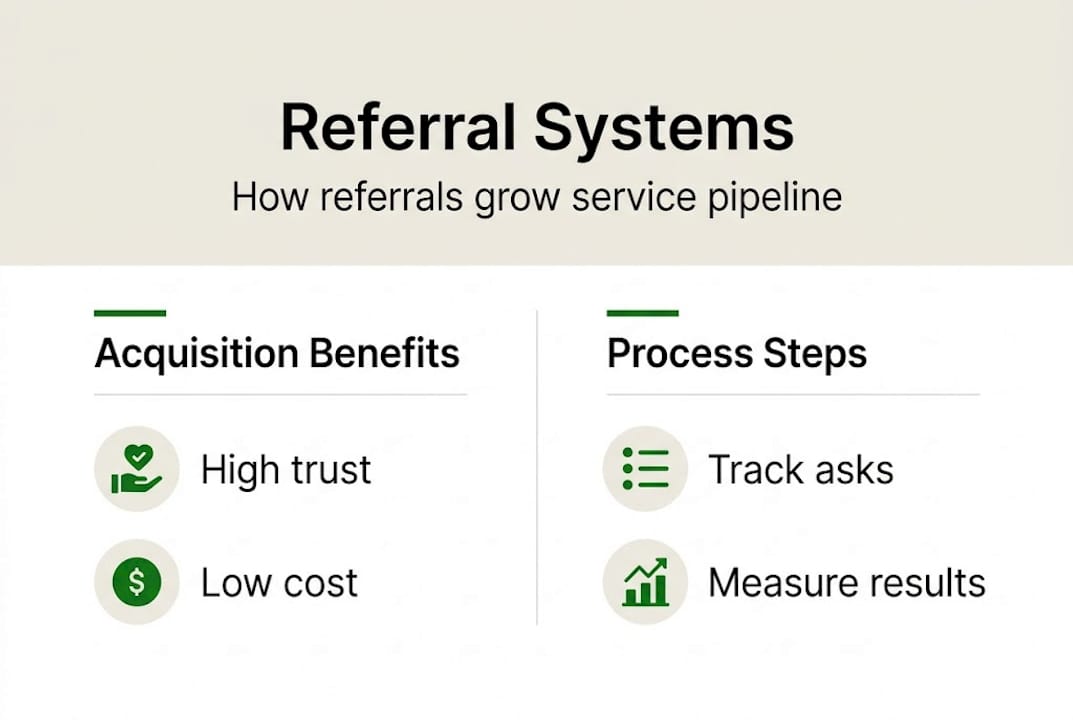
- Set up a simple CRM tag or field to mark every lead as “referral” and track the source
- Log who referred whom and follow up to thank the referrer once a deal progresses
- Schedule quarterly check-ins with your top referral sources to stay top of mind
- Reward referrers meaningfully, this doesn’t have to be cash. A handwritten note, a gift card, or a public shoutout goes a long way
- Review your referral pipeline rate monthly, if referrals are less than 10% of your pipeline, it’s time to be more proactive
- Adjust your ask timing and messaging based on which referral sources convert best
KPIs to watch for a healthy referral pipeline:
- Percentage of new leads marked as referrals (target: 10%+ to start)
- Referral-to-close conversion rate vs. other channels
- Average deal size from referral leads vs. cold or inbound
- Time to close for referral deals vs. all other sources
- Number of active referral partners in your network
The goal is to make this process feel less like a favor and more like a natural part of how you operate. When clients know you appreciate referrals and you have a consistent way of acknowledging them, they refer more often.
If you’re working on how to create a client pipeline that doesn’t rely solely on luck, referrals need to be a named channel inside it. And pairing them with solid sales follow-up best practices ensures no referred lead slips through the cracks.
What most business owners get wrong about referrals
Here’s my honest take: most independents treat referrals like a vending machine. They deliver good work, assume satisfied clients will spread the word automatically, and then wonder why the referrals aren’t flowing.
That’s not how it works. Referrals don’t happen by default. They happen by design.
The businesses I’ve seen consistently win through referrals aren’t just doing great work. They’re running a process. They ask at the right time. They track the results. They nurture their referral partners the same way they nurture their best clients. And they treat the whole thing like a pipeline initiative, not a wish.
If you’re ready to boost your pipeline beyond hoping for word of mouth, the shift is simple: stop waiting and start building. Your referral network won’t grow itself. But with a framework in place, it compounds over time in a way that almost no other channel can match.
Process beats luck. Every single time.
Take the next step: strengthen your pipeline with referrals
You now have the framework. You understand why referrals outperform other channels, how they speed up your deals, and exactly how to build a system that makes them consistent. The next move is yours.
If you want to avoid revenue gaps that come from relying on sporadic referrals, the Generating Pipeline OS is built for exactly that. It covers everything from positioning to outreach to closing, designed for busy service professionals who sell expertise and time. You can also explore how to grow your client pipeline with a repeatable system, or dig into our pipeline forecasting guide to see how referrals fit into your bigger revenue picture.
Frequently asked questions
How do referrals compare to other lead generation methods for service businesses?
Referrals consistently outperform other channels, driving 60-80% of new business for professional services firms, with higher conversion rates and lower acquisition costs than cold outreach or paid ads.
What’s an ideal first step to start generating referrals if I have no system yet?
Start by identifying your top 20-30 clients and make a personalized ask shortly after delivering a strong result, when the relationship and goodwill are at their peak.
How much of my client pipeline should I expect to come from referrals?
Aim for at least 10% of your pipeline from referrals as a starting benchmark, then gradually increase that share as your referral system matures and your network grows.
Do referral-sourced deals really close faster than cold leads?
Absolutely. Referral deals close at 3.8 times the velocity of cold or inbound leads, meaning faster revenue and a shorter sales cycle across the board.
How should I track, reward, and measure referral effectiveness?
Use a CRM to log every referral source, monitor conversion rates by channel, and acknowledge your top referrers with meaningful gestures to keep the momentum going.
