Most freelancers and consultants believe a steady stream of prospects guarantees sales success. They assume that if they keep networking, posting on LinkedIn, and responding to inquiries, clients will naturally follow. Yet without tracking sales pipeline metrics, you can’t identify where deals stall, which leads convert best, or why revenue suddenly dries up. This article reveals why monitoring pipeline metrics transforms your client acquisition from guesswork into a predictable, repeatable system that drives consistent business growth.
Table of Contents
- Key takeaways
- Understanding sales pipeline metrics and their impact
- Common challenges in pipeline management and how metrics solve them
- How to track and use sales pipeline metrics effectively
- Measuring success: interpreting sales pipeline metrics for growth
- Boost your sales pipeline management
- FAQ
Key Takeaways
| Point | Details |
|---|---|
| Bottlenecks revealed early | Tracking key pipeline metrics reveals where deals stall so you can fix the right part of your sales process. |
| Prioritize high conversion leads | Data lets you prioritize leads with the highest conversion potential, making your outreach more efficient. |
| Steady revenue through metrics | Regularly monitoring metrics creates a repeatable, dependable revenue stream rather than relying on luck. |
| Predictable client acquisition outcomes | Understanding metrics helps you forecast future results and design repeatable client acquisition strategies. |
Understanding sales pipeline metrics and their impact
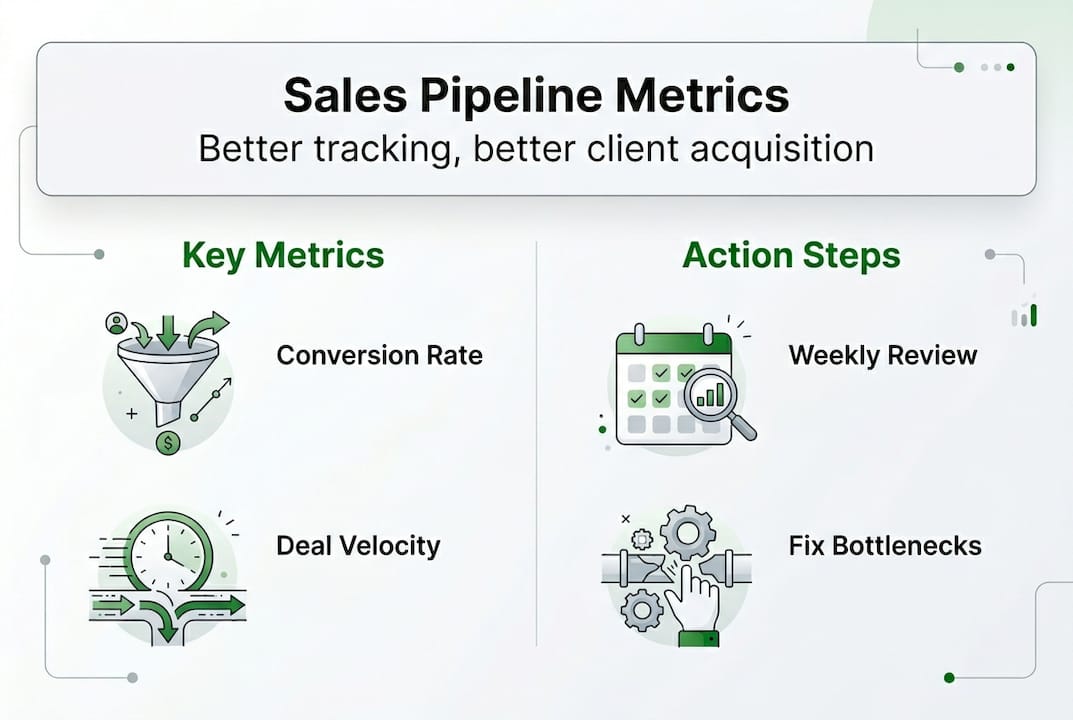
Sales pipeline metrics are quantifiable measurements that track how prospects move through your sales process from initial contact to closed deal. For freelancers and consultants, the most relevant metrics include conversion rates at each stage, deal velocity showing how long prospects take to decide, average deal size indicating typical project value, and total pipeline value representing potential revenue.
These metrics illuminate your entire client acquisition journey. Conversion rates reveal what percentage of prospects advance from discovery calls to proposals to signed contracts. Deal velocity shows whether prospects close in two weeks or two months. Average deal size helps you understand if you’re attracting the right clients at the right price points. Pipeline value gives you a snapshot of potential revenue sitting in your sales funnel right now.
Tracking these numbers exposes exactly where your sales process weakens. Maybe 40% of discovery calls convert to proposals, but only 10% of proposals become clients. That gap signals a proposal problem, not a prospecting problem. Monitoring key sales metrics such as conversion rates and average deal size helps service professionals identify sales process weaknesses. Without metrics, you might waste months improving your LinkedIn outreach when the real issue lies in how you present pricing or handle objections.
Pipeline metrics replace assumptions with evidence. Instead of wondering why revenue dropped last quarter, you see that deal velocity doubled, meaning prospects took twice as long to decide. Instead of guessing which marketing channel works best, you track that referrals convert at 35% while cold outreach converts at 8%. This visibility transforms how you allocate time and energy.
“Sales pipeline metrics turn your client acquisition from a black box into a transparent system where every stage, conversion point, and revenue opportunity becomes visible and actionable.”
The impact extends beyond identifying problems. Metrics enable proactive pipeline management. When you notice pipeline value dropping below your target threshold, you ramp up outreach before a revenue gap hits. When conversion rates improve after changing your proposal format, you know to keep that approach. Metrics create a feedback loop that continuously refines your sales effectiveness.
Common challenges in pipeline management and how metrics solve them
Independent service providers face recurring pipeline challenges that threaten business stability. Unpredictable cash flow tops the list, with feast or famine cycles disrupting financial planning. Stalled deals consume mental energy as prospects go silent after promising conversations. Inefficient time allocation wastes hours on low probability opportunities while high value prospects slip away. Missed follow ups damage credibility when busy schedules cause you to forget touchpoints.

These problems stem from operating without visibility into your sales funnel. Many freelancers face revenue gaps due to unmonitored pipeline stages causing unexpected dry periods. You close three clients in January, then wonder why February brings zero revenue. The answer lies in metrics: January’s success depleted your pipeline, but you didn’t notice because you weren’t tracking pipeline value or stage distribution.
Pipeline velocity metrics solve the stalled deal problem by highlighting how long prospects typically remain at each stage. When a prospect sits in the proposal stage for three weeks and your average deal velocity is nine days, you know to follow up aggressively or move on. Stage conversion rates reveal whether deals stall because your proposals need work or because you’re targeting the wrong prospects.
Tracking average deal size and total opportunities helps predict cash flow. If your average project is $5,000 and you need $15,000 monthly revenue, you know you need at least three closed deals per month. Working backward, if your proposal to close rate is 30%, you need ten proposals. If your discovery call to proposal rate is 50%, you need twenty discovery calls. These calculations only work when you track the underlying metrics.
Metrics enable smarter time allocation by showing which activities and prospect types convert best. If enterprise clients take four months to close while small businesses close in two weeks, you can balance your pipeline accordingly. If LinkedIn outreach converts at 12% but networking referrals convert at 40%, you prioritize accordingly. Without metrics, you chase every opportunity equally, burning time on low probability deals.
Pro Tip: Track your pipeline metrics every Monday morning. Set a recurring 15 minute calendar block to review conversion rates, deal velocity, and pipeline value. This weekly rhythm catches problems early, before they become revenue crises. Use a simple spreadsheet or lightweight CRM to log stage changes and calculate metrics automatically.
How to track and use sales pipeline metrics effectively
Establishing effective pipeline metric tracking requires a systematic approach that fits your workflow without adding overwhelming complexity. Follow these steps to implement tracking that actually improves your client acquisition:
- Define your sales stages clearly with specific criteria for each transition point
- Choose tracking tools that match your technical comfort and budget, from spreadsheets to purpose built CRMs
- Collect data consistently by logging every prospect interaction and stage change immediately
- Analyze metrics weekly to identify trends, bottlenecks, and opportunities for improvement
- Act on insights by adjusting your sales activities, messaging, or targeting based on what the data reveals
- Refine your process continuously as you learn which metrics matter most for your specific business model
Start with simple stage definitions that match how you actually sell. A basic pipeline might include stages like Initial Contact, Discovery Call Scheduled, Discovery Call Completed, Proposal Sent, Negotiation, and Closed Won or Closed Lost. Each stage needs clear entry criteria so you know exactly when to move a prospect forward.
Using structured processes to capture pipeline data improves repeatability and sales efficiency for solopreneurs. Your tracking tool should make logging updates fast and frictionless. A spreadsheet works fine initially, with columns for prospect name, current stage, date entered stage, deal value, and source. As your pipeline grows, consider tools like Pipedrive, Streak, or HubSpot that automate metric calculations.
The table below shows sample metrics with target values and recommended actions:
| Metric | Target Value | Current Value | Action Needed |
|---|---|---|---|
| Discovery to Proposal Rate | 60% | 45% | Improve qualification questions |
| Proposal to Close Rate | 30% | 35% | Maintain current approach |
| Average Deal Velocity | 21 days | 34 days | Add urgency in proposals |
| Pipeline Value | $50,000 | $32,000 | Increase outreach volume |
Dashboards provide ongoing visibility without manual calculation. Set up a simple view showing current pipeline value, number of opportunities at each stage, conversion rates between stages, and average deal velocity. Review this dashboard during your weekly tracking session to spot trends before they become problems.
Pro Tip: Use lightweight CRM tools designed for solopreneurs rather than enterprise sales teams. Complex systems with dozens of fields and features create friction that kills adoption. Choose tools where updating a deal stage takes two clicks, not ten. The best tracking system is the one you’ll actually use consistently.
Measuring success: interpreting sales pipeline metrics for growth
Collecting metrics means nothing without skilled interpretation that drives strategic decisions. Evaluate your metrics by comparing current performance against historical trends and industry benchmarks. Look for patterns over time rather than reacting to single week fluctuations. A conversion rate drop in one week might be random variance, but a steady three month decline signals a real problem requiring action.
Healthy pipeline metrics show consistent or improving trends across key indicators. Your conversion rates between stages remain stable or increase as you refine your sales approach. Deal velocity stays predictable, allowing accurate revenue forecasting. Pipeline value maintains a steady ratio to your monthly revenue target, typically three to five times your goal. Average deal size grows as you improve positioning and target better fit clients.
Warning signs appear as declining conversion rates, lengthening deal velocity, shrinking pipeline value, or increasing percentage of deals stuck in late stages. These indicators demand immediate investigation and correction. A sudden drop in discovery call to proposal conversion might mean you’re attracting the wrong prospects or asking poor qualifying questions. Lengthening deal velocity could indicate unclear value propositions or weak urgency creation.
The comparison table below contrasts healthy metrics with warning signs:
| Metric Pattern | Healthy Signal | Warning Sign |
|---|---|---|
| Conversion Rate Trend | Stable or improving over time | Declining for two or more months |
| Deal Velocity | Consistent average timeline | Increasing time to close |
| Pipeline Distribution | Even spread across stages | Clustering in early or late stages |
| Win Rate | 25-35% for cold outreach | Below 20% consistently |
Understanding metric trends supports smarter prospect prioritization and sales decision making, driving growth. When you notice certain prospect sources convert at higher rates, you double down on those channels. When specific objections correlate with lost deals, you develop better responses. When proposals sent on Tuesdays close faster than Friday proposals, you adjust your scheduling.
Metric interpretation guides resource allocation decisions. If your bottleneck sits at the proposal stage with low conversion rates, invest time improving your proposal templates and pricing presentation. If deal velocity lags because prospects take weeks to respond, implement automated follow up sequences. If pipeline value stays too low, increase top of funnel activities like outreach and networking.
Continuous learning from your data creates compounding improvements. Each quarter, analyze which changes improved metrics and which failed. Test new approaches systematically, tracking their impact on conversion rates and deal velocity. Build a personal playbook of what works for your specific market, service offering, and ideal client profile. This evidence based approach beats copying generic sales advice that may not fit your situation.
Boost your sales pipeline management
Mastering sales pipeline metrics requires both understanding the concepts and implementing practical systems that fit your business. Generating Pipeline specializes in helping freelancers, consultants, and fractional executives build repeatable client acquisition processes that eliminate revenue unpredictability. Our approach focuses on simple, actionable frameworks rather than complex enterprise sales methodologies.

The Generating Pipeline OS course delivers 20 lessons covering everything from positioning and offer clarity to sales execution and delivery foundations. Each lesson includes templates and frameworks designed specifically for solo professionals who sell expertise and time. You’ll learn how to avoid revenue gaps through proactive pipeline management and metric tracking that catches problems before they impact your income.
Our practical client acquisition strategies help you move beyond referral dependence to build a consistent pipeline of qualified prospects. Start with our free guide featuring 11 revenue boosting tactics you can implement immediately, then explore the full course for comprehensive pipeline building systems.
FAQ
Why is it important to track sales pipeline metrics?
Tracking sales pipeline metrics identifies exactly where prospects stall or drop out of your sales process, enabling targeted improvements that increase conversion rates. Without metrics, you operate blindly, unable to forecast revenue accurately or prioritize the highest value opportunities. Metrics transform sales from guesswork into a predictable system where you know which activities drive results and which waste time.
What are the most critical sales pipeline metrics to monitor?
Conversion rate between each pipeline stage shows where your sales process succeeds or fails. Pipeline velocity reveals how long prospects take to move through your funnel, impacting cash flow predictability. Average deal size helps you understand if you’re attracting appropriately valued projects. Total pipeline value indicates potential revenue and whether you’re generating enough opportunities to hit your targets.
How often should I review my sales pipeline metrics?
Weekly reviews provide the optimal balance between staying informed and avoiding obsessive micromanagement. This cadence catches declining trends early enough to correct course before revenue gaps emerge. Monthly reviews miss critical signals until problems become severe, while daily tracking wastes time reacting to normal variance. Set a recurring Monday morning review to start each week with clear pipeline visibility.
Can tracking sales pipeline metrics improve my sales process?
Yes, metrics expose inefficiencies and weak conversion points that you can systematically address through process refinements. When data shows proposals convert poorly, you improve your pricing presentation and value articulation. When discovery calls rarely lead to proposals, you strengthen your qualification questions. This continuous improvement cycle builds a repeatable, scalable sales system that consistently generates clients rather than relying on luck or referrals.
Recommended
- Client Pipeline Refresh: How to Avoid Gaps and Keep Your Revenue Steady – Generating Pipeline
- Business Development: 7 Practical Client Acquisition Strategies
- A Proven Client Acquisition Strategy for Fractional Executives and Consultants – Generating Pipeline
- Sales Process and Optimisation For an Efficient, Repeatable Sales System – Generating Pipeline
