TL;DR:
- Pipeline management provides a predictable system to track prospects through sales stages.
- Regular weekly reviews and tracking key KPIs improve deal flow and forecast accuracy.
- Consistent outreach and nurturing prevent feast-or-famine cycles in freelancing businesses.
If you’ve ever ended a great project only to realize your next client isn’t lined up, you know the gut-punch of the feast-or-famine cycle. One month you’re slammed, the next you’re refreshing your inbox hoping for a lead. The good news? This isn’t a talent problem or a luck problem. It’s a systems problem. Pipeline management gives you a clear, repeatable way to track every prospect from first hello to signed contract, so you always know what’s coming next. This guide walks you through every step, from setup to optimization, so you can build steadier income and stop white-knuckling your way through slow months.
Table of Contents
- What is pipeline management and why it matters
- Setting up your pipeline: Tools and preparation
- Step-by-step: Managing deals through every stage
- Tracking, reviewing, and optimizing your pipeline
- Troubleshooting and maximizing your pipeline’s results
- Hard truths about pipeline management: What most guides won’t tell you
- Ready to transform your pipeline? Next steps with Generating Pipeline
- Frequently asked questions
Key Takeaways
| Point | Details |
|---|---|
| Structure brings stability | A clear-stage pipeline gives freelancers and consultants better control over client flow and income. |
| Weekly reviews essential | Checking and updating your pipeline every week helps spot and fix issues before they hurt revenue. |
| Track crucial KPIs | Measure pipeline value, conversion rates, and client retention for ongoing improvement. |
| Lead generation discipline | Devoting 20% of working time to lead generation keeps your pipeline and bank account healthy. |
What is pipeline management and why it matters
Pipeline management is a visual system for tracking potential clients as they move through each stage of your sales process. Think of it like a map of every conversation you’re having, from the first inquiry all the way to a closed deal and beyond. For freelancers and consultants, this isn’t just a nice-to-have. It’s the backbone of predictable revenue.
Understanding pipeline management basics starts with recognizing that without a structured system, you’re essentially flying blind. You forget to follow up. You lose track of warm leads. You only notice the dry spell after it’s already hurting your bank account.
A well-run pipeline connects directly to stable income. When you can see exactly how many prospects are at each stage, you can forecast revenue, spot gaps early, and take action before things get tight. According to benchmarks, pipeline coverage should be 3-4x your monthly sales goal, with win rates landing around 20-30% for service-based businesses.
| Pipeline stage | Typical conversion rate |
|---|---|
| Inquiry to qualification | 50-60% |
| Qualification to discovery | 60-70% |
| Discovery to proposal | 50-65% |
| Proposal to negotiation | 40-55% |
| Negotiation to close | 60-75% |
As a solo operator, you should be tracking pipeline stages explained across 5-7 distinct steps. That structure keeps you from lumping everything together and losing deals in the noise.
Top benefits of a structured pipeline for solo service businesses:
- Predictable monthly revenue forecasting
- Fewer missed follow-ups and lost leads
- Clearer sense of when to ramp up outreach
- Better understanding of where deals stall
- Reduced stress from income uncertainty
A note worth remembering: Poor pipeline management is the #1 driver of feast-or-famine cycles for freelancers. When you only sell when you’re not busy, you guarantee the next dry spell. A structured pipeline breaks that pattern for good.
Setting up your pipeline: Tools and preparation
Now that you know why pipeline management matters, let’s get your system ready.

Before you pick a tool, get clear on what you actually need. A good pipeline setup starts with a few basics: a place to log every prospect, defined deal stages that match your workflow, and a habit of updating it regularly. Freelancers should use a pipeline with distinct stages like inquiry, qualification, discovery, proposal, negotiation, closing, and nurture. That structure keeps your process clean and your head clear.
Choosing the right tool matters, but don’t overthink it. Here’s a quick comparison to help you decide:
| Tool type | Pros | Cons |
|---|---|---|
| Spreadsheet | Free, flexible, easy to start | Manual, no reminders, can get messy |
| CRM (e.g., HubSpot free) | Automated reminders, reporting | Learning curve, overkill for some |
| Kanban board (e.g., Trello) | Visual, simple to move cards | Limited data tracking |
For most solo operators just getting started, a spreadsheet or a simple CRM pipeline setup works fine. The goal is visibility, not complexity. You can always upgrade later.
Once you’ve picked your tool, customize the stages to match your actual workflow. If you always do a discovery call before sending a proposal, that stage needs to be in your pipeline. If you have a nurture list for past clients, that’s a stage too. Forcing a generic template onto your process creates friction and you’ll stop using it.
To avoid revenue gaps from the start, make sure you’re not skipping these preparation steps:
- Missing lead qualification: Not every inquiry deserves your time. Define what a good fit looks like before you start.
- Skipping the nurture stage: Past clients and warm leads are gold. Don’t let them fall off the map.
- Mixing deal types: Retainers and one-off projects have different sales cycles. Track them separately.
- No defined next action: Every deal in your pipeline should have a clear next step attached to it.
Pro Tip: Start simple but track every prospect from day one. Even a basic spreadsheet beats keeping it all in your head. Visibility is the whole point.
Step-by-step: Managing deals through every stage
With tools and structure ready, let’s break down the pipeline process step by step.
- Inquiry: Someone reaches out or you initiate contact. Log them immediately. Note the source (referral, LinkedIn, outbound) so you can track what’s working.
- Qualification: Ask a few key questions to confirm they’re a real fit. Budget, timeline, and decision-making authority are the big three. Move on quickly if it’s not a match.
- Discovery: This is your deep-dive call. Understand their problem, goals, and what success looks like. This stage sets up your proposal and builds trust.
- Proposal: Send a clear, tailored proposal. Set a follow-up date before you hit send. Don’t just wait and hope.
- Negotiation: Scope, price, timeline. Stay calm and know your walk-away point. Most deals that stall here just need a gentle nudge.
- Closing: Contract signed, deposit received. Celebrate, then immediately move to onboarding.
- Nurture: For clients who said not yet, past clients, or warm referrals. Stay in touch with value, not just check-ins.
For benchmarks, win rates of 20-30% are normal for service businesses, with a typical sales cycle running 40-80 days. Keep your total pipeline value at 3-4x your monthly revenue goal so you always have enough in the mix.
If a deal hasn’t moved in two weeks, it’s stalling. Either re-engage with something useful (an article, a case study, a quick check-in) or archive it. Dead weight in your pipeline skews your forecast and wastes mental energy.
For pipeline forecasting strategies that actually work, you need to know your average conversion rates at each stage. Once you do, you can predict revenue with surprising accuracy.
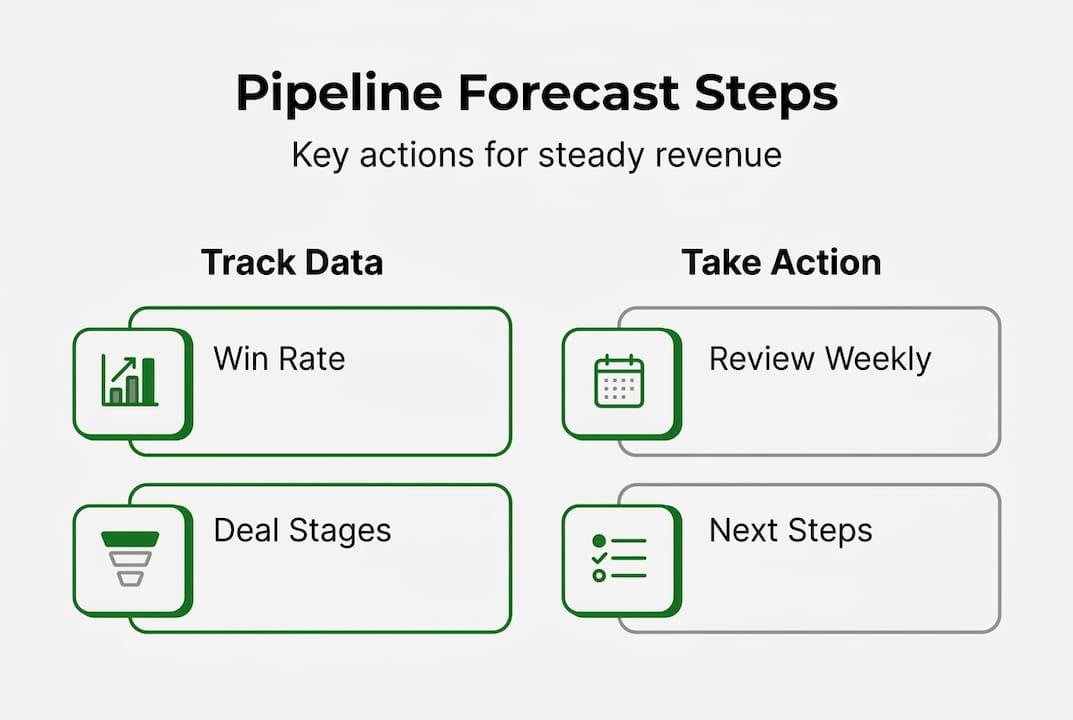
Pro Tip: Do a weekly 20-minute pipeline review. Check every open deal. Ask: what’s the next action, and when is it due? This single habit does more for your business than any fancy tool.
Tracking, reviewing, and optimizing your pipeline
Moving deals is only half the battle. Regular review and continuous tuning close the gap.
You need to track the right numbers. Here are the essential pipeline KPIs and what good looks like:
| KPI | Target |
|---|---|
| Pipeline coverage ratio | 3-4x monthly goal |
| Lead-to-client conversion | 30-40% |
| Client retention rate | >70% |
| New leads added per week | 3-5 minimum |
| Average sales cycle length | 40-80 days |
Your weekly review doesn’t need to be complicated. Check each open deal, confirm the next action is scheduled, and flag anything that hasn’t moved. Weekly pipeline reviews are essential for cleaning stale deals, forecasting weighted revenue, and catching bottlenecks before they cost you.
The most common pipeline mistakes solo operators make:
- Not tracking leads at all (gut feel isn’t a system)
- Reviewing too infrequently (monthly is too late to course-correct)
- Ignoring the nurture stage entirely
- Letting stale deals sit without a decision to re-engage or archive
- Focusing only on active deals and ignoring lead generation
“What gets measured gets managed.” For solo businesses, this is especially true. You can’t fix what you can’t see. Tracking pipeline metrics weekly turns vague anxiety into clear action.
Small weekly tweaks add up fast. If you notice proposals are stalling, test a shorter follow-up sequence. If discovery calls rarely convert, revisit your qualifying questions. The pipeline isn’t a set-and-forget system. It rewards attention.
Troubleshooting and maximizing your pipeline’s results
Even with a system in place, bumps and dry spells happen. Here’s how to troubleshoot and build momentum.
Most pipeline problems fall into a few buckets: your lead pool runs dry, deals stall mid-process, admin eats your selling time, or you stop generating leads because you’re busy delivering. Each one is fixable.
Here are five troubleshooting steps to run through when your pipeline feels stuck:
- Check stage conversions: Where are deals dropping off? That’s your bottleneck. Fix that stage first.
- Remove stale leads: Anything inactive for 30+ days needs a decision. Re-engage or archive. Clutter kills clarity.
- Systematize your outreach: Don’t rely on inspiration. Build a repeatable weekly outreach routine using templates and a set schedule.
- Review your weekly habits: Are you actually doing your pipeline review? Skipping it for two weeks is often what causes the dry spell you’re panicking about now.
- Nurture referrals deliberately: Past clients and partners who’ve sent work your way are your warmest leads. Stay on their radar with consistent, low-pressure touchpoints.
The data backs this up. Spending 20% of your time on lead generation, even when you’re at full capacity, is what separates consultants with steady books from those constantly scrambling. Outbound beats waiting for inbound when you’re solo.
Pro Tip: Block two hours every week for outbound, no matter how full your calendar looks. Treat it like a client meeting you can’t cancel. Your future self will thank you.
When you’re ready to experiment, try one change at a time. Test a new lead source for four weeks. Adjust your follow-up cadence. Refresh your nurture emails. Small, deliberate experiments beat big overhauls every time. For sales tactics for freelancers that complement your pipeline work, layering in a solid client acquisition strategy makes the whole system click.
Hard truths about pipeline management: What most guides won’t tell you
Real talk: most freelancers and consultants deprioritize pipeline management until they’re already in a dry spell. Then it’s panic mode. I’ve been there, and I’ve seen it happen to smart, talented people over and over.
Here’s what I’ve learned. You don’t need a fancy CRM or automated sequences to have a great pipeline. What you need is weekly attention and honest tracking. Personal follow-ups beat automated ones almost every time in service businesses. Clients buy from people they trust, and trust is built through real interaction, not drip campaigns.
The myth that you only need a handful of great clients forever is dangerous. Clients leave, budgets change, priorities shift. A healthy pipeline is always being fed, even when things are going well.
Building repeatable sales systems isn’t glamorous. It’s a weekly habit of updating a spreadsheet, making a few calls, and reviewing what moved and what didn’t. But that discipline, done consistently, is what separates the consultants who scale from the ones who stay stuck in the cycle.
Ready to transform your pipeline? Next steps with Generating Pipeline
You now have the framework. The next move is putting it into practice, consistently.
If you want to skip the trial-and-error phase, GeneratingPipeline.com has you covered. Start by grabbing the free guide with 11 revenue-boosting tactics you can implement this week. Then, when you’re ready to go deeper, the Generating Pipeline OS walks you through 20 lessons covering everything from positioning to outbound to closing, built specifically for solo operators like you. No sales calls, no hidden pricing. Just practical tools that work. Refresh your pipeline, explore the sales process optimization resources, or start with the deep dive pipeline guide to build your system from the ground up.
Frequently asked questions
What are the typical stages in a client pipeline for freelancers and consultants?
The typical pipeline has 5-7 stages: inquiry/prospecting, qualification, discovery, proposal, negotiation, closing, and nurture. Using all of them gives you full visibility into where every deal stands.
How can I keep my client pipeline full when I’m busy with current projects?
Set aside at least 20% of your time for lead generation and nurture referrals systematically, even during your busiest months. Consistent small actions prevent the gaps that sneak up on you.
What KPIs should I track for effective pipeline management?
Track pipeline value, lead-to-client conversion (aim for 30-40%), utilization rate, client retention (above 70%), and customer acquisition cost. These four numbers tell you almost everything you need to know.
How often should I review and update my client pipeline?
Review your pipeline weekly to remove stale deals, forecast revenue, and spot bottlenecks before they become problems. Monthly reviews are too infrequent to catch issues in time.
What’s a healthy pipeline coverage ratio for service-based businesses?
Aim for pipeline coverage of 3-4x your target sales quota. That buffer gives you enough deals in motion to hit your revenue goals even when some fall through.
