TL;DR:
- Create outcome-based offers with clear tiers to attract clients and prevent scope creep.
- Build a multi-lane client pipeline using local SEO, online presence, and partnerships for consistent leads.
- Focus on trust-building through testimonials and case studies rather than relying solely on paid advertising.
Referrals feel great when they come in. But if they’re your only growth strategy, you’re one slow month away from a real problem. Most service business owners know this feeling: the pipeline dries up, panic sets in, and you start scrambling. The good news? There are proven, repeatable ways to attract clients and grow revenue without waiting for someone to recommend you. These 7 growth hacks are practical, data-backed, and built for freelancers, consultants, and service pros who want steady income, not feast-or-famine cycles.
Table of Contents
- Stop selling time: Create irresistible outcome-based offers
- Leverage a multi-lane client pipeline for steady leads
- Optimize local SEO and Google profile to capture high-intent clients
- Content marketing and SEO: Compound your lead flow
- Automate repetitive workflows to unlock time and improve client experience
- Build a trust-first foundation to outperform paid ads
- Why diversifying your growth channels beats quick fixes
- Turn these hacks into consistent revenue with the right system
- Frequently asked questions
Key Takeaways
| Point | Details |
|---|---|
| Package your services | Service packages based on outcomes make sales easier and increase revenue consistency. |
| Diversify your pipeline | Using multiple client acquisition channels protects your business and drives steady growth. |
| Prioritize trust and proof | Social proof, case studies, and testimonials win clients more reliably than paid ads, especially when starting out. |
| Automate to scale | Automating routine tasks frees up time and boosts client retention through better service delivery. |
| Content marketing compounds | Educational content and SEO build long-term authority and drive a continuous flow of organic leads. |
Stop selling time: Create irresistible outcome-based offers
After understanding why typical growth stalls, let’s start with the foundation: your offer.
Most service businesses sell time. “I charge $150 an hour” or “my day rate is $800.” The problem? Clients don’t want to buy time. They want a result. When you create outcome-based offers instead of selling services directly, you remove friction from the buying decision and protect yourself from endless negotiation.
Think about it this way: “leak fixed without stress” lands differently than “plumbing service, $120/hr.” One speaks to the client’s world. The other puts the math burden on them.
Here’s a simple framework to structure your offers:
- Basic tier: Core deliverable, clearly defined scope, entry-level price
- Standard tier: Expanded deliverable, faster turnaround, most popular option
- Premium tier: Full-service, high-touch, results-guaranteed positioning
Three tiers reduce decision friction. Clients self-select instead of haggling. And you stop underpricing because you’ve anchored value to outcomes, not hours.
Service packaging also protects you from scope creep. When deliverables are defined upfront, there’s no ambiguity. That means fewer draining clients and more practical client acquisition strategies that actually scale.
Pro Tip: Write your offer headline as a result, not a task. Instead of “social media management,” try “consistent content that grows your audience in 90 days.”
Leverage a multi-lane client pipeline for steady leads
With modern offers in place, the next step is ensuring your client flow doesn’t rely solely on referrals.
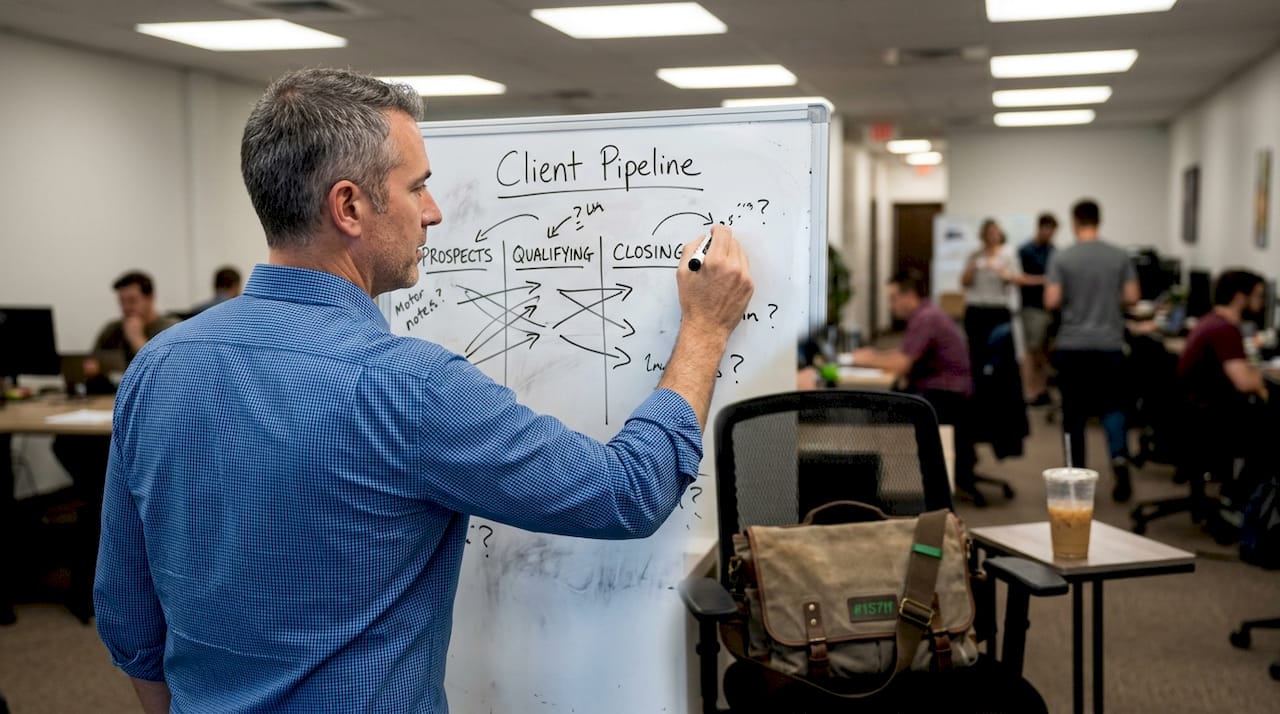
Referrals are great. But they’re passive. You can’t control timing, volume, or quality. A multi-lane client pipeline gives you control because you’re pulling leads from multiple directions at once.
Here’s a three-lane framework worth building:
- Local community visibility: Post helpful, relevant content on platforms like Nextdoor or local Facebook groups. Show up as the expert before anyone asks.
- Search-friendly website: A simple, optimized site that answers the questions your ideal clients are already Googling. This works while you sleep.
- Cross-referral partnerships: Connect with non-competing service providers who serve the same clients. A bookkeeper and a business coach, for example, are natural referral partners.
The small business growth research backs this up: combining local visibility, a searchable web presence, and structured partnerships creates a more resilient and consistent lead flow than any single channel.
Pro Tip: Start with one lane, get traction, then add the next. Trying to build all three at once usually means building none of them well. Check out these pipeline kickstart tactics to get moving fast.
Optimize local SEO and Google profile to capture high-intent clients
Next, let’s supercharge your visibility where high-intent clients search first, locally.
Here’s a stat worth paying attention to: “near me” searches result in a 70% likelihood of a visit and a 50% chance of a purchase. These aren’t browsers. These are buyers.
Claiming and optimizing your Google Business Profile is one of the highest-ROI moves you can make. It’s free, it’s fast, and most of your competitors haven’t done it properly.
Here’s what to prioritize:
- Complete every field: Business name, category, description, hours, and service areas
- Add recent photos: Businesses with photos get significantly more clicks
- Collect reviews actively: Ask every happy client. Respond to every review, good or bad
- Post updates regularly: Google rewards active profiles with better visibility
To give you a clearer picture, here’s a quick action table:
| Action | Impact | Time to complete |
|---|---|---|
| Claim Google Business Profile | High | 30 minutes |
| Add 10+ recent photos | Medium-High | 1 hour |
| Request 5 new reviews | High | 1 week |
| Write keyword-rich description | Medium | 20 minutes |
| Post a weekly update | Medium | 15 min/week |
For more SEO and content marketing insights that apply to service businesses, the blog is a solid starting point.
Content marketing and SEO: Compound your lead flow
Local SEO brings clients in the door. Now let’s multiply inbound leads with valuable content.
Content marketing is slow at first. Then it compounds. A real-world case study showed a 175% organic lead increase in just 5 months through intent-targeted content and technical SEO fixes. That’s not a fluke. That’s what happens when you consistently answer the questions your ideal clients are already searching for.
Here’s how to build a simple content engine:
- Identify 10 questions your best clients asked before hiring you
- Write one article per question, optimized for the specific search term
- Add a clear call to action at the end of each piece (book a call, download a guide, etc.)
- Repurpose each article into a LinkedIn post, email, or short video
- Track rankings monthly and update articles that are close to page one
Here’s a comparison that puts it in perspective:
| Metric | Content-led (6 months) | Referral-led (6 months) |
|---|---|---|
| Lead volume | Growing, compounding | Flat, unpredictable |
| Cost per lead | Decreasing over time | Variable, uncontrolled |
| Client quality | Intent-matched | Mixed |
| Scalability | High | Low |
“Educational content that targets buyer intent doesn’t just generate traffic. It pre-sells your expertise before a prospect ever reaches out.” This is why service business content marketing consistently outperforms cold outreach for long-term lead flow.
Automate repetitive workflows to unlock time and improve client experience
After generating more leads, you need to scale service without burning out. Automation is how you win here.
Here’s a number that should motivate you: acquiring new customers costs 5 to 7 times more than retaining existing ones. So delivering a great experience consistently isn’t just nice to have. It’s a growth strategy. Automation helps you do that without adding hours to your week.
Start by identifying what you repeat. Then automate it. Common wins include:
- Client onboarding: Welcome emails, intake forms, and contract delivery triggered automatically
- Follow-up sequences: Automated check-ins after project milestones or proposals
- Invoicing and billing: Recurring invoices sent without manual effort
- Scheduling: Let clients book directly via Calendly or similar tools
- Feedback collection: Post-project surveys sent automatically to gather testimonials
Tools worth exploring: HoneyBook, Dubsado, Zapier, and Notion with automation integrations.
Pro Tip: Map out your current client journey from inquiry to invoice. Every step you do manually more than twice is a candidate for automation. Explore productivity automation tips to see what’s possible for solo operators.
The payoff? Automated workflows can reduce delivery time by 30 to 40%, freeing you to take on more clients or simply reclaim your time.
Build a trust-first foundation to outperform paid ads
Along with automation, the most overlooked growth hack is making trust your core asset.
Paid ads can work. But for most service businesses, especially early on, they’re expensive experiments. Social proof converts better and costs less. Positioning built on proof through case studies and testimonials consistently outperforms paid ads until your offer is validated and your targeting is dialed in.
Here’s what trust-building actually looks like in practice:
- Written testimonials: Short, specific quotes from real clients about real results
- Case studies: Before and after stories with measurable outcomes (“went from 2 leads/month to 14”)
- Video testimonials: Even a 60-second phone video from a happy client is powerful
- Social proof on your website: Logos, review counts, and results prominently displayed
- LinkedIn recommendations: Publicly visible and searchable by prospects
“Trust isn’t built through clever copy. It’s built through demonstrated results. The businesses that scale fastest are the ones that make their clients’ wins visible.” This is the core of establishing trust and authority as a service provider.
Start collecting proof now, even if your business is early stage. Every project is an opportunity.
Why diversifying your growth channels beats quick fixes
You’ve seen the proven hacks. Now let’s dig into what truly sustains growth long term.
Real talk: most service business owners I’ve talked to are always chasing the next tactic. A new platform. A new script. A new funnel. And I get it. Quick wins feel good. But here’s the uncomfortable truth: no single channel will carry you forever.
I’ve seen this play out with clients who crushed it on LinkedIn for 18 months, then the algorithm shifted and leads dried up overnight. Or consultants who built their whole pipeline around one referral partner, only to have that partner change industries. Fragility is the real enemy of growth, not lack of tactics.
The businesses that grow consistently aren’t the ones with the cleverest hack. They’re the ones who invested in client pipeline resilience by building multiple channels that reinforce each other. Content builds trust. Local SEO drives inbound. Partnerships fill gaps. Automation keeps delivery tight.
Channel discipline, not channel hopping, is what creates real momentum. When one source slows down, the others carry you. That’s not luck. That’s a system.
Turn these hacks into consistent revenue with the right system
These hacks work. But applying them one by one, without a structure, often leads to patchy results.
Consistent growth comes from running these strategies inside a repeatable, trackable system. That’s exactly what we’ve built at GeneratingPipeline.com. Whether you want to avoid revenue gaps with a smarter approach to client acquisition, or you’re ready to start growing your client pipeline from scratch, we have frameworks, tools, and lessons designed for busy service pros. Explore more proven revenue growth strategies and find the right starting point for where you are right now.
Frequently asked questions
What is the fastest way to attract new clients to a service business?
Optimizing your Google Business Profile and local SEO is the fastest way to reach clients actively looking to buy, especially for local service businesses. These searchers already have buying intent, so the conversion rate is much higher than cold outreach.
Why should I package my service as an outcome-based offer?
Outcome-based offers make buying easier for clients and help you avoid underpricing and endless negotiation. Three clear tiers reduce decision friction and anchor value to results, not hours.
How important is a multi-lane client pipeline?
A multi-lane pipeline protects you from unreliable referrals and ensures a steady stream of clients. When one channel slows, the others keep leads coming in.
Does workflow automation help grow my service business?
Yes. Automating workflows can speed up service delivery by 30 to 40% and increase retention since you can focus more energy on client experience rather than admin tasks.
What matters more, ads or trust-building for client growth?
Early on, visible social proof and case studies convert better than paid ads. Trust-first positioning outperforms paid ads until your offer is validated and your targeting is refined.
