TL;DR:
- Proposals are the true sales tool that convert leads into clients.
- An effective proposal clearly addresses the client’s problem, solution, scope, timeline, and investment.
- Tracking and refining proposal conversion rates boosts overall sales performance and revenue.
How proposals convert leads into clients: a complete guide
Most independent business owners think of a sales proposal as a formality. You’ve had the call, the prospect seems interested, so you send over a document and wait. But here’s the thing: the proposal isn’t the follow-up to the sale. It is the sale. Your proposal conversion rate measures exactly what percentage of your sent proposals turn into closed deals, and for most service businesses, it’s the single clearest signal of how well your entire sales process is working. Get this right, and everything downstream gets easier.
Table of Contents
- Why proposals are pivotal in the sales process
- What makes an effective sales proposal
- Measuring the impact: proposal conversion rates
- From proposal to client: practical techniques for higher close rates
- What most business owners miss about sales proposals
- Enhance your sales process with proven resources
- Frequently asked questions
Key Takeaways
| Point | Details |
|---|---|
| Proposals drive conversions | Sales proposals are the critical bridge between lead generation and client acquisition. |
| Structure matters | Effective proposals follow a clear, buyer-centered narrative that makes decision-making easy. |
| Measure for improvement | Tracking proposal conversion rates helps identify and fix weaknesses in your sales process. |
| Action equals results | Applying follow-up techniques and refining your process consistently leads to higher close rates. |
Why proposals are pivotal in the sales process
Having established the impact proposals have, let’s clarify exactly why they matter so much in your sales process.
A lot of service business owners focus their energy on generating leads. That’s important, no question. But there’s a gap that often gets ignored: the space between a warm, interested lead and a signed client. Proposals live in that gap. They’re the bridge. And if that bridge is shaky, you’ll watch perfectly good leads fall through every single time.
Think about the other tools in your sales arsenal. A verbal pitch is flexible and personal, but it’s forgettable. An email introduces you and your offer, but it lacks structure and depth. A LinkedIn message opens a door, but it can’t close a deal. A sales proposal, done well, does something none of those can: it gives a prospect everything they need to say yes, in a clear and compelling format, at the exact moment they’re deciding.
Here’s a quick comparison of how proposals stack up against other common sales assets:
| Sales asset | Strengths | Limitations |
|---|---|---|
| Verbal pitch | Personal, adaptable | Forgettable, no record |
| Fast, scalable | Low depth, easily ignored | |
| LinkedIn message | Relationship-building | Too brief to close |
| Sales proposal | Structured, buyer-focused | Requires effort to do well |
The proposal wins when it comes to converting, because it forces clarity. Both for you and for the buyer.
Proposal conversion rate is tracked as a diagnostic metric for sales effectiveness, meaning it tells you where your process is breaking down. If you’re sending ten proposals and closing one, the problem probably isn’t your lead generation. It’s your proposal quality, your follow-up, or the fit of the client. That’s genuinely useful information.
Here’s what a strong proposal does for your consulting sales process:
- Recaps the problem the prospect told you about (shows you listened)
- Positions your solution as the specific answer to that problem
- Lays out exactly what they’ll get and when
- Sets the investment clearly, without surprises
- Gives them a simple next step to move forward
“The best proposal isn’t the most detailed one. It’s the one that makes the decision obvious.”
That’s the mindset shift. A proposal isn’t a brochure or a spec sheet. It’s a decision-making tool. And as part of a well-designed client acquisition strategy, it’s often the highest-leverage piece you can improve.
What makes an effective sales proposal
Now that you know proposals are pivotal, let’s break down what separates the winners from the rest.
Most proposals that don’t convert share a common flaw: they’re seller-centered, not buyer-centered. They talk about the seller’s credentials, the seller’s methodology, the seller’s process. But the prospect sitting on the other end doesn’t care about any of that (yet). They care about their problem and whether you can solve it.
The structure that actually works follows a tight, buyer-centered narrative: problem, solution, scope and deliverables, timeline, investment, next steps. According to the buyer-centered proposal framework, the goal is to make the decision easy and make delivery clear. Those two things. That’s it.
Let’s walk through each element:
- Problem statement: Start by reflecting the prospect’s situation back to them. Use their words if possible. This signals that you understand what’s really going on, not just what they said on the surface.
- Your solution: Now bridge from their problem to your specific approach. Don’t generalize. Tie your solution directly to the problem you just described.
- Scope and deliverables: Be specific about what’s included. Vague deliverables create anxiety. Anxiety kills deals.
- Timeline: Show them what the engagement looks like over time. A simple visual or milestone list works well here.
- Investment: Be direct. Don’t hide pricing. Transparent pricing builds trust and filters out the wrong clients early.
- Next steps: Tell them exactly what to do to move forward. “Reply to this email” or “book a 20-minute call” works. Leaving them to figure it out does not.
Pro Tip: Write the problem statement before you write anything else. If you can’t clearly articulate their problem in two or three sentences, you’re not ready to write the proposal yet. Go back to your notes from the discovery call.
Common pitfalls to avoid:
- Writing a proposal before completing a proper discovery conversation
- Including too many options (three pricing tiers can paralyze rather than help)
- Using industry jargon the prospect won’t recognize
- Making it too long (a focused four-page proposal almost always beats a ten-page one)
- Forgetting to proofread (yes, this still kills deals in 2026)
When you follow a step-by-step sales process, the proposal naturally fits into a sequence where discovery comes first, the proposal follows, and the close becomes a logical conclusion rather than a leap of faith. That sequence matters. Proposals that arrive too early, before real understanding, rarely convert. And proposals that arrive too late, after the prospect has already moved on mentally, don’t either.
For those looking to pair strong proposals with broader consulting business growth ideas, the proposal is often the fastest lever to pull. Improve the conversion rate from 20% to 35% and you’ve just added significant revenue without generating a single new lead.

Measuring the impact: proposal conversion rates
With the mechanics in place, let’s make sure your proposals are not just sent but actually converting into real revenue.
Here’s the formula you need to know:
Proposal conversion rate = (accepted proposals ÷ total proposals sent) × 100
As defined by MonetizeLy’s conversion framework, this is a critical KPI for any service business. Let’s make it concrete with some numbers.
| Proposals sent | Proposals accepted | Conversion rate |
|---|---|---|
| 10 | 2 | 20% |
| 10 | 4 | 40% |
| 10 | 7 | 70% |
So what’s a good benchmark? For most independent service businesses, a healthy target is somewhere between 35% and 50%. If you’re consistently below 30%, something in your process needs attention. If you’re above 60%, you’re either very good at qualifying leads before you write proposals, or you’re under-pricing (worth checking).
Why does tracking this matter so much? Because most service business owners don’t track it at all. They have a rough sense of whether things are going well, but they don’t have data. Without data, you can’t improve systematically. You’re guessing.
Here’s a simple improvement process you can start this week:
- Log every proposal you send. Date, prospect name, deal value, outcome.
- Calculate your current conversion rate. Be honest with yourself.
- Identify patterns in the ones that didn’t close. Was it price? Timing? Fit? Lack of follow-up?
- Make one change to your proposal template based on what you find.
- Track the next 10 proposals and compare.
This isn’t complicated. But it is consistent. And consistent measurement is how good proposals become great ones over time.
Pro Tip: Track not just whether a proposal was accepted or rejected, but when you heard back. If most of your closed deals come within 48 hours and most of your losses drag past two weeks, that’s a signal: fast follow-up matters more than you might think.
For a deeper look at how proposals fit into a broader conversion system, the consultant sales funnel breakdown gives you a useful visual map of where proposals sit in relation to the rest of your sales activity.
From proposal to client: practical techniques for higher close rates
With conversion rates in mind, here’s how to ensure your proposal actually becomes a signed client agreement.
Sending the proposal is not the finish line. It’s the starting gun for the close. A lot of business owners send a proposal and then wait passively, hoping the prospect will come back with a yes. That’s leaving money on the table.
Here’s a straightforward sequence that improves close rates consistently:
- Walk them through the proposal live. If at all possible, present the proposal on a call rather than just emailing it. Walk through each section. Ask if it resonates. This keeps the conversation alive and lets you handle questions immediately rather than via email thread three days later.
- Follow up within 24 hours. Send a short, human message: “Just checking in to see if you had any questions about the proposal.” No pressure. Just presence.
- Address objections before they become blockers. If you know price is typically a concern, acknowledge it proactively in the proposal itself. Something like: “I know this is a significant investment. Here’s how we make sure it pays off for you…”
- Set a clear expiry or decision date. Not as a pressure tactic, but as a way to keep the conversation moving. “This proposal is valid for 14 days” creates a natural checkpoint.
- Make the yes frictionless. Include an e-signature link, a clear payment process, or a one-click booking link. The easier you make it to say yes, the more yeses you’ll get.
The buyer-centered proposal approach extends beyond the document itself. It applies to how you follow up, how you handle questions, and how you frame the next steps. Every touchpoint after the proposal is sent should reinforce the same message: this decision is easy, and I’m here to make it simple.
Pro Tip: When a prospect goes quiet after receiving a proposal, don’t chase with a series of “just following up” emails. Instead, offer something genuinely useful: a new thought about their problem, a relevant example, or a simple question that re-opens the conversation.
Handling objections is a skill worth practicing. Common ones include price (“it’s more than we budgeted”), timing (“we need to wait until next quarter”), and scope (“we only need part of what you’re proposing”). For each of these, your response should come from curiosity, not defensiveness. Ask what they need, then see if the proposal can be adapted.
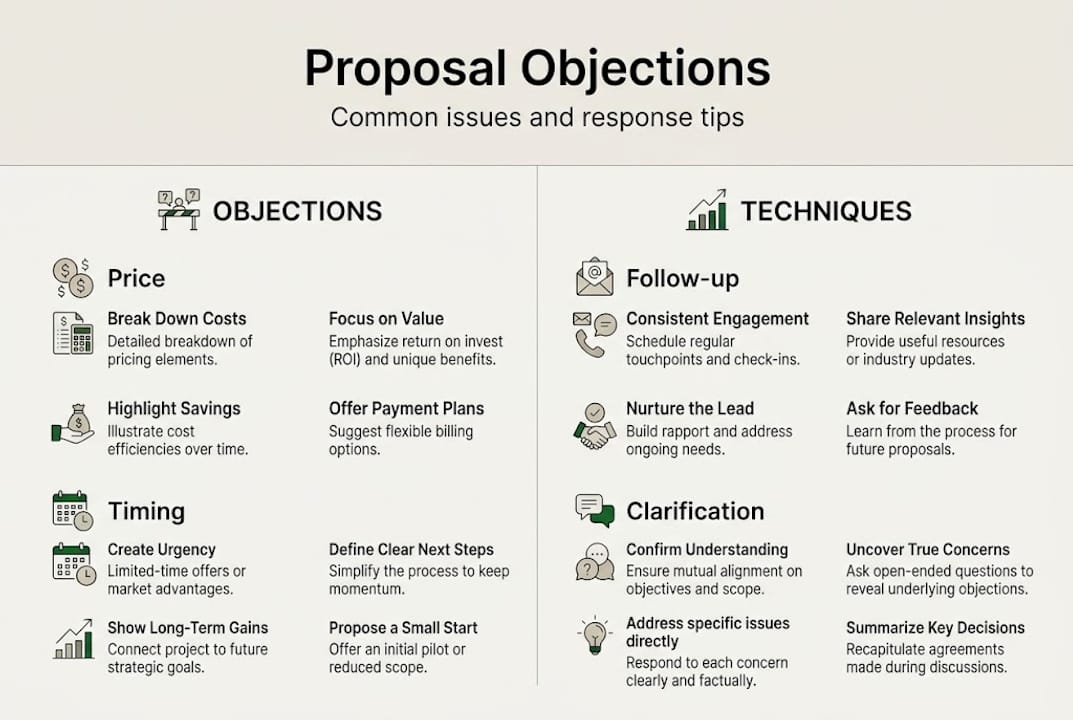
The sales funnel guide can help you see the full picture of how proposal follow-up fits into client conversion, while a refined cold email approach for consultants gives you the tools to warm up leads before they ever reach the proposal stage.
What most business owners miss about sales proposals
Here’s a perspective few articles offer on how proposals really drive your business forward.
Real talk: most independent business owners treat proposals like quotes. They list services, add a price, and hope for the best. That’s not a proposal. That’s a menu. And menus don’t close deals.
What I’ve seen work, again and again, is treating the proposal as the continuation of your sales call. Not a separate document that arrives later, but a written version of the conversation you already had. Every section should remind the prospect of something they told you, something they’re worried about, something they’re excited to achieve.
The other thing most people miss? The next steps section. It’s almost always an afterthought. But it’s actually the most important part of the whole document. If a prospect reads your proposal and doesn’t know exactly what to do next, they’ll do nothing. Clarity on next steps is the difference between a proposal that sits in an inbox and one that converts.
Finally, don’t over-engineer it. A clean, well-structured four-page proposal that speaks directly to the client’s reality will beat an elaborate ten-page document every single time. Simplicity shows confidence. Complexity suggests you’re not sure what they actually need.
Enhance your sales process with proven resources
Now that you’ve learned how to power up your proposals, here are resources to keep your pipeline strong and your sales process sharp.
If your proposals are improving but your pipeline still feels inconsistent, that’s where avoiding revenue gaps becomes critical. A strong proposal strategy works best when there’s a steady stream of qualified prospects to send proposals to.
The Generating Pipeline OS from GeneratingPipeline.com is built for exactly this. It’s a one-time purchase course covering everything from positioning and outreach to sales execution and proposal delivery, with templates and frameworks you can put to work immediately. Whether you want to create a client pipeline from scratch or sharpen an existing one, the pipeline management guide gives you a clear starting point. No sales calls. No webinars. Just practical tools that work.
Frequently asked questions
What is a proposal conversion rate?
Proposal conversion rate is the percentage of sent proposals that result in closed deals, calculated as accepted proposals divided by total proposals sent, multiplied by 100. It’s tracked as a sales effectiveness metric to help identify where your sales process needs work.
What are the essential elements of a winning sales proposal?
A winning sales proposal follows a buyer-centered narrative: client problem, your solution, scope and deliverables, timeline, investment, and clear next steps. Each section builds on the previous one to make the decision obvious and easy.
How can I improve my proposal conversion rates?
Focus on framing proposals around client outcomes rather than your services, present proposals live on a call whenever possible, and consistently track your conversion rate as a KPI so you can refine your approach with real data.
Why do proposals fail to convert leads?
Proposals most often fail when they lack a clear problem statement, use vague deliverables, bury the pricing, or skip actionable next steps. The fix starts with a tighter buyer-centered structure that guides the prospect toward a clear decision.
