TL;DR:
- Testimonials significantly increase purchase likelihood and build trust for service businesses.
- They should be strategically placed at key buyer journey stages and used across multiple channels.
- Authentic, specific testimonials, including case studies and credible sources, are essential for maximum impact.
Most service business owners treat client testimonials like a decoration. They collect a few quotes, paste them on a website, and call it done. But here’s the thing: reviews dramatically lift purchase likelihood — products with just five reviews see a 270% higher chance of being bought compared to those with none, and that number jumps to 380% for higher-priced items. For service businesses, where what you’re selling is often invisible until after the contract is signed, testimonials aren’t just “nice to have.” They’re one of your most powerful sales tools. This article breaks down exactly why they work, where to use them, and how to collect ones that actually move the needle.
Table of Contents
- Why testimonials are crucial for service-based sales
- How testimonials influence the buying journey
- Types of testimonials and how to leverage them effectively
- Building credible testimonials: Pitfalls and best practices
- The real secret: Testimonials as ongoing sales assets, not just website décor
- Enhance your sales strategy with proven tools and expert support
- Frequently asked questions
Key Takeaways
| Point | Details |
|---|---|
| Trust drives sales | Testimonials establish credibility and directly reduce buyer hesitation for service businesses. |
| Strategic placement matters | Positioning testimonials at key points in the buying process increases conversion rates and client acquisition. |
| Case studies outperform quotes | Detailed client stories are more persuasive, especially in B2B scenarios where results are paramount. |
| Credibility is essential | Authentic, well-contextualized testimonials foster trust while fake or vague reviews diminish reputation. |
| Ongoing asset approach | Refreshing and actively using testimonials across sales channels multiplies their impact beyond website decor. |
Why testimonials are crucial for service-based sales
Let’s start with the basics. A testimonial is not the same as a generic online review. A review is what someone leaves on Google or Trustpilot after a transaction. A testimonial is a curated, purposeful statement from a client that speaks to a specific outcome, experience, or transformation they got from working with you. It’s intentional. It’s shaped. And it carries a lot more weight in a sales conversation.
For service businesses, this distinction really matters. When a prospect is considering hiring a consultant, fractional executive, or freelance specialist, they can’t test your product before buying. They can’t return it if it doesn’t fit. What they’re buying is your judgment, your process, and your ability to deliver results they can’t yet see. That’s a significant leap of faith.
This is where social proof comes in. As Zendesk explains in their breakdown of customer testimonials, testimonials build credibility by showing real client experiences, which directly reduces the hesitation buyers feel about intangible services.
“Testimonials provide social proof, reducing buyer hesitation for service-based businesses by showing that real clients have already taken the leap and gotten results.”
Think about it from your prospect’s perspective. They’re scanning your website, trying to figure out whether you’re worth the investment. A well-placed testimonial from someone in a similar role or industry instantly says, “Someone like you already tried this, and it worked.” That’s the psychological shortcut that testimonials provide. And it works.
Here are the core psychological drivers that make testimonials so effective:
- Relatability: When a testimonial comes from someone in the same industry or role as the prospect, it feels relevant and trustworthy
- Specificity: Vague praise means little; outcomes and numbers make testimonials credible and persuasive
- Authority transfer: A well-known client name or title lends credibility by association
- Risk reduction: Seeing that others took the same step and succeeded makes the decision feel safer
- Validation: Prospects in the research phase use testimonials to confirm they’re making a smart call
If you’re also thinking about broader client acquisition strategies, testimonials are one of the most cost-effective assets you can build. They work while you sleep, handling objections before a prospect even books a call with you.
How testimonials influence the buying journey
Understanding why testimonials work is one thing. Knowing where in the buyer’s journey to deploy them is where most service business owners drop the ball.
Let’s map this out. When a prospective client is considering your services, they typically move through three broad stages: awareness, consideration, and decision. Each stage has a different mindset, and testimonials serve a slightly different function at each one.
In the awareness stage, prospects are discovering that they have a problem and starting to look for solutions. Testimonials here should focus on the problem and the transformation. They should say “I was in X situation, and this helped me get to Y.” That resonates with someone who’s just realizing they need help.
In the consideration stage, prospects are comparing options. They’ve found a few potential solutions and are weighing them up. This is where detailed testimonials and case studies shine. The more specific and outcome-focused, the better. A prospect thinking “but will this actually work for my situation?” needs social proof that speaks directly to their context.
In the decision stage, the prospect has mostly made up their mind but is looking for reassurance. This is where a short, punchy quote from a credible client does the job. It’s the final push. It validates their choice before they sign.
To put some numbers behind this: five reviews increase purchase likelihood by 270%, and for higher-priced services (which most consultants and fractional executives offer), that figure climbs even higher. Getting even a handful of strong testimonials in the right places is not optional — it’s essential.
Here are the key touchpoints where testimonials should appear in your sales ecosystem:
- Your website homepage — Above the fold or just below your core value proposition
- Your services or offerings page — Directly next to the service being described
- Outreach emails and follow-ups — Embedded as short social proof snippets
- Proposals and decks — Included as relevant client stories near pricing sections
- LinkedIn profile and posts — Repurposed as content or featured in your “About” section
- Sales calls — Referenced verbally when addressing hesitation or objections
Pro Tip: Don’t just dump testimonials on a single “reviews” page that nobody visits. Distribute them across your most visited pages and highest-intent touchpoints. The closer a testimonial is to a decision moment, the more impact it has.
For anyone building consultant sales funnel tips into their broader strategy, treating testimonials as intentional funnel assets rather than an afterthought is one of the most immediate improvements you can make. And if you’re thinking about the longer game, consulting business growth ideas often come back to credibility. Testimonials are foundational to that.
Types of testimonials and how to leverage them effectively
Not all testimonials are created equal. The format you use should match your audience, your offer, and where the prospect is in their decision process.
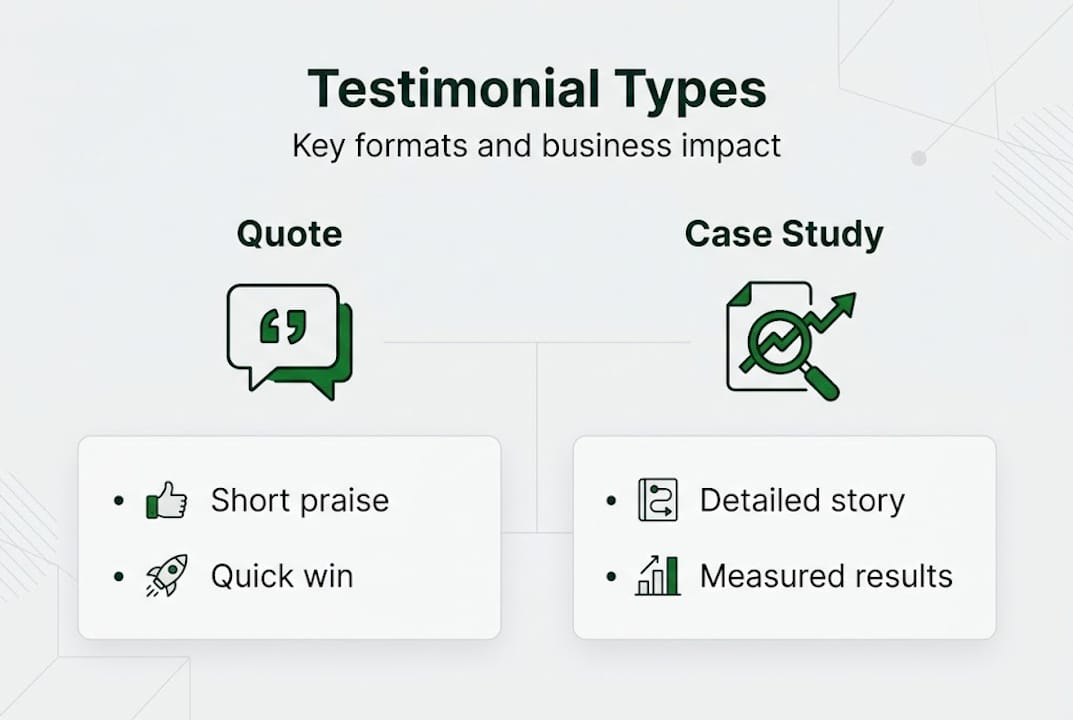
Short quotes are the most common format. A sentence or two from a happy client. They’re easy to collect, easy to display, and work well as quick validation. The downside? They rarely tell the full story, and in B2B service sales, buyers want context.
Detailed case studies are the heavyweights. They walk through the client’s situation before working with you, what you did together, and the measurable outcome afterward. According to research on peer proof in B2B buying, case studies outperform short quotes for B2B services because they reshape how buyers perceive value, especially through the lens of “hidden influencers” within buying committees who need hard evidence to champion your solution internally.
Anonymous testimonials with context fall somewhere in between. Not every client can go on the record publicly. That’s fine. An anonymous testimonial can still be powerful if you provide the right context.
Here’s a quick comparison to help you decide what to use and when:
| Testimonial type | Best for | Impact level | Ideal placement |
|---|---|---|---|
| Short quote | Quick validation, top of funnel | Medium | Homepage, email signature |
| Detailed case study | Decision stage, B2B buyers | High | Proposals, services page |
| Anonymous with context | Industries with NDAs or sensitive clients | Medium-high | Sales calls, proposals |
| Video testimonial | Trust-building, high-consideration offers | Very high | Homepage, LinkedIn |
A few tips for collecting and displaying testimonials effectively:
- Ask immediately after delivery — This is when the client’s experience is freshest and most specific
- Give them a framework — Ask about the situation before, what changed, and the specific result. This structures a better story
- Use their words, not yours — Editing kills authenticity. Keep it genuine even if it’s imperfect
- Tag testimonials by industry or role — This makes it easy to pull the right one for the right prospect
- Rotate them regularly — Fresh testimonials signal that your business is active and growing
If you want to get deeper into the business development best practices around credibility and positioning, testimonials are usually the first place to start because they cost nothing but a good relationship.
Building credible testimonials: Pitfalls and best practices
Here’s where it gets a little uncomfortable. Not every testimonial is doing what you think it’s doing. Some testimonials actively hurt your credibility, and it’s worth knowing the difference.
The most obvious risk is fake testimonials. Whether they’re invented entirely or heavily embellished, fake reviews erode trust and consumers are increasingly savvy at spotting them. Beyond the trust damage, there are real legal risks in some markets. This isn’t worth it — ever. Especially when getting authentic ones isn’t that hard if you approach it right.
Here’s a simple data table to help you distinguish credible testimonials from those that raise red flags:
| Indicator | Credible testimonial | Red flag |
|---|---|---|
| Specificity | Names a real outcome or metric | Vague praise with no detail |
| Source context | Includes role, industry, or company size | No attribution at all |
| Tone | Sounds human, slightly imperfect | Overly polished or corporate |
| Recency | Within the past 1 to 2 years | Undated or clearly outdated |
| Consistency | Aligns with your actual offer claims | Sounds like it could be for any service |
The right way to approach past clients for testimonials is direct and low-pressure. Don’t ask “Can you write me a testimonial?” That’s too open-ended and most people procrastinate on it. Instead, ask a specific question like, “What was the most valuable thing that changed after we worked together?” Then ask if you can quote them on that. Simple. Personal. Effective.
Pro Tip: For clients who prefer to stay anonymous (which happens often in B2B and consulting), you can still use their words. Just add context like “Senior Marketing Director at a Series B SaaS company” or “Independent Consultant, 15 years in financial services.” That context preserves the impact without exposing the individual.
If you’re also using cold email for client outreach, weaving in a well-placed testimonial snippet can significantly boost response rates. And if you’re thinking about consulting revenue growth more broadly, having a bank of strong testimonials to draw from gives you material to repurpose across every channel.
The real secret: Testimonials as ongoing sales assets, not just website décor
Okay, real talk. Most service business owners collect a testimonial, slap it on their homepage, and never touch it again. That’s leaving a huge amount of value on the table.
The best testimonials are living assets. They should show up in your proposals, your outreach emails, your LinkedIn posts, and yes, your actual sales conversations. I’ve seen consultants handle objections live on a call by saying, “Actually, one of my clients had the exact same concern before we started. Here’s what they said afterward…” That’s testimonial use at its most powerful. It’s not showing a screenshot. It’s telling a story.
A lesson I’d share from experience: make testimonial collection a standard part of your post-project workflow. Don’t wait until you need one. Build the ask into your offboarding process so it becomes automatic, not awkward.
One more thing. Your competitors probably have testimonials on their websites too. What they don’t do is use them in consultant sales conversations and proposals in a strategic, contextual way. That’s your edge.
Refresh your testimonial bank every six months. Retire outdated ones. And actively think about which testimonial fits which prospect type. When you treat testimonials as dynamic sales tools rather than static decorations, the impact is completely different.
Enhance your sales strategy with proven tools and expert support
If you’ve made it this far, you already understand that testimonials aren’t just feel-good quotes. They’re part of a bigger system for building trust, reducing friction, and winning clients consistently.
But testimonials are just one piece of a repeatable pipeline. If you want to avoid the revenue gaps that come with inconsistent client flow, you need a full system behind them. At GeneratingPipeline.com, we help freelancers, consultants, and fractional executives build that system from the ground up. Whether you’re starting from scratch or looking to scale what’s already working, check out our resources on client pipeline growth. And if you want quick wins you can use right now, grab our free guide packed with quick revenue strategies to get you moving faster.
Frequently asked questions
Do testimonials actually increase sales for service businesses?
Yes. Testimonials build trust and credibility by showing real client experiences, which is especially powerful for service businesses where results aren’t visible before purchase.
How many testimonials are needed for maximum impact?
Quality and placement matter more than volume, but even five reviews boost purchase likelihood by 270%. Start with five strong, specific ones and build from there.
Is it okay to use anonymous testimonials?
Yes, as long as you provide context like the client’s role or industry. As credibility guidelines note, anonymous testimonials with context are acceptable, but fake or unattributed ones erode trust.
What’s the difference between a quote and a case study testimonial?
A short quote provides quick validation, while a case study demonstrates real outcomes with context and data. Case studies outperform quotes for B2B services, especially where multiple decision makers are involved.
How can I ensure my testimonials are credible and not seen as fake?
Source them directly from real clients, include specific outcomes, and add attribution details. Fake reviews damage trust and carry real legal and reputational risks that simply aren’t worth taking.
