TL;DR:
- Consultative selling focuses on understanding client needs through active listening and tailored solutions.
- It leads to higher client retention, more referrals, and significant revenue growth for service businesses.
- Consistent implementation of discovery, needs analysis, and follow-up is essential for success.
Most people think selling is about talking. You pitch your services, explain your value, and hope the prospect says yes. But that model is broken, especially for service-based businesses where trust is the actual product. Consultative selling flips the script entirely. Instead of presenting a solution before you really understand the problem, you spend time listening, asking smart questions, and building a real picture of what your client needs. It sounds simple, but very few people actually do it well. This article breaks down what consultative selling is, why it matters for independent practices, how to implement it, and how to make it a permanent part of your client pipeline.
Table of Contents
- What is consultative selling?
- Why consultative selling matters for service-based businesses
- Core stages and techniques of consultative selling
- How to integrate consultative selling into your client pipeline
- Our take: The reality of consultative selling in independent practices
- Take action: Build your consultative selling-driven pipeline
- Frequently asked questions
Key Takeaways
| Point | Details |
|---|---|
| Build client trust | Consultative selling strengthens client relationships and makes future sales easier. |
| Increase retention | Focusing on client needs leads to higher repeat and referral rates. |
| Follow a structured process | A step-driven approach brings consistent client wins for service businesses. |
| Integrate with your pipeline | Applying consultative selling to every stage boosts conversion and satisfaction. |
| Avoid common pitfalls | Listen deeply and don’t rush discovery for maximum consultative selling results. |
What is consultative selling?
Consultative selling is an approach to sales that puts the client’s needs at the center of every interaction. Rather than leading with what you offer, you lead with curiosity. You ask questions, listen carefully, and work to understand what the client is actually trying to solve before you ever mention your services.
The difference between consultative selling and traditional (transactional) selling comes down to intent. Transactional selling is focused on speed and volume. Get the deal. Move on. Consultative selling, on the other hand, is built on trust, understanding, and genuine partnership. As the consulting sales process makes clear, consultative selling focuses on understanding client needs and providing tailored solutions rather than generic pitches.
Here’s a quick comparison to make this concrete:
| Factor | Traditional selling | Consultative selling |
|---|---|---|
| Primary focus | Closing the deal | Solving the client’s problem |
| Conversation style | Pitch-led | Question-led |
| Relationship depth | Short-term transaction | Long-term partnership |
| Value delivered | Product or service | Expertise and insight |
| Sales cycle | Often rushed | Deliberately paced |
| Client experience | Pressure to decide | Supported to decide |
The three core principles that drive consultative selling are:
- Active listening: You’re not just waiting for your turn to talk. You’re genuinely absorbing what the client says and reading between the lines.
- Needs assessment: Before any solution, you map out what the client actually needs, not what you assume they need.
- Partnership mindset: You position yourself as an advisor, not a vendor. The client should feel like you’re on their team.
“The best salespeople I’ve ever seen don’t feel like salespeople at all. They feel like someone who really gets your situation and happens to know exactly what to do about it.”
This quote captures the real magic of consultative selling. When you do it right, the sale feels like a natural next step, not a negotiation. For service-based businesses built on expertise, this isn’t just a nice-to-have. It’s the approach that separates the practices growing through referrals from the ones constantly chasing cold leads with generic pitches.
Why consultative selling matters for service-based businesses
Now that you know what consultative selling is, let’s look at why it delivers substantial value for service-based organizations.
When you sell expertise and time (which is exactly what freelancers, consultants, fractional executives, and micro agency owners do), every client relationship is also a reputation. Lose a client’s trust, and you don’t just lose that contract. You lose referrals, testimonials, and social proof. Win their trust and deliver real results, and they stick around, upgrade their engagement, and bring you their network.

Consultative selling directly supports all of this. Clients who feel heard and understood are far more likely to stay. They’re also more likely to refer others because they trust that you’ll treat their connections the same way. Strong revenue growth strategies consistently point to the same outcome: consultative selling leads to higher client retention and more referrals, which are two of the most powerful levers for growing an independent practice.
Here’s how improved retention and referral frequency can affect your revenue over time:
| Metric | Low retention (60%) | High retention (85%) |
|---|---|---|
| Clients retained year 2 | 6 of 10 | 8.5 of 10 |
| Revenue from renewals | $60,000 | $85,000 |
| Referrals generated | 1-2 per year | 4-6 per year |
| New revenue from referrals | $15,000 | $50,000 |
| Total year 2 revenue | ~$75,000 | ~$135,000 |
Illustrative example assuming 10 clients at $10,000 each. Your numbers will vary, but the directional impact is consistent.
The difference is significant. And it doesn’t come from more outreach or a better pitch deck. It comes from building relationships where clients feel genuinely understood.
Beyond retention, consultative selling also opens the door to natural upselling. When you’ve done a thorough needs assessment upfront, you already know where the gaps are. Exploring business growth ideas becomes much easier when you understand a client’s full situation, not just the problem they hired you to fix.
Pro Tip: After your first engagement milestone, revisit the original needs assessment with your client. Ask what’s changed and what new challenges have emerged. This one habit alone can surface upsell opportunities without ever feeling pushy.
Here are the tangible benefits consultative selling brings to service business owners:
- Shorter sales cycles because prospects trust you faster
- Higher close rates because your solution is tailored, not generic
- Stronger client relationships that lead to repeat work
- More referrals from satisfied, loyal clients
- Reduced price sensitivity because value is clearly communicated
- Greater job satisfaction because the work feels collaborative, not transactional
Core stages and techniques of consultative selling
Understanding the impact of consultative selling sets the stage for mastering the actual process. Here’s how to implement it step by step.
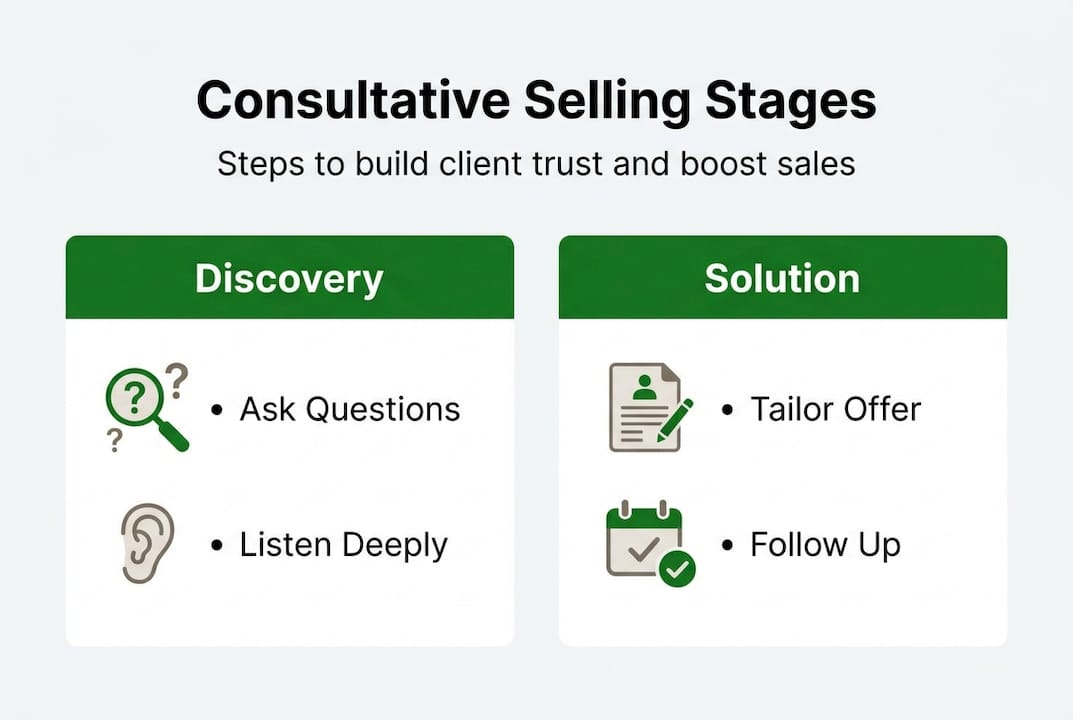
Consultative selling isn’t a single conversation. It’s a sequence of stages, each with a specific purpose. Skipping a stage or rushing through it is where most people go wrong. A solid step-by-step sales process leads to consistent client acquisition because it removes the guesswork and gives you a repeatable structure to follow.
The five stages of consultative selling:
-
Discovery: This is where everything starts. You’re not pitching anything yet. You’re asking open-ended questions to understand the client’s world. Their goals, their challenges, their past experiences, and what success looks like to them.
-
Needs analysis: Once you’ve gathered information in discovery, you synthesize it. What are the root causes of their challenges? What outcomes do they actually need (not just what they say they want)? This step requires real analytical thinking.
-
Solution development: Now you shape your offer around what you’ve learned. This is where your expertise shines, not because you’re showing off, but because you’re applying it directly to their situation. A generic proposal rarely wins. A tailored one almost always does.
-
Proposal and presentation: Present your solution in their language, framed around their goals and their specific pain points. Include clear outcomes and explain how you’ll measure success. This stage is far easier when stages 1 through 3 are done well.
-
Follow-up and partnership: After you win the client, keep the consultative mindset active. Regular check-ins, proactive advice, and honest feedback sessions are what turn a one-time client into a long-term relationship.
Key techniques to use throughout the process:
- Open-ended questions: “What’s the biggest challenge slowing you down right now?” beats “Do you have a budget?” every time.
- Reflective listening: Paraphrase what you hear. “So it sounds like the real issue is X, not just Y?” This confirms understanding and shows the client you’re paying attention.
- Value mapping: Tie every feature of your offer back to a specific outcome the client told you they care about. Never assume the connection is obvious.
- Silence as a tool: After asking a question, let the client talk. Resist the urge to fill the silence with more selling.
Pro Tip: The most common mistake in consultative selling is rushing through discovery because you think you already know the answer. Even if you’ve solved this problem a hundred times, this client is new. Their specific context matters. Spend at least twice as long on discovery as you think you need to.
Real-world example: Imagine you’re a fractional CMO reaching out to a growing SaaS company. Instead of leading with your credentials, you open with: “What does your current pipeline look like, and where are leads falling off?” That one question tells you more about their actual need than any intake form. From there, you can build a tailored proposal around their exact gap, whether that’s awareness, conversion, or retention. A strong client acquisition strategy is built on exactly this kind of precision.
How to integrate consultative selling into your client pipeline
Once you know the techniques, it’s time to weave them into your core client pipeline for sustained results.
Knowing how to do consultative selling is one thing. Actually doing it consistently, across every prospect and every client engagement, is where most independent business owners struggle. It’s easy to be consultative in a first discovery call. It’s harder to maintain that discipline when you’re busy, when the deal seems close, or when a client is ready to sign before you’ve done the work.
That’s why integration matters. You want consultative selling baked into your pipeline, not layered on top of it as an afterthought. Strong consultant sales funnels are built on reliable client conversion, and that reliability comes from process, not just personality.
Here’s how to make consultative selling a regular part of how you operate:
- Create a discovery template: Document your go-to questions for first calls. Customize them by client type, but always have a starting framework. This keeps your discovery consistent and thorough even when you’re tired or distracted.
- Use a simple CRM to track client insights: You don’t need anything fancy. Even a spreadsheet works. The goal is to record what clients tell you about their goals, fears, and priorities so you can reference it in future conversations.
- Tailor every proposal: Never send a generic document. Reference specific things the client told you. Quote their own words back to them when describing the problem you’re solving. This signals that you actually listened.
- Build in checkpoint conversations: At 30, 60, and 90 days into any engagement, schedule a conversation that isn’t about deliverables. Ask how things feel, what’s changed, and what new challenges have come up.
- Review and refine your process regularly: After every engagement (won or lost), ask yourself what you learned about the client’s needs and how well you uncovered them. This builds your consultative instincts over time.
Pro Tip: Use your CRM notes before every client call, even a routine check-in. Reviewing what the client told you three months ago and asking a follow-up question based on that shows a level of care and attentiveness that most service providers never demonstrate. It’s one of the fastest ways to become a trusted advisor rather than just another vendor.
Common mistakes to avoid when integrating consultative selling into your pipeline:
- Treating discovery as a one-time event rather than an ongoing practice
- Forgetting to revisit client needs when you expand the scope of work
- Letting automation replace human judgment in follow-up communication
- Pitching too early in the pipeline before trust is established
- Measuring success only by deals closed, not by relationship depth
The goal isn’t perfection. It’s consistency. Even applying consultative principles to 70% of your client interactions will produce measurable improvements in retention, referrals, and close rates over time.
Our take: The reality of consultative selling in independent practices
Here’s the honest truth. Consultative selling is genuinely powerful, but it’s not a silver bullet. I’ve seen smart, experienced people learn the framework, apply it for two or three calls, and then quietly slip back into pitch mode when they feel pressure to close. That’s the real challenge.
What separates the people who succeed with consultative selling from those who don’t isn’t knowledge. It’s discipline. And, honestly, genuine curiosity. You have to actually care about what the client is trying to do. If you’re asking discovery questions just to check a box, clients feel it. They’re not stupid.
The practices that get the most out of consultative selling are the ones where the owner is authentically curious about clients. They love asking questions. They find the problem-solving genuinely interesting. That mindset doesn’t just improve the sales process, it improves the work itself.
If you want to build that mindset intentionally, start by studying your existing clients more deeply. What did they actually get out of working with you? What changed in their business? What problems are still unsolved? These expert secrets are already inside your current client relationships. You just have to go looking for them.
Real talk: consultative selling will slow you down at first. Your calls get longer. Your proposals take more time. But the quality of what you close is dramatically better, and that compounds over years.
Take action: Build your consultative selling-driven pipeline
If you’re ready to make consultative selling the backbone of your client growth, the next step is putting the right structure around it.
At GeneratingPipeline.com, we’ve built resources specifically for independent service providers who want a repeatable, trustworthy pipeline that doesn’t rely on luck or referrals. From frameworks to help you avoid revenue gaps consulting to step-by-step guides on how to create a client pipeline that grows with you, there’s a clear path forward. The Generating Pipeline OS walks you through positioning, outreach, sales conversations, and delivery, everything you need to make consultative selling your default mode, not a one-off experiment.
Frequently asked questions
How is consultative selling different from transactional selling?
Consultative selling focuses on client needs and providing tailored solutions, while transactional selling prioritizes speed and closing over understanding the buyer’s actual problem.
What types of businesses benefit most from consultative selling?
Service-based businesses and those that depend on long-term relationships benefit most, because higher client retention and referrals are directly tied to trust-based selling.
Can consultative selling work for freelancers and small practices?
Absolutely. Freelancers and small practices can integrate consultative selling into their pipelines to build trust faster and boost reliable client conversion without a large sales team.
What are common mistakes when starting consultative selling?
Rushing the discovery phase and not listening deeply enough are the most frequent errors. A consistent client acquisition process only works when discovery is thorough, not hurried.
How do you measure success in consultative selling?
Track client retention rates, repeat business, and referral volume. These metrics reflect the real impact of trust-based selling far more accurately than close rates alone.
