TL;DR:
- Recurring revenue provides predictable, contractual income that stabilizes business cash flow.
- Building value through client retention and systemic service delivery outweighs solely focusing on long-term contracts.
- Accurate measurement and communication of recurring revenue are crucial for credibility and attracting investment.
Most independent service providers spend every single month chasing the next client. New leads, new proposals, new projects. It’s exhausting, and honestly, it doesn’t have to be that way. The truth is, a shift toward recurring revenue can dramatically smooth out your income, reduce the anxiety of an empty pipeline, and make your business far more resilient. And here’s the thing: recurring revenue isn’t just for software companies or big agencies. Freelancers, consultants, fractional executives, and micro agency owners can all build it. You just need to know where to start.
Table of Contents
- Defining recurring revenue: What it is (and what it isn’t)
- Popular recurring revenue models for service businesses
- Why retention is the real profit lever: The math and the mindset
- How to measure and communicate recurring revenue: What counts, what doesn’t
- How investors and buyers evaluate recurring revenue quality
- The recurring revenue myth: What service businesses really need to know
- Build stable income with smarter pipelines and recurring models
- Frequently asked questions
Key Takeaways
| Point | Details |
|---|---|
| Recurring revenue is predictable | It means income contracts or agreements that guarantee payments at set intervals, not just repeat business. |
| Retention drives profit | Small improvements in client retention can dramatically increase your service business’s bottom line. |
| Not all recurring is equal | Contractual, non-discretionary recurring streams are more valuable than occasional repeat work. |
| Measure and report carefully | Only include contracted, predictable revenue when talking about recurring revenue for transparency. |
| Quality matters to buyers | Outside parties value recurring revenue that is stable, contractual, and hard for clients to cancel. |
Defining recurring revenue: What it is (and what it isn’t)
Let’s get clear on the basics first, because there’s a lot of confusion here.
Recurring revenue is predictable income received at regular intervals from ongoing payments like subscriptions, retainers, or contracts. It’s the opposite of one-time project work, where you deliver something, get paid, and then start the hunt all over again. For service businesses, this is a game-changer. When you know that a certain amount of money is coming in each month, you can plan, invest, and grow with confidence.
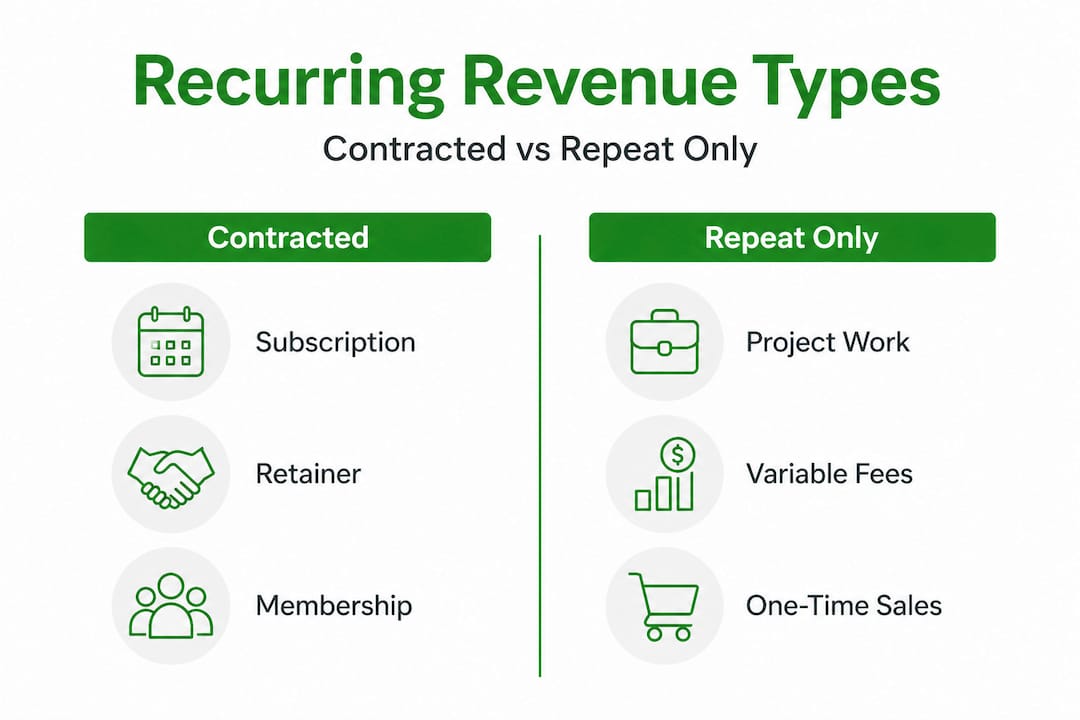
But here’s where a lot of people trip up. They assume that because a client keeps coming back, they have recurring revenue. Not quite. There’s an important distinction between recurring and reoccurring revenue. Not all “recurring” is equal: true recurring revenue is contractual and predictable, while reoccurring revenue means clients repeat purchases without a formal contract or schedule. Think of a client who hires you every quarter for a seasonal project. That’s reoccurring, not recurring. It might feel reliable, but it’s not guaranteed.
This distinction matters a lot for forecasting. If you’re building a budget or trying to plan your capacity, you need to know what’s actually locked in versus what’s just “probably going to happen.”
Here’s a quick breakdown of common revenue types:
| Revenue type | Predictability | Contractual? | Example |
|---|---|---|---|
| Subscription | High | Yes | Monthly strategy retainer |
| Maintenance contract | High | Yes | Ongoing SEO or tech support |
| Reoccurring project | Medium | No | Seasonal copywriting work |
| One-time project | Low | Sometimes | Website redesign |
| Setup or onboarding fee | None | N/A | Initial client onboarding |
When you’re thinking about diversifying freelance income, recurring revenue should be your foundation, not an afterthought. It’s the bedrock that lets you layer other income on top without panic.
Pro Tip: Review your last 12 months of client work. Highlight every engagement that had a formal agreement or contract with a set monthly fee. That’s your true recurring revenue baseline. Everything else is potential, not guaranteed.
The goal is to move as much of your income as possible into that “high predictability, contractual” category. That’s how you start stabilizing your client income instead of riding the feast-or-famine rollercoaster.
Popular recurring revenue models for service businesses
Now that you know what recurring revenue actually is, let’s talk about the models that work best for independent service providers.
There are four main options worth knowing:
Retainers. You agree to provide a set amount of work or availability each month for a fixed fee. Great for consultants, fractional executives, and strategists. Clients pay for your time and expertise on an ongoing basis.

Fixed-scope subscriptions. You productize your service into a defined deliverable that repeats monthly. Think “three blog posts per month” or “weekly social media management.” The scope is clear, the price is fixed, and both sides know exactly what to expect.
Access-based memberships. Clients pay for ongoing access to your knowledge, community, or tools. This works well for coaches, educators, and consultants with a strong point of view.
Maintenance packages. Common in technical services like web development, IT, or marketing. Clients pay a monthly fee to keep things running smoothly.
Here’s a quick comparison to help you figure out which model fits your business:
| Model | Predictability | Best client fit | Admin burden |
|---|---|---|---|
| Retainer | Very high | Ongoing strategic needs | Low |
| Fixed-scope subscription | High | Operational, repeatable tasks | Medium |
| Access membership | Medium-high | Knowledge seekers, communities | Medium |
| Maintenance package | High | Technical or operational clients | Low to medium |
Productizing your service with a fixed scope and price, using value-based pricing tied to outcomes rather than hours, offering pilot discounts to ease the transition, and sending monthly reports are all proven methodologies for making this shift work.
Here’s how to move from project-based to recurring work:
- Identify your most repeatable service (the one clients ask for again and again)
- Define a fixed scope and monthly price for that service
- Offer existing clients a small discount to switch to a monthly agreement
- Create a simple one-page contract that outlines deliverables and payment terms
- Set up automated invoicing so the admin takes care of itself
- Deliver monthly reports to reinforce the value you’re providing
If you’re looking for consulting growth strategies that actually move the needle, adding even one recurring revenue stream can transform your financial picture. And if you want to see real-world consultant revenue stream examples, there are plenty of ways to mix and match these models.
Pro Tip: Start with just one recurring offer. Don’t try to build three models at once. Pick the service you already deliver consistently, package it, and pitch it to your top two or three existing clients first. They already trust you.
Building predictable revenue strategies doesn’t have to be complicated. It starts with one conversation and one contract.
Why retention is the real profit lever: The math and the mindset
Here’s a stat that should stop you in your tracks. A 5% increase in retention can boost profits by 25 to 95 percent. And acquiring a new client costs five to twenty-five times more than keeping an existing one. Read that again.
Most service businesses spend the majority of their energy on acquisition. New leads, new pitches, new clients. But the real profit lever? It’s keeping the clients you already have and growing those relationships over time.
“The best client you’ll ever have is the one already paying you.”
This is a mindset shift as much as a strategy shift. When you’re in recurring revenue mode, your job isn’t just to deliver a service. It’s to consistently demonstrate value so clients never want to leave.
Here are five retention tactics that actually work for independent service providers:
- Deliver proactively, not reactively. Don’t wait for clients to ask for updates. Send a brief monthly summary of what you’ve done and what’s coming next.
- Communicate before problems arise. If something’s going sideways, tell your client before they notice. Trust is built in those moments.
- Tie your work to their outcomes. Show how your service connects to their goals, not just your deliverables. “We published 12 posts” is less powerful than “organic traffic is up 18%.”
- Check in on the relationship, not just the work. A quick “how are things going for you?” goes a long way. Clients stay with people they like.
- Offer a small upgrade or add-on every quarter. This grows the relationship and increases monthly revenue without requiring you to find a new client.
For client acquisition tips and business development strategies that complement your retention efforts, the key is building a system that brings in new clients steadily while your existing base keeps growing. You can also explore digital marketing for consultants to attract the right leads without burning yourself out.
The math is simple. If you have ten clients paying $2,000 per month and you retain all ten for twelve months, that’s $240,000 in predictable revenue. Lose two of those clients and replace them with two new ones? You’ve spent time, energy, and money just to stay in the same place.
How to measure and communicate recurring revenue: What counts, what doesn’t
Okay, so you’re building recurring revenue. Now you need to track it properly. This matters whether you’re reporting to yourself, a business partner, or a potential investor or buyer.
ARR (Annual Recurring Revenue) definitions vary: some businesses use contract-based calculations, others use revenue-based or hybrid approaches. The key is to disclose what you’re including and excluding, how you’re annualizing, and how you’re handling variable usage. Transparency here builds credibility.
Here’s what to include and what to leave out:
| Include in recurring revenue | Exclude from recurring revenue |
|---|---|
| Monthly retainer fees | One-time setup or onboarding fees |
| Fixed subscription payments | Short-term promotional pricing |
| Maintenance contract fees | Variable usage charges |
| Annual contracts (annualized monthly) | Project-based milestone payments |
A quick checklist for calculating your recurring revenue accurately:
- Only count payments tied to a formal agreement or contract
- Exclude any one-time fees, even if they’re large
- Annualize monthly contracts by multiplying by 12
- Don’t include revenue that’s “expected” but not contracted
- Flag any clients on short-term or trial agreements separately
When you’re thinking about diversifying service business revenue, having clean, accurate recurring revenue numbers helps you make smarter decisions about where to focus your energy.
How investors and buyers evaluate recurring revenue quality
If you ever plan to sell your business or bring in a partner, this section matters a lot. And even if you don’t, understanding how outsiders value recurring revenue will help you build a stronger business.
Investors pay a premium for recurring revenue, often two to five times higher multiples than for project-based businesses. But they’re also increasingly scrutinizing the quality of that revenue. Not all recurring revenue is created equal in their eyes.
“The stickier and more necessary your service, the more valuable your recurring revenue becomes.”
Here are the quality signals investors and buyers look for:
- Contract length. Longer contracts signal lower churn risk and more predictability.
- Stickiness. How hard is it for a client to leave? If switching costs are high, your revenue is more secure.
- Necessity. Is your service a “nice to have” or a “must have”? Non-discretionary services command higher valuations.
- Churn rate. Low churn is a green flag. High churn, even with strong new client acquisition, raises red flags.
- Revenue concentration. If one client makes up 50% of your recurring revenue, that’s a risk. Diversification matters.
- Growth trajectory. Is your recurring revenue growing month over month? Flat or declining MRR (Monthly Recurring Revenue) is a concern.
It’s also worth noting that AI and tech trends are adding new scrutiny to revenue quality. Buyers are increasingly asking whether recurring revenue is truly defensible or whether it could be disrupted by automation or changing client needs.
The value of recurring revenue isn’t just in the monthly check. It’s in the signal it sends about your business’s health, reliability, and future potential.
The recurring revenue myth: What service businesses really need to know
Here’s my honest take, and it might surprise you.
A lot of service business owners get so excited about recurring revenue that they start chasing long-term contracts for their own sake. They think the goal is to lock clients in for as long as possible. That’s the wrong mindset.
The real opportunity isn’t in rigid, multi-year contracts. It’s in building services that clients genuinely want to keep paying for because they’re getting real, ongoing results. The best recurring revenue is earned, not locked in.
I’ve seen consultants sign clients to six-month retainers and then scramble to fill the time because they didn’t have a clear, repeatable process. The client gets frustrated, the consultant feels stuck, and the relationship ends badly. That’s not recurring revenue success. That’s just a delayed project.
The businesses that thrive with recurring revenue are the ones that build systems. They have a clear delivery process, regular check-ins, and a way to measure and communicate value every single month. They adapt when client needs change instead of rigidly sticking to a contract scope that no longer fits.
My take: focus on client transformation, not client retention. When your service genuinely moves the needle for clients, retention takes care of itself. You don’t need to lock anyone in. They’ll stay because leaving would mean losing something valuable.
If you’re looking for growth ideas for consulting that are built on this kind of sustainable foundation, start by asking yourself: “Would my clients renew even if they could leave tomorrow?” If the answer is yes, you’re on the right track.
Build stable income with smarter pipelines and recurring models
Understanding recurring revenue is one thing. Actually building it into your business is another. That’s where having the right systems and frameworks makes all the difference.

At GeneratingPipeline.com, we’ve built everything around helping independent service providers like you create consistent, repeatable income without relying on referrals or luck. The Generating Pipeline OS walks you through positioning, outreach, sales, and delivery in a way that naturally supports recurring revenue models. And if you want to start by avoiding pipeline gaps that leave you scrambling each month, that’s a great first move. You can also explore how to build your client pipeline from scratch or grab proven revenue growth hacks to start implementing today. One payment, lifetime access, no sales calls required.
Frequently asked questions
What’s the difference between recurring and reoccurring revenue?
Recurring revenue comes from contracts or ongoing subscriptions with predictable, scheduled payments, while reoccurring revenue means clients repeat purchases without a formal contract or set schedule. The key difference is contractual commitment.
How can service businesses transition to a recurring revenue model?
You can shift by productizing your service into fixed-scope packages, setting up retainer contracts with existing clients, or offering subscription-based access to your expertise. Starting with your most repeatable service is the fastest path.
What counts as recurring revenue for financial reporting?
Only predictable, contracted payments count as recurring revenue. Exclude one-time fees, variable usage charges, and short-term promotional pricing to keep your numbers accurate and credible.
Why do investors value recurring revenue so highly?
Investors pay premium multiples for recurring revenue because it signals predictability, low churn, and business resilience. The stickier and more necessary the service, the higher the valuation premium.
What’s the biggest mistake business owners make with recurring revenue?
The most common mistake is mistaking repeat business for true recurring revenue. If there’s no contract, it’s not guaranteed, and building your forecasts around it will leave you exposed when a client simply doesn’t come back.
Recommended
- Build predictable revenue: unlock growth and peace of mind
- What is a revenue pipeline? A guide for service owners
- Diverse revenue streams guide for freelancers 2026
- 7 reliable ways to stabilize revenue for freelancers
- Ecommerce revenue growth guide: scale smarter, sustain profit – wearebeyondgreatness.co.uk
