TL;DR:
- Most consulting firms now prioritize brand awareness over raw lead volume for client attraction.
- Building trust through consistent content and targeted outreach shortens sales cycles significantly.
- Privacy-first, behavior-based automation enables scalable, personalized engagement in 2026.
Most consultants assume the path to more clients is simple: generate more leads. More outreach, more ads, more volume. But here’s the thing that might surprise you. 86% of consulting firms now list brand awareness as their primary marketing goal for the next 12 months, not just raw lead generation. That’s a fundamental shift in how the consulting industry thinks about client attraction, and if your marketing plan doesn’t reflect it, you’re likely leaving serious revenue on the table heading into 2026.
Table of Contents
- Consultant marketing in 2026: What’s changed?
- Building trust and visibility: Brand awareness takes center stage
- The new automation: Privacy-first personalization and dynamic campaigns
- Practical consultant marketing strategies for measurable results
- Why thinking beyond ‘leads’ is the only path to sustainable consulting growth
- Accelerate your pipeline with proven consulting growth resources
- Frequently asked questions
Key Takeaways
| Point | Details |
|---|---|
| Brand awareness is vital | In 2026, 86% of consulting firms put building brand awareness above all else for growth. |
| New automation wins | Privacy-first, adaptive marketing automation is key for reaching and engaging clients. |
| Unified marketing approach | Combining strong brand, smart automation, and measurable demand generation drives sustained client growth. |
| Relationships over leads | Trust and visibility now matter as much as raw lead volume in consultant marketing. |
Consultant marketing in 2026: What’s changed?
With the need for client attraction evolving fast, the consultant marketing landscape in 2026 looks very different from even two years ago. It used to be straightforward: cold outreach, referral hunting, maybe a blog post or two. Now? The rules have shifted.
Clients are savvier. They research consultants before they ever book a call. They check your LinkedIn, read your content, and look for social proof before you even know they exist. This means your marketing needs to work in the background, building trust and visibility, not just chasing short-term leads.
The 2026 consulting marketing shift is moving toward measurable demand generation and efficiency while still prioritizing brand awareness as the primary near-term goal. That’s a dual challenge: you need to be visible and credible while also driving real, trackable pipeline activity. The consultants who figure out how to balance both are the ones pulling ahead right now.
Here’s a quick side-by-side of how thinking has changed:
| Old school consultant marketing | 2026 consultant marketing |
|---|---|
| Focus on lead volume above all | Balance brand visibility with demand generation |
| Static, one-size campaigns | Dynamic, self-optimizing campaigns |
| Outbound-first approach | Omnichannel brand presence |
| Referrals as primary pipeline | Owned content and multi-channel trust building |
| Ignore pipeline data | Measure everything for continuous improvement |
| Set-and-forget email sequences | Privacy-first, personalized automation |
“The consultants winning in 2026 aren’t just generating leads. They’re building a brand that makes prospects feel like they already know you before you’ve even spoken.”
This is the foundation. And if you want to go deeper on consulting business growth ideas beyond the basics, there are practical frameworks worth exploring. The shift is also being driven by evolving client expectations, where authenticity and brand storytelling in 2026 is increasingly what separates forgettable consultants from in-demand ones.
Building trust and visibility: Brand awareness takes center stage
Now that we understand the industry shift, here’s why brand awareness deserves your attention and how to put it to work.
Brand trust is not a soft metric. It’s a sales accelerator. When a potential client already knows who you are, what you stand for, and what results you deliver, the sales conversation gets shorter. They come in warm. They’re already half-sold. That’s the compounding power of building visibility over time.
And the numbers back this up. 86% of consulting firms now list brand awareness as their primary marketing objective for the next 12 months. This isn’t just a trend. It’s the industry recognizing that trust is the real currency in professional services.
So, what does building brand awareness actually look like for a solo consultant or fractional executive? Here are three concrete action steps you can take right now:
- Publish consistently on one platform. Pick LinkedIn, a newsletter, or a niche podcast. Consistency is more important than perfection. Showing up regularly tells the market you’re serious, credible, and not going anywhere.
- Create content that reflects your specific point of view. Generic advice blends into the noise. Your take on a problem, your frameworks, your stories. That’s what makes someone choose you over someone with more credentials but less personality.
- Build a simple referral amplification system. Ask happy clients to share one LinkedIn post or introduce you to one peer. This isn’t just word-of-mouth; it’s word-of-mouth made intentional and repeatable.
Pro Tip: Don’t try to be everywhere at once. Pick the one channel where your ideal clients are most active and dominate it first. Then expand. Spreading yourself too thin early is one of the fastest ways to burn out and see zero traction.
You’ll also want to tie brand-building directly to your revenue growth strategies so that awareness isn’t just vanity but actually feeds your pipeline. Every piece of content, every connection, every speaking opportunity should trace back to a measurable business outcome, whether that’s inquiries, calls booked, or deals closed.
One thing that’s often overlooked: brand awareness for consultants isn’t about reach in the influencer sense. You don’t need 50,000 followers. You need 500 of the right people to consistently see your name and associate it with the specific problem you solve. Niche visibility beats broad exposure every single time in professional services.
The new automation: Privacy-first personalization and dynamic campaigns
While brand awareness draws attention, it’s modern automation that lets consultants scale personal engagement. Let’s see how this is changing the game.
Automation in 2026 is not what it was. Forget the static drip sequences that sent the same email to every subscriber regardless of behavior. Marketing automation is increasingly framed around privacy-first personalization and more self-optimizing systems rather than static scheduled workflows. This is a big deal for consultants, because it means you can now create highly relevant, personalized outreach at scale without hiring a team or sacrificing authenticity.

Here’s the key concept to understand: the data landscape has changed. Third-party cookies are fading out (or severely limited), and smart marketers are shifting toward zero-party data (information prospects actively share, like survey responses or quiz answers) and first-party data (information you collect directly, like email behavior or content engagement). For consultants, this means building systems where your audience tells you what they care about, and your automation responds intelligently to that.
Here’s how old and new automation approaches compare:
| Old automation approach | New 2026 approach |
|---|---|
| Static email sequences, same for everyone | Dynamic flows triggered by real behavior |
| Third-party data reliance | Zero and first-party data collection |
| Batch-and-blast email campaigns | Segmented, permission-based outreach |
| Manual follow-up processes | Self-optimizing cadences based on engagement |
| No privacy compliance focus | Built-in consent and data transparency |
Building a privacy-compliant, dynamic campaign for your consulting business doesn’t have to be complicated. Here’s a simple process to get started:
- Create a value-driven entry point. A free guide, assessment, or mini-course works well. This is where you collect first-party data with full consent.
- Ask one or two qualifying questions at sign-up. This gives you zero-party data. What’s their biggest challenge? What’s their timeline? Use this to personalize what they receive next.
- Set up behavior-based triggers. If someone opens three emails about LinkedIn outreach, your system should automatically send them your most relevant case study on that topic.
- Review and optimize monthly. The “self-optimizing” part isn’t magic. You still need to look at open rates, reply rates, and conversions and adjust based on what the data tells you.
Pro Tip: The goal of automation for consultants isn’t to sound like a robot. It’s to sound like you remembered what someone told you and followed up thoughtfully. That’s the standard your automation should meet.
Want to go deeper on applying these ideas practically? There’s a solid breakdown of consultant marketing automation tips worth reading, alongside some expert secrets for consultants that connect the dots between automation and authentic relationship-building.
Practical consultant marketing strategies for measurable results
With the right automation and visibility tools in hand, here’s how to put it all together for real client growth.
The problem most consultants hit is not a lack of tactics. It’s a lack of integration. Brand awareness runs in one silo, outreach in another, and automation somewhere else entirely. The result? Inconsistent messaging, confused prospects, and a pipeline that looks more like a leaky bucket than a reliable revenue stream.
The 2026 consulting marketing approach integrates measurable demand generation with ongoing brand investment. Here’s a step-by-step marketing plan that ties everything together:
- Define your positioning clearly. Before any campaign, you need to know exactly who you help, what outcome you deliver, and why you over anyone else. Vague positioning kills conversion at every stage.
- Create a brand-building content rhythm. Two to three pieces of content per week on your primary channel. Mix educational posts, client stories, and personal perspective. This is your visibility engine running in the background.
- Launch a targeted outbound sequence. Once your brand foundation is in place, outbound lands better because prospects recognize your name. Use personalized, short outreach focused on starting a conversation, not pitching.
- Capture intent signals with your automation. Set up a lead magnet or assessment that lets warm prospects self-identify. Feed them into your behavior-based email flow.
- Review pipeline metrics weekly. Track how many conversations started, how many progressed to a call, and how many converted. This is your data compass. If a stage is leaking, fix it.
- Refine based on what’s actually working. Every 90 days, cut what’s not producing and double down on what is. Consistency plus iteration is the formula.
A real-world example: a fractional CFO builds a LinkedIn presence around cash flow visibility for SaaS companies. They publish twice a week, share a free “cash runway calculator” as a lead magnet, and follow up automatically with tailored content based on company size (captured at sign-up). Within 60 days, they’re booking three to five qualified calls per month from inbound alone, with outbound acting as a multiplier, not the sole source.
The pitfall to avoid? Ignoring your pipeline data. Too many consultants run marketing on vibes: “I think LinkedIn is working” or “referrals seem slow this quarter.” Data tells you the truth. If you’re not tracking where clients come from, which content drives conversations, and where deals stall, you’re flying blind.
Check out this resource on client acquisition strategy for fractional executives and consultants, and these sales tactics for client growth that complement the marketing strategies above.
Why thinking beyond ‘leads’ is the only path to sustainable consulting growth
Before you put these strategies into play, here’s why intentionally balancing your marketing approach is essential for 2026 and beyond.
Here’s my honest take, shaped by building and exiting a seven-figure agency and watching hundreds of consultants grow or stall: the ones who obsess over lead volume almost always plateau. They get good at generating interest but terrible at retaining momentum. The pipeline fills and empties in cycles, and every month feels like starting from scratch.
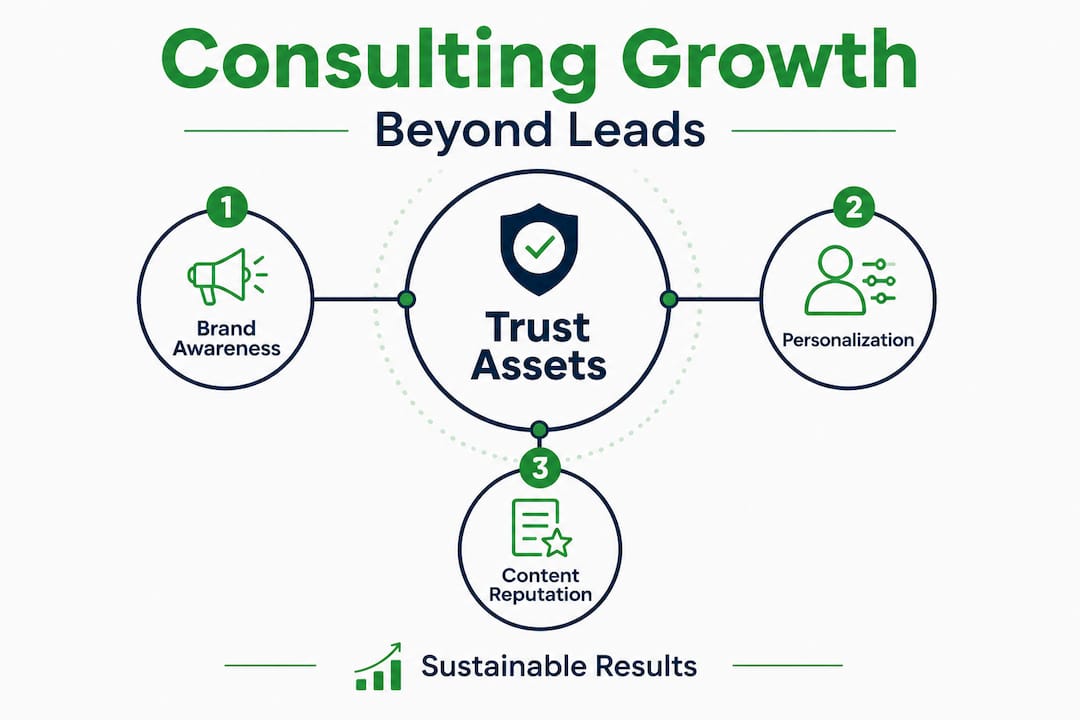
The consultants who grow steadily and sustainably do something different. They invest in trust assets, content, reputation, case studies, systems that work even when they’re not actively selling. And they build adaptive systems that respond to how prospects behave, not just how many they can reach.
Real talk: automation was never about efficiency for its own sake. It’s about maintaining the quality of relationship you’d have if you had unlimited time. When a prospect downloads your guide and gets a follow-up email that speaks directly to their specific situation, that’s not a trick. That’s excellent service before the contract is even signed.
What the best-in-class consultants I’ve observed all share is this: they unify awareness, automation, and authenticity. They don’t treat these as separate marketing departments. Awareness builds the relationship. Automation maintains it. Authenticity closes it. When those three things align, the marketing feels effortless to the prospect and genuinely sustainable for the consultant.
If you want to explore the consulting revenue growth insights that connect brand investment to actual bottom-line results, that’s a great next step. The business case for playing the long game has never been stronger.
Accelerate your pipeline with proven consulting growth resources
Ready to put these approaches to work in your consulting business? Here’s where to start.
If reading this has sparked some ideas (or revealed some gaps in your current approach), the good news is you don’t have to figure it out alone.
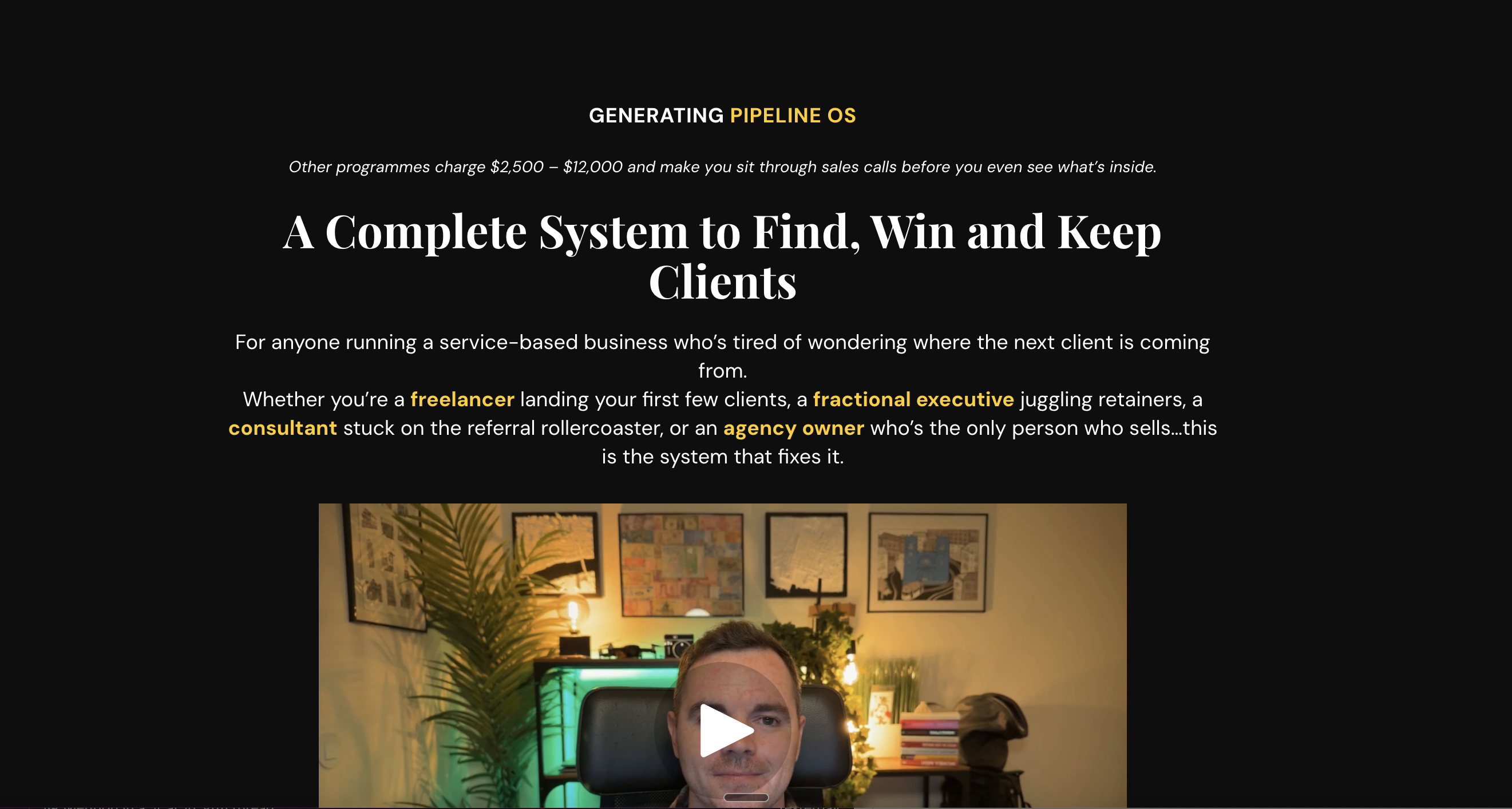
At GeneratingPipeline.com, we’ve built practical, no-fluff resources specifically for consultants, fractional executives, and solo service providers who want a consistent, repeatable client pipeline without the chaos. Whether you’re working to avoid revenue gaps in your consulting business or you’re ready to build a client pipeline from scratch, the resources here are designed to give you real traction. The Generating Pipeline OS covers everything from positioning and outreach to sales execution, in 20 focused lessons you can work through at your own pace, with no sales calls required and transparent, one-time pricing.
Frequently asked questions
What is the biggest consultant marketing trend in 2026?
The biggest trend is a clear shift toward brand awareness and efficiency, with 86% of firms naming awareness as their primary marketing goal rather than pure lead volume.
How does marketing automation change for consultants in 2026?
Marketing automation now focuses on privacy-first, self-optimizing campaigns that use real-time behavioral data and consent-driven personalization rather than static, one-size-fits-all email sequences.
Why is brand awareness so important for consultants?
Brand awareness builds the trust that shortens your sales cycle. As consulting marketing evolves toward measurable demand generation, a strong brand makes every outbound touch land warmer and every inbound lead more qualified.
What’s one mistake to avoid in consultant marketing in 2026?
Relying solely on outbound tactics without investing in brand trust and personalization will stall your growth because prospects are researching you before you ever reach out.
Which marketing channels work best for consultants in 2026?
A blend of content-driven brand building, targeted outbound, referral activation, and behavior-based email automation delivers the most consistent and measurable client results.
Recommended
- Top consulting business growth ideas to boost your pipeline
- Cold email for consultants: proven steps to win more clients
- Consulting revenue growth: 5 strategies to boost income
- Business Development: 7 Practical Client Acquisition Strategies
- Key marketing trends to drive revenue growth in 2026 – wearebeyondgreatness.co.uk
- How to improve client retention: proven strategies for CX leaders
