TL;DR:
- Unpredictable revenue causes growth stalls, burnout, and lower business valuation in service businesses.
- Building predictable revenue through recurring models like retainers increases stability, growth, and valuation.
- Successful predictability requires a cultural shift, aligning sales, delivery, and retention efforts.
If you run a service business, you already know the feeling. One month you’re slammed with work, the next you’re refreshing your inbox hoping for a new inquiry. 72% of sales leaders say pipeline unpredictability is a major challenge, and for independent consultants and freelancers, that number feels even more personal. Unpredictable revenue isn’t just stressful. It actively limits your ability to grow, hire, and plan. This article breaks down what predictable revenue actually means, why it matters more than chasing big one-off projects, and the proven frameworks you can use to build it starting now.
Table of Contents
- The risks of unpredictable revenue in service businesses
- What is predictable revenue and how does it transform your business?
- Proven frameworks for building predictable revenue
- Advanced strategies: Retention systems, productization, and tracking metrics
- What most guides miss about predictable revenue in services
- Ready to move from feast-or-famine to predictable growth?
- Frequently asked questions
Key Takeaways
| Point | Details |
|---|---|
| Beware of feast-or-famine | Service businesses relying only on projects and referrals suffer unpredictable cash flow, which limits growth and causes stress. |
| Focus on recurring models | Retainer or package-based revenue allows for better forecasting, planning, and significantly higher valuations. |
| Frameworks unlock stability | Systems like PPOS, Predictable Revenue, and RISE help you automate and scale predictable income. |
| Retention is your edge | Keeping clients and reducing churn makes revenue more reliable than just chasing new leads. |
| Track the right metrics | Monitor recurring revenue, churn, and client lifetime value to ensure lasting success. |
The risks of unpredictable revenue in service businesses
Let’s be honest about what feast-or-famine actually costs you. It’s not just the slow months. It’s the decisions you can’t make because you don’t know what’s coming. You can’t hire. You can’t invest in tools. You can’t say no to a bad-fit client because you need the cash.
The knock-on effects of volatile revenue go deeper than most people realize. Here’s what typically happens when your income is project-dependent:
- Growth stalls because you’re always in reactive mode, not building mode
- Team burnout sets in when workload swings from overwhelming to empty
- Business valuation drops because buyers and investors price in risk
- Planning becomes guesswork, making it impossible to set meaningful goals
- Client relationships suffer when you’re chasing the next deal instead of serving the current one
The reality of relying on referrals or one-off project work is that you’re always one lost client away from a cash flow crisis. And that’s not a sustainable way to run a business, let alone grow one.
“Steady revenue is worth more than big revenue.” This isn’t just a feel-good idea. It’s valuation logic. A business with consistent monthly income is worth significantly more to a buyer than one with the same annual revenue but massive swings.
This is why feast-or-famine cycles are so dangerous for long-term business health. They feel manageable when times are good, but they quietly erode your ability to build something lasting. Good revenue forecasting becomes nearly impossible when your income is unpredictable, which means every business decision carries more risk than it should.
The good news? This is fixable. Service agencies that target 60-80% retainer revenue for stability report dramatically less stress and far more strategic clarity. If you want to explore ways to stabilize your revenue right now, there are practical starting points available. But first, let’s get clear on what we’re actually building toward.
What is predictable revenue and how does it transform your business?
Predictable revenue means you can reliably forecast your income month to month. Not perfectly, but within a reasonable range that lets you make real decisions. It’s the difference between running your business and being run by it.
There are several recurring revenue models that service businesses use to get there:
- Retainers: Clients pay a fixed monthly fee for ongoing access to your expertise
- Subscriptions: Packaged services delivered on a recurring basis
- Flat-rate packages: Defined scope, defined price, repeatable delivery
- Tiered pricing: Multiple service levels that clients can upgrade over time
- Performance-based models: Revenue tied to client outcomes, often layered on top of a base retainer
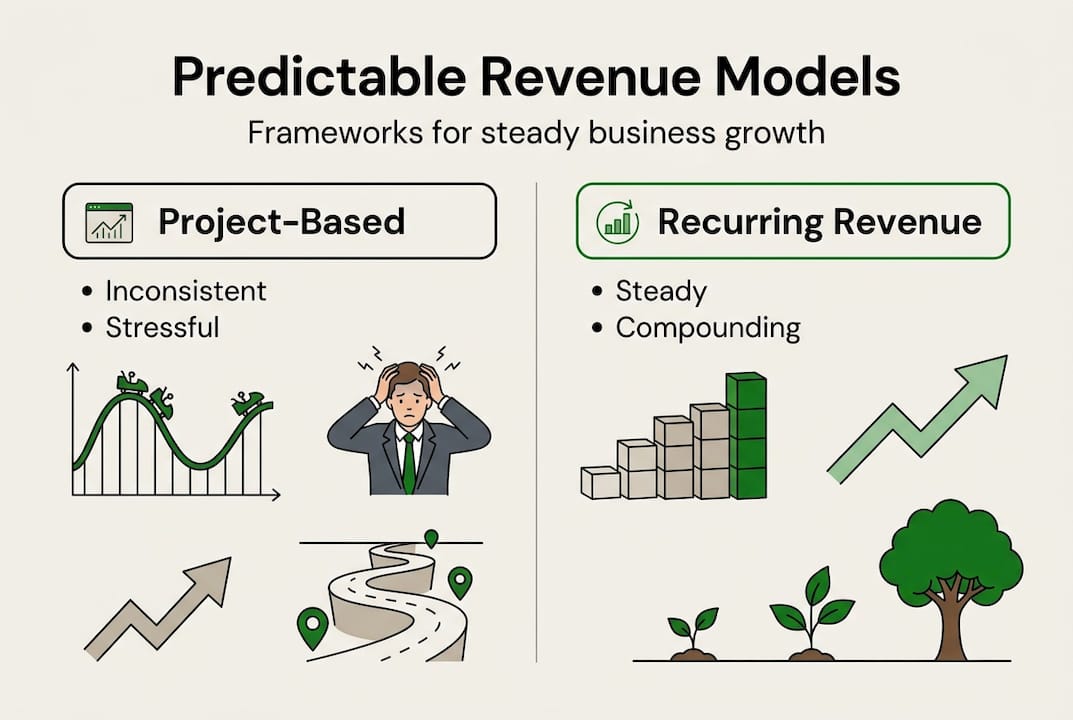
Here’s a simple comparison to show why this matters:
| Factor | Project-based model | Recurring revenue model |
|---|---|---|
| Income predictability | Low | High |
| Growth rate | Slow, inconsistent | Up to 30% faster |
| Business valuation | 1-3x revenue | Up to 10x revenue |
| Stress level | High | Significantly lower |
| Hiring confidence | Risky | Manageable |
Those valuation numbers aren’t made up. Firms with MRR (monthly recurring revenue) grow 30% faster and command up to 10x higher valuations than project-based peers. That’s a massive difference, and it all comes from the structure of how you earn.
Predictable revenue also unlocks things that project work simply can’t:
- You can hire with confidence because you know what’s coming in
- You can plan marketing spend without gambling on outcomes
- You can scale delivery because your model is repeatable
- You can take time off without your income disappearing
Pro Tip: Target at least 50% of your income as recurring as a starting point. Once you hit that threshold, the compounding effect on your revenue pipeline basics becomes very real, very fast.

Understanding predictable revenue models in depth will help you choose the right structure for your specific service and client base.
Proven frameworks for building predictable revenue
With the “what” clarified, you’ll want a road map for the “how.” Let’s compare the leading frameworks for building reliable revenue.
Three models stand out for service businesses:
1. Predictable Profits Operating System (PPOS): Focuses on systematizing lead generation, sales, and retention across 90-day cycles. It’s designed for agencies and consultants who need structure without corporate overhead.
2. Predictable Revenue (Aaron Ross model): Originally built for SaaS, this model separates sales development reps (SDRs) from account executives (AEs) to specialize outbound. Salesforce added $100M in recurring revenue using this approach with specialized roles and Cold Calling 2.0 tactics.
3. RISE framework: Retention, Iteration, Systemization, Expansion. Particularly useful for consultants and fractional executives who want to grow existing accounts before chasing new ones.
Here’s a quick comparison:
| Framework | Core focus | Best for | Key outcome |
|---|---|---|---|
| PPOS | 90-day cycles, full funnel | Agencies, consultants | Stable pipeline fast |
| Predictable Revenue | Outbound specialization | Teams with sales roles | Scalable new business |
| RISE | Retention and expansion | Solo operators, fractionals | Revenue from existing clients |
For a 90-day implementation, here’s a simple numbered path:
- Automate lead generation using outbound sequences and LinkedIn outreach
- Standardize your sales process with a repeatable qualification and close framework
- Convert one-off services into packages that can be sold and delivered consistently
- Build a retention system that checks in with clients proactively
- Track MRR weekly and adjust your pipeline activity based on gaps
Your client acquisition strategy should feed directly into whichever framework you choose. The Aaron Ross Predictable Revenue model is worth studying even if you’re a solo operator, because the principles adapt well.
Pro Tip: Don’t copy-paste SaaS tactics directly into your consulting business. The SDR/AE split doesn’t work when you’re a team of one. Adapt the principles: specialize your outreach, standardize your pitch, and build a follow-up system that doesn’t rely on memory.
Common pitfalls here include siloed thinking (treating sales and delivery as separate worlds) and skipping retention systems entirely because you’re focused on new business.
Advanced strategies: Retention systems, productization, and tracking metrics
The right framework sets the structure. Now let’s look at the expert-level strategies that make revenue truly sustainable over time.
Here’s the uncomfortable truth: most service businesses lose predictability not because they can’t get clients, but because they can’t keep them. Churn (the rate at which clients stop paying you) quietly destroys everything you build on the acquisition side.
Top performing firms have net revenue retention above 110%, meaning they earn more from existing clients each year than they did the year before. Laggards sit below 100%, meaning they’re shrinking even when they add new clients. That gap is where predictability lives or dies.
Productization is one of the most powerful tools here. It means turning your bespoke service into a repeatable package with a defined scope, price, and delivery process. When your service is productized, you can sell it faster, deliver it more efficiently, and upsell it more naturally. The goal is to get 50-80% of your revenue coming from recurring, productized work. That range is where predictable revenue pitfalls become much easier to avoid.
Here are the essential metrics to track every single month:
- MRR (monthly recurring revenue): Your baseline. Know this number cold.
- Churn rate: What percentage of clients left this month? Even small numbers compound fast.
- Customer lifetime value (CLV): How much does a client pay you over the full relationship?
- Utilization rate: Are you actually delivering on what you’ve sold, or are you over or under capacity?
- Net revenue retention (NRR): Are existing clients spending more or less over time?
These metrics connect directly to service business growth hacks that actually move the needle, rather than vanity metrics that feel good but don’t predict anything.
Pro Tip: Analyze your churn monthly and fix the root cause before spending another dollar on lead generation. If clients are leaving after three months, adding more clients just accelerates the leak.
The net revenue retention metric is particularly telling. It tells you whether your business is actually growing from within, which is the most efficient and profitable kind of growth.
What most guides miss about predictable revenue in services
Here’s my honest take after building and exiting a seven-figure agency: most playbooks treat predictable revenue as a tactical problem. Get the right CRM. Build the right sequence. Hire the right SDR. But the businesses that actually achieve lasting predictability treat it as a cultural commitment.
What does that mean in practice? It means your delivery team knows what the sales team is promising. It means you have a feedback loop from clients back into your offer design. It means retention isn’t an afterthought, it’s built into your calendar every single week.
The businesses I’ve seen lose predictability almost always have the same root cause: disconnected teams or disconnected thinking. Sales is chasing new logos while delivery is overwhelmed. Nobody is asking why clients leave after month four.
Building a repeatable sales system is important, but it only works when it’s connected to how you actually deliver and retain. Predictability isn’t a “set and forget” outcome. It’s an active, ongoing process that requires alignment across everything you do.
Ready to move from feast-or-famine to predictable growth?
Predictable revenue is absolutely achievable for independent service businesses. It takes the right frameworks, the right metrics, and a genuine shift in how you think about clients over time.
If you’re ready to stop guessing and start building, GeneratingPipeline.com has the resources to help you get there. Start by learning how to avoid revenue gaps consulting businesses commonly fall into, then go deeper with the pipeline forecasting guide to build real visibility into your future income. And when you’re ready to scale, the revenue growth strategies page gives you proven tactics to put into action right away.
Frequently asked questions
What does predictable revenue actually mean for a service business?
It means you can forecast your income month to month with enough confidence to make real business decisions, without the anxiety of feast-or-famine cycles.
How is recurring revenue different from project-based income?
Recurring models like retainers give you stable, compounding cash flow and higher valuations, while project-based income resets to zero with every engagement.
What’s the fastest way to move toward predictable revenue?
Focus on a 90-day implementation: automate your lead generation, convert your services into repeatable packages, and start tracking your churn and MRR every week.
Why is retention more important than just adding new clients?
Because top firms exceed 110% NRR, meaning they grow from within. Adding clients while losing others at the same rate just keeps you running in place.
How much of my revenue should be recurring for best results?
Aim for 60-80% from retainers as a target. Even hitting 50% recurring puts you in a dramatically stronger position for growth, planning, and business valuation.
