TL;DR:
- Consistent client flow is a process problem, not a talent issue, and requires a structured marketing approach.
- Preparing a clear core service, defining your ideal client, and building proof-based content are essential before tactics.
You work hard, you deliver great results, and yet some months the client pipeline looks full while others feel like a drought. Sound familiar? Inconsistent client flow is one of the most common frustrations for freelancers, consultants, and fractional executives. It is not a talent problem. It is a process problem. The good news is that a structured, repeatable marketing approach changes everything. This guide walks you through each step, from laying the right foundation to measuring what actually works, so you can build a pipeline that holds steady all year long.
Table of Contents
- What you need before starting your marketing engine
- Step-by-step: Service business marketing process that works
- How to measure, diagnose, and improve your funnel
- Referral systems: the overlooked growth channel
- The hard truth most service businesses miss about marketing steps
- Turn strategy into action: your next steps to fill your client pipeline
- Frequently asked questions
Key Takeaways
| Point | Details |
|---|---|
| Build proof-driven content | Demonstrate real outcomes with case studies and success stories before marketing aggressively. |
| Follow a multi-step funnel | Move leads from authority and trust-building through to consultation and partnership using a clear sequence. |
| Track key funnel metrics | Measure booking rate, close rate, and benchmark conversions to identify weaknesses and optimize. |
| Leverage referral systems | Implement a structured, incentivized referral program to unlock high-quality, consistent leads. |
| Systematize for reliability | Treat your marketing steps as a repeatable playbook, not a one-off sprint, to avoid feast-or-famine cycles. |
What you need before starting your marketing engine
Now that we understand why a structured approach is critical, let us look at what every service provider needs before putting their marketing in motion.
Most service businesses skip straight to tactics: posting on LinkedIn, sending cold outreach, running ads. Then they wonder why nothing sticks. The truth is, tactics without a foundation are just noise. Solid client acquisition basics always start with clarity first.
Here is what you need to have in place before you touch a single tactic:
- A defined core service offering. If you cannot explain what you do and who you help in two sentences, prospects will not remember you either. Narrow your offer to one specific outcome for one specific type of client.
- Your ideal client avatar (ICA). Know their industry, their typical revenue range, the problems they are actively trying to solve, and where they spend time online. Vague targeting produces vague results.
- Proof-based content. Content strategy for service businesses should be proof-based: demonstrate outcomes through case studies, success stories, and process breakdowns, and publish in a consistent pillar format while building topic clusters around service pages. This means at minimum two or three short case studies, some client testimonials, and a results-focused about page.
- A primary business development platform. Pick one. LinkedIn works well for most B2B service providers. Do not try to be everywhere at once when you are just getting started.
- A simple web presence with basic tracking. You do not need a fancy website. But you do need a page that clearly states what you do, who you help, and how to contact you. Add Google Analytics or a similar tool from day one.
Here is a quick-reference table to assess your readiness:
| Prerequisite | Why it matters | Ready? |
|---|---|---|
| Defined core offer | Drives all messaging and targeting | Yes / No |
| Ideal client avatar | Focuses outreach and content | Yes / No |
| 2+ case studies or testimonials | Builds credibility with cold prospects | Yes / No |
| Primary platform chosen | Prevents scattered effort | Yes / No |
| Web presence + tracking | Enables measurement and follow-up | Yes / No |
Pro Tip: Do not wait until everything is perfect before starting. Build a simple, repeatable structure first. You can improve each piece over time as you learn what resonates with your audience.
Getting these practical marketing tips locked in early saves you a lot of wasted effort down the road.
Step-by-step: Service business marketing process that works
With your prerequisites in place, it is time to work through the core steps that power client acquisition for service businesses.
A practical service-provider funnel progresses through four stages: Authority, Trust, Consultation, and Partnership. Each stage has specific mechanics that move a prospect forward without pressure or hype.
Here is how to execute each step:
-
Build authority through proof content. Create content that shows what you know and what you have done. Think process walkthroughs, before-and-after client stories, and clear frameworks tied to your core service. Post this on your primary platform consistently, at least two to three times per week. Authority is not claimed. It is demonstrated.
-
Nurture trust with value-rich touchpoints. Do not pitch too early. Send helpful follow-up messages, share relevant articles, comment on prospects’ posts, and invite them into conversations. A strong service business sales funnel includes 5 to 7 nurture touches before you ever ask for a meeting. This is one of those things that feels slow but actually speeds up conversion.
-
Book consultations by framing the first call correctly. Do not call it a “sales call.” Call it a strategy session, a business review, or a discovery call. This framing lowers resistance and sets a collaborative tone. Your goal on that first call is to understand their situation, not to pitch your services.
-
Convert to partnership with timely proposals. Send a consultation summary within 24 hours of your first call. Recap what you heard, restate their goals, and tie your proposal directly to outcomes they mentioned. Proposals that speak the client’s language close faster. Structure your pricing around the value they receive, not just the hours you spend.
-
Repeat and refine using benchmarks. Track your results at every stage and look for patterns. Which content drives the most conversations? Which nurture messages get replies? Which proposal structures close? Follow a clear step-by-step sales process to make this feedback loop systematic.
Here is a comparison of reactive versus proactive approaches at each funnel stage:
| Stage | Reactive approach | Proactive approach |
|---|---|---|
| Authority | Post when inspired | Consistent content calendar |
| Trust | Wait for prospects to reply | Structured 5 to 7 touch sequence |
| Consultation | Hope they book | Proactively invite after warm signal |
| Partnership | Send invoice quickly | Send summary first, then proposal |
Pro Tip: Use 5 to 7 touchpoints in your nurture sequence before asking for a call. Fewer than that and you are leaving warm leads on the table. This works whether you are running outbound outreach or following up after someone engages with your content.
Agencies and micro agency owners can also apply these same principles with specific agency funnel strategies tailored to their delivery model.
How to measure, diagnose, and improve your funnel
Putting a process in place is only the beginning. Making it effective depends on ongoing measurement and improvement.

Too many service providers run their marketing on gut feel. They try something for a few weeks, do not see immediate results, and switch tactics. The problem is usually not the tactic. It is the lack of data telling them where in the funnel things are breaking down.
Here are the key metrics to track at each stage:
| Funnel stage | Metric to track | Target benchmark |
|---|---|---|
| Lead generation | New leads per week | Varies by niche |
| Lead to MQL | % of leads showing interest | 25 to 35% |
| MQL to SQL | % of qualified leads ready to talk | 13 to 26% |
| Consultation booked | Booking rate from outreach | 10 to 20% |
| Close rate | Proposals that convert | Varies by service type |
One metric that often gets overlooked is the real booking rate. A strong funnel diagnostic approach means auditing your booking rate and close rate before making changes, and your real booking rate counts both inbound call volume and manual bookings as a combined key performance indicator. A lot of service providers only count inbound bookings and miss a big chunk of the picture.
“Before you change anything in your marketing, audit the stage where things are actually falling off. Most fixes happen one stage before people think they need to make changes.”
Common bottlenecks and how to spot them:
- Low lead volume: Your content is not reaching enough of the right people. Expand distribution or improve your targeting.
- Leads not converting to conversations: Your messaging is unclear or your offer is not compelling enough. Revisit your ICA and value proposition.
- Consultations not converting to proposals: Your first call may not be uncovering enough pain. Work on your discovery questions.
- Proposals not closing: Pricing may be misaligned, or the proposal is not speaking to their outcomes. Revisit your proposal structure.
The key here is to audit before you adjust. Changing tactics randomly wastes time. Diagnosing the actual leak first means every change you make is targeted and more likely to improve results. Check out these consultant sales funnel metrics for a deeper look at what to track and when.
If you want to accelerate improvement, these growth hacks also offer practical ideas for each funnel stage.
Referral systems: the overlooked growth channel
Beyond structured funnels, one source of consistent, qualified leads is often left untapped: referrals.
Most freelancers and consultants will tell you that their best clients came from referrals. And yet most of them have no formal system for generating referrals consistently. It just kind of happens (or does not). That is a big missed opportunity.
Referral marketing for service businesses can be run as an active acquisition channel by building an explicit referral system with unique tracking links, a referral landing page, and incentives that reward both the referrer and the new client. Think of it like a structured program, not a passive hope.
Here is how to build one:
-
Identify your top 20 to 30 clients. These are the people who know your work best, have seen real results, and are most likely to want to help you. Start here, not with your entire network.
-
Create a simple referral landing page. This page should explain what you do, who you help, and what the referrer’s contact can expect when they reach out. Make it easy to share.
-
Set up unique tracking links. Give each referrer their own link so you can track where leads are coming from. This data helps you identify your best referral sources and reward them appropriately.
-
Build a dual incentive structure. Reward both the person sending the referral and the new client they send your way. This could be a discount on future services, a gift card, or a cash reward depending on your business model. Dual incentives tend to generate significantly more referrals than one-sided rewards.
-
Launch with a personal ask. Email your top clients individually. Make it personal and specific. Tell them exactly who you are looking for and why their network would be a great fit.
- Use a simple CRM or spreadsheet to track referrals and rewards
- Follow up with referrers to thank them and keep them engaged
- Review your referral pipeline monthly and reach out to dormant referrers
Pro Tip: Automate as much tracking and reward delivery as possible. The less friction in the system, the more likely clients are to actually refer people. Tools that handle this automatically free up your time and keep the program running in the background.
Building a formal referral channel alongside your outbound efforts is one of the highest-leverage steps you can take. Explore more referral pipeline strategies to see how other service businesses are making this work.
The hard truth most service businesses miss about marketing steps
With all the tools and steps in hand, it is worth re-examining what actually moves the needle in real service businesses.
Here is something I have noticed after building a seven-figure agency and working with dozens of service providers: most people read guides like this one, get motivated, pick a few tactics, try them for a couple of weeks, and then give up when things do not immediately click. The problem is not the tactics. The problem is the mindset.
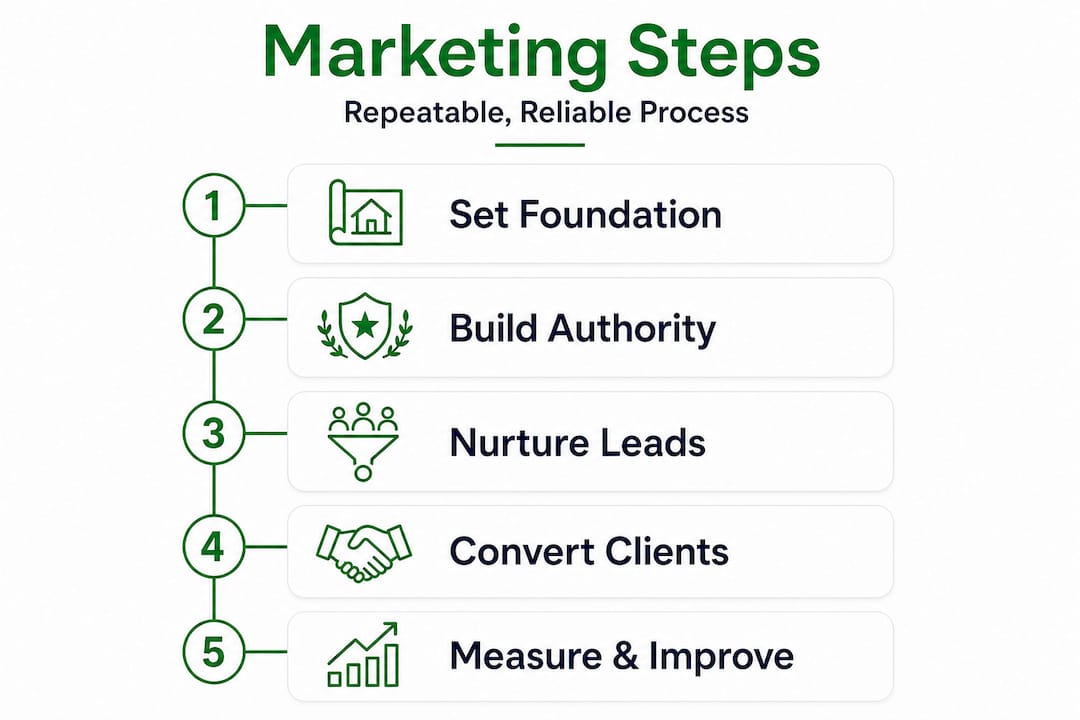
Marketing steps are not a checklist you run through once. They are a system you run repeatedly, measure constantly, and improve gradually. The most effective service businesses I have seen treat their pipeline like a playbook. They run the same plays consistently, track the numbers at each stage, and make deliberate small improvements rather than dramatic pivots.
Real talk: most pipeline gaps do not happen because someone chose the wrong platform or wrote a bad email. They happen because the person running the business stopped doing the consistent work when things got busy. Feast-or-famine cycles are almost always a consistency problem, not a strategy problem.
The other thing that separates top performers is how they use client feedback. Not just testimonials to post on their website. Actual conversations about what the client was worried about before hiring them, what almost made them choose someone else, and what they got that they did not expect. That intelligence is worth more than any tactic.
If you want to break the cycle for good, look at your proven revenue strategies and ask yourself honestly: am I running a system or am I just doing occasional sprints? The answer usually explains everything.
Turn strategy into action: your next steps to fill your client pipeline
Ready to take the next step? Here is how you can implement what you have learned and get support along the way.
Everything in this guide is designed to help you move from reactive to repeatable. But reading about it and doing it are two different things. The fastest way to see results is to follow a structured system built specifically for service-based independent business owners.
At GeneratingPipeline.com, you will find resources specifically built for freelancers, consultants, fractional executives, and micro agency owners who are done with the feast-or-famine cycle. Start by learning how to avoid client pipeline gaps that stall your revenue. Then follow the practical guide to creating a client pipeline that scales with you. And if you want a complete operational view, the pipeline management guide covers everything from tracking to closing in one place. Take the next step today and build something that actually holds.
Frequently asked questions
What is the most important first step for service business marketing?
Identify your ideal client and establish clear proof of results before launching outbound efforts. Content strategy for service businesses should be proof-based, demonstrating outcomes through case studies and success stories before any outreach begins.
How many times should I follow up before requesting a consultation?
Aim for 5 to 7 nurturing touches before asking for a sales call or strategy session. Research on nurture sequences confirms that 5 to 7 touchpoints before requesting a consultation produces more reliable conversion than fewer attempts.
What funnel conversion benchmarks should I use?
Target 25 to 35% lead-to-MQL and 13 to 26% MQL-to-SQL as reference ranges. These B2B funnel benchmarks give you a realistic baseline to compare your own performance against.
How do I track the real booking rate for my service business?
Include both inbound call volume and manual bookings to calculate your true scheduled appointment rate. Treating these as separate numbers gives you an incomplete picture of actual booking rate performance.
How can I set up a referral system that truly works?
Use unique tracking links, set up a referral landing page, and offer rewards to both referrers and new clients. An active referral system built with these mechanics outperforms passive word-of-mouth every time.
