TL;DR:
- Service businesses struggle with cash flow not because of profitability but due to timing gaps between payments and expenses.
- Closing this gap involves invoicing promptly, implementing deposits, building a disciplined collections process, and managing cash flow proactively through forecasting.
Running a service business means your biggest asset is your time and expertise — but your bank account doesn’t always reflect that. You finish the work, send the invoice, and then… wait. Meanwhile, payroll is due, software subscriptions auto-renew, and your vendor just emailed asking for payment. That timing crunch is real, and it’s one of the leading reasons service-based businesses struggle even when they’re busy. This article cuts through the recycled advice and gives you specific, actionable strategies to close the cash gap, collect faster, and stop playing financial catch-up.
Table of Contents
- Understand and manage the payment timing gap
- Invoice faster and use deposits/progress billing
- Build a disciplined collections process
- Use cash-flow forecasting and control outflows
- Encourage faster payments with flexible options
- My honest take on cash flow advice
- Ready to build the pipeline that makes better terms possible?
- Frequently asked questions
Key Takeaways
| Point | Details |
|---|---|
| Speed up invoicing | Sending invoices immediately and requiring deposits gets cash in your account faster. |
| Standardize collections | A simple, repeatable collections process shrinks overdue accounts and cuts risk. |
| Forecast proactively | A rolling forecast built on expected cash receipts gives you time to course-correct before issues escalate. |
| Control outflows | Negotiate vendor terms and trim expenses to keep more cash on hand. |
| Use modern payment tools | Offering ACH and digital payment options speeds up client remittance and improves cash flow. |
Understand and manage the payment timing gap
To start, let’s identify why cash flow issues are so persistent in service businesses. The core problem isn’t profitability. Most of the time, you’re making money on paper. The real issue is timing.
In service businesses, the core cash-flow lever is shortening the gap between when you pay out (often biweekly payroll or contractor fees) and when clients actually settle their invoices (often 30 to 60 days or more). That gap is where cash shortages live.
Think about it this way: you pay your team on a fixed schedule. But your clients pay on their own schedule. And those two schedules rarely align.
| Cash flow event | Typical timing |
|---|---|
| Payroll / contractor fees | Every 1 to 2 weeks |
| Invoice issued after project | 1 to 5 days after completion |
| Client invoice payment | Net 30 to Net 60 (or longer) |
| Actual cash in account | 35 to 75+ days after work starts |
That table tells a pretty uncomfortable story. You could complete a project in week one and not see a dollar until week ten. That’s the gap we need to close.
Here’s what makes this especially sneaky for solo consultants and small agencies: you might have three or four clients on different billing cycles, all paying at different times. Without revenue forecasting for service businesses, it’s nearly impossible to see problems coming before they hit.
A few simple moves that can help immediately:
- Tighten your billing cycle so invoices go out faster after work is complete
- Map your cash outflows (payroll, tools, overhead) against expected inflows each month
- Identify which clients consistently pay late and flag them for tighter terms
The goal isn’t to stress about every dollar. It’s to build a clear picture of what’s coming in and when. Once you see the gap clearly, you can start closing it.
Invoice faster and use deposits/progress billing
With the timing gap clear, let’s tackle how you can control invoice and payment timing for a stronger cash position. This one sounds obvious but it’s one of the most consistently overlooked levers.
Invoice immediately after work is completed (or within 48 hours) to speed cash inflows. Not at the end of the week. Not when you get around to it. Same day if possible, 48 hours at the absolute latest.
Every day you delay sending an invoice is a day you pushed your payment further into the future. If you finish work on a Wednesday and send the invoice Friday afternoon, you’ve already lost two days on a Net 30 clock.
Here’s a step-by-step approach to tighten this up:
- Set a personal rule that invoices go out within 24 hours of project completion or milestone delivery.
- Use invoicing software with templates so there’s no delay from formatting or setup.
- Require a 30 to 50% deposit upfront before starting any new project. This is especially important for longer engagements.
- Break larger projects into milestones with payment tied to each one. Don’t wait until the end to invoice.
- Include clear payment terms on every invoice (due date, late fee policy, preferred payment method).
Require deposits or progress billing for projects to reduce upfront cash strain. This isn’t just good advice, it’s a best practice for service businesses specifically. Unlike product businesses that can hold inventory as a buffer, you’re investing your time upfront with no asset to fall back on.
“Getting paid in stages isn’t about distrust. It’s about aligning payment with the value you’re delivering at each stage of the project.”
Progress billing also benefits your clients, by the way. It creates natural checkpoints, keeps projects on track, and reduces the shock of a large final invoice.
Pro Tip: If a new client pushes back hard on a deposit requirement, that’s a signal worth paying attention to. Clients who resist standard payment terms upfront often become the ones who pay late (or not at all). Stand your ground on deposits. You’ll thank yourself later.
Need more growth ideas to boost your pipeline? Getting paid predictably starts with winning the right clients on the right terms from day one.
Build a disciplined collections process
Invoicing quickly is vital, but actually getting paid requires structured follow-up. A lot of service business owners send an invoice and then feel awkward following up. So they wait. And wait. And then suddenly 45 days have passed.

Collections isn’t a dirty word. It’s a system.
Use a collections cadence (including phone calls for later-due invoices) and don’t treat collections as optional. Here’s what a solid cadence looks like in practice:
| Days past due | Action |
|---|---|
| Day 0 (invoice sent) | Automated invoice delivery with clear due date |
| Day 7 past due | Automated friendly reminder email |
| Day 15 past due | Personal email from you directly |
| Day 30 past due | Phone call (yes, actually call) |
| Day 45 past due | Formal notice with escalation options |
Most business owners skip the phone call. Don’t. A real conversation resolves late payment issues faster than any email thread. People respond differently when there’s a human on the other end.
Another metric worth tracking is DSO (Days Sales Outstanding). DSO measures the average number of days it takes to collect payment after an invoice is issued. Benchmarking AR performance (DSO) and using industry-specific targets can highlight when collections are drifting. Construction, for example, often runs a DSO of 70 to 80 days, while professional services averages closer to 40 to 50.
Knowing your DSO compared to your industry benchmark gives you an early warning system. If your DSO is creeping up month over month, it means your collections process needs attention before cash flow becomes a crisis.
Key practices to tighten collections:
- Track outstanding invoices in a simple dashboard or spreadsheet
- Assign each invoice a follow-up date when you issue it
- Review your AR (accounts receivable) list every single week
- Never assume a client “forgot” — assume they need a nudge
Want to build predictable revenue that doesn’t depend on chasing payments? Predictable cash starts with predictable collection behavior.
And if you’re looking for broader revenue growth hacks that go beyond collections, there’s a lot you can do on the front end to set yourself up for easier cash flow downstream.
Use cash-flow forecasting and control outflows
Now that you have control over AR (accounts receivable), maintaining positive cash flow also relies on anticipating challenges and managing your expenses. This is about getting ahead of problems instead of reacting to them.
Build and maintain a rolling cash-flow forecast (often 13 weeks) so you manage cash timing proactively rather than after gaps appear. A 13-week rolling forecast gives you a 90-day window into your cash position. Update it weekly and you’ll rarely get blindsided.
Here’s how to build a simple version:
- List all expected cash inflows for the next 13 weeks, based on when you actually expect payment (not when the invoice is due).
- List all fixed outflows (payroll, software, rent, contractor fees, subscriptions).
- Add variable outflows (project costs, travel, one-time expenses).
- Calculate your net cash position week by week.
- Flag any week where cash goes negative and plan your response in advance.
The critical nuance here? Use expected cash receipt dates, not invoice dates. An invoice dated March 1 with Net 30 terms means cash arrives April 1 at best. A lot of forecasts get this wrong and create a false sense of security.
On the outflows side, improve cash flow by managing both inflows and outflows, including negotiating better vendor terms and cutting unnecessary costs. Here’s what that looks like practically:
| Outflow type | Action to improve cash timing |
|---|---|
| Vendor invoices | Negotiate Net 30 or Net 45 where possible |
| Annual subscriptions | Request monthly billing instead |
| Contractor payments | Align contractor pay schedule with client payment receipt |
| Non-essential tools | Audit quarterly, cancel what you don’t use |
Pro Tip: Ask your key vendors for extended terms once a year. Most business owners never ask. The worst they can say is no. Getting even one vendor to move from Net 15 to Net 30 could free up thousands of dollars in working capital.
A recurring revenue guide can also help you think through how to structure retainers and ongoing client work to create more predictable inflows. And if you’re a freelancer or consultant, these ways to stabilize revenue pair well with a solid forecasting habit.
Encourage faster payments with flexible options
Beyond internal processes, you can use technology and incentives to accelerate client payments. Sometimes clients don’t pay slowly because they want to. They pay slowly because your payment process is friction-heavy.
Offer multiple payment methods (like ACH and online payments) to reduce friction and speed payment. If the only way to pay you is by mailing a check, you’re going to wait a long time.
Here’s a quick checklist of payment options worth enabling:
- ACH bank transfer — low cost, widely used for B2B payments
- Online payment portals (via your invoicing software)
- Credit or debit card — adds convenience even if there’s a processing fee
- Stripe, PayPal, or similar for clients who prefer digital wallets
- Payment links embedded directly in your invoice email
The easier you make it to pay, the faster you get paid. Full stop.
For service businesses with slow-paying customers, early-payment and invoice-discounting programs can accelerate cash without changing the original contract terms. Some fintech platforms let your clients access early-payment options through third-party programs. You get paid now (at a small discount), your client pays later on their preferred schedule. It’s a win for both sides when used strategically.
Pro Tip: If you have a client who consistently pays late but is otherwise great to work with, try a conversation about enabling ACH auto-pay on a recurring retainer. Frame it as a convenience for them. A lot of late payments are just administrative bottlenecks on the client side, and ACH removes those completely.
You can also explore more growth hacks for service business cash flow to layer these payment strategies with a stronger client acquisition approach.
My honest take on cash flow advice
Here’s what most cash flow articles won’t tell you: the biggest cash flow problem in service businesses isn’t a financial problem. It’s a positioning and sales problem.
When you don’t have a full pipeline, you take on clients at bad terms just to keep revenue coming in. You accept Net 60 because you need the work. You skip the deposit conversation because you’re afraid of losing the deal. You under-price to win the contract.
All of those decisions create cash flow problems downstream. And no amount of forecasting or collections cadence will fully fix a business that’s operating from scarcity.
I’ve seen this pattern repeatedly with freelancers and consultants who are technically solid but undermine themselves commercially. The real unlock is building a consistent enough pipeline that you can afford to hold firm on payment terms. When you have three other qualified leads in conversation, saying “I require a 40% deposit to start” becomes a lot easier.
Cash flow discipline and pipeline strength are two sides of the same coin. You need both. Tighten up your processes, yes. But also invest in generating enough demand that you never feel forced to accept bad payment terms again.
Ready to build the pipeline that makes better terms possible?
If cash flow stress is partly coming from not having enough leads in your pipeline, you’re not alone. That’s the most common scenario I see with independent consultants and micro agency owners.
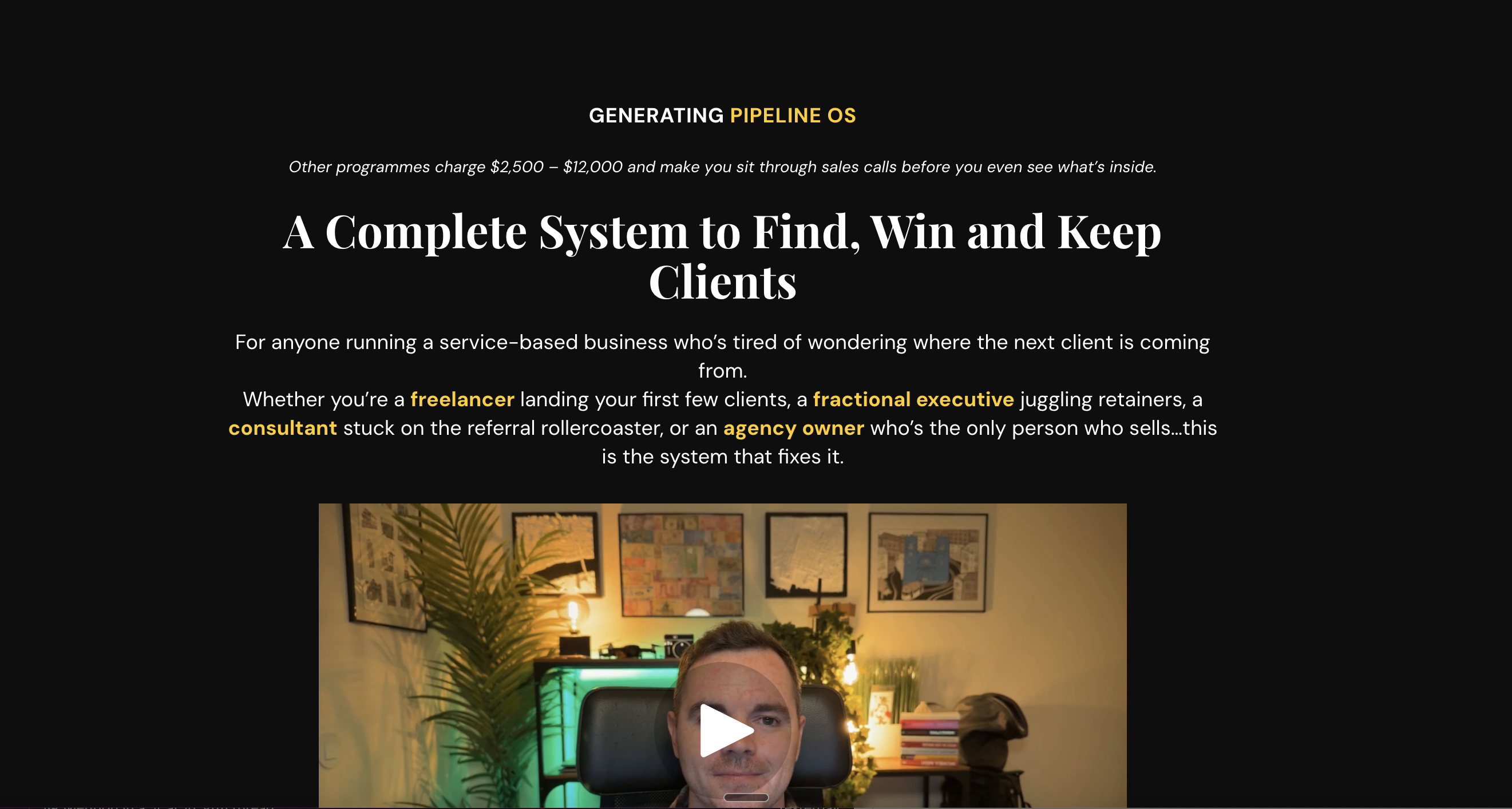
At GeneratingPipeline.com, we built the Generating Pipeline OS specifically for service-based business owners who want a consistent, repeatable way to attract clients without relying on referrals. It covers everything from positioning and outbound outreach to sales execution and delivery systems. There’s also a free guide with 11 revenue-boosting tactics covering pricing, sales, and marketing that you can grab and start using today. One payment, lifetime access, no sales calls required.
Frequently asked questions
What is the most effective way to improve cash flow fast?
Requiring deposits or progress billing and invoicing immediately after project completion put cash in your account quickly, often faster than any other single change you can make.
How often should I update my cash-flow forecast?
Update your rolling cash-flow forecast every week. Building it on expected receipt dates rather than invoice dates gives you an accurate picture and surfaces problems early enough to act on them.
What’s the best collections cadence for overdue invoices?
Use automated reminders by day 7, a personal email at day 15, and a phone call at day 30. A structured collections cadence (including real phone calls) dramatically shortens average payment time.
How can I encourage clients to pay faster?
Offering multiple payment methods including ACH, online portals, and card payments removes friction. Early-payment programs can also help slow-paying clients settle faster without changing their internal processes.
Should I prioritize cost-cutting or negotiating better payment terms?
Both matter, but deposits and progress billing typically have more impact than cutting minor expenses because they directly close the upfront funding gap created by long payment cycles.
