TL;DR:
- Most independent service businesses rely on luck for referrals, which can leave their pipeline empty during slow periods.
- A sustainable lead pipeline requires combining multiple channels like inbound and outbound efforts, which are learnable skills.
Most independent service businesses run on referrals — until they don’t. One slow quarter, a couple of clients wrapping up at the same time, and suddenly the pipeline looks terrifyingly empty. The problem isn’t that you’re bad at what you do. It’s that word-of-mouth isn’t a system, it’s luck. According to HubSpot, a sustainable lead pipeline comes from combining multiple acquisition channels rather than betting everything on a single tactic. The good news? Lead generation is a learnable, repeatable skill. And this guide walks you through exactly how to build it.
Table of Contents
- Understanding the foundations of lead generation
- Essential tools and assets for sustainable lead generation
- Executing outbound and inbound: Step-by-step process
- Funnel tracking and nurturing: Ensuring no leads go cold
- The real reason most lead generation fails (and how to avoid it)
- Build your repeatable client pipeline with expert help
- Frequently asked questions
Key Takeaways
| Point | Details |
|---|---|
| Combine multiple channels | Don’t rely on one tactic—combine inbound and outbound methods for a sustainable pipeline. |
| Map content to funnel stages | Make each lead magnet align with a specific step in the buying process to maximize results. |
| Track and optimize conversions | Monitor each funnel step and improve the areas where most leads drop off. |
| Nurture every lead | Only a small percentage of leads are sales-ready immediately—use automation to keep them engaged. |
| Focus on offer and qualification | A clear, relevant offer and qualification process outperform more cold outreach or web traffic alone. |
Understanding the foundations of lead generation
Before you can build a pipeline that runs predictably, you need to understand what lead generation actually is — and what it isn’t. For service-based businesses, lead generation is the process of attracting the right people, capturing their interest, and moving them toward a buying conversation. It’s not just traffic. It’s not just followers. It’s a deliberate flow of qualified prospects.
The biggest mistake independent consultants, fractional executives, and freelancers make is treating lead generation as a single activity. “I’ll post on LinkedIn” or “I’ll send some cold emails.” That’s not a strategy. That’s a tactic. A real client acquisition strategy combines multiple channels so that if one slows down, the others keep you afloat.
There are two fundamental modes of lead generation you need to understand:
- Inbound: You create content, resources, or visibility that pulls people toward you. Think SEO, LinkedIn thought leadership, and downloadable guides.
- Outbound: You go find the right people and start a conversation. Think cold email, LinkedIn outreach, and targeted prospecting.
Neither one is better. They serve different timelines. Outbound can generate conversations in days. Inbound builds momentum over months but compounds beautifully over time.
Here’s a simple breakdown to visualize the difference:
| Channel type | Time to results | Scalability | Cost |
|---|---|---|---|
| Outbound (email, LinkedIn) | Days to weeks | Moderate | Low to medium |
| Inbound (SEO, content) | Months | High | Time-heavy upfront |
| Paid ads | Immediate | High | Requires budget |
| Referrals/partnerships | Variable | Low | Near zero |
As Shopify’s guide on SEO lead generation points out, SEO works best when you treat it as a conversion system with qualified traffic, strong offers, and clear calls to action — not just a blog publishing schedule. That mindset shift is huge. Most people publish content and wait. Instead, you should be actively building a sales funnel that captures and converts interest at every stage.
Understanding demand generation for service businesses is also worth your time. Demand generation is broader than lead gen — it’s about creating awareness and desire, so that by the time someone enters your pipeline, they’re already warm to what you offer.
Essential tools and assets for sustainable lead generation
Now that you understand the foundational logic, let’s talk about the actual building blocks. Because knowing the theory is one thing. Having the right assets in place is what actually fills your pipeline.
Lead magnets are your primary conversion tools. These are resources you offer in exchange for someone’s contact details or their engagement with you. Common types include:
- Checklists: Easy to consume, highly actionable. Great for top-of-funnel.
- Templates: High perceived value. Works well mid-funnel when someone is evaluating how to solve a specific problem.
- Audits: Excellent for service businesses because they naturally lead to a paid engagement.
- Webinars or recorded workshops: Build trust and demonstrate expertise at scale.
- Whitepapers or guides: Useful for establishing credibility with senior decision-makers.
One nuance worth getting right is the gated vs. ungated debate. As Digital Applied’s B2B content guide explains, gated assets can convert well at the right funnel stage, while ungated content builds organic visibility and earns backlinks that compound over time. Neither is universally better. Context matters.
Here’s a simple comparison to guide your thinking:
| Asset type | Gate it? | Best use case |
|---|---|---|
| Short checklist | Optional | Awareness stage, high-volume traffic |
| In-depth guide | Yes | Mid-funnel, email capture |
| Free audit | Yes | Bottom-of-funnel, pre-sales conversation |
| Blog post | No | SEO, social sharing, awareness |
| Video walkthrough | No | Visibility, trust-building |
Mapping your assets to funnel stages matters a lot. A blog post that someone finds via Google is a top-of-funnel touchpoint. An audit offer at the bottom of that post is a bottom-of-funnel conversion play. Stack them intentionally and you have a consultant sales funnel that does a lot of the heavy lifting for you.
Pro Tip: Don’t try to build five lead magnets at once. Start with one genuinely high-value asset that addresses your ideal client’s most pressing problem. One great lead magnet beats ten mediocre ones every single time. Get feedback, iterate, then expand.
Executing outbound and inbound: Step-by-step process
This is where the rubber meets the road. Let’s walk through a practical, sequenced approach to building both sides of your pipeline.
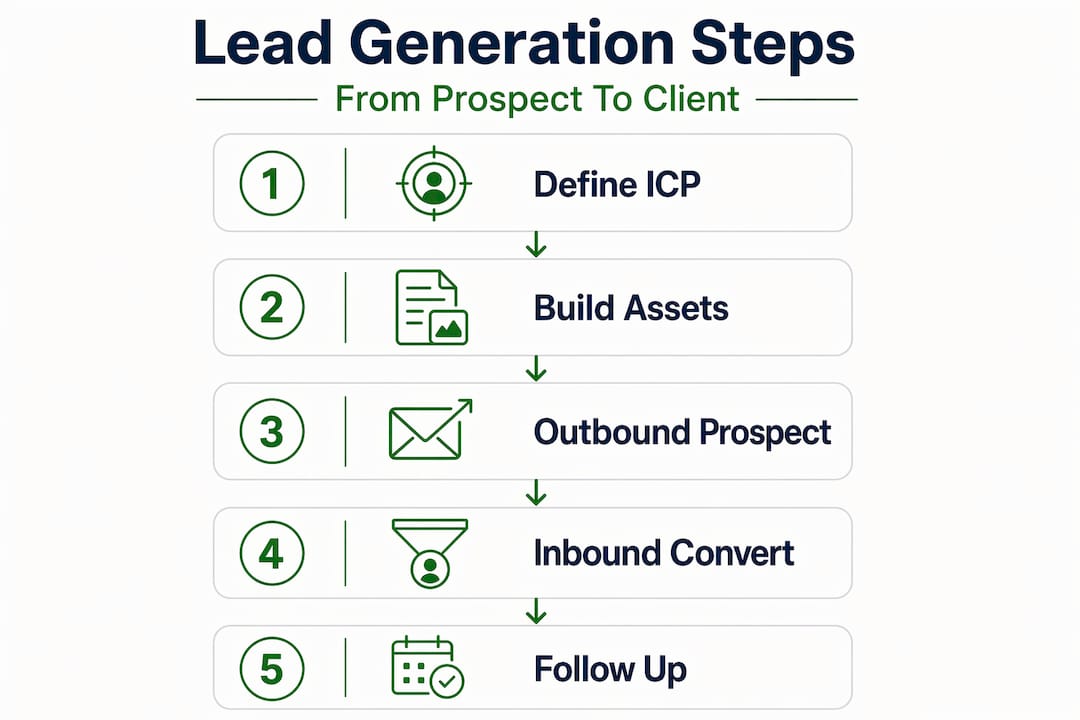
Step 1: Build your Ideal Client Profile (ICP)
Before you send a single email or write a single post, get crystal clear on who you’re targeting. Your ICP should include industry, company size, role/title, biggest pain points, and what success looks like for them. This single step will make everything else dramatically more effective. As Fullcast’s B2B lead generation guide notes, outbound executed without ICP precision produces poor pipeline efficiency, even when the activity levels look impressive.
Step 2: Set up a repeatable outbound sequence
Your outbound marketing strategy should include multiple touches across multiple channels. A solid starting structure looks like this:
- Day 1: LinkedIn connection request with a short, relevant note.
- Day 3: LinkedIn message referencing their context, not a sales pitch.
- Day 7: Cold email that leads with value, not features.
- Day 12: Follow-up email with a different angle or a relevant resource.
- Day 18: Final touchpoint, keep it brief and respectful.
Three to five touches is the sweet spot for independent service businesses. You’re not a mass-market SaaS product. Personalization matters more than volume.
Step 3: Optimize your inbound conversion points
Driving traffic is one thing. Converting that traffic is another. Review your website and LinkedIn profile with fresh eyes. Is it immediately clear who you help and what you offer? Is there a strong, specific call to action above the fold? Do you have a lead magnet that’s visible and easy to claim?

LinkedIn’s native Lead Gen Forms are worth considering if you’re running any paid promotion there. They reduce friction dramatically because the form auto-populates with the user’s profile data. Fewer clicks, more conversions.
Step 4: Set up simple sales funnel strategies for follow-through
Once someone enters your pipeline, have a clear next step ready. A discovery call booking link, a case study to send, or a short email sequence that nurtures them toward a conversation. Don’t leave leads to go cold because you didn’t have a process in place for what happens after they raise their hand.
Pro Tip: Stop measuring success purely by the number of meetings booked. A meeting with the wrong person is worse than no meeting at all. Qualify hard, early. Measure pipeline quality, not just quantity.
Funnel tracking and nurturing: Ensuring no leads go cold
You’ve built your assets and started generating interest. Now comes the part most independent service business owners skip entirely: tracking and nurturing. This is where deals either close or quietly die.
“Only a small fraction of leads are ready to buy immediately. Nurturing is what converts interest into revenue over time.”
Salesforce’s lead generation funnel guide makes this point clearly: most leads need multiple touchpoints before they’re ready to buy. If you’re only following up once (or not at all), you’re leaving money on the table.
Here’s a benchmark framework for visualizing your funnel performance, adapted from Little Bird Marketing’s funnel benchmarks:
| Funnel stage | Benchmark conversion rate |
|---|---|
| Visitor to lead | 2% to 5% |
| Lead to MQL (marketing qualified) | 20% to 40% |
| MQL to SQL (sales qualified) | 30% to 50% |
| SQL to opportunity | 50% to 70% |
| Opportunity to closed-won | 20% to 40% |
These are rough benchmarks, not targets carved in stone. Your numbers will vary based on your niche, offer, and outreach quality. But having visibility into each stage is what lets you diagnose where leads are dropping off and fix it.
Here’s what a basic nurture system looks like for an independent consultant:
- Email drip sequence: Three to five emails over two to three weeks, each providing a piece of value (insight, case study, tool recommendation). End with a gentle call to action.
- LinkedIn engagement: Comment on your leads’ posts, share content they’d find relevant, keep yourself visible without being pushy.
- Check-in emails: For leads who’ve gone quiet, a simple “hey, how’s it going with [their problem]?” often reopens the conversation.
- Re-engagement campaigns: Every quarter, email your cold leads with something genuinely useful. A percentage will resurface when the timing is right.
Your step-by-step sales process should include explicit follow-up milestones. And when you get to the proposal stage, make sure you know how to use it as a conversion tool. A well-crafted proposal does more than summarize the engagement — it reinforces why you’re the right choice. Check out this guide on converting leads with proposals for a deeper dive.
The key habit here: review your funnel every week. Where did leads come in? Where did they drop? What needs attention? Small, regular reviews beat big quarterly audits every time.
The real reason most lead generation fails (and how to avoid it)
Here’s something I’ve seen over and over again, both in building my own agency and in working with independent consultants: people spend enormous energy chasing tactics and almost no energy understanding why those tactics aren’t working.
They see a competitor with a big LinkedIn following and think, “I need to post more.” They see someone talking about cold email and launch a 500-person sequence. They download lead generation templates and start “doing the thing” without asking whether the thing is targeted at the right people with the right message.
Real talk: the biggest lead generation failures aren’t caused by picking the wrong channel. They’re caused by not knowing your ICP well enough, not mapping your content and offers to actual buying stages, and not following up consistently enough to catch people when the timing shifts.
Here’s the uncomfortable truth. Most independent service business owners focus on activity metrics. How many emails did I send? How many posts did I publish? But client acquisition fundamentals are built on outcome metrics. How many qualified conversations did I have? How many of those converted? Where exactly in my funnel am I losing people?
The businesses that build sustainable pipelines are the ones running small, fast feedback loops. They send ten outreach messages, look at the reply rates, adjust the messaging, and send ten more. They try two different lead magnet angles and see which one converts better. They don’t wait for a thousand data points before making a change.
My advice: find the one stage in your funnel where the biggest drop-off is happening, and fix that before doing anything else. Don’t just do more marketing. Do smarter marketing at the exact point where it matters most.
Build your repeatable client pipeline with expert help
Ready to stop the pipeline rollercoaster and take real control of your business growth? You don’t have to figure this out alone.
GeneratingPipeline.com is built specifically for freelancers, consultants, fractional executives, and micro agency owners who want a consistent, repeatable client pipeline without relying on referrals. Start with the free guide on creating a client pipeline that delivers 11 revenue-boosting tactics you can act on immediately. When you’re ready to go deeper, the Generating Pipeline OS covers 20 structured lessons across positioning, outbound, sales execution, and delivery. There’s also a solid pipeline management guide to help you stay on top of your deal flow, and a dedicated resource for avoiding revenue gaps during the slow seasons. One payment, lifetime access, no sales calls required.
Frequently asked questions
What is the best first step for generating leads if I don’t have an audience?
Start by defining your ideal client profile and build one simple lead magnet (like a checklist or free audit) to promote via LinkedIn or outbound email outreach. As noted by Digital Applied, gated assets can convert well even at early funnel stages when targeted at the right audience.
Which platform works best for service-based outbound lead generation?
LinkedIn combined with segmented cold email typically delivers the best results for service businesses targeting decision-makers. Native LinkedIn Lead Gen Forms reduce friction significantly and improve conversion rates.
How many leads do I need per month to grow my pipeline sustainably?
The number varies based on your close rate and deal size, but the smarter move is to track conversion rates at each funnel stage and work backward from your revenue goal to determine the lead volume you actually need.
Should I gate all my lead magnets, or offer everything for free?
Use a mix. Gate your highest-value resources to capture contact details, but keep awareness-level content ungated so it can build visibility and earn organic reach over time.
How long does it take to see results from lead generation efforts?
Outbound efforts can produce qualified conversations within a few weeks when your messaging is tight. Inbound channels like SEO take longer, often several months, because SEO lead generation compounds gradually rather than delivering instant results.
