TL;DR:
- Solution selling emphasizes diagnosing client needs and tailoring outcomes over product pitching, leading to higher conversion.
- It involves a structured discovery, needs assessment, solution presentation, and clear closing, fostering trust and client retention.
- While more time-consuming, this approach is ideal for complex, high-stakes projects, enabling value-based pricing and predictable growth.
Most independent business owners think selling means talking about what they do, listing their services, and hoping the prospect sees the value. That’s product pitching, and it’s the reason so many freelancers, consultants, and fractional executives struggle to convert conversations into clients. Solution selling flips this completely. Instead of leading with your offer, you lead with the client’s problem. You diagnose before you prescribe. And when you do it right, clients feel understood before you even mention what you charge. This article walks you through exactly how solution selling works and how to make it the foundation of your client acquisition strategy.
Table of Contents
- What is solution selling?
- Key stages of solution selling
- Solution selling vs. product selling: which approach fits your clients?
- Adapting solution selling for independent business owners
- Why solution selling wins over referrals and product pitching
- How Generating Pipeline helps you master solution selling
- Frequently asked questions
Key Takeaways
| Point | Details |
|---|---|
| Problem-led sales method | Solution selling starts by understanding the client’s problem and crafting a tailored solution. |
| Structured discovery process | Using questions and needs assessment uncovers pain points that a generic pitch would miss. |
| Outcome-focused proposals | Link your offering to client results, not just features or tasks. |
| Adapted for freelancers and consultants | Map diagnosis to delivery steps for service businesses to attract clients beyond referrals. |
| Choosing the right approach | Use solution selling for complex/high-value needs; product selling works faster for simple offers. |
What is solution selling?
Let’s start with a clean definition. Solution selling is a sales methodology where the seller leads with diagnosing the customer’s needs or problem, then recommends a tailored product or service to improve the customer’s outcomes, rather than pitching the product first. That distinction matters a lot for independent professionals.
The methodology has real history behind it. It was developed by Frank Watts in the 1970s and later evolved in B2B sales contexts. Over decades, it shifted from a niche technique into one of the most respected approaches in complex sales environments. And here’s the thing: if you’re a consultant, a freelancer, or a fractional executive, your work is almost always complex. You’re not selling a box. You’re selling outcomes.
Here’s what solution selling looks like in practice:
- You ask questions before making recommendations
- You uncover problems the client may not have fully articulated
- You position your service as the specific answer to a specific problem
- You tie your offer to measurable outcomes, not just deliverables
The contrast with traditional selling is stark. Product-led approaches say “here’s what we do, here’s what it costs.” Solution selling says “here’s what we heard, here’s what that costs you, and here’s how we solve it.” For anyone building a client acquisition strategy without relying on referrals, this is the mindset shift that changes everything.
“The goal isn’t to talk about your service. It’s to make the client feel so understood that saying yes feels like the obvious next step.”
This approach works because it aligns with how buyers actually think. They don’t wake up wanting to hire a consultant. They wake up with a problem they need gone. Solution selling meets them exactly there.
Key stages of solution selling
Now that you know what solution selling is, let’s walk through its core stages and see how you can turn diagnosis and prescription into repeatable client wins.
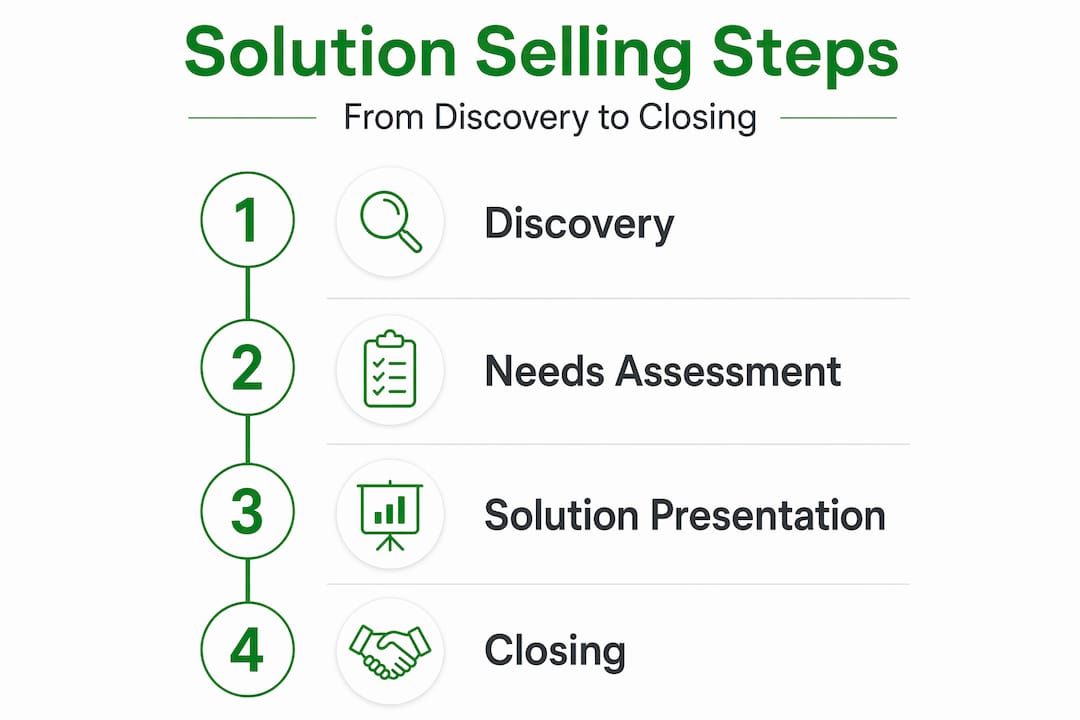
A structured discovery phase is at the heart of solution selling: asking questions to surface needs and pain points, educating the buyer by tying insights to a value proposition, then positioning the solution and communicating expected ROI. Think of it as four distinct stages you move through with every prospect.
Stage 1: Discovery
This is where you ask, not pitch. Your job is to surface both the explicit needs (what the client tells you) and the hidden needs (what’s really driving the problem). Good discovery questions go beyond “what are you looking for?” They dig into timeline, consequences, past attempts, and what success actually looks like.
Stage 2: Needs assessment
After discovery, you synthesize what you heard. You reframe the problem in your own words and confirm it with the prospect. This step builds massive trust because it shows you actually listened.

Stage 3: Solution presentation
Here you connect your service directly to the outcomes the client wants. Not “I offer fractional CMO services” but “Based on what you’ve told me, the gap in your go-to-market strategy is X, and here’s the specific way I’d address it over 90 days.”
Stage 4: Closing
This is where you make the next step obvious. Not pushy. Just clear. A good close gives the client a natural path forward and makes it easy to say yes if they’re a fit.
| Stage | Your focus | Client outcome |
|---|---|---|
| Discovery | Ask and listen deeply | Feels heard and understood |
| Needs assessment | Reframe and confirm | Gains clarity on their own problem |
| Solution presentation | Map service to outcomes | Sees specific value and ROI |
| Closing | Define next steps clearly | Knows exactly how to proceed |
Pro Tip: Build a discovery script you actually use on every sales call. It doesn’t have to be rigid, but having a sequence of 5 to 7 core questions means you won’t leave a call without the insight you need to present a compelling, tailored solution.
For freelancer sales tactics, this process is particularly powerful because you’re not hiding behind a brand. You’re the service. When you demonstrate deep understanding of a client’s problem, it’s personal and it builds real trust fast.
The key is repeatability. A consulting sales process built on these four stages lets you run every prospect interaction with confidence, even when you’re talking to someone cold. And according to PandaDoc’s research, building a repeatable discovery-to-prescription script, where you diagnose need, quantify impact, map a delivery approach, and close with clear next steps, helps outbound and inbound prospects quickly self-identify as a good fit. That’s the goal: make fit obvious so you spend time with people who are ready to move.
Solution selling vs. product selling: which approach fits your clients?
After outlining process steps, let’s compare solution selling to more traditional product-first techniques and help you choose the right fit for your client base.
Here’s the real talk: solution selling isn’t always the right tool. It often takes more time and skill than product or feature selling because it requires deeper discovery and customization. For simpler or commodity needs, product-led selling can be faster and more efficient.
But for most independent professionals? Simple commodity offers are rare. You’re usually dealing with:
- High-stakes decisions (budget, team changes, strategic direction)
- Complex buyer situations (multiple stakeholders, risk aversion)
- Outcomes that are hard to quantify without context
- Buyers who are comparing your approach to doing nothing
In those situations, solution selling wins every time. And the research backs this up. In B2B contexts, buyers navigate organizational risk and decision complexity. Solution selling supports this by driving alignment between the buyer’s needs and a tailored offering, shifting from transactional, product-focused thinking to outcome-focused conversations.
| Scenario | Best approach | Why |
|---|---|---|
| Quick, repeatable deliverables | Product selling | Speed matters, discovery adds friction |
| Complex, high-value engagements | Solution selling | Personalization drives trust and retention |
| First-time client, unknown context | Solution selling | Discovery builds understanding and fit |
| Returning client, known scope | Product selling | Context already exists, efficiency wins |
| Outbound to cold prospect | Solution selling | You need to earn attention through insight |
| Inbound with clear brief | Hybrid | Use discovery to deepen, not restart |
One major advantage of solution selling for service businesses is client retention. When you’ve built a service around a client’s specific needs and outcomes, they’re less likely to shop around. You’re not interchangeable. You’re the person who understood their problem better than they did.
This is also why pricing strategy becomes much easier with solution selling. When you’ve diagnosed a problem and tied your service to a specific outcome, you’re no longer competing on rate. You’re competing on value. That opens the door to value-based pricing, which is where your income really starts to scale without requiring more hours.
Adapting solution selling for independent business owners
With the pros and cons clear, let’s make solution selling actionable for you as a freelancer, consultant, or fractional executive.
The most important adaptation is this: your diagnosis must lead to a specific delivery journey, not a generic statement of work. For freelancers and consultants, the edge is adapting discovery and prescription to a service-based offer. Diagnosis must lead to a specific delivery journey including process, timeline, and risk management, rather than generic statements like “I’ll do X.”
What does that actually look like? Here are some practical examples:
- Strategy sprint: Instead of “I’ll create a content strategy,” say “Based on what you’ve described, I’d run a focused two-week strategy sprint: week one is audit and stakeholder interviews, week two is a documented playbook with a 90-day action plan. You’ll have clarity on where to focus and what to stop.”
- Testing phase: For clients unsure about committing, offer a structured discovery engagement. “Let’s start with a two-session needs assessment. At the end, you’ll have a clear picture of your gaps and I’ll have a specific recommendation. If we both agree it’s a fit, we move to the full engagement.”
- Implementation timeline: Map out the engagement in phases. Clients who can see the road ahead feel much safer saying yes.
Here’s a step-by-step process to adapt solution selling to your service business:
- Create a list of 7 to 10 discovery questions tailored to your niche
- Practice summarizing what you heard back to the prospect (needs assessment out loud)
- Build a simple service map showing how your work flows from diagnosis to delivery
- Prepare 2 to 3 case studies that show outcomes, not just deliverables
- Write a closing framework that defines the next step clearly and removes friction
Pro Tip: Position your service as a collaborative journey, not a transaction. Tell the prospect what will happen at each stage, who does what, and what success looks like. This directly addresses client risk, which is often the biggest barrier to a “yes.”
These consultant secrets are the kind of things that separate the freelancers who land consistent clients from those who stay stuck on referrals. And when you combine this approach with smart outreach (including cold email strategies), you have a full engine for consulting revenue growth that doesn’t depend on luck or word of mouth.
Why solution selling wins over referrals and product pitching
Here’s my honest take after years of running B2B sales and building an agency from zero to exit: referrals feel safe, but they’re a trap.
When you rely on referrals, you’re not in control of your pipeline. You’re at the mercy of whether someone remembers to mention you at the right moment. Some months are great. Some are terrifying. And you can’t fix it because the problem isn’t your skill. It’s your system.
Solution selling solves this because it’s a repeatable, learnable process. Once you’ve built your discovery script and your delivery journey narrative, you can run this with anyone. Cold prospect via LinkedIn. Inbound lead from your website. Warm intro at a conference. The process is the same. The outcome is consistent.
The second trap I see constantly is generic proposals. Someone goes through a conversation, asks a few vague questions, and then sends a PDF that says “here’s my service, here’s my rate.” That’s product pitching disguised as consulting. It doesn’t demonstrate insight. It doesn’t build trust. And it leaves the prospect with no real reason to choose you over anyone else.
Solution selling forces you to do the work of understanding before proposing. That’s uncomfortable at first (it means you can’t rely on a one-size template). But the payoff is huge: clients feel seen, proposals land with precision, and you attract the right people by design rather than by accident.
Real talk: the business owners I see thrive consistently are the ones who’ve built a method around client conversations, not a brochure. They know how to create opportunity from cold conversations because their process creates trust faster than any referral ever could.
If you want to explore more ideas like this, the full blog at Generating Pipeline covers positioning, outreach, pricing, and sales execution in real depth.
How Generating Pipeline helps you master solution selling
If this article sparked something, good. Now let’s make sure you have the tools to actually do it.
At GeneratingPipeline.com, everything is built around helping independent business owners like you build a consistent, repeatable client pipeline without relying on referrals. The Generating Pipeline OS is a 20-lesson course covering positioning, outbound and LinkedIn outreach, sales execution, and delivery foundations. Each lesson includes templates and frameworks you can use immediately. No fluff. One-time payment, lifetime access, no sales calls required. There’s also a free guide packed with 11 revenue-boosting tactics covering pricing, sales, and marketing, perfect if you want quick wins right now. If solution selling is the mindset shift, this is the system that makes it stick.
Frequently asked questions
How does solution selling help freelancers win clients without referrals?
Solution selling surfaces client needs and maps tailored service journeys, positioning freelancers as true problem solvers so clients self-identify as a fit without needing a warm referral.
What’s the first step in solution selling for a consulting service?
Start with structured discovery questions to diagnose the client’s underlying needs before proposing any service or engagement structure.
How is solution selling different from product selling?
Solution selling focuses on diagnosing problems and customizing outcomes, while product selling centers on features and faster cycles with less discovery required.
Does solution selling work for low-ticket offers or only complex projects?
Solution selling is best suited for complex, outcome-driven projects, but even in simpler deals, outcome-linked framing can increase perceived value and strengthen client relationships.
What script can I use to start solution selling with outbound prospects?
Use a four-step structure: diagnose the need, quantify the impact, map a delivery journey, and close with clear next steps so prospects can quickly self-identify as the right fit.
