TL;DR:
- Demand generation is a strategic approach that builds long-term trust with clients beyond simple lead capture.
- It involves creating awareness, educating the market, and positioning yourself as the expert through authentic content like case studies and webinars.
Most freelancers and consultants hear “demand generation” and assume it’s a corporate buzzword that doesn’t apply to them. Or they think it’s just another way to say “get more leads.” Real talk: that’s a pretty costly misunderstanding. Demand generation is actually a broader, more strategic approach to building client trust before anyone ever fills out a contact form. And recent data shows that even small B2B service businesses are shifting toward this model fast. This guide breaks down exactly what demand generation is, how it works for service professionals, and how you can start using it to build a more predictable client pipeline.
Table of Contents
- Defining demand generation: More than lead capture
- How demand generation works for service professionals
- Demand generation vs. lead generation: Which builds a sustainable pipeline?
- Building your demand generation framework
- Why real demand generation outperforms quick-win tactics
- Take your pipeline to the next level with proven demand generation tools
- Frequently asked questions
Key Takeaways
| Point | Details |
|---|---|
| Demand generation is holistic | It’s about building ongoing client trust, education, and brand presence—not just chasing leads. |
| Case studies drive results | Proof-focused content like client stories now leads the way in demand generation for service businesses. |
| Sustainability over quick wins | Structuring efforts around demand generation delivers a steadier, higher-quality pipeline and better client retention. |
| Frameworks fuel growth | A clear step-by-step demand generation process will help solo and service businesses see more consistent inquiries. |
Defining demand generation: More than lead capture
Let’s begin by demystifying what demand generation really means and how it relates to, but is distinct from, lead generation.
At its core, demand generation is about creating awareness, educating your market, and building long-term interest in what you do. It’s not just about capturing a contact’s information. It’s about shaping the way potential clients think about their problems, and positioning you as the obvious person to help solve them.
Lead generation, on the other hand, is much more transactional. It says: “You’re interested? Great, give me your email.” Demand generation says: “Let me teach you something genuinely valuable so that when you’re ready, you’ll already trust me.”
Here’s a simple way to think about the difference:
- Lead generation = capturing intent that already exists
- Demand generation = creating and nurturing that intent from scratch
- Lead gen tends to be short-term and campaign-driven
- Demand gen is ongoing, relationship-driven, and deeply tied to your brand
For service businesses especially, this distinction matters a lot. You’re not selling a physical product someone can return. You’re selling your expertise, your judgment, and your time. That requires trust. And trust doesn’t come from a well-designed landing page alone.
“Demand generation is the engine that makes lead generation work. Without real demand, lead capture is just fishing in an empty pond.”
The 2025 Demand Generation Benchmark Survey highlights exactly this shift. B2B marketing teams are emphasizing proof-focused content like case studies and increasingly integrating brand and demand marketing as one unified strategy. That’s not a trend reserved for enterprise teams. It’s something you can act on today.
The practical takeaway? Demand generation integrates brand-building with direct outreach to create sustainable growth. It’s the difference between chasing one-off clients and building a pipeline that fills itself. If you want to improve your client acquisition strategies for the long term, demand generation is the foundation worth building first. And there are plenty of service business growth hacks that align perfectly with this approach.
How demand generation works for service professionals
Now that you know what demand generation is, let’s see how you, as a service provider, can put these concepts into action.
Here’s the good news: you don’t need a marketing team or a big ad budget. The most effective demand generation tactics for service pros are actually pretty accessible. Think educational webinars, in-depth case studies, LinkedIn posts that teach something useful, and strategic partnerships with complementary service providers.
Let me give you a concrete example. Say you’re a fractional CFO. Instead of running cold outreach saying “I offer fractional CFO services,” you could publish a case study showing how you helped a SaaS startup reduce burn rate by 30% in 90 days. That case study does several things at once: it educates, it proves results, and it positions you as an expert before anyone even speaks to you. That’s demand generation in action.

The benchmark data confirms that B2B teams are leaning hard into proof-focused educational content. If it works for large teams, it absolutely works for solo operators and small service businesses, often even better because your content feels personal and authentic rather than polished and corporate.
Here’s a breakdown of the most effective demand generation channels for service professionals:
| Channel | Goal | Example tactic |
|---|---|---|
| Content marketing | Build authority and awareness | Weekly LinkedIn posts, how-to articles |
| Case studies | Build proof and trust | Client success story with measurable results |
| Webinars and live events | Educate and engage warm audiences | Free training on a niche problem you solve |
| Strategic partnerships | Tap into adjacent audiences | Co-hosting an event with a complementary provider |
| Email newsletters | Nurture interest over time | Weekly tips for your ideal client type |
| Speaking opportunities | Establish credibility at scale | Podcast guest slots, industry panels |
A diversified approach like this targets both awareness (people who don’t know you yet) and conversion (people who are almost ready to hire). Your client acquisition strategy should map activities to both stages, not just focus on the bottom of the funnel.
Pro Tip: Don’t try to activate all channels at once. Pick one or two where your ideal clients already spend time, and build a consistent presence there first. Consistency beats volume every time.
If you’re looking for practical ideas tailored to growing a consultancy, there are some solid consulting business growth ideas worth exploring that pair well with a demand generation mindset.
Demand generation vs. lead generation: Which builds a sustainable pipeline?
But how is this approach really different from classic lead generation, and which strategy sets you up for lasting results?
Let’s be honest. Lead generation isn’t bad. You absolutely need leads to run a business. The problem is when lead generation becomes your only strategy. When that happens, your pipeline is entirely dependent on active effort. Stop the campaigns, stop the cold outreach, stop the referrals flowing, and the pipeline dries up. That’s the feast-or-famine cycle so many service providers know all too well.
Demand generation changes that dynamic because it compounds over time. A well-written case study you publish today can generate inquiries six months from now. A podcast episode can bring in warm leads for years. Educational content you post consistently builds an audience that begins to see you as the go-to person in your space. That’s a fundamentally different asset than a lead list.
Here’s a direct comparison:
| Factor | Lead generation | Demand generation |
|---|---|---|
| Time horizon | Short-term | Long-term |
| Client quality | Variable | Generally higher quality |
| Effort required | Active, campaign-driven | Ongoing, compounding |
| Trust built before contact | Low | High |
| Pipeline stability | Peaks and valleys | More consistent over time |
| Best for | Quick wins, filling gaps | Sustainable business growth |
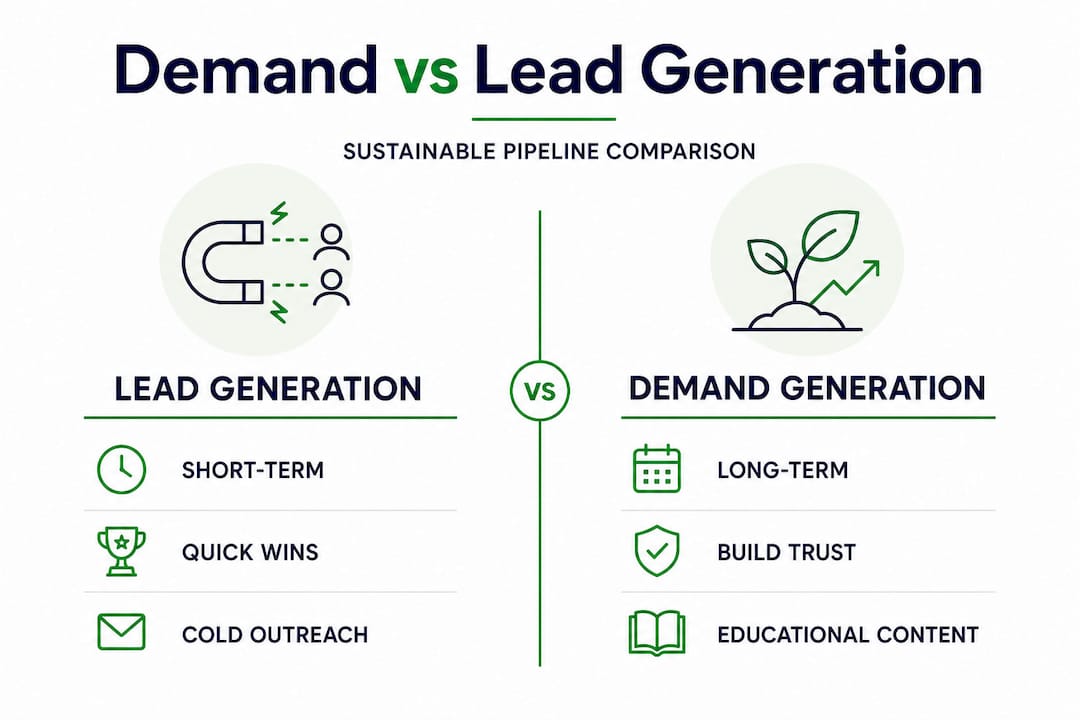
The data backs this up. According to the 2025 Demand Generation Benchmark Survey, 57% of marketers chose case studies as their top content format, and 29% reported a fully integrated approach to brand and demand marketing. That integration is what makes the pipeline sustainable.
For service businesses specifically, the key benefits of a demand-first pipeline include:
- Higher-quality inbound inquiries from clients who already understand what you do
- Shorter sales conversations because trust is already established
- Better client retention because expectations are set correctly from the start
- Less dependence on any single lead source (referrals, cold outreach, etc.)
- More predictable revenue month to month
That said, the smart play is combining both. Use lead generation to fill short-term gaps and demand generation to build the long-term foundation. If you want to sharpen your sales tactics for freelancers on the lead gen side while building demand in parallel, you’ll cover both ends of the spectrum. And pairing that with solid revenue growth hacks gives you a really well-rounded growth engine.
Building your demand generation framework
Ready to act? Here’s how to architect a demand generation machine that fits your business and lifestyle.
The goal here is simplicity. You don’t need a 40-step marketing funnel. You need a clear, repeatable process that consistently puts useful content in front of your ideal clients and nudges them closer to trusting you. Here’s how to do it:
-
Define your ideal client persona in detail. Go beyond job title. What keeps them up at night? What outcomes do they actually want? What language do they use to describe their problems? The more specific you are, the more your content will resonate.
-
Map out their journey from unaware to ready to buy. Think about what someone needs to know, believe, and feel before they’re ready to hire you. Your demand generation content should serve each stage: awareness, consideration, and decision.
-
Create educational content that directly addresses their pain points. This doesn’t have to be long or fancy. A LinkedIn post that teaches one useful thing, a short video explaining a common mistake, or a simple checklist can all generate real demand if they speak to the right problem.
-
Build proof into everything. The benchmark survey found that case studies remain the top content format for demand generation, with 57% of marketers ranking them first. Every client win you have is an opportunity for a case study. Even a short paragraph with a clear result counts.
-
Set a realistic publishing cadence and stick to it. Consistency is more important than volume. One great LinkedIn post per week beats five mediocre ones. One solid case study per quarter beats a dozen thin testimonials.
-
Track what’s working using simple metrics. You don’t need complex analytics. Watch which content gets the most saves, shares, and replies. Notice which case studies generate the most DMs or inquiries. Double down on what resonates.
-
Review and optimize every 90 days. Block time quarterly to review what’s working, what to stop, and what to experiment with next.
Pro Tip: A strong pricing strategy for client growth pairs naturally with demand generation. When clients arrive already educated on your value, you’re in a much stronger position to hold your rates and close without discounting.
For consultants and fractional executives especially, building a demand generation engine is one of the most powerful things you can do for long-term income stability. There are some detailed consulting revenue growth strategies that layer in nicely on top of this framework once the foundation is in place.
Why real demand generation outperforms quick-win tactics
Let’s pull back and share why this mindset is genuinely transformative for service-based entrepreneurs, based on what I’ve seen firsthand.
Here’s something I believe pretty strongly: the obsession with “leads at any cost” is one of the most self-defeating traps a solo service provider can fall into. When you’re constantly chasing new contacts, you’re always starting from zero. Every cold outreach campaign requires trust to be built from scratch. Every sales conversation is fighting against skepticism. It’s exhausting, and frankly, it’s inefficient.
What demand generation does differently is that it shifts the dynamic. Instead of you hunting for clients, you’re creating the conditions for the right clients to find you, already warm, already educated, and already predisposed to trust you. That’s a completely different starting point for a sales conversation.
The compounding effect is real. A single piece of well-crafted content can generate inquiries over months or years. A thoughtful case study published today might be the thing that convinces a prospect to reach out in six months. That’s leverage. And for lifestyle-driven business owners who want freedom, not just revenue, that leverage is incredibly valuable.
Benchmark data shows that 29% of B2B marketers now report a fully integrated approach to brand and demand marketing. That number will keep growing. The service providers who build this foundation now will have a significant advantage over those still relying entirely on referrals or cold outreach.
My honest take? The best clients I’ve ever worked with came through education-first pipelines. Not from aggressive outreach. Not from a flashy ad. From content that taught them something useful and made them think, “This person actually gets it.” That’s what demand generation produces at its best. And for those of you building proven acquisition strategies for the long haul, this is absolutely the foundation to build on.
Take your pipeline to the next level with proven demand generation tools
If this article got you thinking about how to actually implement a demand generation strategy in your business, that’s great. The next logical step is to embed these methods in your business with hands-on resources.
At GeneratingPipeline.com, there are practical tools, frameworks, and guides built specifically for freelancers, consultants, and fractional executives who want a real, repeatable client pipeline. Whether you want to avoid revenue gaps in your consulting work, understand how to create your client pipeline from scratch, or get clear on pipeline forecasting so you can predict your income more reliably, there’s something here for you. The Generating Pipeline OS covers everything from positioning and outreach to sales execution, all in one straightforward, no-fluff course designed for busy service professionals.
Frequently asked questions
What is the main difference between demand generation and lead generation?
Demand generation creates long-term interest and awareness through education and trust-building, while lead generation focuses on capturing immediate sales prospects who are already showing intent. The 2025 Benchmark Survey confirms that leading B2B teams are now integrating both approaches, with demand gen as the foundation.
What is an example of demand generation for consultants?
Publishing detailed client case studies and hosting educational webinars are two of the most effective demand generation tactics for consultants, because they build credibility and trust before any sales conversation begins. The benchmark data shows 57% of marketers rank case studies as their top content format for good reason.
Is demand generation effective for small or solo service businesses?
Absolutely. Integrated demand generation and proof-focused content are shown to benefit businesses of all sizes, and solo operators often have an advantage because their content feels personal and authentic in a way that large corporate content rarely does.
Which content format works best for demand generation in 2026?
Case studies remain the single most effective content format for demand generation campaigns. According to the 2025 benchmark research, 57% of marketers chose case studies as their top format because they combine proof, storytelling, and education in one package.
Recommended
- Sales funnel guide: how service businesses win clients
- What is revenue forecasting: A guide for service businesses
- Pricing psychology: boost client acquisition in 2026
- Referrals drive 65% of pipeline growth for service businesses
- Autonomous AI Agents vs Traditional Sales Teams: Which Delivers 4x Higher Conversion Rates for Service Businesses? – AI Management Agency
