TL;DR:
- A sales funnel for service businesses guides prospects through trust-building stages from awareness to action.
- Differentiating between a buyer-focused funnel and an internal sales pipeline is essential for effective management.
- Focusing on client fit and relationship stages improves conversion rates over merely increasing lead volume.
Most service business owners think a sales funnel is just a fancy marketing term for “get more leads.” So they chase volume, post more content, run more ads, and wonder why their client flow is still unpredictable. The real problem isn’t the number of leads. It’s the absence of a structured, repeatable process that moves the right people from “I’m curious” to “let’s sign the contract.” This article breaks down exactly how a sales funnel works for service businesses, how it differs from a sales pipeline, and what you can do right now to make yours actually convert.
Table of Contents
- Sales funnel fundamentals: Decoding the stages
- How the sales funnel works for service-based businesses
- Funnel versus pipeline: Why service businesses must know the difference
- Optimizing your sales funnel: Tools, content, and tracking
- Our take: Why most service business funnels break and how to fix yours
- Next steps: Build a winning sales funnel with Generating Pipeline
- Frequently asked questions
Key Takeaways
| Point | Details |
|---|---|
| Funnel stages matter | Understanding each stage helps service businesses create consistent processes for client acquisition. |
| Relationship drives results | Building trust and aligning solutions to client needs is essential for converting prospects. |
| Funnels versus pipelines | Knowing the difference allows owners to both nurture and track opportunities effectively. |
| Optimize with tools | Using CRM software, educational content, and tracking frameworks boosts conversion rates. |
Sales funnel fundamentals: Decoding the stages
A sales funnel is a visual model that maps the journey a prospect takes from first hearing about you to becoming a paying client. Think of it as a series of filters. At the top, you have a wide pool of potential leads. As they move through each stage, the ones who aren’t a good fit drop out, and the ones who are move closer to working with you.
The classic funnel has four stages:
- Awareness: The prospect discovers you exist, through content, LinkedIn, referrals, or outreach.
- Interest: They engage, read your content, visit your website, or respond to a message.
- Decision: They’re evaluating whether you’re the right fit, often comparing options.
- Action: They sign the contract or make the first payment.
For product businesses, this process can be fast and transactional. For service businesses, it’s different. Relationship-building and longer cycles with discovery calls and proposals are central to how service funnels actually work. Trust is the currency. And trust takes time to build.
That’s why service funnels often include additional steps like discovery calls, proposal reviews, and negotiation phases. You’re not just selling a product someone can return. You’re selling your expertise, your judgment, and your time.
Here’s a quick comparison of how a standard funnel compares to a service-specific one:
| Standard funnel stage | Service business equivalent |
|---|---|
| Awareness | LinkedIn post, outbound email, referral |
| Interest | Content engagement, reply, or inquiry |
| Decision | Discovery call, proposal review |
| Action | Contract signed, onboarding begins |
For a deeper look at how these stages play out in consulting specifically, check out these consulting funnel stages to see how each phase connects.
“The funnel isn’t just a marketing tool. For service businesses, it’s a trust-building system that requires patience, clear positioning, and consistent follow-through at every stage.”
How the sales funnel works for service-based businesses
With a clear understanding of funnel stages, let’s examine how those stages work in practice for service-based businesses.
Here’s the typical step-by-step journey a prospect takes:
- Lead generation: You attract attention through outbound outreach, content, or referrals.
- Qualification: You identify whether the lead has the budget, need, and timeline to work with you.
- Discovery call: You explore their challenges and goals, and they evaluate whether you’re the right fit.
- Proposal: You present your solution, scope, and pricing.
- Negotiation: You address objections, adjust scope if needed, and work toward agreement.
- Closing: The contract is signed and the engagement begins.
Discovery calls, proposals, and negotiations are the backbone of service sales funnels, and each one requires a different skill set. Rushing any of these steps is one of the fastest ways to lose a deal or land the wrong client.
Here’s a rough look at how conversion rates tend to drop at each stage:
| Funnel stage | Typical conversion rate |
|---|---|
| Lead to qualified | 20 to 30% |
| Qualified to discovery call | 50 to 60% |
| Discovery call to proposal | 60 to 70% |
| Proposal to close | 30 to 50% |
These numbers vary by industry and offer, but the pattern is consistent. Most drop-off happens early, which means your qualification process matters more than your closing script.
For a smoother discovery call process, preparation is everything. Know what you’re trying to learn, not just what you’re trying to sell. And once deals are in motion, solid deal tracking for services keeps you from losing track of where each prospect stands.

Pro Tip: Use one or two strong case studies at the proposal stage. A specific result (“we helped a consultant increase their close rate by 40%”) builds far more trust than a generic testimonial. Pair that with a short webinar or video walkthrough of your process, and you give prospects the confidence to say yes.
Funnel versus pipeline: Why service businesses must know the difference
Service business owners often hear “funnel” and “pipeline” used interchangeably. Let’s break down how these concepts differ and why mastering both is essential.
Here’s the core distinction: a sales funnel is about the buyer’s journey. A sales pipeline is about the seller’s tracking system.
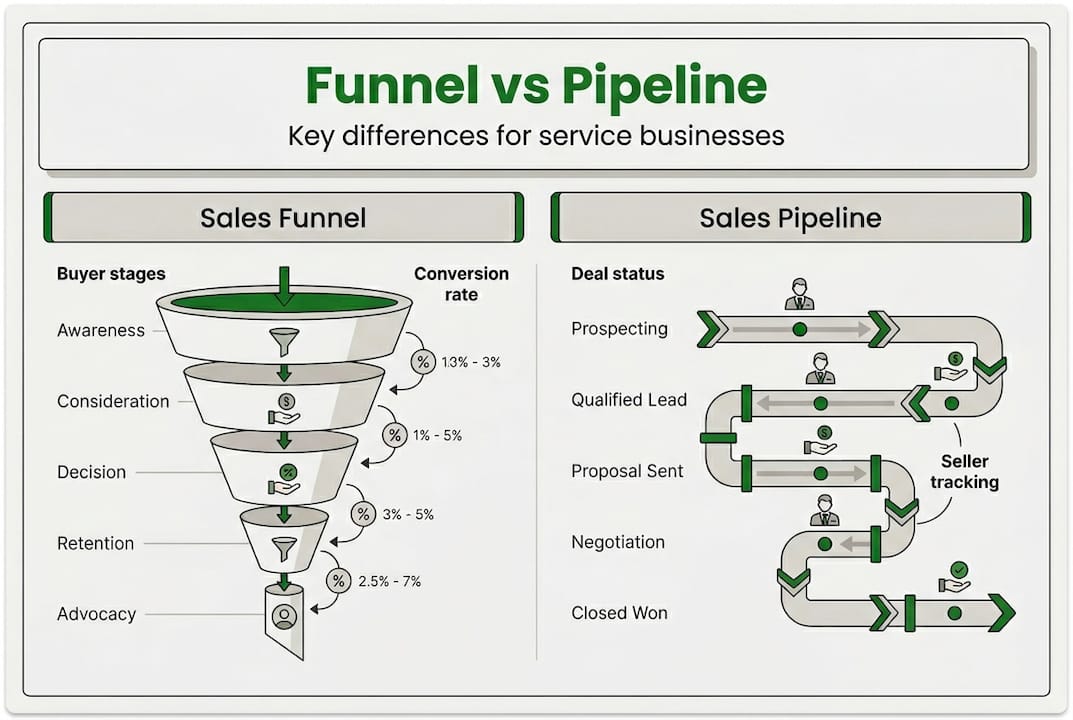
The funnel answers: “Where is this prospect in their decision-making process?”
The pipeline answers: “Where is this deal in my sales process, and what do I need to do next?”
The funnel is a buyer journey view; the pipeline is for tracking deals and managing your own actions. Both matter. But confusing them leads to a common mistake: focusing on volume (how many leads are in the funnel) instead of fit (are these the right leads for my service?).
For service businesses, fit is everything. Taking on the wrong client costs you time, energy, and often your reputation. A well-managed pipeline helps you stay honest about which deals are real and which ones are just wishful thinking.
Key differences at a glance:
- Funnel: Buyer-centric, marketing-focused, measures awareness to action
- Pipeline: Seller-centric, sales-focused, measures deal stages and next steps
- Funnel metric: Conversion rate at each stage
- Pipeline metric: Deal value, stage, and expected close date
- Goal of funnel: Build awareness and trust
- Goal of pipeline: Move deals forward and close revenue
| Concept | Focus | Key metric | Managed by |
|---|---|---|---|
| Sales funnel | Buyer journey | Stage conversion rate | Marketing + sales |
| Sales pipeline | Deal tracking | Deal value and stage | Sales rep or owner |
For a full breakdown, the sales pipeline explained guide covers the mechanics in detail. And if you want to tighten up how you manage active deals, these pipeline management tips are a solid starting point.
Optimizing your sales funnel: Tools, content, and tracking
Understanding the funnel and pipeline is just the start. Now, let’s look at how to optimize your funnel with the right tools and tracking methods.
Multi-phase deal tracking in CRMs and educational content builds trust and prevents deals from slipping through the cracks. Here’s what that looks like in practice:
Tools and content by funnel stage:
- Awareness: LinkedIn content, cold email sequences, SEO articles, podcast appearances
- Interest: Lead magnets, free guides, newsletter sign-ups, short videos
- Decision: Case studies, testimonials, proposal templates, webinars
- Action: Clear contracts, smooth onboarding docs, e-signature tools
For CRM tools, you don’t need anything complex. A simple setup in HubSpot (free tier), Notion, or even a well-structured spreadsheet can do the job if you’re consistent. The tool matters less than the habit of updating it.
For deeper sales process optimization, focus on what’s happening between stages, not just at them. That’s where deals stall.
Pro Tip: Use “necessary conditions for advancement” (NCA) for each stage. Before a deal moves from discovery call to proposal, ask: Did I confirm budget? Did I identify the decision-maker? Did they express a clear problem I can solve? If the answer to any of these is no, the deal isn’t ready to advance. This simple check prevents you from wasting time on proposals that were never going to close.
For broader client acquisition tactics, combining a tight funnel with proactive outreach is what separates service businesses that grow consistently from those that ride the feast-or-famine rollercoaster.
A quick stat worth noting: businesses that use CRM tools to track funnel stages report significantly higher close rates compared to those managing deals informally. Structure creates results.
Our take: Why most service business funnels break and how to fix yours
Here’s the hard truth most experts won’t say out loud: your funnel isn’t broken because you need more leads. It’s broken because you’re optimizing for volume instead of fit.
I’ve seen this pattern repeatedly. A consultant fills their pipeline with 20 leads, sends 20 proposals, and closes two clients who turn out to be a nightmare to work with. The funnel “worked” by the numbers, but the business suffered.
Funnel stages must align with ideal client fit and multi-stakeholder needs, not just lead volume. That means being willing to disqualify early and often. It means building trust before you pitch. It means treating the discovery call as a mutual evaluation, not a sales performance.
The fix isn’t a new tool or a better script. It’s a mindset shift: your funnel exists to find the right clients, not just more clients. Once you internalize that, every stage gets sharper. Your messaging gets clearer. Your proposals get more targeted. And your close rate goes up because you’re only proposing to people who are genuinely ready.
For a look at common pipeline mistakes to avoid, that resource covers the specific traps that catch most service business owners off guard.
Next steps: Build a winning sales funnel with Generating Pipeline
If this article gave you clarity on how your funnel should work, the next step is putting it into practice. That’s exactly what we’ve built Generating Pipeline to help you do.
Whether you want to avoid revenue gaps that come from an inconsistent pipeline, get a handle on your pipeline management so no deal falls through the cracks, or grab some quick win sales tactics you can use this week, we’ve got practical, no-fluff resources ready for you. No sales calls, no webinar funnels. Just tools that work for busy service business owners who want consistent clients.
Frequently asked questions
What is a sales funnel in a service business?
A sales funnel is a structured series of steps that guides prospects from first contact to becoming paying clients, with a strong emphasis on relationship-building and longer cycles that include discovery calls and proposals.
How does a sales funnel differ from a sales pipeline?
A funnel maps the buyer’s journey from awareness to action, while a pipeline is a tool for tracking where each deal stands and what the seller needs to do next, as the funnel is buyer-focused and the pipeline tracks deals.
What tools can help optimize a sales funnel?
CRM platforms, case studies, webinars, and proposal templates all support funnel performance, and multi-phase tracking and trust-building content are especially effective for service-based businesses.
Which funnel stage is most important for service businesses?
The discovery call and proposal stages carry the most weight because they’re where trust is built and fit is confirmed, and discovery calls and proposals are the stages most likely to make or break a deal.
