TL;DR:
- Most sales require at least five follow-ups, but nearly half of salespeople stop too early.
- Persistence with value-focused follow-up significantly boosts conversion rates and client acquisition.
- Timely, personalized follow-ups are crucial, with quick responses and consistent cadence outperforming single outreach efforts.
Here’s a stat that should stop you in your tracks: 80% of sales require five or more follow-up attempts after the initial meeting, yet nearly half of all salespeople quit after just one try. If you’re a freelancer, consultant, or fractional executive wondering why your pipeline feels dry despite solid initial conversations, this is probably your answer. Follow-up isn’t a nice-to-have. It’s the engine behind a consistent client pipeline. This guide breaks down the numbers, busts the myths, and gives you a practical system to follow up with confidence.
Table of Contents
- The numbers: How follow-up impacts sales success
- Breaking the myths: Why follow-up isn’t pushy when done right
- Follow-up timing: Speed, cadence, and responding first
- Follow-up essentials: How to turn touches into clients
- Our take: Why persistent follow-up creates independent success
- Build your pipeline with smarter follow-up
- Frequently asked questions
Key Takeaways
| Point | Details |
|---|---|
| Most sales need follow-up | The majority of clients close after several follow-up touchpoints, not the first call. |
| Persistence drives results | Sticking with 5-6 messages can multiply your conversions and pipeline consistency. |
| Timing matters | Quick, well-paced follow-up increases reply rates and helps you win more business. |
| Value over volume | Clients appreciate useful, relevant follow-ups more than frequent, generic check-ins. |
| Systematize for growth | Automating and tracking your follow-ups creates a steady flow of clients for your business. |
The numbers: How follow-up impacts sales success
Let’s look at what the data actually shows, because the gap between what works and what most service providers do is pretty eye-opening.
The follow-up statistics are clear: 80% of sales require 5+ follow-up calls after the first meeting, but somewhere between 44% and 48% of salespeople never follow up more than once. That means almost half of your competition is handing you deals simply by giving up too early.
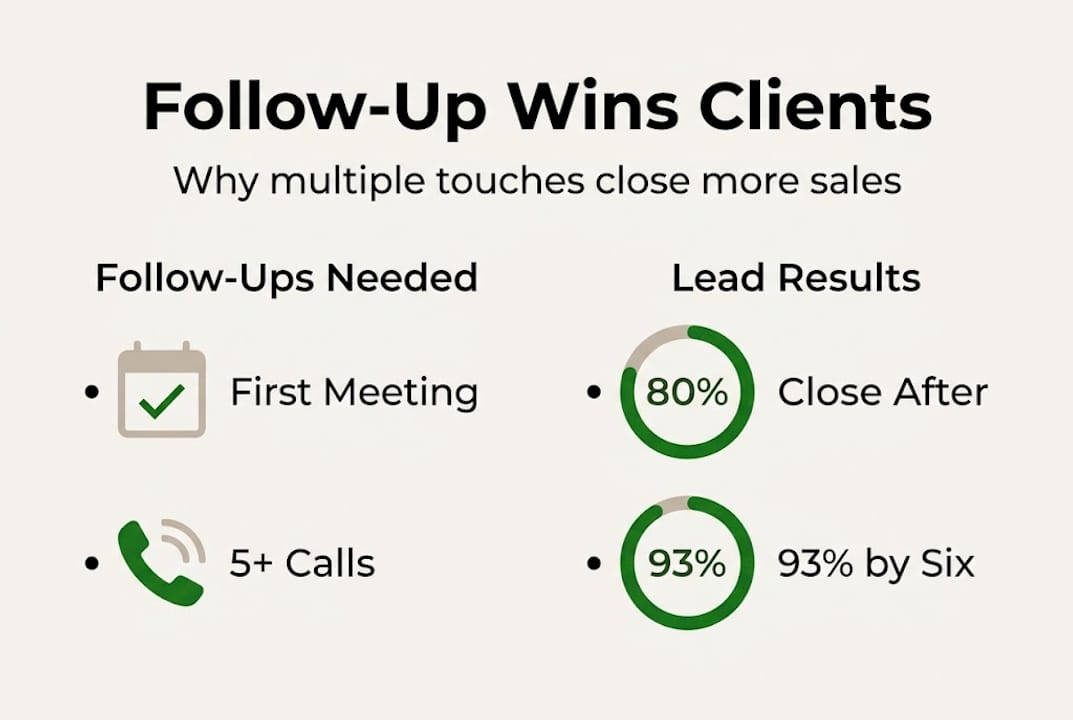
And it gets more interesting. Research shows that 93-95% of converted leads are reached by the sixth follow-up attempt. Prospects who receive six or more touches are 70% more likely to buy. That’s not a marginal improvement. That’s a completely different conversion reality.
Here’s a quick look at how persistence stacks up:
| Number of follow-ups | % of salespeople who stop | Estimated conversion impact |
|---|---|---|
| 1 | 44-48% | Very low |
| 2-4 | ~35% | Moderate |
| 5-6 | ~10% | High |
| 7+ | ~5% | Very high |
So why do so many independent professionals quit early? A few reasons come up again and again:
- Fear of being annoying or coming across as desperate
- No defined system for when and how to follow up
- Assuming silence means no when it often just means busy
- Lack of a CRM or reminder tool to prompt action
- Inconsistent outreach that breaks momentum
The data doesn’t lie. A strong consulting sales process is built on persistence, not just a great first impression. And your sales call tips only matter if you actually stay in the game long enough for them to land.
Breaking the myths: Why follow-up isn’t pushy when done right
With those facts in place, it’s time to bust the biggest myth holding back many independent professionals: that following up is annoying.
Real talk. Most prospects are juggling a dozen priorities. When they go quiet after an initial call, it’s rarely because they’re not interested. It’s because life got in the way. A well-timed follow-up message isn’t an interruption. It’s a reminder that you’re still there and still care.
“Persistence and value-focused follow-up is what separates a full pipeline from a dry one. Most people don’t follow up enough, not too much.”
Here’s what the pipeline-building insights actually tell us: the biggest risk isn’t following up too much. It’s quitting after one or two attempts and assuming the deal is dead. Automation and simple message templates make it easy to stay warm without feeling like you’re chasing someone.
Here’s how to follow up without being pushy:
- Lead with value, not just a check-in. Share a relevant article, a quick insight, or a case study that speaks to their situation.
- Keep messages short. Two to three sentences max. Respect their time.
- Reference the last conversation so it feels personal, not templated.
- Space out your touches so you’re not hitting them every day.
- Make it easy to respond by asking a single, specific question.
Pro Tip: Think of every follow-up as a small gift of attention, not a demand for their time. That mindset shift changes everything about how your messages land.
A solid client acquisition strategy accounts for the full arc of a relationship, not just the first touchpoint. And consultant sales funnels that build in follow-up sequences consistently outperform those that rely on a single outreach.
Follow-up timing: Speed, cadence, and responding first
Removing the fear of follow-up is only the start. Timing and consistency are the real game changers.

Here’s a stat that should motivate you to move fast: 50% of sales go to the first vendor to respond. And if you follow up within five minutes of an inquiry, you’re 9 to 21 times more likely to convert that lead. That’s not a small edge. That’s a massive competitive advantage hiding in plain sight.
But speed alone isn’t enough. You also need a cadence, which is just a fancy word for a planned schedule of touches. The sales conversion stats show that the first follow-up boosts reply rates by 49%, the second by about 3%, and by the third, you’re seeing diminishing returns if the messages aren’t adding value.
Here’s a simple cadence comparison:
| Touch | Timing | Expected reply rate boost |
|---|---|---|
| First follow-up | 24-48 hours after initial | +49% |
| Second follow-up | 3-5 days later | +3% |
| Third follow-up | 7-10 days later | Neutral to slight drop |
| Fourth and beyond | Every 10-14 days | Value-dependent |
The risk of following up too often? You come across as desperate and train prospects to ignore you. Too little? You disappear and lose the deal to someone more persistent.
Here’s what a balanced cadence looks like for most independent service providers:
- Day 1: Send a summary or recap of your conversation
- Day 3: Add a relevant resource or insight
- Day 7: A short, direct check-in
- Day 14: A light nudge with a clear call to action
- Day 21+: Monthly touchpoint to stay top of mind
Building quick win sales tactics into your cadence keeps momentum alive. And having a step-by-step sales process means you never have to wonder what to do next.
Follow-up essentials: How to turn touches into clients
With timing and cadence set, it’s time for hands-on application. Here’s how to build your follow-up system from scratch.
The goal is simple: make follow-up automatic so it doesn’t rely on your memory or motivation. Here’s how to do it step by step:
- Map your follow-up sequence. Decide in advance how many touches you’ll send, what each one will say, and when it will go out. Write the templates once and reuse them.
- Use a CRM or simple tool. You don’t need anything fancy. Even a spreadsheet with contact names, last contact date, and next action works. Tools like HubSpot’s free tier or Notion can handle this easily.
- Personalize each message. Reference something specific from your last conversation. Generic messages get ignored. Personalized ones get replies.
- Focus on clarity and relevance. Every message should have one clear purpose. Are you sharing a resource? Asking a question? Proposing a next step? Pick one and stick to it.
- Know when to stop. If someone has asked you not to contact them, respect that immediately. If you’ve sent six to eight touches with zero response, it’s okay to send a final “closing the loop” message and move on.
Tracking your follow-up activity also improves your pipeline health over time. You start to see patterns: which message types get replies, which timing works best, and which prospects tend to convert after a longer nurture period.
The conversion research is consistent: prospects with 6+ touches are 70% more likely to buy. That’s not magic. That’s a system doing its job.
Pro Tip: Use B2B sales triggers to make your follow-ups feel timely and relevant. When a prospect changes roles, posts something on LinkedIn, or announces a new initiative, that’s your cue to reach out with something genuinely useful.
Our take: Why persistent follow-up creates independent success
Here’s a perspective most guides miss entirely.
Follow-up isn’t just a tactic. It’s a discipline. And it requires a kind of humility that most sales advice doesn’t talk about. You have to be willing to keep showing up even when the silence feels uncomfortable. That takes real grit.
From experience, the biggest client wins don’t come from the first conversation or even the third. They come from the seventh or eighth check-in, when a prospect finally has the budget approved, the timing aligned, or the internal approval they were waiting on. Charisma gets you in the door. Consistency keeps you there.
Here’s the part that surprises most people: clients actually appreciate thoughtful persistence. Not the spammy, copy-paste kind. The genuine, value-first kind that says, “I’m still thinking about your problem.” That’s rare. And rare things get remembered.
A systematized follow-up habit is, honestly, the single biggest difference-maker I’ve seen for independent service providers trying to maintain a steady consulting client growth trajectory. It’s not glamorous. But it works every single time.
Build your pipeline with smarter follow-up
If this article has shown you anything, it’s that a consistent follow-up habit is the fastest path to a full client pipeline. The good news? You don’t have to figure it all out alone.
At GeneratingPipeline.com, we’ve built resources specifically for freelancers, consultants, and fractional executives who want a repeatable system without the overwhelm. Start by exploring client pipeline strategies to understand how follow-up fits into your bigger growth picture. If feast-or-famine cycles are your reality, the guide on avoiding revenue gaps is a must-read. And for practical, actionable ideas you can use right now, check out our sales tactics for freelancers. Your next client is probably already in your pipeline. You just need to follow up.
Frequently asked questions
How many times should I follow up with a sales prospect?
Aim for at least five to six follow-ups, since 93-95% of conversions happen by the sixth attempt and prospects with six or more touches are 70% more likely to buy.
Does quick follow-up really increase my chances of closing a sale?
Absolutely. Following up within 5 minutes makes you 9 to 21 times more likely to convert a lead, and half of all sales go to the first person who responds.
How can I follow up without being annoying?
Focus each message on helping the prospect, not just checking in. Automation and personalized messages keep communication warm and relevant without feeling intrusive.
What is the risk if I don’t follow up consistently?
You risk handing deals to competitors who are simply more persistent. Since 80% of sales require 5+ follow-ups, stopping early is one of the most common and costly mistakes independent service providers make.
Recommended
- Client Pipeline Refresh: How to Avoid Gaps and Keep Your Revenue Steady – Generating Pipeline
- How to create a client pipeline that grows your business
- Sales Process and Optimisation For an Efficient, Repeatable Sales System – Generating Pipeline
- Sales pipeline stages explained: A 2026 guide for freelancers
