TL;DR:
- Most agencies struggle with conversion rates rather than lead generation.
- Implementing a structured sales funnel with clear stage ownership improves predictable client acquisition.
- Regularly reviewing and optimizing funnel stages ensures continued growth and higher conversion rates.
Most agencies don’t have a lead generation problem. They have a conversion problem. You can fill your calendar with discovery calls, run ads, post content daily, and still end the month wondering where the revenue went. The real issue is that most agencies treat their pipeline like a loose collection of conversations rather than a structured system. A well-designed sales funnel changes that. It turns scattered activity into a predictable path from first contact to signed contract, and that is exactly what this guide is about.
Table of Contents
- What is a sales funnel for agencies?
- Pinpointing agency funnel bottlenecks and conversion rates
- Structuring sales funnel ownership and scalable systems
- Practical lead generation tactics to fill your agency funnel
- Why most agencies underestimate the ongoing work of high-performing funnels
- Build your agency’s growth engine with proven sales funnel strategies
- Frequently asked questions
Key Takeaways
| Point | Details |
|---|---|
| Funnels offer predictability | A structured sales funnel guides clients from awareness to onboarding with measurable conversion at each step. |
| Biggest drop-offs | Most agency sales are lost at the qualification and handoff stages, not at the initial lead stage. |
| Stage ownership matters | Assigning responsibility for each funnel stage boosts improvement and accountability. |
| Content drives entry | Gated resources, webinars, and research reports serve as high-leverage lead generators for agencies. |
| Continuous optimization | High-performing agencies treat sales funnels as living systems, refining them as the market shifts. |
What is a sales funnel for agencies?
A sales funnel is both a visual map and an operational model of the steps a potential client takes before they pay you. Think of it less as a marketing concept and more as a client journey you actively design and manage.
For agencies and service businesses, the typical stages look like this:
- Awareness: The prospect discovers you (LinkedIn, referral, content, outreach)
- Interest: They engage with something you share or send
- Consideration: They compare you against other options
- Decision: They decide to move forward with a proposal or call
- Close: Contract signed, payment confirmed
- Onboard: They become an active client
Here is where a lot of agencies go wrong. They treat lead generation (getting someone into Awareness) as the finish line. But the real work is in qualifying, nurturing, and converting at every single stage that follows.
As agencypro.app notes, the funnel’s core role is to “create predictable conversion from attention to paying clients” and that word predictable is the whole point.
A sales funnel is not a lead bucket. It is a system that moves the right people toward a buying decision in a way you can repeat and improve.
Here is a quick comparison of how traditional lead generation differs from a full-funnel approach:
| Approach | Focus | Outcome |
|---|---|---|
| Traditional lead gen | Volume of contacts | Unpredictable revenue |
| Full-funnel sales | Qualified conversion at each stage | Consistent, repeatable client acquisition |
| Full-funnel with ownership | Stage-specific accountability | Faster deals, lower drop-off |
If you want a deeper look at how this applies to your specific business model, the service business sales funnel guide at GeneratingPipeline.com breaks it down further. There is also a solid resource on consultant sales funnels if you are a solo operator or small team.
The bottom line: a funnel without stage-level thinking is just a list of names. You need to know what moves someone from one stage to the next, and what stops them.
Pinpointing agency funnel bottlenecks and conversion rates
Now that you understand the full funnel concept, let’s talk numbers. Because most agencies are losing deals in places they are not even watching.
Here are some benchmark conversion rates worth knowing:
| Funnel Stage | Typical Conversion Rate |
|---|---|
| Visitor → Lead | 2–5% |
| Lead → Marketing Qualified Lead (MQL) | 20–30% |
| MQL → Sales Qualified Lead (SQL) | Teens to low 20s |
| SQL → Proposal | 40–60% |
| Proposal → Close | 20–30% |
The biggest drop-off tends to happen between the lead stage and sales qualification, where conversion sits in the teens to low twenties on average. That is the MQL to SQL gap, and it is where most agencies hemorrhage opportunity without realizing it.

Why? Because handoffs are messy. Someone downloads your guide or books a call, and then… nothing happens in a structured way. No clear follow-up. No qualification questions. No next step defined. The lead goes cold and you blame the channel.
Here are three actions that will help reduce bottlenecks:
- Map every handoff point explicitly. Write down what triggers a lead to move from one stage to the next. Gut feel is not a system.
- Add a qualification layer early. Use a short intake form or diagnostic call to filter out poor-fit leads before investing heavy sales time.
- Set follow-up sequences, not one-off emails. A single follow-up rarely converts. A structured three to five touch sequence does.
Pro Tip: Assign a named owner to each funnel stage. Even if you are solo, decide which role you are playing at each point (marketer, qualifier, closer) and switch hats deliberately. This thinking makes leaks obvious fast.
If you want a structured way to build this out, the step-by-step sales process guide covers the mechanics in detail. For a more consulting-focused angle, check out this resource on building a consistent consulting sales process.
Structuring sales funnel ownership and scalable systems
Here is a concept that changes how agencies think about growth: TOFU, MOFU, and BOFU. These stand for Top, Middle, and Bottom of Funnel. Each zone has a different goal and should have a different owner (or mindset, if you are solo).
Top of Funnel (TOFU): Create awareness and generate interest. Focus on reach, content, and outreach.
Middle of Funnel (MOFU): Nurture interest and qualify leads. Focus on education, discovery calls, and proposals.
Bottom of Funnel (BOFU): Close deals and onboard clients. Focus on objection handling, contract execution, and delivery handoff.
Separating ownership by funnel stage improves repeatability and accountability across the team. That insight matters even if you are a team of one, because it forces you to be intentional about where you are spending your time.
Here are the key roles and responsibilities by stage:
- TOFU owner: Manages content, outreach campaigns, and first-touch nurturing
- MOFU owner: Runs discovery calls, scores leads, and sends proposals
- BOFU owner: Handles negotiation, closes deals, and manages the onboarding experience
- KPI owner: Tracks conversion rates at each stage and flags drops early
Critical KPIs to track at each stage include: visitor to lead rate (TOFU), MQL to SQL rate (MOFU), and proposal to close rate (BOFU). These three numbers will tell you where to focus attention at any given time.
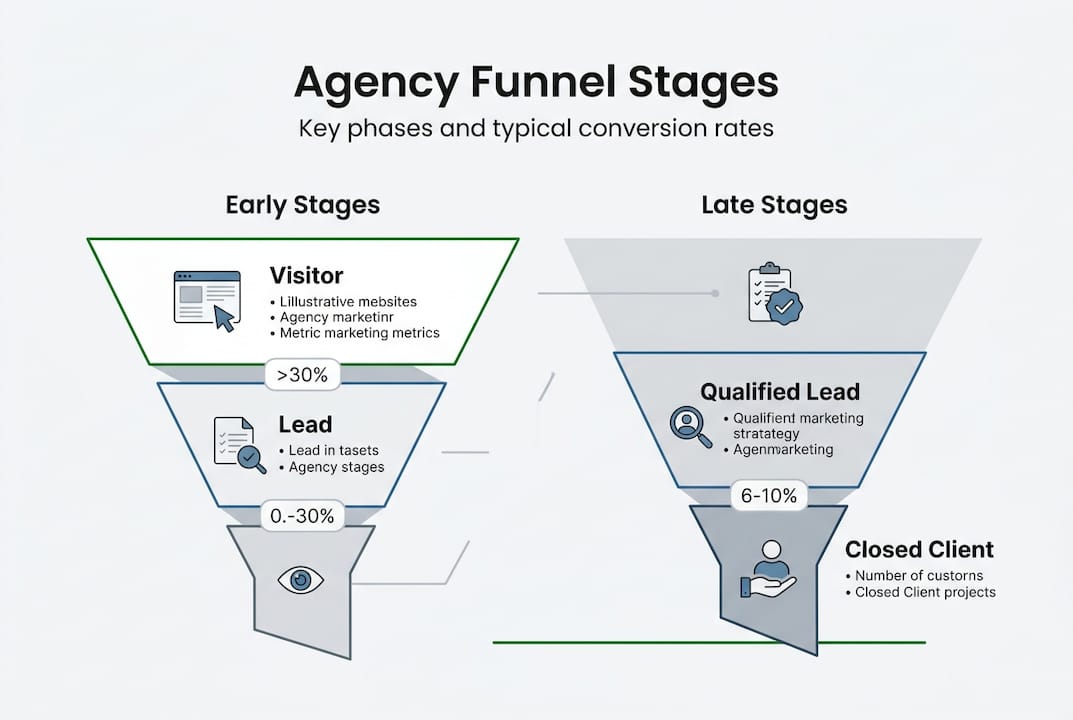
Pro Tip: Do not treat funnel design as a one-off project. Revisit your stage KPIs every quarter and make small adjustments. A funnel that worked six months ago may not reflect how your buyers behave today.
This is also the fix for the “funnels don’t work” complaint. Funnels do work. They just stop working when nobody is responsible for keeping them healthy. If you want to see how this applies specifically to solo operators, the repeatable agency sales process guide is a great starting point.
Practical lead generation tactics to fill your agency funnel
With clear stage ownership in place, let’s talk about how to actually fill the top of that funnel with qualified people, not just anyone with a pulse.
Gated resources, webinars, and research-based content are proven lead generation tools for agencies and professional service businesses. Here is how to use them smartly:
- Gated content (e-books, checklists, templates): These work best when they solve a very specific problem your ideal client has right now. Generic guides get downloads. Specific guides get the right downloads.
- Webinars and live sessions: These are high-trust formats. Someone who spends 45 minutes with you is already warmer than someone who clicked an ad.
- Original research or industry reports: If you survey your audience or compile niche data, you become a source of authority. That attracts inbound interest at scale.
- Direct outreach with a content hook: Instead of cold pitching, share a relevant piece of content first. It opens a conversation without pressure.
Pro Tip: Always connect your content campaigns (whether inbound or outbound) directly to a clear, high-converting next step. That might be a call booking link, a short survey, or a free audit offer. Content without a next step is just noise.
One thing agencies consistently underestimate is lead source segmentation. Not all leads are equal, and not all channels attract the same buyer. Tag every lead by source so you know whether LinkedIn, referrals, or content is driving your best clients. This data will sharpen your TOFU strategy over time.
For more ideas on growing your lead volume without burning out, the consulting business growth ideas resource is worth a read. And if you are specifically focused on attracting the right clients, not just more clients, this guide on proven client acquisition strategy will resonate.
Why most agencies underestimate the ongoing work of high-performing funnels
Here is the uncomfortable truth nobody puts in the headline: most agencies build a funnel once and then wonder why it stops delivering six months later.
Markets shift. Buyer priorities change. A message that resonated in Q1 might fall flat by Q3. That is not a failure of the funnel. It is a failure to treat the funnel like the living business asset it actually is.
Scalable agency systems depend on regular iteration and clear responsibility across funnel stages. Small, frequent tweaks consistently outperform large, dramatic overhauls. Changing one email subject line, testing a different call-to-action, or tightening your qualification criteria can move the needle faster than rebuilding everything from scratch.
Real talk: I have seen agencies double their close rate not by generating more leads, but by fixing a single leaky handoff between discovery and proposal. One tweak. Big result.
The mindset shift is this: your funnel is never finished. It is a core business system, and it deserves the same ongoing attention as your service delivery. If you want to build that efficient sales system for the long haul, start by scheduling a monthly 30-minute funnel review into your calendar today.
Build your agency’s growth engine with proven sales funnel strategies
If this guide has sparked some ideas (or surfaced a few uncomfortable gaps in your current setup), you are in the right place.
GeneratingPipeline.com is built for service-based business owners who want a consistent, repeatable client pipeline without the chaos of relying on referrals. Whether you need to avoid client pipeline gaps, learn how to create your client pipeline from scratch, or sharpen your approach to pipeline management for steady revenue, there are practical, no-fluff resources waiting for you. No sales calls. No hidden pricing. Just tools that work for busy people who sell expertise.
Frequently asked questions
What is the biggest reason agencies’ sales funnels fail?
Most agency funnels fail because they lose prospects at key handoff points, especially between lead generation and sales qualification. Conversion at this stage averages in the teens to low twenties, meaning most leads never reach a proposal.
How many stages should an agency sales funnel include?
Effective agency funnels usually include at least five to six stages: awareness, interest, consideration, decision, close, and onboarding. Each stage requires its own conversion trigger and follow-up logic.
What content works best to generate agency leads?
For agencies, gated resources like e-books, webinars, and research are most effective at attracting and qualifying leads. These formats build trust and filter for higher-intent prospects from the start.
Do agencies need to assign specific owners to each funnel stage?
Yes, and this matters even if you are solo. Assigning ownership by funnel stage increases accountability and makes it easier to spot where deals are being lost before it becomes a revenue problem.
