TL;DR:
- Effective positioning shapes how potential clients perceive your brand before engagement, enabling marketing to work effortlessly.
- Building strong positioning involves defining your target decision-makers, promising clear outcomes, and backing it with proof to differentiate effectively.
- Activation across all client touchpoints is essential; positioning is only valuable when consistently reflected in your website, outreach, proposals, and client experience.
Most service business owners spend months obsessing over visibility. More LinkedIn posts, more ads, more outreach volume. But here’s the thing: if your positioning isn’t clear, none of that activity will convert the way you want. Positioning is the quiet force that shapes how a potential client feels about you before they even book a call. Get it right, and your marketing starts doing the heavy lifting. Get it wrong, and you’re just making noise in a very crowded room.
Table of Contents
- What is positioning in marketing?
- Positioning frameworks for service businesses
- Making positioning actionable in your business
- Positioning vs. value proposition: What’s the difference?
- Measuring, mapping, and refining your positioning
- The overlooked reality: Positioning is what clients actually experience, not what you claim
- Position your firm for a stronger client pipeline
- Frequently asked questions
Key Takeaways
| Point | Details |
|---|---|
| Positioning is foundational | Your market position shapes how clients see and choose your service above competitors. |
| Frameworks drive clarity | Clear positioning frameworks help define your audience, outcome, and differentiation for marketing effectiveness. |
| Action beats documentation | Positioning must be activated in sales, messaging, and customer experience to be effective. |
| Proof supports promises | Buyers rely more on your results and experience signals than on internal labels or claimed expertise. |
| Measure and refine | Use mapping and metrics to refine positioning and maximize your client pipeline growth. |
What is positioning in marketing?
Let’s clear something up right away. Positioning isn’t your tagline. It’s not your elevator pitch. And it’s definitely not the bio section on your website.
“Positioning is the process of defining how a brand or product is perceived in the minds of the target audience relative to competitors, and it functions as the foundation for marketing decisions and messaging consistency.”
That’s a dense sentence, so let’s break it down. Positioning means you’re deliberately shaping the mental image a potential client forms when they encounter your business. Not just what you say you do, but how you are understood. There’s a big difference.
Think about two consultants who both offer “strategic marketing support.” One positions herself as a generalist. The other positions herself as the go-to fractional CMO for B2B SaaS companies scaling from $1M to $5M ARR. Same service, completely different positioning. Clients searching for the second option will find her fast, feel an immediate connection, and be far more likely to reach out.
Here’s what strong positioning actually does for you:
- It creates an instant sense of relevance for the right clients
- It reduces the need to convince people you’re a fit
- It gives your marketing consistent direction across every channel and touchpoint
- It makes pricing conversations easier because value is pre-established
- It becomes the backbone of your client acquisition strategy
Without this foundation, even the best business development strategies feel like pushing water uphill. You’re working harder than you need to.
Positioning frameworks for service businesses
Now that we’ve grounded the concept, let’s dig into the practical side. How do you actually build strong positioning for a service business?
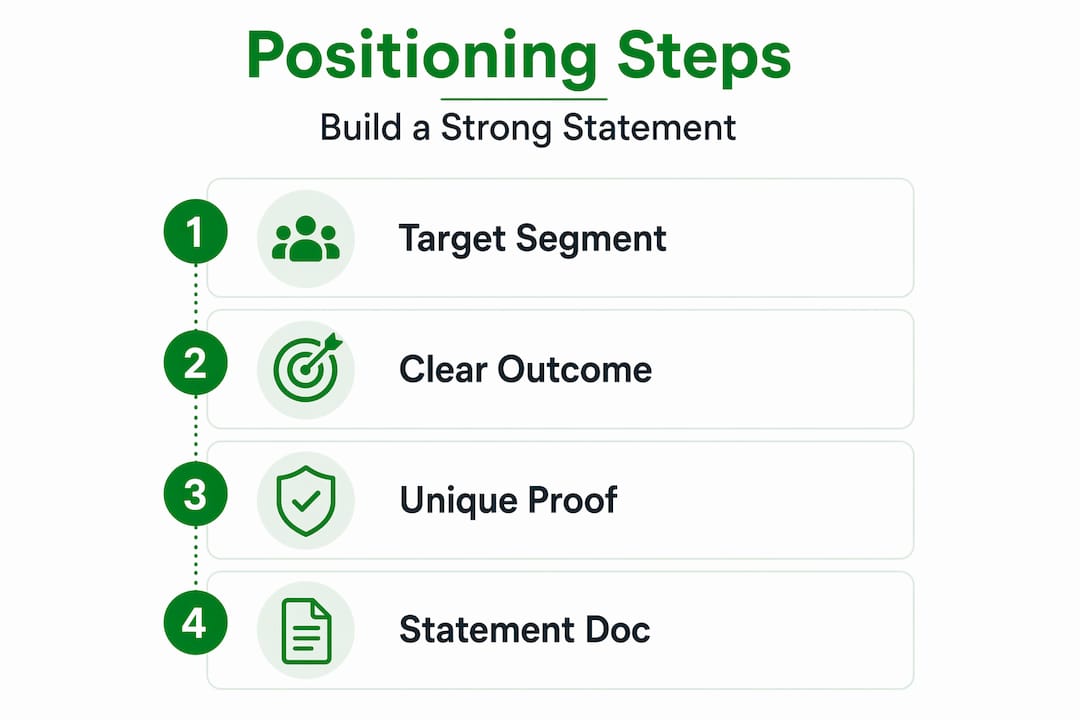
For service-based businesses, a practical methodology is to define the target segment and decision-maker along with the specific outcome you deliver, then translate that into a defensible differentiation. That’s a useful formula. Let’s turn it into a numbered process.
Step 1: Name your specific decision-maker segment
Don’t say “B2B companies.” Say “VP of Sales at Series A SaaS startups who just missed their quota two quarters in a row.” The sharper the description, the more magnetic your positioning becomes.
Step 2: Promise a clear, outcome-based result
Vague outcomes repel clients. “Better marketing” means nothing. “10 qualified discovery calls per month within 90 days” means everything. Your positioning must include a concrete result tied to a real business goal your clients care about.
Step 3: Develop a unique differentiator backed by proof
What makes you the right choice over every other option? This could be your methodology, your niche experience, a proprietary framework, or a track record with a specific type of client. The key word is proof. Anyone can claim a differentiator. Not everyone can back it up with case studies, testimonials, or data.
Step 4: Write your positioning statement and document it
A positioning statement gives you a reference point for every piece of content, every outreach email, and every proposal you write. A simple template: “We help [specific segment] achieve [specific outcome] through [unique approach], unlike [alternative options].”
Here’s a quick comparison of weak versus strong positioning elements:
| Element | Weak positioning | Strong positioning |
|---|---|---|
| Target segment | “Small businesses” | “Fractional CFOs working with PE-backed portfolio companies” |
| Outcome promised | “Improve your marketing” | “Generate 15 qualified leads per month in 60 days” |
| Differentiator | “We’re experienced” | “12-step outbound framework with 94% deliverability rate” |
| Proof | “Happy clients” | “Case study: 3x pipeline in 90 days for [named client type]” |
Pro Tip: Don’t wait until your positioning is “perfect” to start using it. Test a working version with real outreach and proposal language now. The feedback you get from real conversations is worth more than any positioning workshop.
Strong positioning also feeds directly into your consultant marketing strategies and accelerates consulting growth ideas that compound over time.
Making positioning actionable in your business
Here’s where most business owners drop the ball. They spend time crafting a positioning statement, feel good about it, save it in a Google Doc, and then… nothing changes. The website still says “we help businesses grow.” The LinkedIn headline still reads “consultant and advisor.” The proposals still open with a generic overview.
According to one sharp take on this, positioning that remains only a document “is already dead.” That’s blunt but true. Positioning only creates value when it’s activated across every client-facing surface.
Let’s get specific about where your positioning needs to live:
- Your website homepage: The headline above the fold should reflect your target segment and outcome. If a VP of Sales at a SaaS startup lands on your page and doesn’t feel immediately spoken to, you’ve already lost them.
- Your LinkedIn profile: The banner, headline, and “About” section should all reinforce the same positioning. Consistency here builds the trust that gets people to send that first message.
- Your outreach emails and DMs: Every first message you send should feel like it was written specifically for the recipient, which is only possible when your positioning is clear enough to customize around.
- Your proposals: The executive summary of every proposal should restate your positioning as it relates to that client’s specific problem. This is what makes clients feel understood, not just sold to.
- Your onboarding materials: Yes, even here. When a client starts working with you, your positioning should reinforce why they made the right decision. It builds confidence and reduces early-stage doubt.
Pro Tip: Do a positioning audit on your own business this week. Read your website headline, your LinkedIn bio, and the opening line of your last proposal. Do they all tell the same story? If not, you’ve got a gap to close.
Connecting your pricing strategy and acquisition approach to your positioning also makes a huge difference. Clients who understand your value before a sales call are far less likely to push back on price.

Positioning vs. value proposition: What’s the difference?
This one trips people up all the time. Positioning and value proposition are related, but they’re not the same thing. Mixing them up leads to messaging that feels fuzzy and unconvincing.
Here’s the clearest way to understand the difference:
“Positioning provides context (category and frame plus differentiation), while value proposition drives conversion by stating the customer outcome and why they should choose you.”
So positioning answers: “Where do you fit in the market, and why are you different?”
A value proposition answers: “What specific result will I get if I work with you, and why should I believe that?”
You need both. But they serve different roles in the buyer journey.
| Concept | Primary function | Example |
|---|---|---|
| Positioning | Defines your market context and differentiation | “The fractional sales director for early-stage B2B tech companies” |
| Value proposition | Converts interest into action with outcome and proof | “We help you build a repeatable outbound system in 60 days, so you can stop guessing where your next client is coming from” |
Here’s the uncomfortable truth: buyers may not care about your labels as much as your proposition and the real experience signals behind your claims. In other words, what you say you are matters less than whether the client’s actual experience lines up with your promise.
That’s why pairing strong positioning with a clear, outcome-focused value proposition is so powerful. Positioning gets you noticed by the right people. The value proposition gets them to act. And value-based pricing ties it all together by anchoring your fees to the result, not the hours.
Measuring, mapping, and refining your positioning
Understanding your positioning isn’t enough. You need to test it, measure it, and refine it over time. This is where a lot of consultants and freelancers miss out. They set their positioning once and treat it as fixed, when really it should evolve as their market changes and their track record grows.
One of the most useful tools here is a perceptual map (also called a positioning map). Perceptual maps help make positioning more evidence-based by visualizing how customers perceive competing options along buyer-relevant attributes. In plain terms, you pick two dimensions that matter most to your target clients (say, “speed of delivery” vs. “depth of strategy”) and plot yourself and your competitors on that grid. What you often find is a clear white space where your positioning can live without direct competition.
Here’s a step-by-step approach to refining your positioning over time:
-
Set a baseline. Before you change anything, document your current positioning and note your existing metrics: website conversion rate, inbound inquiry quality, win rate on proposals, average deal size.
-
Gather client feedback. Ask your best clients how they describe what you do when they refer you to someone else. Their language will often be sharper and more accurate than your own.
-
Map the competitive landscape. Do a simple perceptual map exercise. Where are your competitors positioned? Where is there unclaimed, high-value territory?
-
Test positioning changes in outreach first. Change a few LinkedIn messages or email subject lines to reflect the refined positioning. Track response rates and quality of replies before updating your website.
-
Connect changes to downstream metrics. Measure what shifts after positioning changes using pre and post comparisons.
Here’s a simple tracking table to use:
| Metric | Before positioning shift | After positioning shift |
|---|---|---|
| Website inquiry quality | Generic leads | Segment-specific leads |
| Proposal win rate | 20% | 40% |
| Average deal size | $3,000 | $6,500 |
| Time to close | 45 days | 22 days |
These kinds of shifts in consulting revenue growth are very much achievable when positioning aligns with the actual buyer’s decision-making process. Small clarity improvements compound fast.
The overlooked reality: Positioning is what clients actually experience, not what you claim
Here’s my honest take, shaped by years of building and selling a seven-figure agency and working with dozens of consultants since.
Most positioning advice focuses almost entirely on messaging. Get the right words. Nail the headline. Write a tight positioning statement. And yes, all of that matters. But the bigger failure I see is this: business owners craft brilliant positioning on paper and then deliver a mediocre or inconsistent client experience. And that gap destroys everything.
Buyers don’t care what you say you are. They care about the real experience signals behind your claims. That means the responsiveness of your communication, the clarity of your onboarding, the quality of your first deliverable. Those signals either confirm or contradict your positioning in the client’s mind.
So the advice I’d push back on in most positioning articles is the idea that great messaging alone will build your reputation. It won’t. Great positioning is earned, not just written. Your positioning becomes real when the client journey matches the promise you made at the start.
The good news? This actually makes positioning more achievable for small independent businesses. You don’t need a massive brand budget. You need to be consistent, specific, and genuinely deliver on what you say. That’s it.
If you want a sharp place to start, the consultant positioning secrets section at GeneratingPipeline.com covers this in real detail, with examples from people who’ve actually done it.
Position your firm for a stronger client pipeline
If positioning is the foundation, then everything else you do in marketing and sales builds on top of it. Outreach, content, referrals, proposals. They all convert better when your positioning is crystal clear.
At GeneratingPipeline.com, we’ve built an entire system around this. The Generating Pipeline OS starts with positioning and offer clarity because nothing else works without it. Whether you’re trying to avoid revenue gaps in consulting or want a reliable way to grow your client pipeline without depending on referrals, the framework gives you the tools to make it happen. One purchase, lifetime access, and no sales calls required.
Frequently asked questions
What is the main role of positioning in marketing?
The main role of positioning is to define how your business is perceived versus competitors, guiding all marketing and communication. As a foundational concept, positioning shapes brand perception across every touchpoint.
How do I know if positioning is working for my service business?
Track quality leads, win rate, and whether clients can easily describe your unique strengths. Strong positioning should be connected to downstream KPIs using pre and post comparisons to measure real performance shifts.
Does positioning matter if my business is not a category creator?
Yes, especially for established categories, positioning by segment and differentiation is critical for standing out. Positioning in crowded categories often means choosing a specific buyer segment and credibly emphasizing a unique pathway.
Can I use both rational and emotional positioning?
Absolutely. The strongest positioning integrates both rational claims and emotional appeal for long-term brand impact. Keeping rational and emotional layers together produces more durable positions over time.
What’s a perceptual map and how does it help in positioning?
A perceptual map visually shows how buyers perceive you against competitors, helping you spot opportunities for differentiation. Perceptual maps make positioning evidence-based by plotting competing options across buyer-relevant dimensions.
