TL;DR:
- Pricing services involves balancing costs, value, and market expectations to ensure business sustainability.
- Effective strategies include analyzing expenses, choosing suitable pricing models, and communicating changes confidently.
Pricing your services is one of the hardest things you will do as an independent business owner. Not because the math is complicated, but because so much of it feels personal. Charge too little and you resent your clients. Charge too much and you fear losing them. Knowing how to price services effectively means finding the number that covers your costs, reflects your value, and still wins you the work. This guide walks you through exactly that, from cost analysis to value-based pricing to communicating increases with confidence.
Table of Contents
- How to price services effectively: Start with your costs and market context
- Choose the right pricing model for your service
- Calculate your minimum viable hourly rate accurately
- Implement value-based pricing to capture your service’s true worth
- Monitor, adjust price strategically, and communicate changes effectively
- Rethinking pricing: Why a flexible portfolio approach beats a one-size-fits-all model
- Elevate your service business with effective client pipeline strategies
- Frequently asked questions
Key Takeaways
| Point | Details |
|---|---|
| Conduct detailed cost analysis | Include all direct and indirect expenses to set a solid pricing foundation. |
| Select pricing model by service type | Use hourly for unpredictable time services and per-project for predictable deliverables. |
| Calculate hourly rate realistically | Base your rate on minimum income needs divided by actual billable hours, plus premiums. |
| Consider value-based pricing | Charge based on measurable client outcomes to align price with value delivered. |
| Review and communicate pricing changes | Adjust prices thoughtfully with clear, advance communication to maintain client trust. |
How to price services effectively: Start with your costs and market context
Before you pick a number, you need to know what you actually need to earn. This sounds obvious, but most independent service providers skip it entirely and just guess based on what they see others charging.
Start by splitting your costs into two buckets:
- Direct costs: Time spent on client work, software tools you use per project, subcontractors, materials
- Indirect costs: Rent or home office expenses, marketing spend, insurance, accounting fees, subscriptions
Once you have both mapped out, add your personal living expenses and an estimated tax buffer (typically 25 to 30% of net income in the US). The total gives you your Minimum Viable Income (or MVI), which is the floor below which you simply cannot sustain your business.
As the US Chamber of Commerce explains, you set pricing by combining your cost analysis (direct plus indirect) with your chosen pricing model. That combination is what keeps your prices grounded in reality rather than wishful thinking.
Here is a quick look at the typical cost components you should account for:
| Cost category | Examples | Monthly estimate |
|---|---|---|
| Direct labor | Your time (billed hours) | Varies by rate |
| Tools and software | CRM, design tools, project apps | $50 to $300 |
| Subcontractors | Freelance support, VA | $0 to $1,500 |
| Marketing | Ads, content, outreach tools | $100 to $500 |
| Admin and accounting | Bookkeeping, legal, taxes | $100 to $400 |
| Personal expenses | Rent, food, transport, health | $3,000 to $6,000 |
Also take a look at what others in your space are charging. Searching for pricing strategy examples from similar service providers gives you a useful benchmark. You are not copying their rates. You are making sure you are not wildly out of range in either direction.
Pro Tip: Track your actual costs for one full month before setting your prices. Most service owners underestimate indirect costs by 30 to 40%, which means their “profitable” rate is actually losing them money.
Now that you know the importance of preparing your pricing with solid cost and market research, let us look at how to select the right pricing model.
Choose the right pricing model for your service
There is no universal “best” pricing model. The right one depends on how you deliver your service, how predictable the scope is, and what your clients expect.
Here are the three main service pricing models:
- Hourly pricing: You charge for time spent. Good for consulting, coaching, or any work where scope is hard to predict upfront.
- Per-project pricing: You charge a flat fee for a defined deliverable. Works well for web design, copywriting packages, or audit services.
- Variable pricing: Your rate shifts based on complexity, client size, or urgency. Less common but powerful when your work varies a lot.
As research on service pricing confirms, hourly pricing suits time-centered services while flat per-project rates fit predictable deliverables, and variable pricing is useful when scope justifiably changes.
Here is a comparison to help you decide:
| Pricing model | Pros | Cons | Best for |
|---|---|---|---|
| Hourly | Compensates for scope creep | Caps earning potential | Consulting, coaching |
| Per-project | Rewards efficiency | Risk if scope expands | Design, writing, audits |
| Variable | Reflects true complexity | Can confuse clients | Custom dev, strategy |
One thing worth considering is a “pricing portfolio” approach, where you apply different models to different offers. A consultant might charge hourly for ad-hoc advisory calls, per-project for a defined strategy deliverable, and a monthly retainer for ongoing support. This layered approach (explored further in pricing strategy for client acquisition) gives you both predictability and flexibility.
Pro Tip: If you have been hourly-only for years and feel like income has plateaued, add one per-project offer. You will likely earn more for the same amount of work because you get rewarded for being fast and experienced, not just present.
With a pricing model selected, let us move into calculating your baseline rate.
Calculate your minimum viable hourly rate accurately
Even if you plan to charge per project, knowing your minimum viable hourly rate is critical. It is your safety net. It tells you whether a project fee actually makes sense before you quote it.
Here is how to calculate it step by step:
- Add up your MVI: Total monthly personal expenses plus business costs plus tax buffer. Multiply by 12 for your annual figure.
- Estimate realistic billable hours: Most solo service providers bill between 15 and 25 hours per week. Multiply your weekly billable hours by 48 (allowing for vacations and sick days).
- Divide MVI by billable hours: This gives your base hourly rate.
- Add a premium: Factor in your experience level, demand for your specialty, and market positioning. Typically 20 to 50% on top of base.
Freelance rate calculations work by starting from minimum income plus expenses, then dividing by realistic annual billable hours to find a base hourly rate, adding premiums for expertise, demand, and service type.
Here is what this looks like in practice:
| Variable | Conservative | Mid-range | Premium |
|---|---|---|---|
| Annual MVI | $60,000 | $90,000 | $120,000 |
| Weekly billable hours | 15 hours | 20 hours | 25 hours |
| Annual billable hours | 720 | 960 | 1,200 |
| Base hourly rate | $83 | $94 | $100 |
| With 30% premium | $108 | $122 | $130 |
One thing most people get wrong here is confusing total working hours with billable hours. You might work 40 hours a week, but only 20 of those are actually chargeable. The rest goes to admin, sales, and business development. Use freelance pricing calculations to build a model that reflects your actual working reality, not an optimistic fiction.

Pro Tip: Recalculate your rate every January and whenever you land a significant surge in demand. Your rate from three years ago almost certainly does not reflect what you are worth today.
After knowing your minimum viable rate, the next step is value-based pricing, which can push your income significantly higher.
Implement value-based pricing to capture your service’s true worth
Value-based pricing flips the script entirely. Instead of charging for your time or costs, you charge based on the outcome your client gets. Real talk: this is where the income ceiling gets removed.
The concept is simple. Clients do not actually care how long something takes you. They care about the result. A consultant who saves a client $500,000 in operational costs should not be charging $150 an hour just because that is their “rate.”
Here is how to put it into practice:
- Identify the core client outcome: What specific, measurable result does your service create? Think revenue gained, cost reduced, time saved, or risk avoided.
- Assign a dollar value to that outcome: Be specific. “I help SaaS founders increase demo-to-close rates” needs a number attached. If they close 10 extra deals a month at $2,000 ACV, that is $20,000 monthly value.
- Calculate your fee as 10 to 30% of that value: According to value-based pricing research, charging 10 to 30% of measurable client outcomes aligns your pricing with client success rather than time or cost.
- Build a simple value calculator: Even a one-page document that walks through the numbers before you quote builds huge trust with clients.
For communication, always lead with the outcome before revealing the price. Show the math. Make it obvious that your fee is a fraction of the value you create. And offer tiered options (basic, standard, premium) so clients feel in control of the investment level.
Pro Tip: Track your actual delivered results against what you projected at the sale. If you regularly over-deliver, that is your signal to raise prices. The gap between what you charge and what you create is money left on the table. Check out value-based pricing explained for a deeper walkthrough.
Once your prices are set, keeping them relevant over time is just as important as setting them well in the first place.
Monitor, adjust price strategically, and communicate changes effectively
Pricing is not a set-it-and-forget-it decision. Markets change. Your skills grow. Costs go up. Your prices need to keep pace.
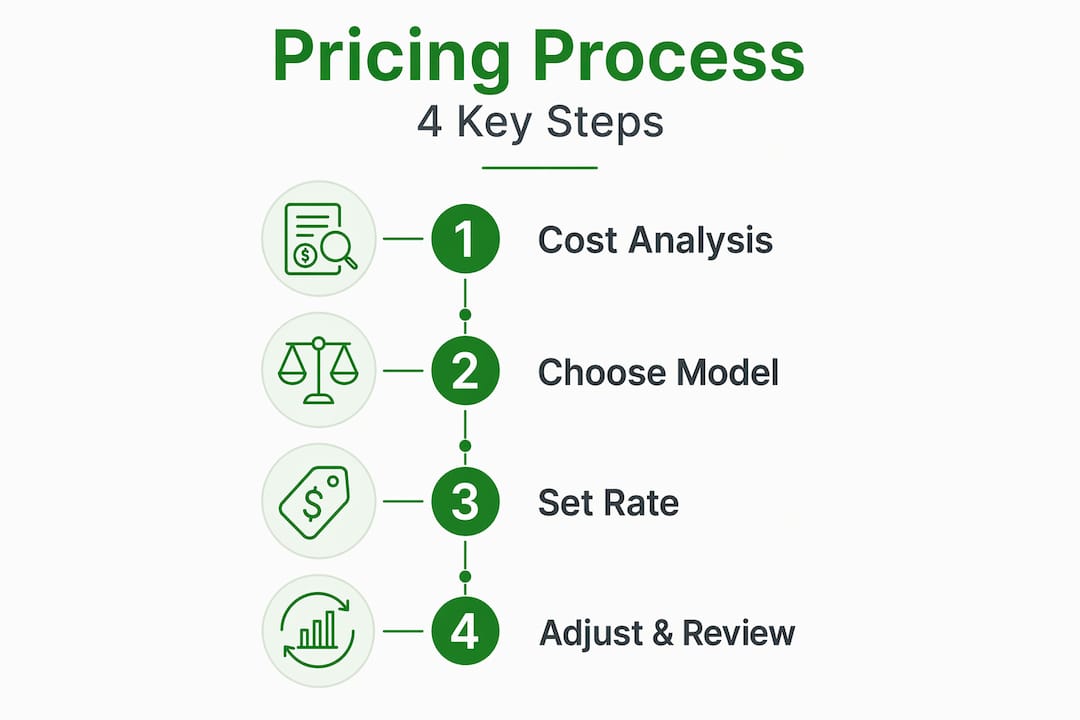
Best practice for service businesses is to monitor profits monthly and adjust prices as needed, avoiding drastic or frequent changes to keep client trust.
Here is how to structure your review process:
- Quarterly check: Review your costs and compare actual margins to projected margins.
- Annual rate review: Ask whether your experience has grown, your demand has increased, or your service has improved. If yes, a rate increase is warranted.
- Event-based adjustments: New service offering, significant market shift, or a surge in client demand are all valid triggers.
When it comes to methods for increasing prices, you have a few options:
- Across-the-board increase: Simplest approach, works well if your client base is diverse.
- Tier-based increase: Raise rates only for new clients or a specific service tier.
- Selective increase: Identify low-margin clients and increase their rates first.
“The way you communicate a price increase matters as much as the increase itself. Done well, it reinforces your value. Done poorly, it damages trust and triggers churn.”
Dos and don’ts for communicating price increases:
- Do give at least 30 to 60 days notice
- Do explain the reason honestly (rising costs, expanded service quality)
- Do emphasize what stays the same: your commitment and the results you deliver
- Don’t apologize excessively (it undermines confidence in your value)
- Don’t bury the news in a long email. Lead with it clearly.
- Don’t raise rates and reduce service quality at the same time
Also, use pricing psychology for client retention as a tool here. Framing a rate increase alongside a new service element or enhanced support option can turn what feels like bad news into a genuine upgrade conversation.
Pro Tip: Time your price increase announcement to coincide with a delivery win. If you just hit a big result for a client, that is the perfect moment to mention your updated rates for the next engagement.
Rethinking pricing: Why a flexible portfolio approach beats a one-size-fits-all model
Here is something I have seen trip up talented service providers over and over again: the belief that you need to pick one pricing model and stick with it forever. That is just not how real business works.
When I was building my agency, we used to debate endlessly about whether to go hourly or project-based. The honest answer was that neither worked perfectly for every client or every service. Some work was exploratory and hourly made sense. Other work was well-scoped and project pricing rewarded us for being efficient. We eventually stopped trying to pick one and built a pricing portfolio instead.
A practical pricing portfolio approach uses hourly pricing for unpredictable scope, per-project for clear deliverables, and variable fees when justified, which maximizes both profitability and client satisfaction.
“Rigid pricing is a sign of rigid thinking. The most profitable independent service businesses treat pricing as a living system, not a fixed rule.”
The real win is matching the pricing model to the nature of each offer. Your advisory retainer might be monthly flat-fee. Your one-off audit might be project-based. Your overflow capacity work might be hourly. All three can exist at once without confusing anyone.
What matters most is ongoing evaluation. Treat your prices the same way you treat your diverse revenue streams: with regular attention, honest analysis, and a willingness to evolve. The independent service owners who thrive are not the ones who found the “right” rate in year one. They are the ones who kept asking whether their pricing still reflects the value they deliver today.
Elevate your service business with effective client pipeline strategies
Knowing how to price your services is a huge step. But pricing alone does not fill your calendar or keep revenue predictable. That is where a real client pipeline comes in.
Getting your pricing right and your pipeline humming together is what creates consistent, repeatable income as a solo operator. If you want to go further, the free 11 revenue-boosting tactics guide on GeneratingPipeline.com covers pricing, sales, and marketing quick wins you can use right away.
For a deeper system, the Generating Pipeline OS walks you through everything from positioning your offer to running outbound outreach and closing sales, all built for busy independent service providers like you. You can also dig into how to create a client pipeline that keeps work flowing, explore a pipeline management guide for winning more clients with less guesswork, and find proven consulting revenue growth strategies to pair with your new pricing approach.
Frequently asked questions
What key costs should I include when pricing my service?
Include both direct costs like your time and materials, and indirect costs such as rent, marketing, taxes, and personal expenses to fully cover your needs. Conduct a full cost analysis before setting any rate to avoid leaving money on the table.
How do I know if hourly or per-project pricing is better for my service?
Choose hourly if your work time varies a lot from client to client; choose per-project when deliverables and timelines are predictable and well-defined. Hourly suits time-centered services while per-project fits consistent, scoped deliverables.
What is value-based pricing and how can it benefit my service business?
Value-based pricing sets your fees as a share of the measurable results you create for clients, so your income rises with your impact rather than your hours. Charging 10 to 30% of client value aligns your pricing with outcomes instead of time.
How often should I review and adjust my service prices?
Review your prices at least once a year, or whenever your costs rise or demand increases, to stay profitable without sudden shocks to clients. Recalculate your rate annually and monitor monthly profits to catch issues early.
What is the best way to communicate a price increase to my clients?
Be upfront, give at least 30 to 60 days notice, explain the reasoning simply, and reinforce the continued quality and results they can expect. Clear advance communication with honest reasoning is what keeps clients on board through a rate change.
