Freelance consulting looks like freedom on paper. But the reality? Annual revenues range from $60,000 to $240,000, with most landing somewhere between $82,400 and $99,230. That’s a huge spread. And for most independent consultants, income swings wildly depending on referrals, one big client, or a slow quarter. The fix isn’t working harder. It’s building smarter revenue streams that don’t all depend on the same source. In this guide, you’ll learn the most practical ways to diversify your consulting income, how to choose the right streams for your situation, and a simple framework to get started without losing focus on what you do best.
Table of Contents
- Why revenue streams matter for consultants
- Core consultant revenue streams explained
- Choosing and sequencing your new streams strategically
- Real-world examples and revenue benchmarks
- Building your resilient revenue model: A quick-start framework
- What most consultants get wrong about revenue streams
- Level up your consultant revenue strategy
- Frequently asked questions
Key Takeaways
| Point | Details |
|---|---|
| Diversify revenue | Mixing income streams makes consultants more resilient and less dependent on referrals. |
| Choose streams wisely | Pick 1-2 new streams that fit your skills and bandwidth before adding more. |
| Learn from benchmarks | Use current industry benchmarks to set realistic revenue and margin goals. |
| Avoid over-diversification | Too many streams can distract from your core strengths and reduce profitability. |
| Build and reassess | Review your revenue model regularly and adjust to maximize stability and growth. |
Why revenue streams matter for consultants
Here’s the uncomfortable truth about consulting income: most of it is fragile. You land a great client, do solid work, and then… the project ends. Or a referral source goes quiet. Or a long-term client cuts their budget. Suddenly you’re scrambling.
This isn’t a rare situation. It’s the default experience for a huge number of independent consultants. The consultant income statistics tell the story clearly. The gap between a $60K year and a $240K year isn’t always about skill. It’s often about how income is structured.
The business case for diversification is real. Multiple revenue streams make consulting firms 30% more resilient to downturns. That’s not a small edge. That’s the difference between riding out a slow quarter and panicking about next month’s rent.
Here are the most common risks when you rely on a single stream:
- Losing one big client wipes out 50% or more of your income overnight
- Referrals dry up during holidays, recessions, or industry slowdowns
- Project-based work creates feast-or-famine cash flow cycles
- You have zero leverage when negotiating rates because you need every client
- Burnout increases when you’re always chasing the next project
“Diversified revenue streams increase resilience. Firms with multiple streams are 30% more resilient to downturns.” — Zigpoll Research
Understanding why diversify revenue streams matters is the first step. But knowing what streams exist and how to layer them in is where the real work begins. There are also reliable ways to stabilize revenue that complement diversification without adding chaos to your workload.
Core consultant revenue streams explained
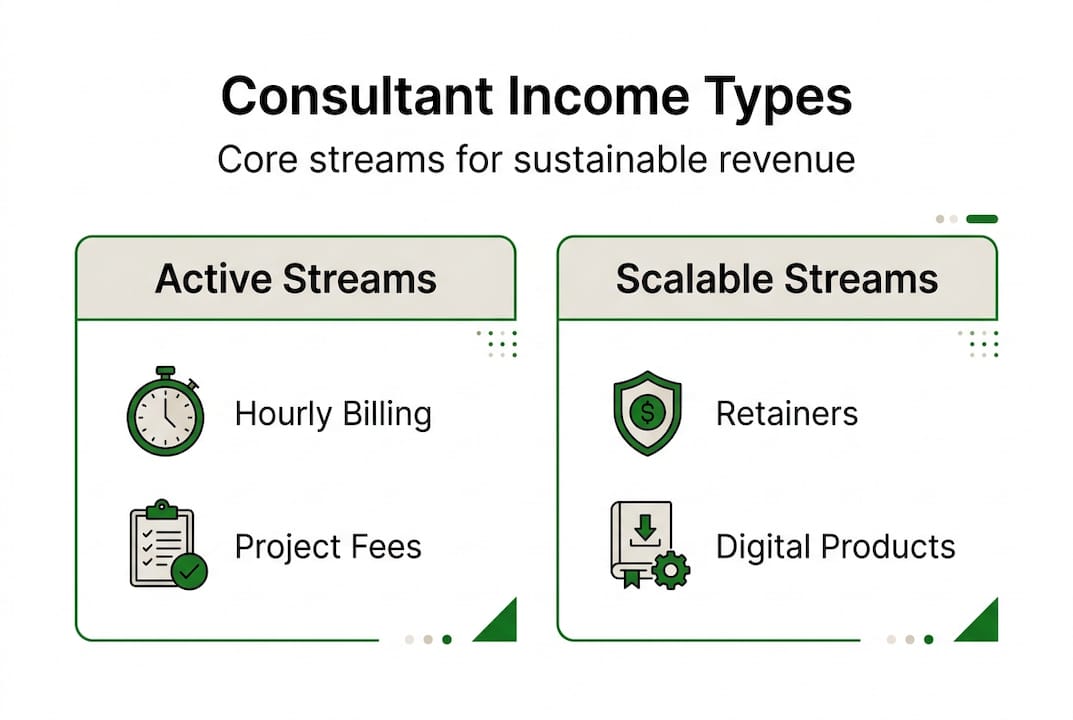
Not all revenue streams are created equal. Some require a lot of upfront time. Others scale beautifully once they’re set up. Common revenue streams for independent professionals include hourly billing, project fees, retainers, subscriptions, productized services, digital products, reselling, affiliates, and partnerships or joint ventures.

Here’s a quick comparison to help you see how they stack up:
| Stream type | Time required | Scalability | Cash flow reliability |
|---|---|---|---|
| Hourly billing | High (ongoing) | Low | Moderate |
| Project fees | High (per project) | Low | Unpredictable |
| Retainers | Medium (setup + delivery) | Medium | High |
| Productized services | Medium | Medium-High | Moderate |
| Digital products | High (upfront) | Very High | Passive over time |
| Reselling / affiliates | Low | High | Variable |
| Partnerships / JVs | Medium | High | Variable |
If you’re just starting to think about diversification, here’s a smart order to consider:
- Retainers first. Convert existing clients to ongoing relationships. It’s the fastest path to predictable income.
- Productized services second. Package your most repeatable work into a fixed-scope, fixed-price offer.
- Digital products third. Once your process is documented, turn it into a guide, template, or mini-course.
- Affiliates and reselling fourth. Recommend tools you already use and earn a commission with minimal extra effort.
- Partnerships last. These take the most relationship-building but can unlock significant scale.
Your consultant pricing strategies also play a big role here. The way you price each stream affects how clients perceive value and how predictable your cash flow becomes. And as you layer in new streams, your client acquisition strategy needs to evolve too, because different streams attract different buyers.
Choosing and sequencing your new streams strategically
Knowing the options is just the start. The real impact is in how you sequence and select your next revenue streams. Because here’s what most consultants get wrong: they try to do too many things at once and end up doing none of them well.
The smartest approach is to start with streams that are adjacent to what you already do. Start with 1-2 adjacent streams like retainers before products, and use partnerships or reselling to scale without expanding capacity. That’s practical advice that actually works in the real world.
Here’s a quick breakdown of pros and cons for the most popular stream types:
- Retainers: Predictable income, deeper client relationships. Downside: can limit how many clients you take on.
- Productized services: Easier to sell, faster to deliver. Downside: requires clear scoping upfront.
- Digital products: Scales without your time. Downside: takes significant upfront effort to create and market.
- Affiliates: Low effort once set up. Downside: income can be inconsistent and small at first.
- Partnerships: High potential upside. Downside: takes time to build trust and align incentives.
Over-diversification is a real trap. If you’re splitting attention across five different income models, your core consulting quality suffers. And your reputation is your most valuable asset. Protect it.
Pro Tip: Before adding any new stream, make sure your core offer is dialed in and your delivery process is smooth. Complexity on top of chaos just creates more chaos. Check out consultant expert secrets for frameworks that help you sharpen your positioning before scaling. And if you’re thinking bigger picture, the path to a scalable consultant business starts with getting the fundamentals right.
Real-world examples and revenue benchmarks
To bring this to life, let’s look at what consultants actually earn and how different streams stack up in real scenarios.
Annual revenues range from $60,000 to $240,000 for most freelance consultants. And the margins? Net profit margins typically sit between 30% and 50%, with gross margins of 60% to 80% before overhead. That’s genuinely strong compared to most small businesses.
Here’s how different streams tend to perform in practice:
| Revenue stream | Sample annual revenue | Estimated net margin |
|---|---|---|
| Hourly billing (solo) | $60,000 to $90,000 | 35% to 45% |
| Project fees | $80,000 to $150,000 | 40% to 50% |
| Retainers (3 to 5 clients) | $90,000 to $180,000 | 45% to 55% |
| Productized service | $50,000 to $120,000 | 50% to 65% |
| Digital products | $10,000 to $80,000 | 70% to 90% |
| Affiliates / reselling | $5,000 to $30,000 | 80% to 100% |
Let’s make this concrete. Imagine a marketing consultant billing $120/hour. She works 40 billable hours a month, earning around $57,600 a year. She adds two retainer clients at $3,000/month each, bringing in an extra $72,000. Then she creates a $297 content strategy template pack that sells 15 copies a month, adding $53,460 annually. Total: over $180,000, with the same core expertise, just packaged differently.
That’s the power of layering. You’re not working more hours. You’re monetizing your knowledge in more ways. Exploring revenue growth hacks can help you identify the fastest levers to pull based on where you are right now.
Building your resilient revenue model: A quick-start framework
Armed with real income data and option comparisons, here’s a straightforward framework you can apply to redesign your consulting revenue mix.
- Audit your current streams. List every way you currently earn money. Note which ones are predictable and which are feast-or-famine.
- Identify your biggest gap. Is it cash flow predictability? Income ceiling? Over-reliance on one client type? Name the problem clearly.
- Pick one new stream to add. Just one. Choose the option that’s closest to what you already do and requires the least new infrastructure.
- Set a 90-day target. Define what success looks like. A specific revenue number, a number of new clients, or a product launched.
- Track and review quarterly. Look at which streams are growing, which are stagnating, and where your time is going.
Pro Tip: Put a recurring calendar block every quarter to review your revenue mix. Ask yourself: which stream took the most time? Which delivered the best return? Adjust accordingly.
As your business grows, rebalance. A consultant who starts with hourly billing and retainers might shift toward productized services and digital products as they build reputation and audience. Diversifying revenue streams can make your consulting business 30% more resilient to downturns, and that resilience compounds over time.
For example: a sales consultant pivoted from pure project-based fees to a mix of three retainer clients plus a $497 onboarding playbook. Within 18 months, her income was more predictable, her stress was lower, and she had time to develop a group coaching offer. That’s the compounding effect of a well-sequenced proven client acquisition strategy.
What most consultants get wrong about revenue streams
Here’s a candid take based on years of working with and as a consultant: the biggest mistake isn’t choosing the wrong stream. It’s believing that more streams automatically equals more income.
I’ve seen consultants chase six different income models simultaneously and end up earning less than when they had two. Why? Because attention is finite. Every new stream you add takes energy away from your core work and your best clients.
The consultants who grow most sustainably are the ones who pick streams that reinforce each other. A retainer client who also buys your digital product. A partnership that sends referrals who convert into productized service buyers. These are synergistic streams. They compound your expertise instead of fragmenting it.
I know a consultant who said no to a lucrative affiliate deal because it didn’t align with his positioning as a trusted advisor. Smart move. His reputation stayed intact, his retainer clients stayed loyal, and his income grew steadily. Quality over quantity. Always.
Level up your consultant revenue strategy
If this guide got you thinking about your own revenue mix, that’s a great start. But thinking and doing are different things. The next step is having the right frameworks, templates, and systems to actually build that pipeline.

At GeneratingPipeline.com, we’ve built practical tools specifically for consultants and freelancers who want to avoid revenue gaps and build a more consistent income. Whether you’re figuring out your positioning, improving your outreach, or exploring business acquisition strategies, there’s a clear path forward. You can also grab the free guide packed with revenue boosters you can implement right away. No sales calls, no webinar funnels. Just real, actionable help.
Frequently asked questions
What are the most common consultant revenue streams?
Billing by the hour, project fees, recurring retainers, productized services, digital products, and affiliate or reselling partnerships are the most common options for independent consultants.
How much do freelance consultants typically earn per year?
Annual revenue ranges from about $60,000 to $240,000, with most consultants earning between $82,400 and $99,230 depending on their niche and business model.
How many revenue streams should a consultant aim for?
Start with 2 to 3 well-aligned streams. Over-diversification can distract from your core expertise and actually reduce overall income quality.
What are typical profit margins for freelance consultants?
Net margins usually range between 30% and 50%, with gross margins of 60% to 80% before overhead costs are factored in.
How does having multiple revenue streams improve resilience?
Consultants with diversified income are 30% more resilient to economic downturns than those depending on a single revenue source.
