TL;DR:
- Effective pricing communicates value, builds trust, and attracts the right clients.
- Choosing the correct pricing model depends on service scope, client mindset, and income goals.
- Regularly reviewing and adjusting prices based on value and market changes enhances revenue.
Pricing is one of those things most freelancers and consultants set once and never revisit. You pick a number that feels reasonable, maybe check what a competitor charges, and go with it. But here’s the thing: that gut-feel approach is quietly costing you clients and revenue. Your price isn’t just a number. It’s a signal. It tells prospective clients who you’re for, what you’re worth, and whether they should trust you with their business. Get it wrong and you’ll either repel the clients you want or attract the ones who drain your energy. This article walks you through the fundamentals, the models, and the practical steps to build a pricing strategy that actually works for you.
Table of Contents
- Understanding the fundamentals of pricing strategy
- Impact of pricing strategy on client acquisition
- Comparison of pricing models for service businesses
- Practical steps to optimize your pricing strategy
- Our perspective: What most freelancers and consultants get wrong about pricing
- Take your pricing strategy and client pipeline to the next level
- Frequently asked questions
Key Takeaways
| Point | Details |
|---|---|
| Strategic pricing is essential | A carefully crafted pricing strategy is critical for attracting and retaining ideal clients. |
| Choose the right pricing model | Comparing hourly, project, and value-based models helps select what suits your business goals. |
| Regular reviews drive growth | Continually reviewing and adjusting pricing ensures your rates stay competitive and profitable. |
| Testing builds confidence | Experimenting with pricing models safely enables you to find what works best for your market. |
| Expert guidance accelerates results | Leveraging proven resources and tools can speed up successful pricing and revenue strategies. |
Understanding the fundamentals of pricing strategy
Let’s start with the basics. A pricing strategy is a structured approach to setting the price of your services based on a combination of factors, not just what feels right in the moment. It’s the difference between reacting to client pushback and confidently standing behind your rates.
A solid pricing strategy has four core components:
- Cost: What does it actually cost you to deliver the service? Think tools, time, subcontractors, and overhead.
- Value perception: How much does the client believe your service is worth to them? This is often more important than your actual cost.
- Competition: What are others in your space charging? Useful context, but not the whole picture.
- Client needs: What outcome is the client trying to achieve, and how urgently do they need it?
Strategic pricing means you’re actively thinking about all four of these. Reactive pricing means you’re just responding to whatever the client says or copying the first number you find on a competitor’s website. One builds a business. The other keeps you stuck.
For freelancers and consultants, pricing strategy matters even more than it does for product businesses. You’re selling time and expertise, both of which are finite. If you underprice, you fill your calendar with low-value work and burn out. If you overprice without communicating value clearly, you lose deals you should have won.
You can explore pricing strategy examples to see how other service providers have structured their rates across different niches. And if you want to see what transparent, well-structured pricing plans look like in practice, that’s worth a look too.
The bottom line: pricing strategy is not a one-time decision. It’s an ongoing part of running your business well.
Impact of pricing strategy on client acquisition
Here’s something that surprises a lot of people: your price is marketing. Before a prospect even gets on a call with you, your rate is already doing work. It’s shaping how they perceive you.
Pricing affects perceived value and the decisions clients make before they ever speak to you. A consultant charging $500 a day and one charging $2,500 a day are not competing for the same clients, even if they offer identical services. Price positions you in the market.

Here’s a quick look at how different pricing approaches affect client quality:
| Pricing approach | Client type attracted | Common outcome |
|---|---|---|
| Below market rate | Budget-focused, high-churn | Overworked, undervalued |
| Market rate | Mixed, price-sensitive | Inconsistent results |
| Premium, value-led | Outcome-focused, loyal | Higher revenue, better fit |
The two most common mistakes service business owners make are undervaluing their work and overpricing without context. Undervaluing looks like charging hourly rates that don’t account for your expertise or the outcome you deliver. Overpricing without context means quoting a high number with no explanation of why it’s worth it.
Both mistakes hurt your client acquisition strategies. One attracts the wrong clients. The other scares away the right ones.
Pro Tip: Before your next sales conversation, write down three specific outcomes your service delivers for clients. Quantify them if you can (time saved, revenue generated, costs reduced). That list becomes your pricing justification, and it makes conversations about rates much easier.
When you adjust your pricing intentionally, you often find that you win fewer deals but better ones. That’s a good trade. Fewer clients who pay more, stay longer, and refer others is the goal. You can dig deeper into sales tactics for freelancers to see how pricing fits into a broader client-winning approach.
Comparison of pricing models for service businesses
Now let’s look at the actual models available to you. There’s no single right answer here. The best model depends on your service, your clients, and your goals.
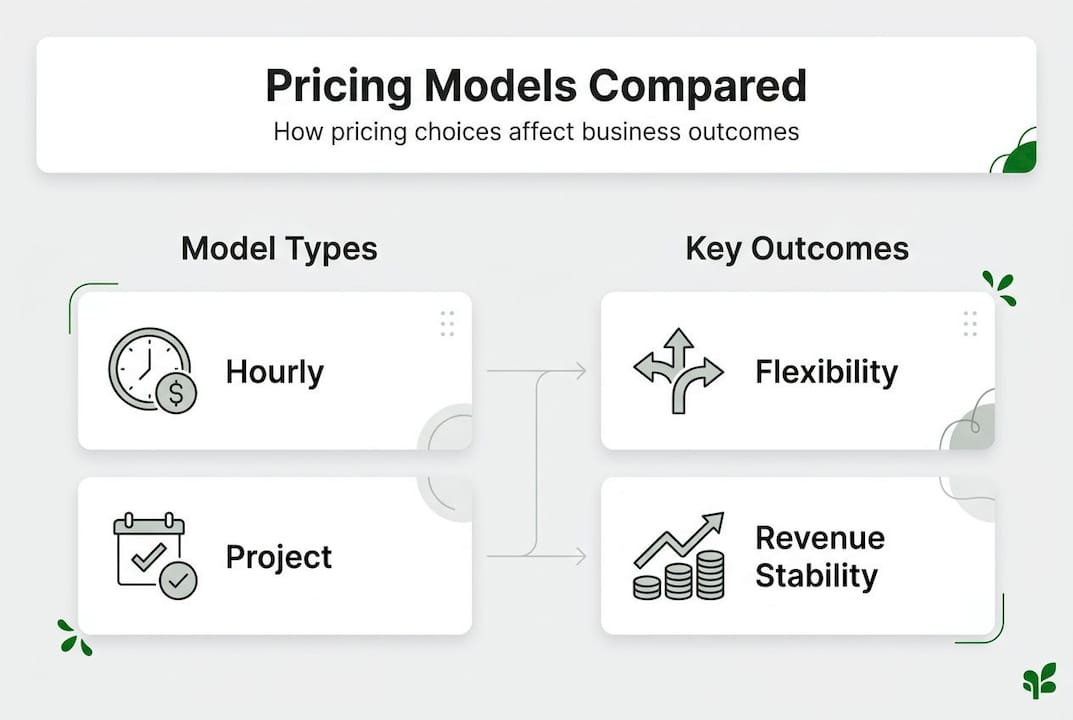
Here’s a comparison of the four most common pricing models:
| Model | Best for | Pros | Cons |
|---|---|---|---|
| Hourly | Ad-hoc or undefined scope work | Easy to explain, low risk | Caps your income, rewards slowness |
| Project-based | Defined deliverables | Predictable for both sides | Scope creep can hurt margins |
| Retainer | Ongoing relationships | Recurring revenue, easier planning | Requires clear scope to avoid overdelivery |
| Value-based | High-impact, outcome-driven work | Highest earning potential | Requires strong positioning and confidence |
Value-based pricing is often the most powerful model for experienced consultants and fractional executives, but it’s also the hardest to execute without a clear understanding of the client’s desired outcome.
Here’s how to choose the right model for your business:
- Assess your service type. Is the scope predictable or variable? Defined scopes favor project or retainer models. Open-ended work suits hourly or value-based.
- Know your client’s mindset. Budget-conscious clients often prefer fixed-price projects. Outcome-focused clients are more open to value-based discussions.
- Consider your income goals. If you want predictable monthly revenue, retainers are your friend. If you want upside potential, value-based pricing opens that door.
- Test before committing. You don’t have to pick one model forever. Try different approaches with different client types and see what works.
Exploring consultant revenue streams can also help you think beyond a single pricing model. Many successful independents combine models, using retainers for stability and project-based work for growth. A diverse revenue streams guide is a great starting point if you want to think bigger about how you structure your income.
Practical steps to optimize your pricing strategy
Knowing the models is one thing. Actually improving your pricing is another. Here’s how to do it without overthinking it.
Start with a pricing audit. Look at your last ten clients. What did you charge? What did you deliver? What was the outcome for them? If you can see a pattern where clients got significantly more value than they paid for, that’s a signal to raise your rates.
Here are the key steps to optimize your pricing on an ongoing basis:
- Align price with value, not just cost. If a client saves $50,000 because of your work, charging $3,000 is leaving money on the table. Price closer to the value you create.
- Review your rates every six months. Markets shift, your skills grow, and your positioning evolves. Don’t let your prices stay static while everything else moves.
- Ask for feedback after projects. A simple question like “Was the investment worth it?” tells you a lot. If clients say yes enthusiastically, you probably have room to charge more.
- Test price increases on new clients first. Don’t roll out a price hike to existing clients overnight. Test your new rate with incoming prospects and see how it lands.
- Track your win rate. If you’re winning 90% of proposals, you’re probably underpriced. A healthy win rate for premium services is closer to 50 to 60%.
Pro Tip: Create a simple pricing document you update every quarter. Include your current rates, your reasoning behind them, and any feedback you’ve received. This makes it easier to spot patterns and make confident adjustments.
The revenue growth hacks covered in our service business guide go deeper on this, including best practices for pricing that independent business owners can apply immediately. Small, intentional changes to how you price can have a bigger impact on revenue than landing new clients.
Our perspective: What most freelancers and consultants get wrong about pricing
Real talk: most service business owners are scared of their own prices. They quote low because they’re afraid of rejection. They follow competitors because it feels safer than standing alone. And they never raise rates because they don’t want to rock the boat with existing clients.
Here’s what I’ve seen again and again: the freelancers and consultants who earn the most aren’t always the most skilled. They’re the ones who communicate value clearly and price with confidence. That’s it.
Copying competitor prices is one of the riskiest things you can do. You have no idea what their costs are, what their positioning is, or whether their business is even profitable. You’re benchmarking against an unknown.
The uncomfortable truth is that transparency and confidence in pricing build more trust than a low number ever will. Clients who push back hard on price are often not your ideal clients anyway. The expert consultant secrets worth knowing aren’t about tactics. They’re about mindset. Price like you believe in your own value, and the right clients will follow.
Take your pricing strategy and client pipeline to the next level
Getting your pricing right is a huge step. But pricing alone won’t fill your pipeline. You need a repeatable system for finding, attracting, and converting the right clients consistently.

At GeneratingPipeline.com, we’ve built resources specifically for freelancers, consultants, and fractional executives who want to stop relying on referrals. Whether you’re working on avoiding revenue gaps, getting smarter about pipeline forecasting, or looking for proven revenue growth strategies, we’ve got practical, no-fluff resources to help. Start with our free guide featuring 11 revenue-boosting tactics and see what’s possible when your pricing and pipeline work together.
Frequently asked questions
How often should I review my pricing strategy as a freelancer or consultant?
You should review your pricing strategy at least every six months, or whenever you notice shifts in client demand, your costs, or market competition. Staying on top of this is one of the best practices for pricing that high-earning independents consistently follow.
What is the biggest mistake service business owners make with pricing?
The most common mistake is undervaluing services or copying competitor prices without assessing your own value and client needs. Value-based pricing is a more reliable foundation than benchmarking against others.
How can I tell if my pricing strategy is attracting the right clients?
If your clients value your work, pay on time, and refer others, your pricing is likely aligned with your ideal market. Pricing affects client quality more than most people realize, so strong signals like these are worth paying attention to.
What’s the best way to experiment with different pricing models safely?
Test new pricing with a small segment of incoming clients or new projects, collect feedback, and compare revenue outcomes before rolling changes out more broadly. Best practices for experimentation suggest keeping changes incremental so you can isolate what’s working.
Where can I find examples of pricing strategies that work for consultants?
You can find real-world examples and frameworks in our article on pricing strategy examples that boost profits for freelancers and consultants.
