TL;DR:
- Most consulting deals are lost because of poor preparation and failure to involve decision-makers early. Effective closing relies on tailored techniques, value-based pricing, and clear next steps to build trust and overcome objections. Customizing your approach and maintaining a structured sales process significantly increase your chances of converting prospects into clients.
You put in the work. You had great calls, sent a polished proposal, and then… silence. Or worse, a “we’ve decided to go in a different direction.” Sound familiar? Losing deals at the final stage is one of the most frustrating parts of consulting, and it happens more often than most people admit. The good news is that closing is a skill, not a talent. This guide breaks down exactly what you need to do before, during, and after the pitch so you can stop losing winnable deals and start converting more of your best prospects into paying clients.
Table of Contents
- Set up for success: What you need to close consulting sales
- Step-by-step: The consultant’s sales closing process
- The role of pricing: Value-based strategies for closing
- Avoid common closing pitfalls and troubleshoot lost sales
- What most sales closing advice misses for solo consultants
- Next steps: Optimize your sales pipeline and close more deals
- Frequently asked questions
Key Takeaways
| Point | Details |
|---|---|
| Pre-close preparation | Thorough research, qualification, and mindset set the groundwork for a successful close. |
| Tailored closing steps | Effective closing involves rapport, value summary, handling objections, and clear next actions. |
| Value-based pricing | Using value-based pricing boosts close rates and better positions your services. |
| Avoiding common pitfalls | Summarize value, confirm next steps, and clarify decision timelines to prevent lost sales. |
| Customize your approach | Adapt closing strategies for consulting, not just generic sales scripts, for better outcomes. |
Set up for success: What you need to close consulting sales
Now that you’ve seen why most deals slip away, let’s make sure you’re heading into every close with an optimal foundation. Because here’s the thing: most consultants lose deals before the closing call even starts. They show up underprepared, underqualified, or with no clear sense of who actually makes the decision.
Pre-closing with rapport and qualification, handling objections early, summarizing value, multi-threading stakeholders, and making clear next-step asks are the core mechanics that separate consultants who close from those who wonder what went wrong.
Let’s start with the prerequisites. Think of these as your pre-flight checklist.
| Prerequisite | Why it matters |
|---|---|
| Deep prospect research | Understand their goals, pain points, and current situation |
| Decision-maker map | Know who influences and who approves the buy |
| Qualified opportunity | Confirm budget, authority, need, and timeline (BANT) |
| Value-based pricing approach | Anchor price to outcomes, not hours |
| Summary of value already delivered | Remind them of your expertise before you ask for the close |
| Clear decision timeline | Know when they need to decide and why |
Getting this right is honestly half the battle. Consultants who show up without a stakeholder map often find themselves pitching to someone who has to “run it by the team.” That’s a deal killer if you didn’t plan for it.

The mindset shift matters too. You’re not selling a product off a shelf. You’re co-creating a solution. That means showing up as a collaborative partner, not a vendor. Clients can feel the difference, and it affects how they respond when you ask for their business.
Here are the habits that consistently improve your closing odds:
- Summarize the value you’ve already discussed before presenting your offer
- Handle likely objections before they surface, not after
- Confirm who else is involved in the decision, and involve them early
- Set clear expectations for next steps at the end of every call
- Follow up with a written recap immediately after each meeting
- Use value-based pricing to position your fee around outcomes, not time
Pro Tip: Before your final closing call, map every stakeholder involved in the decision. Name them, understand their role, and know their likely concerns. If you can speak to each person’s priorities during the call, you dramatically increase your odds of a yes.
Step-by-step: The consultant’s sales closing process
With your prep in place, let’s break down the ideal sales closing sequence tailored for consultants. This is not a script. It’s a framework you adapt based on the client, the situation, and the complexity of the engagement.
-
Re-establish rapport. Open by reconnecting on something personal or referencing a previous conversation. This lowers the pressure and reminds them you’re human, not a pitch machine.
-
Summarize their situation and goals. Before you pitch anything, reflect back what they told you they need. This shows you listened and builds the psychological foundation for your offer.
-
Present your solution in terms of outcomes. Not “here’s what I’ll do,” but “here’s what you’ll get.” Focus on the transformation, not the deliverables.
-
Handle objections early. Don’t wait for them to bring up concerns. Surface the likely ones yourself. “Some clients wonder about X at this stage. Here’s how we handle that.” This disarms resistance before it becomes a wall.
-
Use a trial close. Ask something like, “Based on what we’ve covered, does this feel like the right direction for your team?” This tests buy-in without triggering a fight-or-flight response.
-
Move to an assumptive or summary close. Recap the key points and assume they’re moving forward. “So, based on what we’ve agreed on, here’s how we’d kick things off…” This naturally guides them to a yes without high-pressure tactics.
-
Confirm next steps explicitly. Who does what, by when. Never leave a call without this. If they need to review internally, agree on a specific follow-up date.
Now, different clients need different closing approaches. Here’s a quick breakdown of five techniques and when to use each:
| Closing technique | Best used when… | Example phrase |
|---|---|---|
| Summary close | Client has lots of context to process | “So, to recap everything we’ve covered…” |
| Assumptive close | Client has shown strong buying signals | “Let’s look at how we’d get started next week…” |
| Urgency close | There’s a genuine timeline or capacity constraint | “I have one slot opening up in Q3, and I want to hold it for you…” |
| Trial close | Testing readiness partway through the conversation | “Does this feel aligned with what you’re looking for?” |
| Question-based close | Client is analytical or needs to talk through it | “What would need to be true for you to feel confident moving forward?” |
Closing techniques like the assumptive, summary, urgency, trial, and question-based close are the toolkit every consultant should have ready. The trick is knowing which one fits the moment. Matching your close to the client’s personality and decision-making style is what separates good closers from great ones.
Building a consistent sales process makes it easier to apply these techniques reliably. And if you want to sharpen your delivery, revisiting sales call tips tailored for client-facing consultants is a great next step.
The role of pricing: Value-based strategies for closing
Successfully guiding your prospect through the close also means presenting your offer in a way that maximizes trust and value. And that starts with how you price.
Here’s the real talk on pricing: if you’re charging by the hour, you’re making the close harder than it needs to be. Hourly pricing invites scope creep conversations, budget anxiety, and endless back-and-forth. Value-based pricing, on the other hand, anchors your fee to the outcome you deliver, and that’s a much easier conversation to close.
Adapting consultative sales methods for independent consultants means researching prospects deeply, mapping collaborative processes, using value-based pricing over hourly, and yes, being willing to walk away from poor-fit clients.
Here’s why value-based pricing specifically helps at the closing stage:
- It positions you as a strategic partner, not a contractor
- It removes the “are they worth the hours?” calculation from the client’s mind
- It gives you a clear, confident anchor when price questions come up
- It naturally filters out clients who are looking for the cheapest option
- It increases your fees without increasing your workload
- It closes objections around ROI because the value is built into the number
Pro Tip: When a prospect asks about your price, resist the urge to justify it with time. Instead, redirect to outcomes. Say something like: “The fee reflects the result we’re aiming for, which in your case is [specific outcome]. Does that outcome feel worth the investment?” This reframe shifts the conversation from cost to value in seconds.
“The right client sees your price as an investment. The wrong client sees it as an expense. Knowing the difference before you reach the close is what protects your time and your reputation.”
When you walk away from poor-fit clients (yes, even when you could use the revenue), you protect your capacity for clients who actually value what you bring. That clarity comes through during the close in a way that confident buyers respond to.
Explore pricing strategy examples built specifically for freelancers, learn more about how pricing strategy drives revenue, or read up on broader consulting revenue growth strategies to put this into wider context.
Avoid common closing pitfalls and troubleshoot lost sales
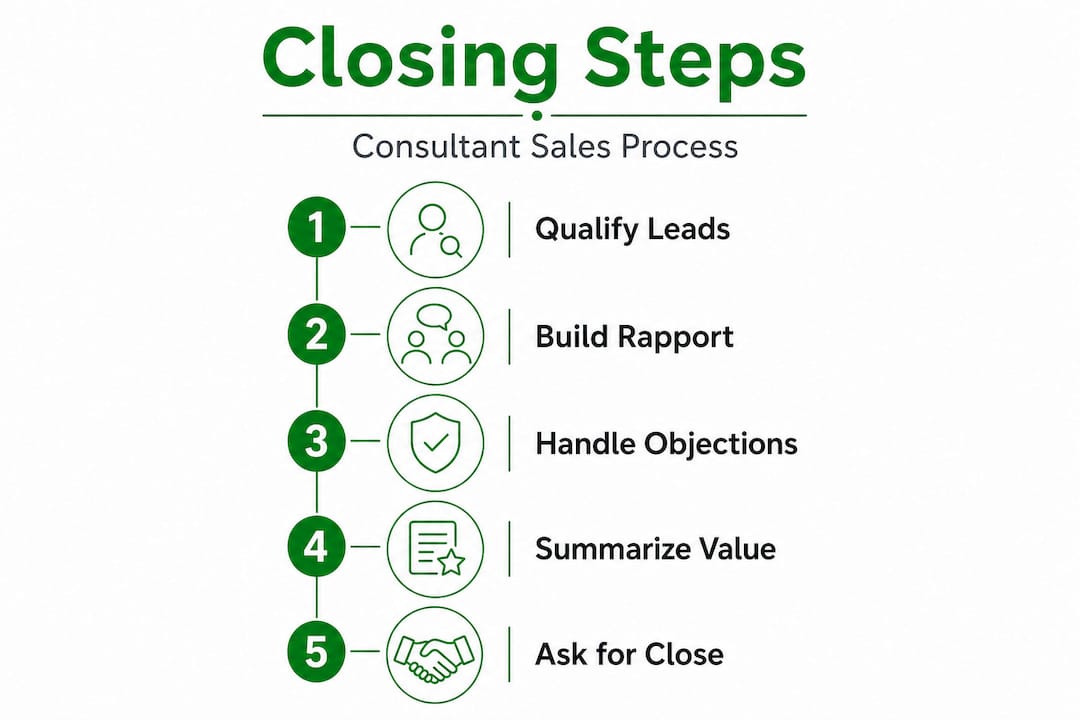
Even the best closing techniques can fall short if old habits or silent risks sneak back in. Here’s how to troubleshoot and prevent lost opportunities.
Let’s be honest: most deals don’t fall apart because of the competition. They fall apart because of avoidable mistakes on the consultant’s side. Here’s what to watch out for:
- Not summarizing value before asking for the close. If the client can’t immediately connect your fee to their desired outcome, hesitation creeps in.
- Failing to ask for the business directly. A lot of consultants hint at closing without actually doing it. Be direct. “Are you ready to move forward?” is still a valid question.
- Missing stakeholder buy-in. If you haven’t involved the actual decision-makers early, you’re setting yourself up for “we need to discuss this internally” as a final answer.
- Unclear pricing or scope. Price confusion kills deals. If the client isn’t sure what they’re getting for the fee, they default to caution.
- No clear next steps. Leaving a call without a defined action item and timeline is the fastest way to watch a warm prospect go cold.
Pre-closing mechanics like qualification, rapport, early objection handling, multi-threading stakeholders, and explicit next-step asks aren’t optional extras. They’re the structure that holds the close together.
Pro Tip: At the end of every closing call, confirm two things out loud: the specific next step and who owns it. “So you’ll send that to your CFO by Thursday, and I’ll follow up with the contract on Friday. Does that work?” This creates shared accountability and dramatically reduces ghosting.
When a deal stalls, don’t panic. Run through this simple troubleshooting flow:
- Diagnose the stall. Is it price, timing, internal politics, or a hidden objection?
- Send a value recap. A short, clear email that ties your solution to their specific goal.
- Ask a direct question. “Is this still a priority for you right now?” gives you honest data.
- Offer a decision deadline. Not high-pressure, but real. “I want to hold space for your project, but I’ll need to know by [date].”
- Know when to move on. If they can’t commit after three genuine follow-ups, it’s time to redirect your energy.
A solid step-by-step sales process makes troubleshooting easier because you always know where the deal is and what should happen next. And if you want to think bigger picture, pairing this with smart consulting growth ideas keeps your pipeline healthy so no single deal feels like make or break.
What most sales closing advice misses for solo consultants
Here’s a perspective you rarely see in mainstream sales advice: most closing scripts were written for teams, not individuals.
Think about it. The classic “always be closing” mentality comes from environments where salespeople have quotas, managers, and a conveyor belt of leads. You, as an independent consultant, are operating in a completely different reality. You have limited capacity. Your reputation is on the line with every client. And you’re often selling something highly intangible, your thinking, your judgment, your experience.
That changes everything about how you should close.
The biggest miss I see in standard sales advice is the assumption that all closes are equal. They’re not. A software sales rep can use a hard close because if the relationship sours, someone else handles onboarding and delivery. You don’t have that buffer. A mismatched client doesn’t just affect one deal. It affects your energy, your results, and the case studies you’ll use for the next six months.
This is why customizing your close is the real game-changer. Freelancer-specific sales tactics recognize that the “win” isn’t just getting a yes. It’s getting the right yes.
Here’s an uncomfortable truth I’ve had to learn myself: some of my best “closes” were the deals I walked away from. When a prospect is obsessed with your hourly rate, wants endless revisions, or clearly hasn’t bought into your approach, closing them is actually a loss disguised as a win. You’ll spend more time managing the relationship than delivering value.
The consultants who close consistently aren’t the ones with the slickest scripts. They’re the ones who know their ideal client so well that the close feels like a natural next step in a conversation that was already going the right direction. They don’t need pressure tactics because they’ve built enough trust and clarity throughout the process that the decision feels easy for the client.
So yes, learn the techniques. Practice the frameworks. But don’t forget to customize them to who you are and who you serve. That’s the part no playbook can do for you.
Next steps: Optimize your sales pipeline and close more deals
Closing more deals as a consultant isn’t just about what happens on the final call. It’s about everything you build before it.
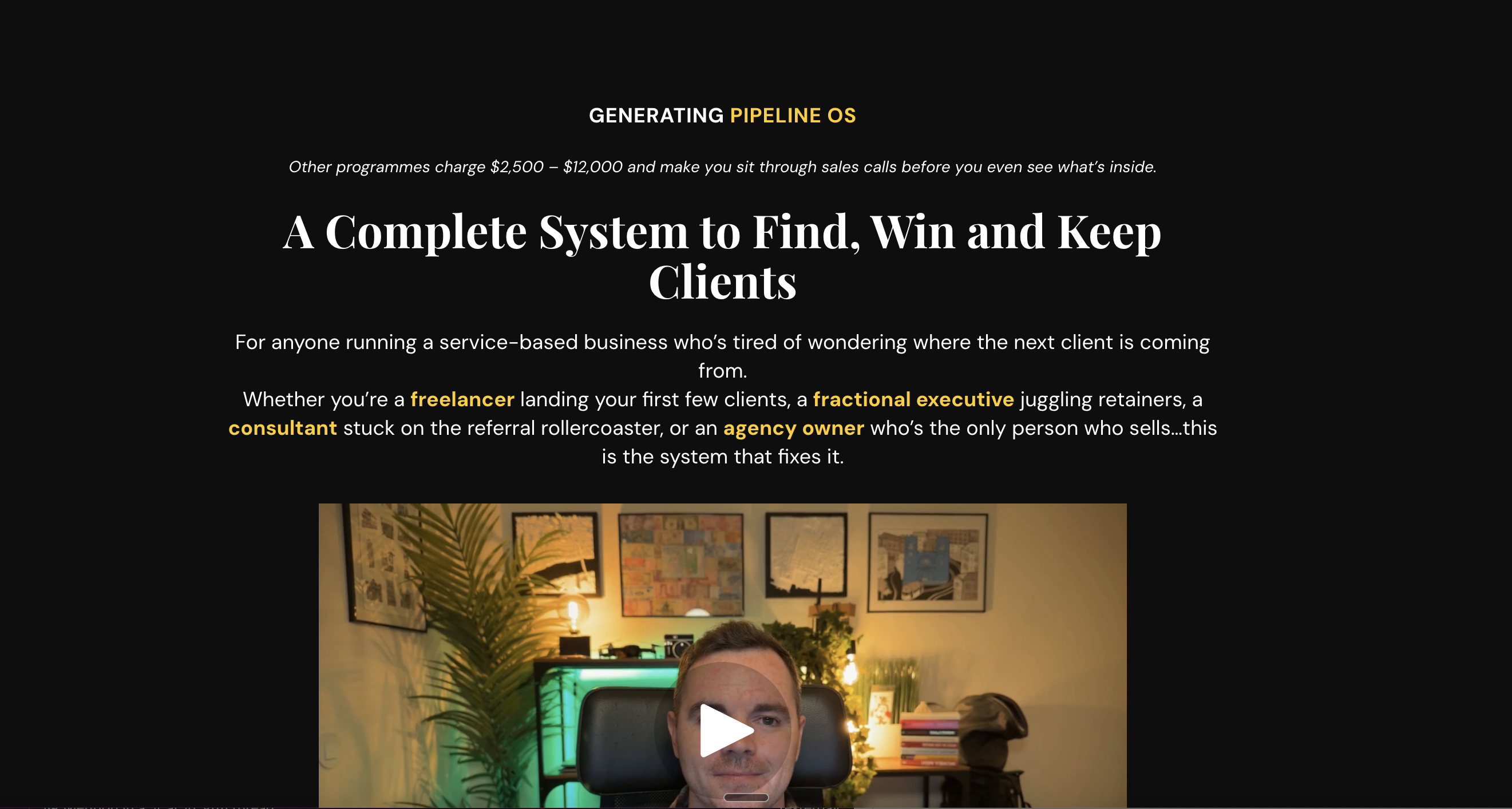
If you’re serious about creating a consistent client pipeline (not just chasing one-off wins), the resources at GeneratingPipeline.com are built specifically for solo operators like you. Whether you want to avoid revenue gaps between projects, learn how to grow your client pipeline systematically, or set up an efficient sales system that doesn’t burn you out, there’s something practical waiting for you. The Generating Pipeline OS covers everything from positioning to outreach to closing in 20 focused lessons, with no fluff and no sales calls required to access it.
Frequently asked questions
What is the best closing technique for consultants?
The most effective closing technique depends on your client’s personality and readiness, but the summary and assumptive closes tend to perform best for consultants because they feel collaborative rather than pushy.
What should you do when a consulting client goes silent after the proposal?
Send a concise value recap, clarify their decision timeline, and ask directly if the opportunity is still a priority. Using pre-closing mechanics like stakeholder mapping and agreed next steps earlier in the process reduces the chance of silence occurring in the first place.
Should consultants use value-based pricing when closing?
Yes. Value-based pricing over hourly makes the close cleaner because it anchors your fee to outcomes rather than time, which shifts the client’s mindset from cost to investment.
What’s the biggest mistake consultants make when closing?
Not confirming clear next steps, decision timelines, or ownership at the end of the call. Multi-threading stakeholders and explicit next-step asks are among the most important mechanics for keeping deals moving forward after the closing conversation.
