TL;DR:
- Building a structured client pipeline transforms unpredictable income into a reliable, repeatable system.
- Defining an ideal client profile helps target outreach, increasing response rates and deal success.
- Regular pipeline management, diversification, and focusing on retention maximize revenue stability and growth.
If you’ve ever finished a big project and stared at an empty calendar wondering where the next client is coming from, you already know the cost of income volatility. 62% of freelancers face this exact problem without systems in place. The feast-famine cycle isn’t just stressful, it actively kills revenue growth. A structured client pipeline fixes this. It turns random wins into a repeatable process, so you always know what’s coming in and what you need to do next. This guide walks you through every step: defining your pipeline, building your foundation, generating leads, avoiding common mistakes, and maximizing profit with smart retention and pricing strategies.
Table of Contents
- Understand the basics: What is a client pipeline?
- Prepare for success: Define your ideal client and pipeline goals
- Build your pipeline: Proven methods for consistent client acquisition
- Avoid common pitfalls: Keep your pipeline healthy and full
- Maximize profit: Retention, pricing, and AI for pipeline leverage
- Our perspective: Why most pipelines underperform (and what actually fixes them)
- Take your client pipeline to the next level
- Frequently asked questions
Key Takeaways
| Point | Details |
|---|---|
| Define stages clearly | A structured client pipeline from lead to nurture prevents lost opportunities. |
| Target the right clients | Clarifying your Ideal Client Profile ensures effective prospecting and higher win rates. |
| Systematize your actions | Use proven methods and regular reviews to keep your pipeline healthy and active. |
| Retention drives profit | Repeat and retainer clients are far more profitable and stable than first-timers. |
Understand the basics: What is a client pipeline?
A client pipeline is not just a fancy word for a sales funnel. It’s a repeatable system that tracks every potential client from the moment they first hear about you to the moment they sign a contract and beyond. Think of it as your business’s circulatory system. Without it, revenue is unpredictable. With it, you have visibility, control, and momentum.
Most freelancers and consultants wing it. They rely on referrals, respond to inbound inquiries, and hope for the best. That’s not a strategy. That’s luck. And luck runs out.
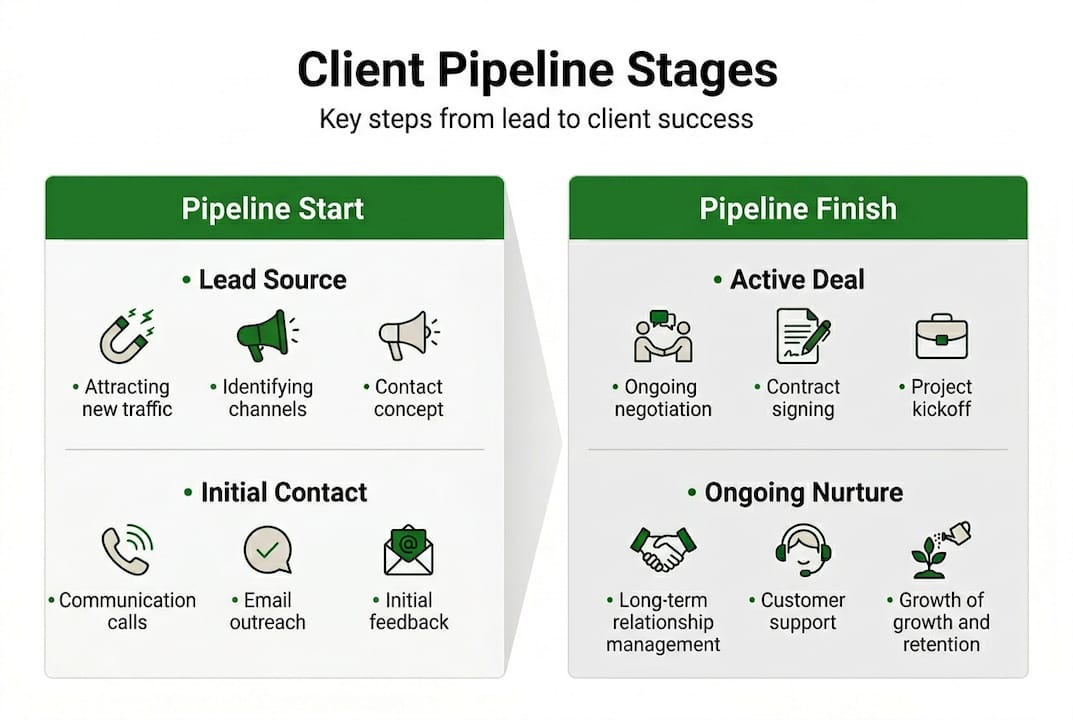
A structured pipeline for service businesses typically moves through these core stages:
- Lead generation: Attracting potential clients through content, outreach, referrals, or networking
- Qualification: Deciding if a lead is worth your time based on budget, fit, and urgency
- Discovery: A deeper conversation to understand the client’s problem and goals
- Proposal: Presenting your solution, scope, and pricing
- Negotiation: Aligning on terms
- Close: Signing the contract and kicking off the work
- Nurture: Staying in touch with past clients and warm leads for future opportunities
Here’s a quick look at what healthy pipeline benchmarks look like for service businesses:
| Metric | Benchmark |
|---|---|
| Pipeline coverage ratio | 3x to 4x your revenue goal |
| New prospects per week | 15 to 20 |
| Average win rate | 20% to 30% |
| Average sales cycle | 2 to 6 weeks |
The data tells a clear story. You need significantly more leads entering your pipeline than deals you expect to close. That’s not pessimism, that’s math.
“A pipeline without regular review is just a wishlist.”
Good pipeline management means you’re actively moving deals forward, not just tracking them. And avoiding revenue gaps starts with understanding which stage of your pipeline is leaking prospects. Once you see the full picture, fixing it becomes a lot more straightforward.
Prepare for success: Define your ideal client and pipeline goals
Before you start reaching out to anyone, you need to get clear on who you’re actually trying to reach. Skipping this step is one of the most common and costly mistakes service providers make. Without a clear Ideal Client Profile (ICP), your outreach is scattered, your messaging is vague, and your win rate suffers.
Your ICP is a detailed description of the type of client who gets the most value from your work, has the budget to pay for it, and is a joy to work with. It’s not just an industry or a job title. It includes company size, pain points, goals, decision-making style, and how they typically buy services like yours.
Once you define your ICP first, everything else gets sharper: your content, your LinkedIn outreach, your referral asks, and your follow-up sequences. You stop chasing everyone and start attracting the right people.

Here’s how ICP-driven outreach compares to generic outreach:
| Approach | Result |
|---|---|
| Generic outreach to anyone | Low response rates, poor fit, wasted time |
| ICP-targeted outreach | Higher response rates, faster closes, better clients |
| Niche networking with ICP focus | Warm introductions, shorter sales cycles |
Once your ICP is clear, set measurable pipeline goals. Here’s a simple process:
- Decide your monthly revenue target
- Calculate how many closed deals you need to hit it
- Apply your win rate (e.g., 25%) to find how many proposals you need
- Work backward to figure out how many discovery calls and qualified leads that requires
- Set a weekly prospecting target (aim for 15 to 20 new prospects)
Pro Tip: Track your pipeline coverage ratio. Aim for 3x to 4x your revenue goal in active pipeline value. If your goal is $10,000 per month, you want $30,000 to $40,000 worth of potential deals in play at any given time.
A strong client acquisition strategy starts here, not with tactics. And if you want to go deeper on goal-setting and planning, the business development strategies for solopreneurs are worth exploring before you build your outreach engine.
Build your pipeline: Proven methods for consistent client acquisition
Now the fun part. Let’s talk about actually filling your pipeline with real prospects.
Here’s a step-by-step process that works for freelancers, consultants, and small service businesses:
- Attract: Create content that speaks directly to your ICP’s pain points. LinkedIn posts, short articles, and case studies work well. Show your thinking, not just your services.
- Qualify: When someone shows interest, run a quick qualification check. Do they have the budget? Are they the decision-maker? Is the timing right? Don’t waste discovery calls on poor-fit leads.
- Move: Use a simple CRM (even a spreadsheet works) to track where every prospect sits in your pipeline. Set follow-up reminders. Deals die from silence, not rejection.
- Close: Make your proposal clear and easy to say yes to. Summarize the problem, your solution, the outcome, and the investment. Keep it simple.
Diversify your lead generation channels. Relying on one source is risky. Use a mix of LinkedIn outreach, content marketing, referrals, and niche networking events.
Speaking of referrals: systematize them during offboarding. Referrals have 37% higher retention than other acquisition channels, and systematic follow-ups raise win rates by 30%. That’s not a small edge. That’s a serious competitive advantage.
Statistic: Systematic follow-up sequences raise win rates by 30% for service businesses.
Pro Tip: At the end of every project, ask your client two things: a testimonial and a referral. Make it easy by giving them a template or a simple prompt. Most clients are happy to help if you just ask.
For quick win sales tactics you can implement this week, there are some solid starting points. And if you want to map out the full journey from stranger to signed client, the sales funnel guide for service businesses is a great companion resource.
Avoid common pitfalls: Keep your pipeline healthy and full
Building a pipeline is one thing. Keeping it healthy is another. Most service providers build momentum, get busy with client work, and then stop prospecting. Three months later, they’re back to zero. Sound familiar?
Here are the most common pipeline mistakes and how to avoid them:
- Single-channel reliance: If all your leads come from one source (say, referrals), you’re one dry spell away from a revenue crisis. Diversify your channels across content, outreach, and networking.
- Busy-period neglect: When you’re heads-down on client work, prospecting stops. This creates the classic feast-famine swing. Block time for pipeline activities every week, even during your busiest periods.
- Poor qualification: Chasing leads that aren’t a good fit wastes time and clogs your pipeline. Set clear qualification criteria and stick to them.
- Stale deals: Deals that have been sitting in your pipeline for months without movement are dead weight. They give you a false sense of security and skew your forecasting.
“A bloated pipeline full of stale deals is worse than a small, clean pipeline. At least with a small pipeline, you know exactly what you need to do.”
Here’s a quick self-audit you can run weekly:
- Review every open deal. When did you last make contact?
- Remove or archive any lead that hasn’t responded in 30 days despite follow-up
- Check your lead sources. Are you over-reliant on one channel?
- Confirm your weekly prospecting activity is on track
Strategies to stabilize your revenue often start with this kind of honest pipeline audit. And if you want a deeper look at the mechanics, the guide on pipeline management for freelancers breaks it down clearly.
Maximize profit: Retention, pricing, and AI for pipeline leverage
Once your pipeline is running, the next move is to make it more profitable. And the biggest lever most service providers ignore is retention.
Retaining a client is 5 to 7 times cheaper than acquiring a new one. Yet most freelancers and consultants spend 80% of their energy chasing new business. Flip that ratio. Aim for 60% of your focus on retention and expansion, and 40% on new client acquisition.
Here’s how to build retention into your pipeline:
- Retainer offers: Package your ongoing services into a monthly retainer. Predictable revenue for you, consistent support for them.
- Quarterly check-ins: Schedule touchpoints with past clients even when you’re not actively working together. Stay top of mind.
- Expansion conversations: Look for opportunities to grow the scope of your work with existing clients before pitching new ones.
- Loyalty incentives: Offer returning clients a small discount or priority access. It costs little and builds loyalty fast.
On pricing: value-based pricing fits service pipelines far better than hourly rates. When you price based on the outcome you deliver rather than the hours you work, your revenue potential grows without adding more hours.
Pro Tip: If you’re still billing by the hour, try repackaging one service as a fixed-price offer tied to a specific outcome. See how clients respond. Most prefer the certainty.
AI tools are also worth exploring for pipeline efficiency. Use them to research prospects, personalize outreach at scale, and draft follow-up sequences faster. They won’t replace your judgment, but they’ll save you hours every week.
For practical ideas on pricing strategy examples that work for freelancers, there’s a lot to work with. And if you’re curious how AI fits into a solo consulting workflow, this piece on AI in consulting is worth a read.
Our perspective: Why most pipelines underperform (and what actually fixes them)
Real talk: most pipeline advice focuses on tactics. Use this tool. Send this template. Follow up three times. And yes, those things matter. But they miss the deeper issue.
Pipelines underperform because people treat them as a one-time setup rather than a living system. You build it, feel good about it, and then stop tending to it. Life gets busy. Client work takes over. And suddenly your pipeline is full of stale deals and wishful thinking.
The fix isn’t a better CRM or a smarter outreach sequence. It’s discipline. Specifically, the discipline to keep prospecting when you’re already busy. That’s when it feels least urgent and matters most.
I’ve seen consultants with beautifully designed pipelines that never convert, and I’ve seen others with a simple spreadsheet who consistently hit their revenue goals. The difference is always behavior, not tools.
Sustainable pipelines combine structured process with honest, regular review. Schedule a weekly pipeline check. Be ruthless about avoiding revenue gaps before they appear. And stay curious about what’s working and what isn’t. Adapt. Experiment. Don’t just follow the formula.
Take your client pipeline to the next level
Building a client pipeline that actually works takes clarity, consistency, and the right frameworks. You don’t need to figure it all out on your own.
At GeneratingPipeline.com, we’ve put together practical resources built specifically for freelancers, consultants, and service-based business owners. Whether you want to avoid revenue gaps before they hit, sharpen your approach with a solid pipeline management guide, or grab proven revenue growth hacks you can act on immediately, it’s all there. No sales calls. No hidden pricing. Just actionable tools that help you build a pipeline you can rely on.
Frequently asked questions
How many leads should I add to my client pipeline each week?
Aim to add 15 to 20 new prospects to your pipeline weekly to maintain healthy coverage for your revenue goals. Consistency matters more than volume spikes.
What is the best way to qualify a service business lead?
Check the lead’s budget, authority, need, and timeline before investing more time in follow-up. This BANT qualification approach keeps your pipeline focused on winnable deals.
How do I prevent my pipeline from going stale?
Schedule weekly reviews to follow up, remove dead leads, and diversify your lead generation channels. Single-channel reliance is one of the fastest ways to end up with a stale, unreliable pipeline.
Why is retention more profitable than finding new clients?
Retaining a client costs 5 to 7 times less than acquiring a new one and helps keep revenue steady month over month. Retention is the most underrated growth lever in a service business.
What’s a common mistake service providers make with client pipelines?
Many focus only on sales calls and forget to nurture or clean their pipeline, resulting in feast-famine cycles that are entirely avoidable with a simple weekly review habit.
