TL;DR:
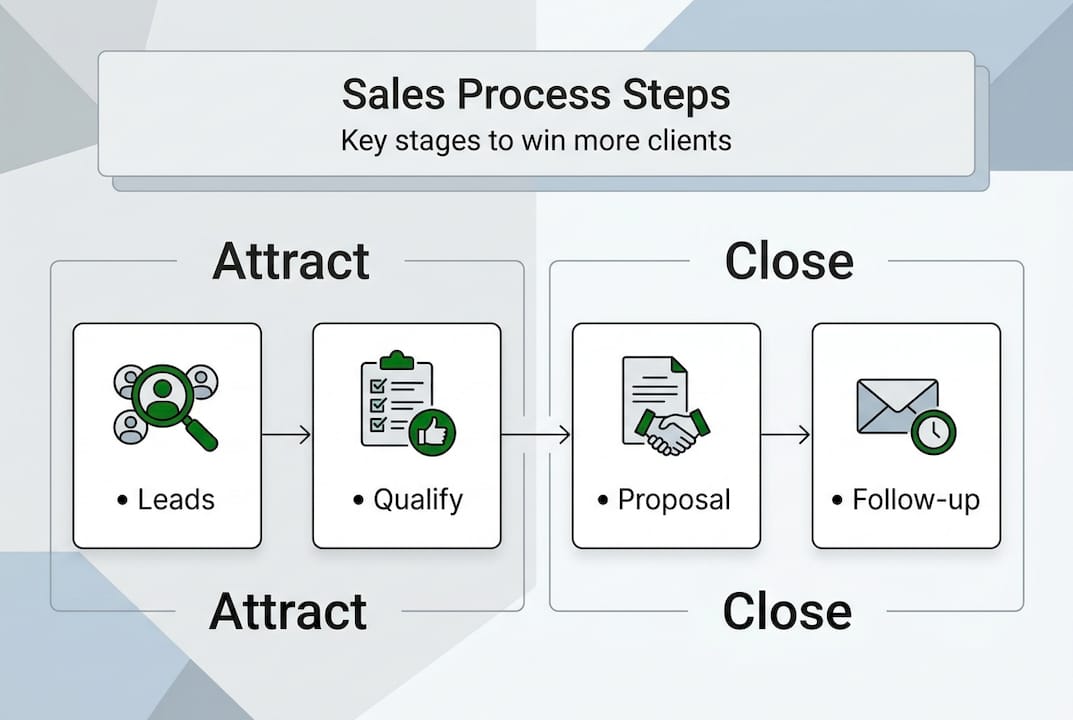
- A repeatable sales process is essential to maintain consistent client flow.
- Tracking key metrics and tailoring outreach improves sales efficiency and win rates.
- Genuine follow-up and adaptable strategies are crucial for long-term success.
Inconsistent client flow is one of the most stressful parts of running a service business. One month you’re slammed, the next you’re refreshing your inbox hoping for a lead. Sound familiar? The problem usually isn’t your skills or your offer. It’s the absence of a repeatable sales process. Without one, you’re essentially starting from scratch every time you need a new client. Agency win rates average 20-40%, and the businesses that hit the top of that range aren’t luckier. They just follow a structured, consistent process. This guide breaks down every step so you can do the same.
Table of Contents
- What you need to build a reliable sales process
- Step 1: Attract and qualify leads effectively
- Step 2: Conduct winning sales conversations
- Step 3: Craft proposals and follow-up for higher conversions
- Measuring, optimizing, and troubleshooting your sales process
- Why most service business sales systems fail (and what actually works)
- Level up your sales process with tailored support
- Frequently asked questions
Key Takeaways
| Point | Details |
|---|---|
| Structure wins clients | A clear, repeatable sales process is essential for consistent client acquisition in services. |
| Track the right metrics | Measuring win rate, cycle length, and pipeline velocity helps spot and fix leaks quickly. |
| Qualify leads early | Screening prospects up front saves time and increases your close rate. |
| Adapt every stage | Customizing each step to your service and market yields better results than generic templates. |
What you need to build a reliable sales process
Let’s start with what you’ll need before you map out your process.
Building a reliable sales process isn’t just about tactics. It starts with the right mindset. You need to commit to tracking your activity and results consistently, even when it feels tedious. The data you collect in the early weeks becomes the foundation for every improvement you make later.
Here are the core tools you’ll need:
- CRM or spreadsheet: A simple place to track every prospect and their current stage
- Email templates: Reusable outreach and follow-up messages you can personalize quickly
- Qualification checklist: A short list of criteria that separates good-fit clients from time-wasters
- ICP document: A written description of your Ideal Client Profile, including industry, company size, pain points, and budget range
ICP clarity is often overlooked, but it’s one of the biggest drivers of sales efficiency. When you know exactly who you’re targeting, every step of your process gets sharper.
The key metrics to track from day one:
| Metric | What it measures | Why it matters |
|---|---|---|
| Win rate | Deals closed vs. deals entered | Shows overall process effectiveness |
| Sales cycle length | Days from first contact to close | Service cycles average 44-84 days |
| Pipeline velocity | Revenue generated per day | Reveals speed of deal progression |
| Conversion rate per stage | Drop-off between each stage | Pinpoints where deals are stalling |
Understanding pipeline stages explained before you build your process will save you a lot of confusion later.
Pro Tip: Don’t wait until you have a perfect CRM setup. A Google Sheet with five columns (name, stage, last contact, next action, deal value) is enough to get started today.
Step 1: Attract and qualify leads effectively
With your tools and metrics in place, your next priority is capturing and qualifying the right leads.
Not all leads are created equal. Spending time on low-fit prospects is one of the fastest ways to burn out and miss revenue targets. MQL-to-SQL conversion rates (that’s marketing-qualified leads turning into sales-qualified leads) range from 15 to 21%, which means most of your leads won’t convert. Your job is to filter fast and focus on the ones that will.
High-value lead sources for service businesses:
- LinkedIn outreach targeting your ICP directly
- Referrals from past clients and professional networks
- Content marketing (articles, newsletters, case studies)
- Speaking at events or appearing on podcasts in your niche
- Partnerships with complementary service providers
Once a lead enters your pipeline, qualify them quickly. Here are the red flags to screen for:
- No clear budget or decision-making authority
- Vague goals with no urgency to act
- History of switching providers frequently
- Expecting results outside your area of expertise
- Wanting a discount before the conversation even starts
Paying attention to B2B sales triggers can help you reach prospects at exactly the right moment, when they’re most likely to be open to a conversation. Combined with strong client acquisition strategies, you’ll spend less time chasing and more time closing.
Pro Tip: Add a short intake form to your website or outreach process. Ask two or three qualifying questions before you book a call. It filters out low-fit leads automatically and signals professionalism to the right ones.
Step 2: Conduct winning sales conversations
Once you have qualified prospects, it’s time to engage in meaningful sales conversations.

The discovery call is where deals are won or lost. Most service providers treat it like a pitch. The best ones treat it like a diagnostic. Your goal isn’t to impress. It’s to understand.
Here’s a simple structure for an effective discovery call:
- Open (5 min): Set the agenda and confirm time. Make the prospect feel at ease.
- Explore (15-20 min): Ask open questions about their current situation, goals, and challenges.
- Diagnose (10 min): Reflect back what you’ve heard and connect it to outcomes you can deliver.
- Next steps (5 min): Agree on a clear follow-up action before the call ends.
The questions you ask matter more than anything you say about yourself. Try these:
- “What’s the biggest obstacle standing between you and [desired outcome]?”
- “What have you already tried, and why didn’t it work?”
- “What does success look like six months from now?”
- “What happens if this problem isn’t solved?”
Active listening is a skill. Resist the urge to jump in with solutions. Let the prospect finish. Pause before responding. It builds trust faster than any script.
“The best salespeople I’ve worked with ask twice as many questions as they answer. They make the client feel heard before they ever mention a solution.”
Professional services win rates fall between 20% and 40%, and the gap between those numbers often comes down to how well you run this conversation. Building a repeatable sales system around your discovery call structure is one of the highest-leverage moves you can make. You can also explore quick win tactics to sharpen your approach between calls.
Step 3: Craft proposals and follow-up for higher conversions
A great conversation sets the stage. Here’s how to land the deal.
Your proposal is not a document. It’s a decision-making tool. It should make it easy for your prospect to say yes. That means clarity over cleverness, and specificity over scope creep.
Every strong proposal includes:
- A clear summary of the client’s problem (in their words)
- Your recommended solution and why it fits
- Specific deliverables, timeline, and investment
- Social proof (a relevant case study or testimonial)
- A simple next step (e-sign, deposit, or confirmation call)
Here’s a benchmark comparison to calibrate your expectations:
| Win rate tier | Proposal close rate | What separates them |
|---|---|---|
| Low performers | Under 20% | Generic proposals, slow follow-up |
| Average performers | 20-30% | Some personalization, inconsistent follow-up |
| Top performers | 30-40% | Tailored proposals, fast and structured follow-up |
Improving win rate by 5 points can yield a 25% revenue lift. That’s not a small number. It means the difference between a struggling pipeline and a healthy one.
Your follow-up sequence after sending a proposal:
- Same day: Confirm receipt and invite questions
- Day 3: Check in with a value-add (a relevant article or insight)
- Day 7: Ask directly if they have what they need to decide
- Day 14: Final follow-up with a soft deadline or next availability
For more ways to accelerate revenue, check out these revenue growth hacks built specifically for service businesses.
Measuring, optimizing, and troubleshooting your sales process
Even a solid process demands continuous improvement. Here’s how you verify and accelerate results.
Once your process is running, the real work begins. You need to measure it. Tracking pipeline velocity (which ranges from $743 to $2,456 per day depending on your industry) alongside stage conversion rates reveals exactly where you’re losing deals.
Common drop-off points and how to fix them:
- Leads not converting to calls: Revisit your outreach messaging and ICP targeting
- Calls not converting to proposals: Strengthen your discovery questions and listening skills
- Proposals not converting to closes: Audit your proposal format and follow-up speed
- Long sales cycles: Add urgency through limited availability or time-sensitive bonuses
Running optimization experiments doesn’t have to be complicated. Change one variable at a time. Test a new subject line for two weeks. Try a different proposal format with your next five prospects. Track what shifts.
Common sales process errors to watch for:
- Skipping qualification to fill your pipeline faster (it backfires)
- Sending proposals without a verbal agreement on budget first
- Following up once and giving up after no response
- Treating every deal the same regardless of size or complexity
Exploring solid business development strategies alongside your sales process will help you keep the top of your pipeline full while you optimize the bottom.
Pro Tip: Block 20 minutes every Friday to review your pipeline. Look at anything that hasn’t moved in 10 or more days and decide: follow up, close out, or reassign to a nurture sequence. This one habit alone can meaningfully improve your pipeline velocity.
Why most service business sales systems fail (and what actually works)
Having mapped out a robust process, let’s talk about what separates struggling sellers from consistent client winners.
Here’s the uncomfortable truth: most service businesses fail at sales not because they lack a process, but because they copy one without adapting it. A rigid script that works for a SaaS company will fall flat in a consulting conversation. Real sales, especially for expertise-based services, require you to read the room and adjust.
I’ve seen plenty of freelancers and consultants follow every “best practice” step perfectly and still lose deals. Why? Because they treated the process like a checklist instead of a conversation. The framework is there to guide you, not replace your judgment.
What actually moves the needle is genuine follow-up. Not automated sequences that feel robotic, but real messages that show you listened. The sales pipeline guide I recommend focuses on relationship quality at every stage, not just activity volume.
Win rates rise when you tailor each stage to your specific service and market. That takes time to figure out. But once you do, the process compounds and client wins become far more predictable.
Level up your sales process with tailored support
Ready to boost your sales process results even further? Here’s where you can get personalized help and advanced tools.
If you want to stop guessing and start building a repeatable sales system that fits your specific service business, GeneratingPipeline.com has you covered. From step-by-step frameworks to tools for avoiding revenue gaps, everything is built for freelancers, consultants, and micro agency owners who are serious about consistent growth.
The Generating Pipeline OS walks you through 20 focused lessons covering positioning, outreach, sales execution, and delivery. It’s a one-time purchase with lifetime access and no sales calls required. You can also explore the pipeline management guide to keep your pipeline full and your revenue steady. The next step is yours to take.
Frequently asked questions
What are the stages of a typical sales process for service businesses?
Most service business sales processes include lead generation, qualification, discovery call, proposal, follow-up, and closing. You can find a detailed breakdown of stages tailored specifically for freelancers and consultants.
How long does it usually take to close a new client?
Closing a client averages 44 days for professional services, though deal size and client type can push that higher or lower. Tracking your own average is the fastest way to spot delays.
How can I boost my proposal close rate?
Personalize every proposal, follow up within 24 hours of sending, and benchmark your results. Top service closers reach 40% win rates by combining tailored proposals with structured follow-up sequences.
What is pipeline velocity and why does it matter?
Pipeline velocity measures how fast deals move through your pipeline and translates that speed into daily revenue. Velocity benchmarks range from $743 to $2,456 per day depending on your industry, making it one of the clearest indicators of sales health.
